Future Perfect Tense Chart (Formula, Rules & Examples)
What Is the Future Perfect Tense?
The future perfect tense indicates an action that will be finished before a point in the future. This tense is constructed with three parts that never change: will + have + the past participle of the main verb.
The subject makes no difference:
The tense almost always travels with a deadline, because the deadline is the whole point:
Friday is the future point. The submitting happens before it.
Compare the three future forms below. Each one places the same action differently against the same deadline of 8 p.m.
| Sentence | What it says about 8 p.m. |
|---|---|
| I will cook dinner at 8 p.m. | The cooking starts at 8. |
| I will be cooking dinner at 8 p.m. | At 8, the cooking is in progress. |
| I will have cooked dinner by 8 p.m. | Before 8, the cooking is finished. |
Two things follow from that, and they explain most errors:
Practice
Which sentence means the work is already finished at 6 p.m.?
- She will mark the papers at 6 p.m.
- She will be marking the papers at 6 p.m.
- She will have marked the papers by 6 p.m.
Answer
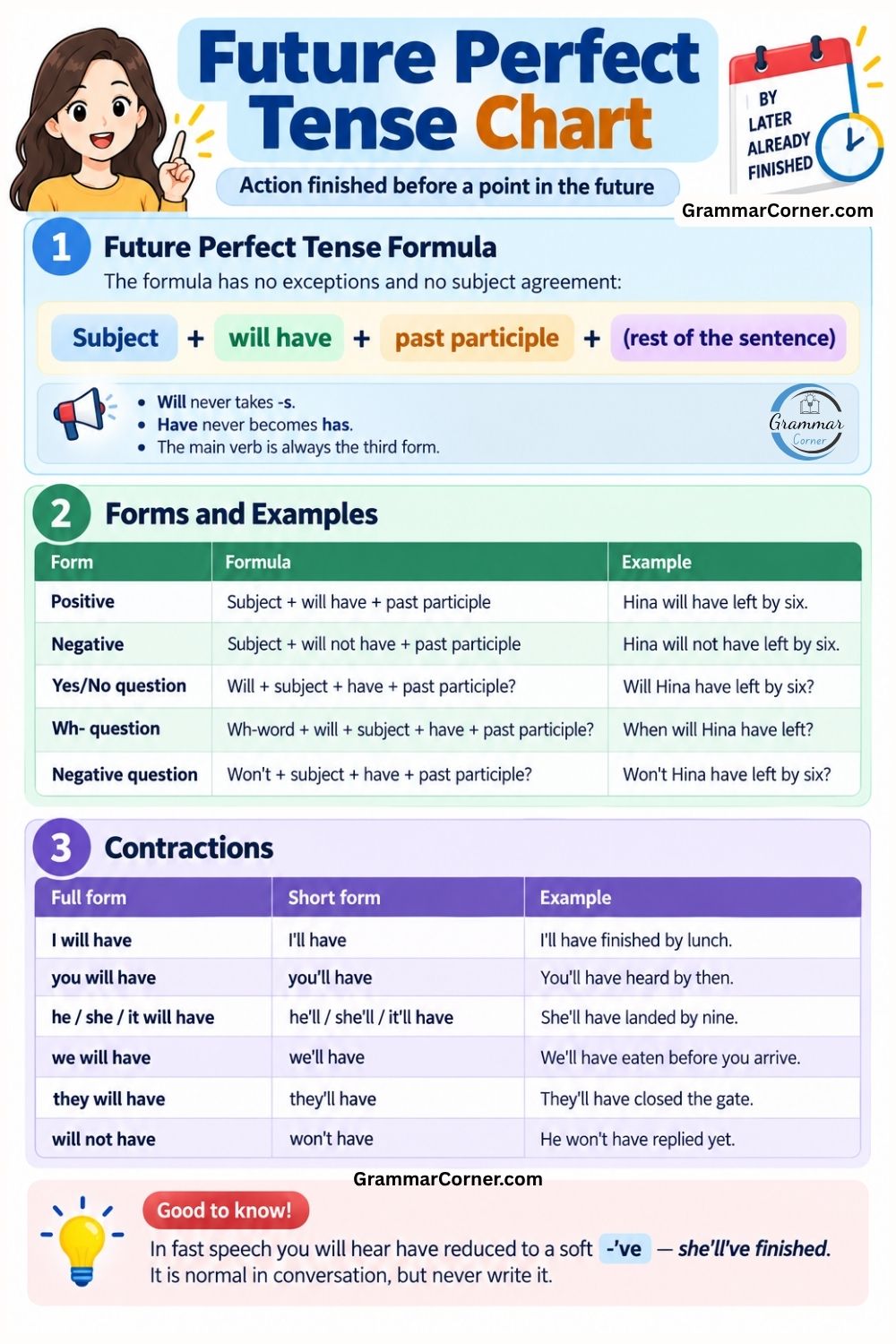
Future Perfect Tense Formula
The formula has no exceptions and no subject agreement:
Will never takes -s. Have never becomes has. The main verb is always the third form.
| Form | Formula | Example |
|---|---|---|
| Positive | Subject + will have + past participle | Hina will have left by six. |
| Negative | Subject + will not have + past participle | Hina will not have left by six. |
| Yes/No question | Will + subject + have + past participle? | Will Hina have left by six? |
| Wh- question | Wh-word + will + subject + have + past participle? | When will Hina have left? |
| Negative question | Won’t + subject + have + past participle? | Won’t Hina have left by six? |
Contractions
| Full form | Short form | Example |
|---|---|---|
| I will have | I’ll have | I’ll have finished by lunch. |
| you will have | you’ll have | You’ll have heard by then. |
| he / she / it will have | he’ll / she’ll / it’ll have | She’ll have landed by nine. |
| we will have | we’ll have | We’ll have eaten before you arrive. |
| they will have | they’ll have | They’ll have closed the gate. |
| will not have | won’t have | He won’t have replied yet. |
In fast speech you will hear have reduced to a soft -ve — she’ll’ve finished. It is normal in conversation, but never write it.
Two notes on word order
Shall have can replace will have with I and we: I shall have completed the course by June. Formal, chiefly British, and optional.
When the wh-word is the subject, nothing swaps places. Who will have finished first? keeps statement order, because who is already the subject. Compare What will you have finished by then?, where will jumps in front of you.
Practice
Rewrite each sentence in the form given in brackets.
- The guests will have arrived by seven. (negative)
- You will have packed the boxes. (yes/no question)
- She will have saved enough money by June. (wh- question, asking how much)
- They will have repaired the road. (negative question)
- The guests will not have (won’t have) arrived by seven.
- Will you have packed the boxes?
- How much money will she have saved by June?
- Won’t they have repaired the road?
Getting the Past Participle Right
The tense collapses if the third form is wrong. Will have wrote is the single most common future perfect error in exam scripts.
Regular verbs
Regular participles are identical to the past simple form — add -ed, with four spelling adjustments.
| Rule | Examples |
|---|---|
| Most verbs: add -ed | finish → finished, work → worked |
| Ends in -e: add -d only | close → closed, arrive → arrived |
| One syllable ending consonant–vowel–consonant: double the last letter | stop → stopped, plan → planned |
| Longer verb, stress on the last syllable: double it | prefer → preferred, admit → admitted |
| Longer verb, stress on the first syllable: do not double | open → opened, visit → visited |
| Consonant + -y: change y to i | carry → carried, study → studied |
Never double w, x or y: play → played, fix → fixed, sew → sewed.
Irregular verbs
Irregular participles are not random. Sorting them into three groups cuts the memory load by more than half.
| Group | Pattern | Examples (base – past – participle) |
|---|---|---|
| All three the same | nothing changes | cut – cut – cut, put – put – put, cost – cost – cost, hit – hit – hit |
| Past and participle the same | learn one form, use it twice | buy – bought – bought, teach – taught – taught, send – sent – sent, build – built – built |
| All three different | the group that causes errors | write – wrote – written, go – went – gone, take – took – taken, speak – spoke – spoken, break – broke – broken |
The third group is where mistakes live, because the past simple sounds close enough to slip through. A quick test: say I have ___ aloud. If it sounds wrong, it is wrong after will have too.
Practice
Give the past participle.
- drop
- carry
- prefer
- eat
- choose
- bring
- dropped
- carried
- preferred
- eaten
- chosen
- brought
When to Use the Future Perfect Tense
Four situations. The fourth is missing from most course books and is the reason the tense sounds so natural in the mouths of fluent speakers.
1. Completed before a stated future time
The deadline is named directly.
By 31 March, the company will have opened three new branches.
The film will have started by the time we park the car.
2. Completed before another future action
Two future events, and this tense marks which one finishes first.
The train will have left before we reach the platform.
She will have graduated by the time her brother joins university.
Notice the order on the page does not matter. Before we reach the platform, the train will have left means exactly the same thing — the tense, not the word order, carries the sequence.
3. How long something will have lasted by a future point
This use answers how long and takes for or since. It works comfortably with state verbs, which the continuous tenses refuse.
In August, I will have worked here for six years.
By next Eid, they will have owned the shop for a decade.
She will have known him since childhood by the time they marry.
4. An assumption about now or the very recent past
Here the tense is not about the future at all. It expresses near-certainty about something you believe has already happened. Read will have as I’m fairly sure has.
You will have seen the notice by now. (= I assume you’ve already seen it.)
Don’t ring him — he’ll have gone to bed.
The parcel will have reached Lahore by this morning.
Swap in the present perfect and the certainty changes: he has gone to bed states a fact you know; he’ll have gone to bed states a conclusion you have drawn.
Practice
Match each sentence to the use above (1–4).
- By December, we will have lived in this house for twenty years.
- Don’t wait for her — she’ll have finished by now.
- The builders will have laid the roof before the rains start.
- I will have submitted my thesis by 15 January.
Show Answers
1 → use 3 (duration up to a future point)
2 → use 4 (assumption about now)
3 → use 2 (before another future event)
4 → use 1 (stated deadline)
Time Expressions Used with the Future Perfect
This tense depends on its time marker more than any other. Take the marker away and most future perfect sentences stop making sense.
| Expression | Example |
|---|---|
| by + time / date | The results will have come out by Monday. |
| by the time + clause | By the time you land, I will have collected the tickets. |
| before + clause | She will have eaten before the guests arrive. |
| by then | Wait till Friday — he will have replied by then. |
| by the end of | By the end of the term, we will have covered the whole syllabus. |
| in + period (from now) | In three months, I will have paid off the loan. |
| for / since (duration) | I will have taught here for ten years in April. |
| by now / already | The letter will have arrived by now. |
By and until are not interchangeable
This trips up learners constantly. By marks a deadline — at or before that point. Until marks continuation — right up to that point, and it does not fit a completed action.
| ❌ Incorrect | ✅ Correct |
|---|---|
| I will have finished the work until Friday. | I will have finished the work by Friday. |
| Wait here by I return. | Wait here until I return. |
A simple check: if the verb is finished and done with, use by. If something carries on up to the moment, use until.
Practice
Fill each gap with by, by the time or until.
- The shop will have closed ______________ eight.
- ______________ we reach Murree, the snow will have melted.
- Please stay ______________ the results are announced.
Show Answers
1. by
2. By the time
3. until
Never Use Will Inside the Time Clause
When a clause opens with by the time, before, when, after, as soon as or until, the verb inside it takes a present form, even though the meaning is clearly future. The will stays in the main clause.
| ❌ Incorrect | ✅ Correct |
|---|---|
| By the time you will arrive, I will have left. | By the time you arrive, I will have left. |
| She will have gone before he will call. | She will have gone before he calls. |
| We will have eaten when they will get here. | We will have eaten when they get here. |
There is one useful extra option. Inside a by the time clause you may use the present perfect to stress that the first action is complete: By the time you have read this, I will have boarded the plane. Both forms are correct; the present perfect is slightly more emphatic.
Practice
Fix the error in each sentence.
- By the time the bell will ring, we will have finished the paper.
- He will have left before you will reach the gate.
- They will have cleared the table when the guests will arrive.
Future Perfect vs Other Future Forms
Almost all confusion around this tense is really confusion between four forms that all point forward.
| Form | What it signals | Example |
|---|---|---|
| Simple future (will + base) | A plain future fact, decision or prediction | I will finish the report tomorrow. |
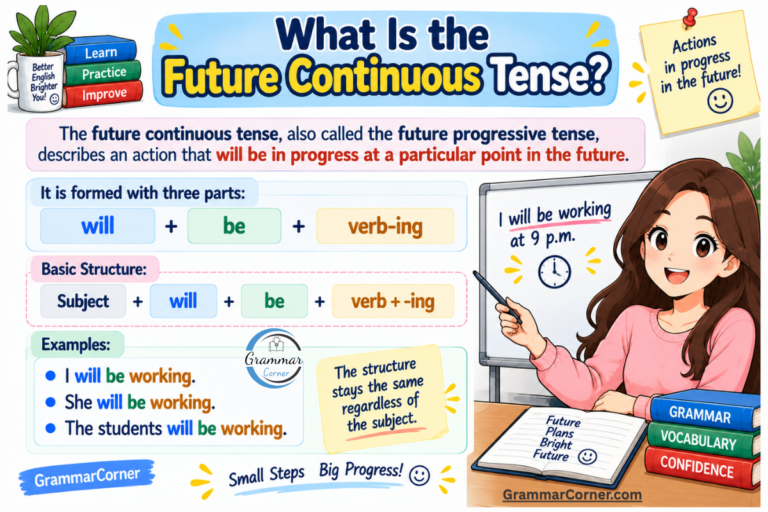
| Future continuous (will be + -ing) | In progress at a future moment | At 4 p.m. I will be finishing the report. |
| Future perfect (will have + participle) | Complete before a future moment | By 4 p.m. I will have finished the report. |
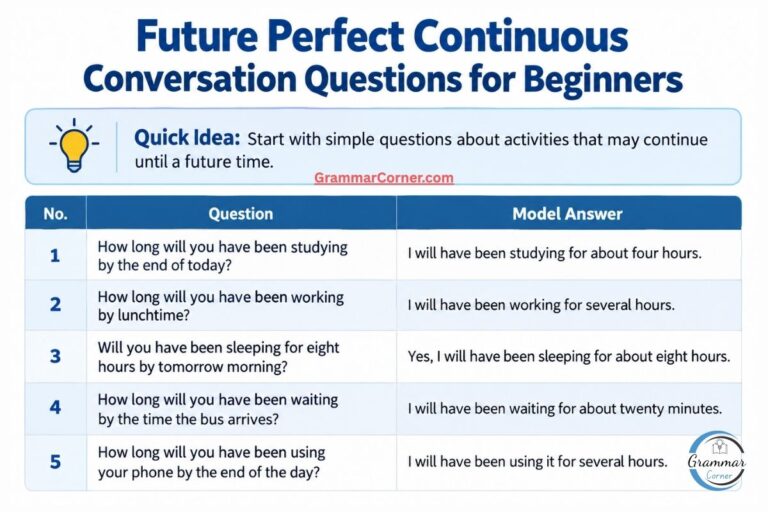
| Future perfect continuous (will have been + -ing) | How long an action will have run up to that moment | By 4 p.m. I will have been writing for six hours. |
Future perfect vs future perfect continuous
Both look back from a future point. The difference is what they emphasise.
| Future perfect — the result | Future perfect continuous — the duration |
|---|---|
| By June, she will have written four chapters. | By June, she will have been writing for a year. |
| He will have painted the whole house by Sunday. | He will have been painting all weekend. |
Use the simple form when you can count the result (four chapters, the whole house). Use the continuous form when you are answering how long. And with state verbs — know, own, be, have — only the simple form works: I will have known her for ten years, never will have been knowing.
Will have is not would have
Will have + participle looks forward from now. Would have + participle looks back at something that did not happen.
Practice
Choose the better form.
- By this time next year, I (will have saved / will have been saving) enough for the deposit.
- By ten o’clock she (will have been marking / will have marked) papers for five hours.
- In March, he (will have owned / will have been owning) the business for twenty years.
- If we had left earlier, we (will have caught / would have caught) the train.
Future Perfect in the Passive
The passive is formed with will have been + past participle, and unlike the passive of the future continuous, this one is smooth and genuinely common — especially in reports, notices and formal writing where the doer does not matter.
| Active | Passive |
|---|---|
| The council will have repaired the bridge by June. | The bridge will have been repaired by June. |
| They will have announced the results by Friday. | The results will have been announced by Friday. |
| The team will have completed the audit by then. | The audit will have been completed by then. |
Only transitive verbs — verbs that take an object — can go passive. The train will have arrived by six has no passive form, because nothing receives the action.
Practice
Change to the passive.
- The workers will have painted the office by Sunday.
- The committee will have reviewed all the applications by Thursday.
Show Answers
1. The office will have been painted by Sunday.
2. All the applications will have been reviewed by Thursday.
Common Mistakes with the Future Perfect
| ❌ Incorrect | ✅ Correct | Why |
|---|---|---|
| She will have wrote the letter. | She will have written the letter. | The third form follows have, not the past simple. |
| He will have go by then. | He will have gone by then. | The base form cannot follow have. |
| She will has finished. | She will have finished. | After will, have stays in its base form. |
| He wills have left. | He will have left. | Will never takes -s, whatever the subject. |
| Will she finished by six? | Will she have finished by six? | Questions keep all three parts: will + subject + have + participle. |
| I will have finished until Friday. | I will have finished by Friday. | Until marks continuation; a deadline takes by. |
| By the time you will come, I will have gone. | By the time you come, I will have gone. | No will inside a time clause. |
| If he had asked, I will have helped. | If he had asked, I would have helped. | Unreal past situations take would have. |
Practice
Find and fix the mistake.
- The class will have began before we arrive.
- Will they finished the survey by Monday?
- He will has left by the time you call.
- We will have reached home until midnight.
Show Answers
1. will have begun
2. Will they have finished…?
3. He will have left…
4. …by midnight.
Mixed Practice Test
Fill in the blanks with the correct future perfect form, or the correct alternative where the future perfect does not fit.
- By the time you read this letter, I ______________ (leave) for Dubai.
- The mechanic ______________ (not / repair) the car by Thursday; he is short of parts.
- ______________ the results ______________ (announce — passive) before the holidays?
- In September, my father ______________ (teach) at this college for thirty years.
- Don’t call her now — she ______________ (go) to sleep.
- By the time the bell ______________ (ring), we will have handed in our papers.
- By December, he ______________ (work) on the project for eight months straight.
- ______________ (who / finish) the assignment first, do you think?
- If they had informed us earlier, we ______________ (arrange) transport.
- The builders ______________ (lay) the foundation by the end of this month.
Answer key
Show Answers
- will have left
- will not have repaired / won’t have repaired
- Will … have been announced (passive: will have been + participle)
- will have taught (duration up to a future point)
- will have gone (assumption about now)
- rings (no will inside a time clause)
- will have been working (the question is how long, so the continuous form fits)
- Who will have finished (wh-word is the subject — no inversion)
- would have arranged (unreal past, not future perfect)
- will have laid
Frequently Asked Questions
What is the future perfect tense in simple words?
It is the tense for an action that will already be finished before a future point in time. Its formula is will + have + past participle, as in “By Friday, I will have submitted the report.“
What is the formula of the future perfect tense?
Subject + will have + past participle. The formula never changes for person or number — I will have gone, she will have gone, they will have gone are all correct. Adding been to that formula gives you a different structure: will have been + -ing is the future perfect continuous, and will have been + past participle is the passive.
Does the future perfect always need a time expression?
Almost always. Without a deadline such as by Monday, before she arrives or by then, the sentence sounds incomplete, because the tense exists to place an action before a future point. The exception is when the deadline is already obvious from the previous sentence.
Why do we say “by the time you arrive” and not “by the time you will arrive”?
Time clauses beginning with by the time, before, when, after, as soon as and until take a present form even when the meaning is future. The will belongs in the main clause only, so there is one will per sentence.
What is the difference between by and until?
By marks a deadline — the action is finished at or before that point, which is why it suits the future perfect. Until marks continuation up to a point, so it does not fit a completed action. I will have finished by Friday, not until Friday.
Can the future perfect be used with state verbs?
Yes, and this is one of its advantages over the continuous tenses. “In August I will have known her for ten years” is correct, while “will have been knowing” is not.
What is the difference between “will have finished” and “will have been finishing”?
The first reports a completed result; the second reports how long the action had been running. Use the simple form for something countable or complete, and the continuous form when you are answering how long.
Can the future perfect talk about the present?
Yes — in its assumption use. “You will have heard the news by now” is not about the future at all; it means you are fairly sure the person has already heard. Read will have as “I’m almost certain has.”
All 12 tenses, in one place
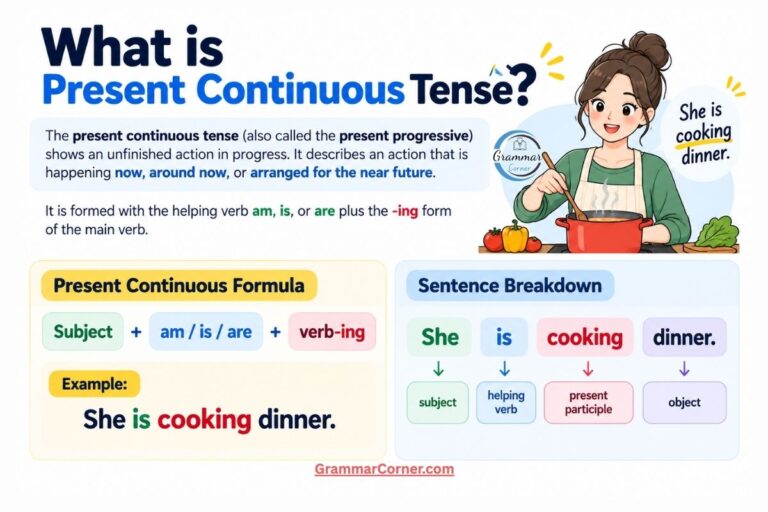
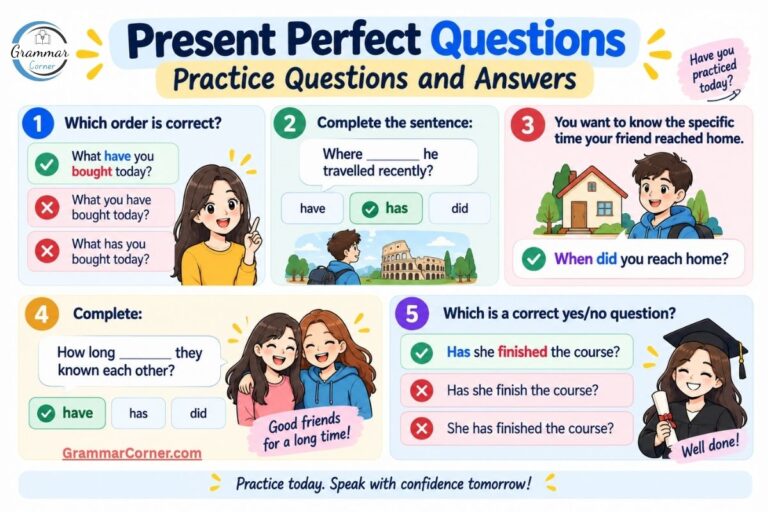
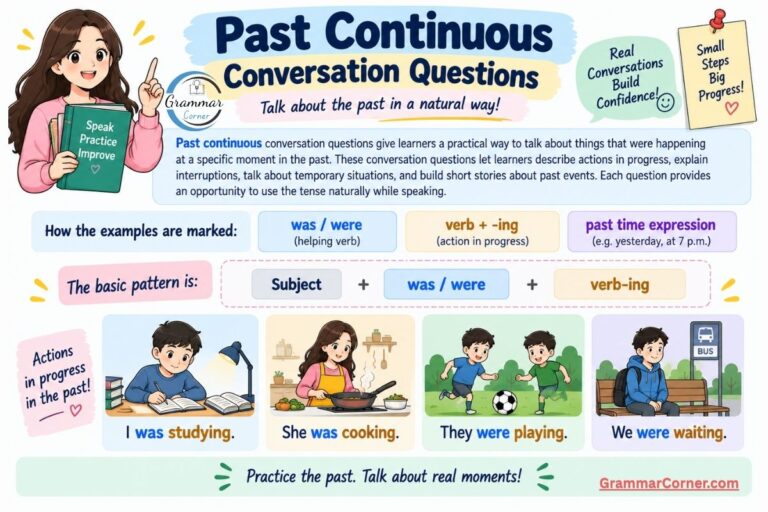
English builds every tense from the same two ingredients — when (present, past, future) and aspect (simple, continuous, perfect, perfect continuous). Each tense below links to its chart and a set of practice conversation questions.
| Present Tense | Past Tense | Future Tense |
|---|---|---|