First Conditional (Structure, Rules and Examples)
What Is the First Conditional?
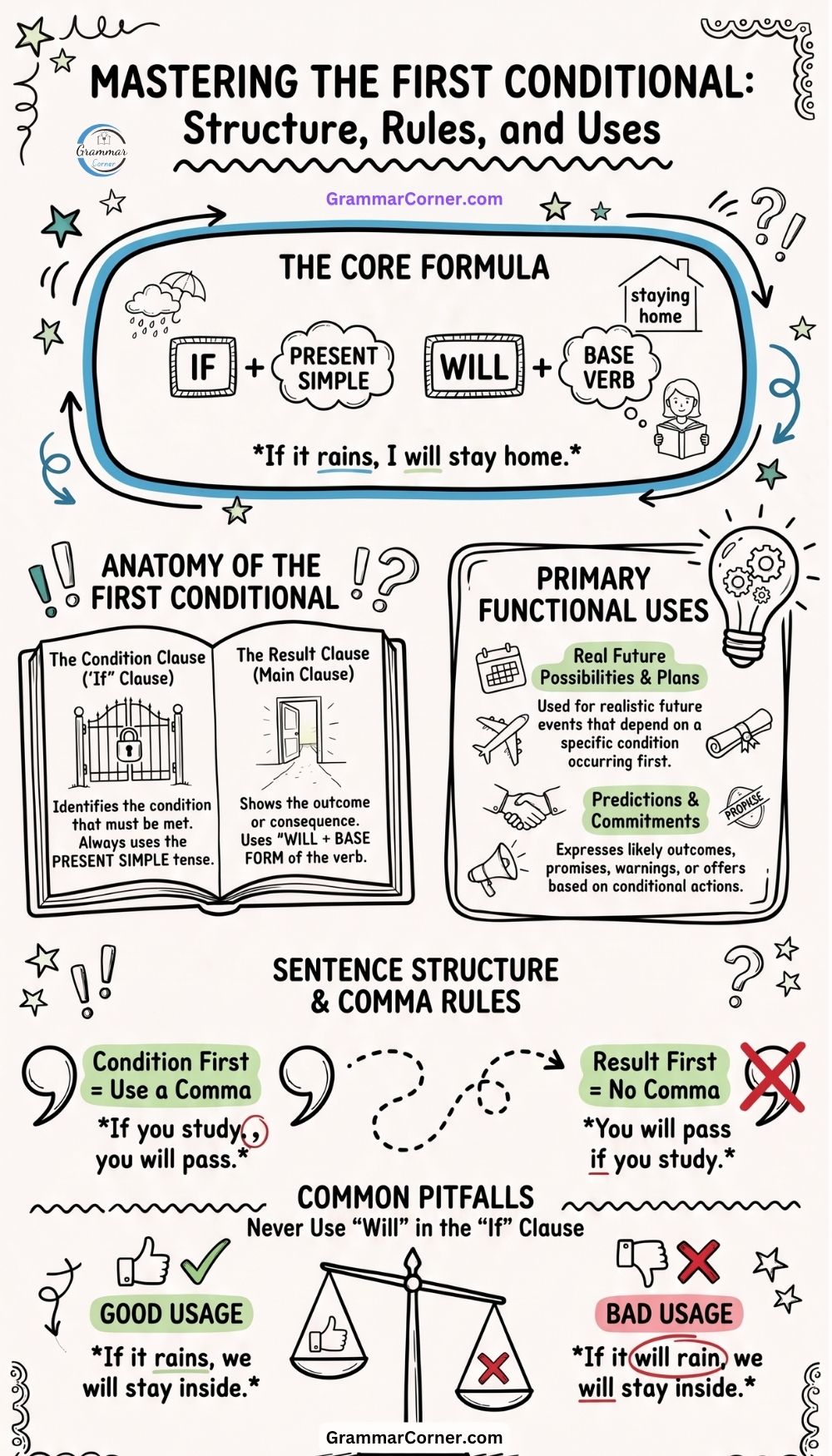
The first conditional describes a realistic situation that is possible in the present or future, along with the expected result that may follow. We use it when there is a genuine, real-world possibility that the condition will be met.
Structure of the First Conditional
The first conditional links a present simple condition with a future result clause:
Establishes the prerequisite future condition. Even though it points forward in time, the verb remains strictly in the present simple:
• “If Sara studies hard”
• “If you hurry”
Delivers the predicted outcome that will occur if the condition is fulfilled:
• “she will pass the test.”
• “you will catch the bus.”
More Everyday Examples
- If she comes, we will start.
- If they work hard, they will succeed.
- If they invite me, I will go.
- If he calls, I will answer.
Never put will inside the condition clause. Write ✅ If I study hard, I will pass. instead of ❌ If I will study hard, I will pass.
Quick Challenge
Choose the correct verb form to complete the sentence: “If I ______ hard, I will pass the test.” Tap an option.
See the full explanation
Answer: A. study
Grammar breakdown:
- Formula:
If + Present Simple (study), will + Base Verb (will pass). - Tense Agreement: The if-clause sets up a real future possibility using the present simple, while the modal will belongs strictly in the main (result) clause.
- Distinction: Choice B incorrectly duplicates will in the condition, while Choice C creates a mismatched second conditional structure.
The Two Parts of a First Conditional Sentence
Every first conditional sentence links two complementary elements: a possible condition that must occur first, and an expected future result that will follow as a consequence.
Specifies what must happen first. We do not know for certain whether it will happen, but it represents a realistic possibility:
• “If Sara arrives early”
• “If you save enough money”
Explains what is predicted or expected to occur once the condition is fulfilled:
• “we will start the lesson”
• “you will buy a new bicycle”
When Do We Use the First Conditional?
The first conditional is versatile. Whenever you want to connect a realistic condition to a future consequence, you can adapt it to express a wide variety of communicative purposes:
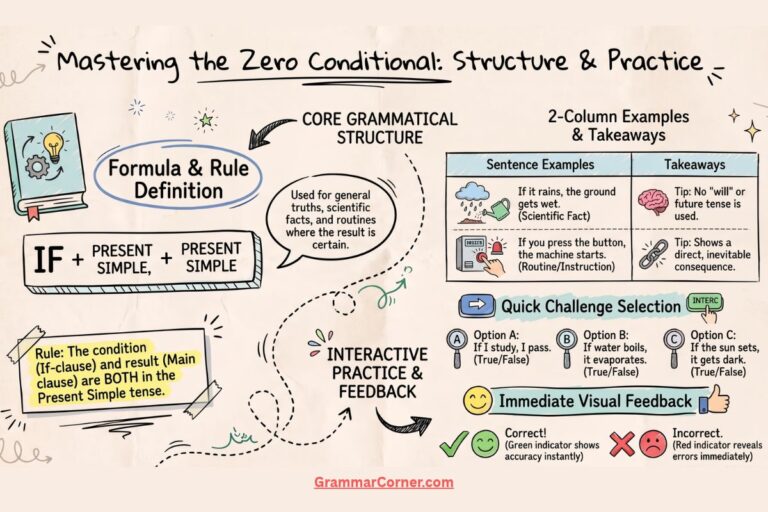
- Zero Conditional: Scientific facts, universal laws, unchanging routines.
- First Conditional: Real, possible events and decisions happening in the future.
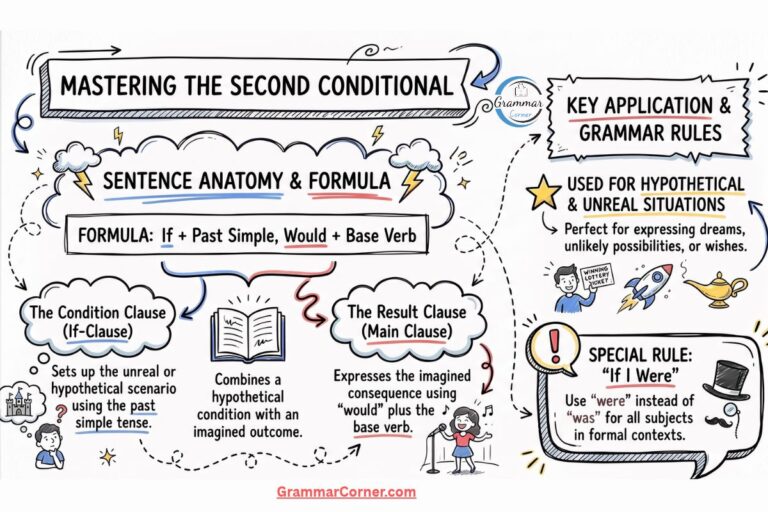
- Second Conditional: Imaginary, unlikely, or impossible dreams in the present/future.
Quick Challenge
Which situation is most suitable for using a first conditional sentence? Tap an option.
See the full explanation
Answer: B. A possible event tomorrow
Grammar breakdown:
- Function: The first conditional handles real future possibilities (“If it rains tomorrow, we will stay home”).
- Condition Identification: In “If you save enough money, you will buy a new bicycle,” the phrase “If you save enough money” is the condition clause setting the prerequisite.
- Core Distinctions: Choice A calls for the Zero Conditional (
present simple + present simple), while Choice C requires the Second Conditional (past simple + would).
First Conditional: Possible Future Events, Plans, and Predictions
The first conditional is the primary grammatical structure for discussing realistic possibilities in the present or future. It allows speakers to map out upcoming plans, anticipate events, and make confident predictions about what will follow when a specific condition is met.
Realistic situations that may occur:
- If it rains tomorrow, we will stay home.
- If I see George, I will talk to him.
- If she comes to the party, I will be happy.
- If the shop is open, we will buy some food.
- If they arrive early, we will start the meeting.
Arranging upcoming activities based on conditions:
- If the weather is good tomorrow, we will go swimming.
- If Dad comes home early, we will have dinner together.
- If I finish my work, I will visit my friend.
- If we have enough time, we will watch a movie.
Predicting likely outcomes if a condition is met:
- If you keep practising, you will improve.
- If the team plays well, it will win the match.
- If the weather gets colder, people will wear warmer clothes.
- If you continue eating so quickly, you will feel uncomfortable.
Differentiating Events, Plans, and Predictions
We do not know with absolute certainty whether the condition will occur, but the speaker treats it as a realistic possibility rather than a fantasy or impossible dream.
Quick Challenge
Which sentence correctly uses the first conditional to make a prediction about a future result? Tap an option.
See the full explanation
Answer: A. If you study regularly, you will improve.
Grammar breakdown:
- Formula:
If + Present Simple (study), will + Base Verb (will improve). - Prediction Role: It expresses strong confidence that consistent study will lead to future improvement.
- Distinctions: Sentence B has broken tense agreement, while Sentence C is a Second Conditional reflecting an unreal or improbable present situation.
First Conditional: Warnings, Promises, and Offers
In everyday spoken English, the first conditional is frequently used for key communicative actions: issuing cautionary warnings, making binding promises, and extending helpful offers based on realistic upcoming conditions.
Alerts someone to a potential danger or negative result:
- If you touch that hot pan, you will burn your hand.
- If you do not hurry, you will miss the bus.
- If you play near the road, you may get hurt.
- If you do not wear a coat, you will feel cold.
Commits the speaker to an action if the condition is met:
- If you help me, I will help you tomorrow.
- If you finish your homework, I will buy you an ice cream.
- If you need me, I will come.
- If you do your best, I will be proud of you.
Provides assistance or service on demand:
- If you are hungry, I will make you a sandwich.
- If you need a pen, I will lend you one.
- If you want, I will carry your bag.
- If you need help with your homework, I will explain it.
Comparing Intentions: Warnings vs. Universal Facts
Notice that in promises and offers, the result clause typically features “I will…” because the speaker is personally committing to a voluntary future action in response to the listener’s condition.
Quick Challenge
Which of the following sentences correctly uses the first conditional to extend a helpful offer? Tap an option.
See the full explanation
Answer: A. If you need a pencil, I will lend you one.
Grammar breakdown:
- Formula:
If + Present Simple (need), will + Base Verb (will lend). - Function: Extends a real-time offer of help based on an immediate condition.
- Distinctions: Sentence B shifts into a hypothetical frame (Second Conditional), while Sentence C violates tense agreement by using the past tense lent.
First Conditional for Giving Advice
While the standard first conditional uses will to state expected consequences, you can swap will for modal verbs like should when giving practical recommendations or advice about possible future situations.
- If you feel tired, you should take a rest.
- If you do not understand the lesson, you should ask your teacher.
- If you are hungry, you should eat something.
- If you want better marks, you should study regularly.
The Core Formula & Base Verb Rule
The standard formula links a present condition to a future result using the base form (infinitive without to) of the main verb:
Why Does the If-Clause Use Present Simple for Future Events?
In English grammar, subordinate time and conditional clauses take the present simple to refer to future time. Do not place will directly after if in standard conditionals.
In advanced English, will can appear after if only when expressing polite willingness or refusal: “If you will listen carefully, I will explain the problem.” (meaning: if you are willing to listen). For everyday conditional statements, always stick to the standard present simple.
Negative Forms in the First Conditional
You can make either the condition, the result, or both parts negative:
- If it rains, we won’t go outside.
- If you do not hurry, you won’t catch the bus.
- If she does not study, she won’t pass the test.
- If they arrive late, we won’t wait for them.
- If I don’t study, I will fail.
- If she doesn’t hurry, she will be late.
- If they don’t leave now, they will be late.
- If he doesn’t practise, he will not improve.
Quick Challenge
Which sentence correctly applies subject-verb agreement and negative conditional grammar? Tap an option.
See the full explanation
Answer: B. If she doesn’t hurry, she will be late.
Grammar breakdown:
- Agreement Rule: Third-person singular subjects (he, she, it) take doesn’t + base verb (doesn’t hurry) in negative present simple clauses.
- Clause Placement: Future markers like will and won’t stay in the main clause, not the opening if-clause.
- Modal Shift: When converting a statement into advice, simply substitute will with should (“If you feel sick, you should rest”).
First Conditional with Modal Verbs
The result clause does not always require will. You can substitute different modal verbs (can, may, might, should, must) to express permission, degrees of possibility, advice, or necessity.
First Conditional with “Going to” and Imperatives
You can also replace will with be going to (to emphasize pre-existing intentions) or direct imperative verbs (to issue instructions):
Emphasizes a firm existing plan or expected outcome:
- If you do not study, you are going to fail the test.
- If the weather gets worse, we are going to stay home.
- If I see him, I am going to invite him.
Tells the listener what action to take when the condition happens:
- If you are tired, take a rest.
- If you see Ali, tell him to call me.
- If you finish your homework, come downstairs.
- If you feel sick, see a doctor.
Changing Clause Order & Punctuation Rules
You can position the condition first or second without altering the fundamental meaning. The punctuation changes depending on clause position:
✅ “If I finish my work, I will call you.”
✅ “I will call you if I finish my work.”
Forming First Conditional Questions
Questions in the first conditional explore what someone plans to do or what will happen if an upcoming event occurs:
- What will you do if it rains tomorrow?
- Will you go outside if the weather is good?
- What will happen if we miss the bus?
- Will you help me if I need you?
“If I save enough money, I will buy a bicycle” states a direct spontaneous prediction or decision, whereas “I am going to buy a bicycle” highlights a pre-existing intention or goal.
Quick Challenge
Which of the following sentences correctly uses the first conditional to ask about a possible future situation? Tap an option.
See the full explanation
Answer: B. What will you do if it rains tomorrow?
Grammar breakdown:
- Question Structure:
Question word + will + Subject + Base Verb + if + Present Simple? - Function: Asks for a planned reaction to a realistic upcoming weather condition (“tomorrow”).
- Variations Review: Remember that modal verbs (can, may, might, should, must) adjust the nuance, imperatives provide direct instructions, and reversing clauses eliminates the comma.
Alternative Connectors in the First Conditional
While if is the default conditional marker, English uses alternative conjunctions like unless, when, and as long as to add precise shades of meaning—including negative conditions, certainty/expectations, and exclusive prerequisites.
Specifies what will happen if a condition fails to occur:
- Unless you hurry, you will miss the bus.
- Unless we leave now, we will be late.
- You will not pass unless you study.
- Unless it stops raining, we will not go outside.
Used when the future condition is expected to happen:
- When I see Sara tomorrow, I will tell her.
- When Dad comes home, we will have dinner.
- When the teacher arrives, we will start.
- When I finish school, I will call you.
Expresses that an outcome depends strictly on one rule:
- You can play outside as long as you finish your work.
- We will go to the beach as long as the weather is good.
- I will help you as long as you listen carefully.
Comparing Certainty: “If” vs. “When”
Because unless already carries a negative meaning (if not), do not add a second negative word inside the clause:
✅ Correct: Unless you hurry, you will miss the bus. (Or: If you do not hurry…)
Just like an if-clause, clauses starting with as long as must remain in the present simple even when referring to future conditions:
✅ “You can use my computer as long as you are careful.” (Avoid: will be).
Quick Challenge
Choose the correct verb form to complete the sentence: “You can use my computer as long as you ______ careful.” Tap an option.
See the full explanation
Answer: A. are
Grammar breakdown:
- Structure:
as long as + Present Simple (are). - Function: Sets a firm prerequisite condition (only on the condition that you are careful).
- Connector Nuance Review:
- Unless = If not (e.g., “You will miss the bus unless you hurry” = “if you do not hurry”).
- When implies certainty/expectation, whereas if indicates mere possibility.
First Conditional vs. Zero Conditional
Both the zero and first conditionals use if followed by the present simple in the condition clause. The distinction rests entirely on scope and timeframe: general habits/facts versus specific upcoming events.
Describes what happens every time or as a universal law:
• “If you sit in the sun for too long, you get sunburned.” (General rule).
Focuses on one specific, realistic upcoming event:
• “If you sit in the sun all afternoon, you will get sunburned.”
First Conditional vs. Second Conditional
The difference between first and second conditionals is about likelihood and reality:
“If I win the competition, I will buy a new laptop.”
The speaker believes winning is genuinely possible.
“If I won a million dollars, I would buy a new laptop.”
The speaker is imagining a hypothetical dream that is far less realistic.
• Second: “If she studied harder, she would pass.” (Suggests she is currently not studying).
First Conditional vs. Third Conditional
This comparison contrasts an open future possibility against an unchangeable past event:
“If I study tonight, I will pass the test tomorrow.”
The studying and test are upcoming; the outcome is still open.
“If I had studied last night, I would have passed the test.”
The opportunity has passed; the studying did not occur, and the test is finished.
First Conditional in Everyday Conversation
Native speakers use the first conditional constantly across day-to-day interactions:
• Zero: Always true / habit (present + present)
• First: Realistic future event (present + will)
• Second: Imaginary present/future (past + would)
• Third: Past regret / unchangeable (past perfect + would have)
Quick Challenge
Which sentence would naturally and realistically be used when making a future plan for an upcoming journey? Tap an option.
See the full explanation
Answer: A. If the bus is late, we will take a taxi.
Grammar breakdown:
- Formula:
If + Present Simple (is), will + Base Verb (will take). - Function: Establishes a practical, realistic contingency plan for an upcoming commute.
- Comparison Summary:
- Choice A = First Conditional (realistic future plan).
- Choice B = Second Conditional (hypothetical/unlikely present).
- Choice C = Third Conditional (counterfactual past regret).
First Conditional with Different Subjects
A common misconception is that both clauses in a first conditional sentence must share the same subject. In real-life interactions, one person or external condition often triggers an outcome for someone else entirely.
First Conditional for Cause and Consequence
The first conditional clearly illustrates practical cause-and-consequence relationships, linking an action to its probable future result:
• Cause: Leaving home late
• Consequence: Missing the bus
• Cause: Failing to charge the phone
• Consequence: The battery dying
Using Short Answers in Natural Conversations
In daily speech, native speakers rarely repeat the entire conditional sentence when answering questions. Answering with just the result clause (often using contractions like I’ll or we’ll) makes the conversation sound more fluent:
First Conditional in Real-Life Decision Making
Whenever an upcoming choice depends on a variable condition, the first conditional provides a practical decision-making framework:
- If the shop is open, I’ll buy some milk.
- If the bus arrives soon, we’ll take it.
- If the weather is good, we’ll go for a walk.
- If my friend calls, I’ll ask her about the homework.
- If the library is open, I will borrow a book.
Contractions such as I’ll, we’ll, and she’ll are preferred in spoken English for first conditional decision-making because they keep the rhythm natural and direct.
Quick Challenge
In the sentence “If you do not water the plant, it will die,” which part represents the consequence? Tap your answer.
See the full explanation
Answer: B. The plant will die.
Grammar and clause analysis:
- Cause vs. Consequence: The condition clause (“If you do not water the plant”) represents the prerequisite cause, while the main result clause (“it will die”) delivers the consequence.
- Different Subjects: The subject of the condition is you, while the subject of the result is it (the plant).
- Natural Responses: In everyday conversation, responding to “What will you do if you feel tired?” with a streamlined answer like “I’ll take a rest” is completely natural and grammatically correct.
A Simple Way to Remember the First Conditional
You can instantly recall the first conditional with a 3-word mental formula: Possible ➔ Future ➔ Result. If the condition represents a genuine possibility and the outcome is anchored in the future, the first conditional is the correct grammatical choice.
“If I get good marks, I will celebrate.”
• Possible: Yes, getting good marks is realistic.
• Future: Yes, the celebration will take place later.
• Result: will + base verb (will celebrate).
Do not let the term present simple confuse you. The verb inside the if-clause looks like a present-tense form, but it refers to an upcoming future condition (e.g., in “If I see him tomorrow, I will tell him,” see is present simple, but points to tomorrow).
Common Mistakes with the First Conditional
✅ Correct: If it rains, we will stay home.
✅ Correct: If I study, I will pass.
✅ Correct: If I study tonight, I will pass tomorrow.
✅ Correct: I will go.
❌ Incorrect: If she doesn’t studies, she will fail. ➔ ✅ Correct: If she doesn’t study, she will fail.
✅ Correct: If it rains tomorrow, we will stay home.
How to Recognize the First Conditional
Apply this 3-question checklist whenever you analyze or construct a conditional sentence:
The condition and consequence are focused forward in time rather than general past history.
The speaker believes there is a genuine, real-world probability of the event occurring.
If + Present Simple ➔ will + Base Verb (or equivalent modal / imperative).
Quick Challenge
Which conditional type is represented in the sentence: “If we leave now, we will catch the train”? Tap an option.
See the full explanation
Answer: B. First conditional
Grammar breakdown:
- Checklist Verification:
- 1. Future/immediate timeframe? Yes.
- 2. Realistically possible? Yes.
- 3. Structure:
If + Present Simple (leave), will + Base Verb (will catch)? Yes.
- Error Correction Review: For the sentence “If she will studies hard, she would pass the test,” remove will from the if-clause and replace would with will: “If she studies hard, she will pass the test.”
Practice Exercises on the First Conditional
Strengthen your command of the first conditional (If + Present Simple, will + Base Verb) through targeted exercises covering verb forms, multiple choice, negative transformations, sentence scrambles, zero vs. first comparisons, error correction, dialogue completion, and paragraph analysis.
Show Answers for Exercise 1
2. If she arrives early, we will start the meeting.
3. If it rains tomorrow, we will stay home.
4. If they leave now, they will be on time.
5. If you listen carefully, you will understand the lesson.
A. see B. will see C. saw
A. passes B. will pass C. would pass
A. take B. will take C. took
A. are B. will be C. would be
A. will go B. go C. would go
Show Answers for Exercise 2
2. B. will pass (Future result clause)
3. B. will take (Future consequence)
4. B. will be (Future state)
5. A. will go (Voluntary future plan)
Show Sample Negative Answers
2. If she doesn’t come, we won’t start.
3. If they don’t hurry, they won’t catch the bus.
4. If he doesn’t practise, he won’t improve.
Show Unscrambled Answers
2. If it rains, we will stay home.
3. If she comes, I will be happy.
4. If you hurry, you will catch the bus.
Show Corrected Sentences
2. study ➔ If she studies hard, she will pass.
3. misses ➔ If they don’t hurry, they will miss the bus.
4. tomorrow we ➔ If it rains tomorrow, we will stay home.
5. will finish ➔ If you finish your homework, you can play.
6. would call ➔ If I finish early, I will call you.
A: “What will you do if it rains tomorrow?”
B: “If it ______ (rain), I ______ (stay) at home.”
A: “What will you do if you finish your homework early?”
B: “If I ______ (finish) early, I ______ (play) football.”
A: “What will you do if you miss the bus?”
B: “If I ______ (miss) the bus, I ______ (take) a taxi.”
Show Completed Dialogue Answers
2. B: “If I finish early, I will play football.”
3. B: “If I miss the bus, I will take a taxi.”
Show Sample Completions
2. If it rains tomorrow, I will stay inside.
3. If I have enough money, I will buy a new book.
4. If my friend calls me, I will answer.
5. If I study hard, I will get good marks.
6. If I feel tired, I will take a rest.
Show Analysis Results
• “If the weather is good, Ali will go to the park.”
• “If his friends come with him, they will play football.”
• “If they finish early, they will have lunch together.”
• “If it rains, they will stay at home and watch a movie.”
Quick Challenge
Which sentence correctly applies the first conditional formula with proper punctuation and modal placement? Tap an option.
See the full explanation
Answer: “If it rains tomorrow, we will stay home.”
Grammar breakdown:
- Formula:
If + Present Simple (rains), will + Base Verb (will stay). - Function: States a realistic plan for an upcoming weather scenario (“tomorrow”).
- Punctuation Note: Because the if-clause opens the sentence, it must be separated from the main clause by a comma.
Frequently Asked Questions About the First Conditional
Get quick, clear answers to common questions about the first conditional formula, modal choices, negative forms, sentence order, and differences between the first, zero, second, and third conditionals.
- Negative (won’t): “If it rains, we won’t go outside.”
- Permission / Ability (can): “If you finish your homework, you can play outside.”
- Advice (should): “If you feel tired, you should rest.”
- Uncertainty (might): “If it rains, we might stay home.”
- Future Intention (going to): “If I save enough money, I am going to buy a bicycle.”
- Instructions / Commands (Imperative): “If you see Ali, tell him to call me.”
- Condition First (Comma): “If it rains, we will stay home.”
- Result First (No Comma): “We will stay home if it rains.”
- Unless (= if not): “Unless you hurry, you will miss the bus.” (➔ If you do not hurry…)
- When (= expected/certain): “When Dad comes home, we will eat dinner.” (Use if when the event is uncertain).
First Conditional Quick Reference
| Feature | First Conditional Rule / Detail |
|---|---|
| Main Use | Real or possible future situations and their likely outcomes |
| Condition Clause | Present simple |
| Usual Result Clause | will + base verb |
| Basic Formula | If + Present Simple, will + Base Verb |
| Degree of Possibility | Realistic and open possibility |
| Standard Example | If it rains, I will stay home. |
| Negative Result Form | won't + base verb (will not) |
| Other Result Variations | can, may, might, should, must, going to, or imperative |
| Alternative Condition Words | unless, when, as long as |
| Core Contrasts | Zero = general truths / habits; Second = imaginary / unlikely; Third = finished past |
Quick Challenge
Which of the following sentences correctly applies first conditional grammar and punctuation for an expected future situation? Tap an option.
See the full explanation
Answer: B. When Dad comes home, we will eat dinner.
Grammar breakdown:
- Formula:
When + Present Simple (comes), will + Base Verb (will eat). - Function: Describes a planned future event that the speaker expects with confidence (when vs. if).
- Tense Rule: Condition and time clauses never take will in standard future reference.