Simple Present Tense Chart (All Rules Explained With Examples)
The simple present tense (also called the present simple tense) describes actions and situations that are generally true. It talks about facts or situations that are true in general, not just what is happening right now.
Look at the simple present examples:
-
I drink tea every morning.
A habit — something that happens again and again.
-
Water boils at 100 degrees Celsius.
A fact that never changes.
-
My sister works at a hospital.
A long-term situation.
None of them tells you what is happening at this exact moment. The first one describes a habit. The second one describes a fact that never changes. The third one describes a long-term situation.
That’s the heart of this tense. It answers the question What is generally true? rather than What is happening right now?
Why Is It Called the Simple Present Tense?
The name has two halves, and each half tells you something useful.
Present means the time frame is now — not the past, not a promise about the future.
Simple means the verb has no helping verb attached to it in positive sentences. Compare these:
| Tense | Example | Helping verb? |
|---|---|---|
| Simple present | She reads. | No |
| Present continuous | She is reading. | Yes (is) |
| Present perfect | She has read. | Yes (has) |
| Present perfect continuous | She has been reading. | Yes (has been) |
One verb, standing alone. That’s what makes it simple.
Helping verbs do show up in negatives and questions (She doesn’t read. / Does she read?), but the positive form stays bare. Keep that picture in your head — it explains a lot of the rules.
SIMPLE PRESENT RULES
Quick answer
Review the simple present structure again. With I, you, we, and they, use the plain dictionary verb. With he, she, it, or any single person or thing, add -s or -es. Everything below is just the detail of that one decision.
Base Form of the Verb
What “base form” means
The base form is the verb as it appears in a dictionary, with no ending attached: eat, go, play, finish, carry. Grammar books sometimes call it V1 or the infinitive without to.
- eat
- go
- play
- finish
- carry
For I, you, we, and they, you use this form and nothing else:
- I eat rice.
- You go early.
- We play together.
- They finish at noon.
Third-Person Singular Rules
Third-person singular means one person or thing that is not the speaker or the listener: he, she, it, and any singular noun — my brother, the cat, this phone, Sara.
- he
- she
- it
- my brother
- the cat
- this phone
- Sara
With these subjects, add -s or -es to the verb:
| Subject | Verb | Sentence |
|---|---|---|
| He | runs | He runs every morning. |
| She | studies | She studies medicine. |
| It | costs | It costs two hundred rupees. |
| Bilal | fixes | Bilal fixes old bicycles. |
| The cat | sleeps | The cat sleeps on my chair. |
| My phone | rings | My phone rings too often. |
Memory trick
A memory trick many teachers use: he, she, it — don’t forget the -s. Say it out loud a few times. It sticks.
Spelling Rules for Adding -s and -es
Most verbs simply take -s. A few groups need -es because of how the word ends.
| Verb ending | Rule | Examples |
|---|---|---|
| Most verbs | add -s | work → works, read → reads, sing → sings |
| -s, -ss, -sh, -ch, -x, -z | add -es | pass → passes, wash → washes, teach → teaches, fix → fixes, buzz → buzzes |
| -o | add -es | go → goes, do → does, echo → echoes |
| consonant + y | change y to i, add -es | study → studies, carry → carries |
| vowel + y | just add -s | play → plays, enjoy → enjoys |
Why -es exists
The -es group exists for a practical reason: you cannot pronounce washs or teachs. The extra vowel gives your mouth somewhere to land. Say watches and fixes aloud and you’ll hear the extra syllable appear naturally.
Here is the same set of rules as a decision you can walk through:
-
Ask firstIs the subject he, she, it, or one person or thing?No → base formThey finish at noon.
-
Then check the endingDoes the verb end in -s, -ss, -sh, -ch, -x, -z or -o?Yes → add -espasses, washes, teaches, fixes, buzzes, goes
-
One more checkDoes it end in a consonant + y?Yes → y becomes iesstudy → studies, carry → carries
-
Everything else → add -sruns, plays, sleeps, works
Tap a verb, see the rule
Each verb below belongs to one of the five groups. Tap one and watch what happens to the ending after he, she, or it.
Pick any verb above to see its he / she / it form.
Verbs Ending in -y
This rule trips up more learners than any other spelling rule, so it deserves its own look. Check the letter before the y.
| Letter before -y | What to do | Examples |
|---|---|---|
| A consonant (b, r, d, p…) | y → ies | cry → cries, try → tries, fly → flies, hurry → hurries, copy → copies |
| A vowel (a, e, o, u) | keep y, add -s | say → says, buy → buys, stay → stays, obey → obeys, employ → employs |
- She carries her books in a canvas bag.
- The baby cries when she’s hungry.
- He buys vegetables from the market.
- My cousin stays with us in summer.
Did you know?
One pronunciation note worth knowing: says is spelled with ay but pronounced “sez,” not “sayz.” Native speakers say it that way without thinking about it.
Mini challenge: which group?
Look at the letter just before the y, then choose.
- dry
- enjoy
- marry
- obey
- worry
- destroy
The Irregular Verb “Be”
Be refuses to follow any pattern. It has three present forms instead of two, and it never uses do/does for negatives and questions.
| Subject | Positive | Negative | Question |
|---|---|---|---|
| I | am | am not (‘m not) | Am I…? |
| You / We / They | are | are not (aren’t) | Are you…? |
| He / She / It | is | is not (isn’t) | Is he…? |
- I am a student.
- You are early today.
- She is a nurse at the city hospital.
- We are ready.
- They aren’t at home.
- Is the shop open?
Teacher tip
Notice the gap in the table: am not has no one-word contraction. You can shorten the subject (I’m not late), but never write amn’t. In questions, English borrows a different form instead: Aren’t I early?
Because be handles its own negatives and questions, adding do is always wrong:
- Incorrect: Does she is a teacher?
- Correct: Is she a teacher?
The Irregular Verb “Have”
Have is only slightly irregular. It behaves normally except in the third-person singular, where it becomes has instead of haves.
| Subject | Positive | Negative | Question |
|---|---|---|---|
| I / You / We / They | have | don’t have | Do you have…? |
| He / She / It | has | doesn’t have | Does he have…? |
- I have two brothers.
- They have a large garden.
- She has a driving licence.
- The house has four rooms.
- He doesn’t have any change.
- Do you have a minute?
Watch the negative and question forms carefully. Has disappears there, because does already carries the -s:
- Incorrect: Does she has a car?
- Correct: Does she have a car?
Mini challenge
Only one of these questions is correct. Which one?
Key takeaways
- With I, you, we, they → base form, no ending.
- With he, she, it or one person or thing → add -s or -es.
- The letter before a final y decides between cries and buys.
- Be never uses do/does; have loses its -s after does and doesn’t.
Simple Present Tense Chart
Here is everything on one page. This simple present tense chart will not only help you understand the tense but also enable you to use it correctly in everyday speaking and writing.
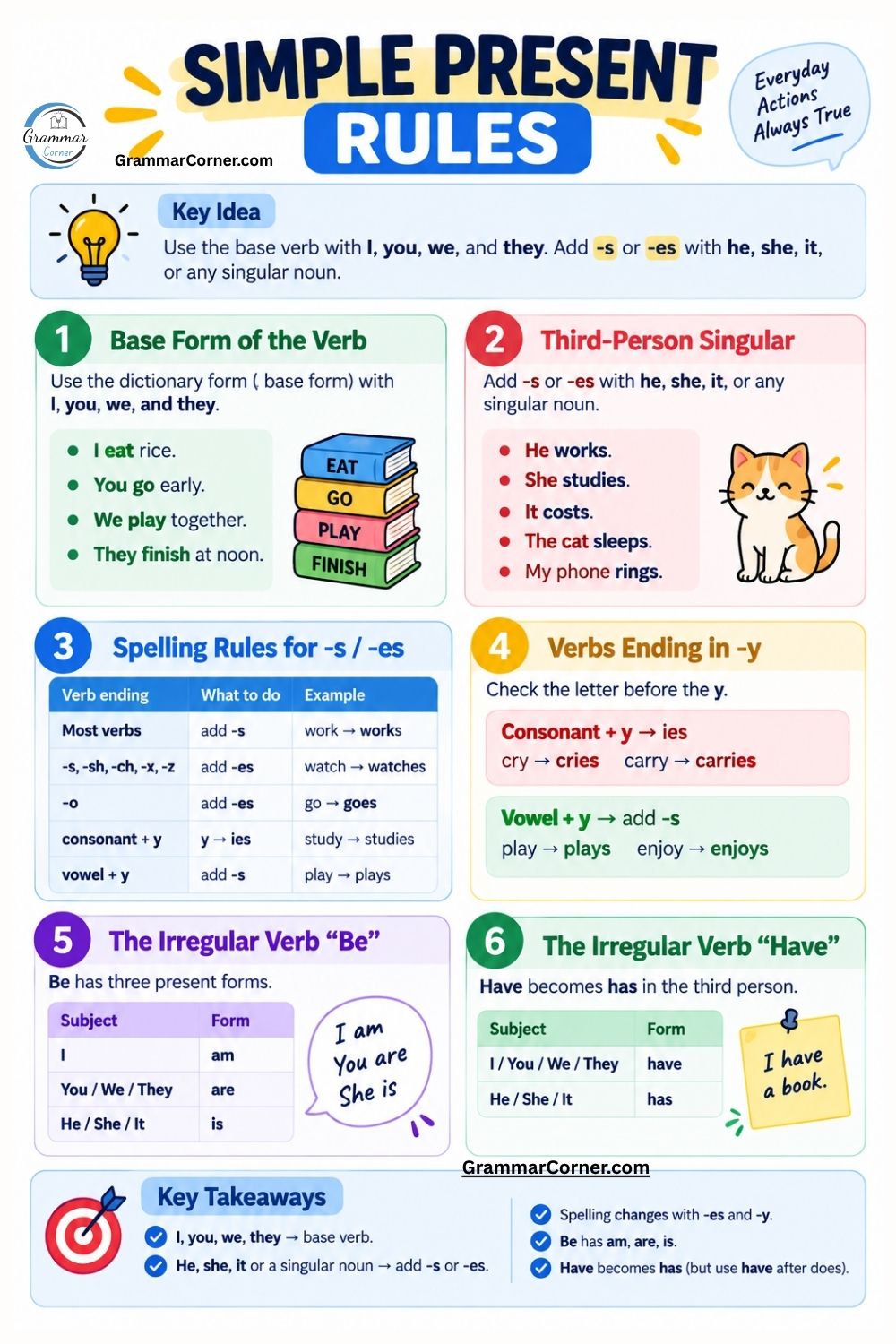
Subject-Verb Agreement in the Simple Present
Quick answer
Agreement means the verb matches its subject. In the simple present, that boils down to one decision: does this subject need the -s or not?
| Subject type | Verb | Example |
|---|---|---|
| I | base form | I want tea. |
| You (one person or many) | base form | You look tired. |
| Singular noun / he / she / it | + -s/-es | The teacher explains the lesson. |
| Plural noun / we / they | base form | The teachers explain the lesson. |
| Two subjects joined by and | base form | Sana and Omar work together. |
| Uncountable noun | + -s/-es | Milk spoils quickly in summer. |
| Everyone, everybody, someone, nobody | + -s/-es | Everybody knows the rules. |
The row that catches people out
That last row catches people out. Words like everyone and nobody feel plural because they refer to many people, but grammatically they are singular:
- Everyone loves a good story.
- Nobody wants to sit at the back.
- Somebody leaves the light on every night.
Two more situations worth noticing:
Subjects with extra words in between
Find the real subject and ignore the phrases around it.
- The box of chocolates costs four hundred rupees. box costs, not chocolates cost
- The students in my class come from six cities.
Either/or and neither/nor
The verb agrees with the closer subject.
- Neither my brothers nor my father drives.
- Neither my father nor my brothers drive.
Check yourself
Find the real subject first, then pick the verb that agrees with it.
- The list of ingredients … on the back of the packet.
- My cousins … in Karachi.
- Everybody … a break sometimes.
- Neither the players nor the coach … the result.
- Rice and lentils … a complete meal.
Simple Present Tense with the Verb “Be”
Be deserves extra attention because it does a different job from other verbs. Most verbs describe actions. Be describes identity, condition, age, feelings, and location.
| Use | Example |
|---|---|
| Identity / job | She is an engineer. |
| Nationality / origin | They are from Turkey. |
| Age | My nephew is seven. |
| Feeling or condition | I am hungry. |
| Location | The keys are on the table. |
| Description | This soup is too salty. |
More examples across everyday situations:
- The weather is cold this week.
- My shoes are under the bed.
- He is good at cricket.
- We are late again.
- The library is closed on Fridays.
- Their office is on the second floor.
A frequent error
A frequent error involves adjectives that describe how you feel or what you think. In some languages these use a verb; in English many of them use be plus an adjective, while a few are plain verbs on their own.
- Incorrect: I am agree with you.
- Correct: I agree with you.
Agree is a verb, no “be” needed.
- Incorrect: She has thirty years.
- Correct: She is thirty years old.
- Incorrect: I have cold.
- Correct: I am cold.
Teacher tip
One word of caution on that last pair. I am cold describes how your body feels right now. I have a cold — with a — is also correct English, but it means you are ill. The mistake is only I have cold, with no article and no illness in mind.
Mini challenge: am, is, or are?
Match the form of be to its subject.
- My sister … a dentist.
- I … ready now.
- The keys … in my bag.
- It … very hot today.
Simple Present Tense with the Verb “Have”
Have mostly signals possession, relationships, and features.
| Use | Example |
|---|---|
| Possession | I have a bicycle. |
| Family relationships | She has two sisters. |
| Features and parts | The phone has a cracked screen. |
| Illness | He has a headache. |
| Appointments and duties | We have a meeting at ten. |
- My grandparents have a farm outside the city.
- This restaurant has excellent biryani.
- Our school has three computer labs.
- The car has a flat tyre.
- I don’t have your number.
- Does the room have air conditioning?
When have is not about owning
Have also appears in fixed expressions where it describes an activity rather than ownership:
- have breakfast
- have a shower
- have a rest
- have a look
- have fun
- We have dinner at eight.
- She has a shower before bed.
- Do you have lunch at the office?
Did you know?
British English sometimes uses have got for possession — She’s got two sisters — with the same meaning as She has two sisters. Both are correct; have alone is safer in formal writing.
Mini challenge: owning or doing?
Decide what have is doing in each sentence.
- We have dinner at eight.
- They have a red car.
- She has a shower before bed.
- Our school has three computer labs.
Key takeaways
- Agreement is one question: does this subject take the -s?
- Everyone, nobody, somebody and uncountable nouns are singular, whatever they feel like.
- Ignore the words between the subject and its verb; with either/or and neither/nor, follow the closer subject.
- Be describes who or how someone is; have covers what they own, who they’re related to, and what they do at fixed times.
Simple Present Examples
Here is a bank of simple present examples grouped by sentence type. Read them aloud — hearing the pattern helps more than memorizing it.
Positive Sentences
- 1.
I wake up at half past six.
- 2.
My mother waters the plants before sunrise.
- 3.
We travel by train during the holidays.
- 4.
The baker opens his shop at five in the morning.
- 5.
Farhan repairs mobile phones.
- 6.
Penguins live in cold places.
- 7.
The kettle whistles when the water boils.
- 8.
Our neighbours grow tomatoes on their roof.
- 9.
She writes short stories in her free time.
- 10.
This road leads to the old fort.
- 11.
Rain falls heavily in August.
- 12.
My laptop starts slowly.
- 13.
Children learn languages quickly.
- 14.
He drives a delivery van.
- 15.
The bank charges a small fee.
- 16.
They pray at the mosque near the market.
- 17.
Coffee keeps me awake.
- 18.
The tailor stitches beautiful kurtas.
- 19.
My uncle collects old coins.
- 20.
Football matches attract huge crowds.
Negative Sentences
- 1.
I don’t eat spicy food.
- 2.
She doesn’t watch horror films.
- 3.
We don’t own a television.
- 4.
The bus doesn’t stop at this corner.
- 5.
They don’t sell tickets at the gate.
- 6.
My father doesn’t use social media.
- 7.
This pen doesn’t work.
- 8.
Kittens don’t drink cow’s milk safely.
- 9.
He doesn’t remember my name.
- 10.
You don’t need an invitation.
- 11.
The library doesn’t open before nine.
- 12.
I don’t understand this question.
- 13.
Rice doesn’t cook well without enough water.
- 14.
She doesn’t like crowded places.
- 15.
We don’t have classes on Sunday.
Questions
- 1.
Do you live near the station?
- 2.
Does she teach English?
- 3.
Do they accept card payments?
- 4.
Does this bus go to the airport?
- 5.
Do we need our passports?
- 6.
Does your brother play the guitar?
- 7.
Do the shops close early on Friday?
- 8.
Does the price include delivery?
- 9.
Do you drink tea or coffee?
- 10.
Does it rain much in December?
- 11.
Is your sister a doctor?
- 12.
Are the tickets expensive?
- 13.
Am I in the right queue?
- 14.
Does he have your address?
- 15.
Do you have a spare charger?
WH-Questions
WH-questions ask for information rather than a yes or no. The pattern is: WH-word + do/does + subject + base verb.
- 1.
Where do you work?
- 2.
What does this word mean?
- 3.
When does the film start?
- 4.
Why does he arrive so late?
- 5.
How do you make cold coffee?
- 6.
Which bus goes to the university?
- 7.
How often do they visit?
- 8.
What time does the bank open?
- 9.
How much does a ticket cost?
- 10.
Where does your family come from?
One special case deserves your attention
When who or what is the subject of the question, you drop do/does completely and use the -s form:
- ✅ Who lives in that house? (not: Who does live)
- ✅ What causes rust?
- ✅ Who teaches your maths class?
Compare with who as the object, where does comes back:
Who does she teach? (she is the subject)
Simple Present Tense with Stative Verbs
Quick answer
Some verbs describe states rather than actions. These are called stative verbs, and they almost always take the simple present rather than the continuous.
Common Stative Verbs
| Category | Verbs | Example |
|---|---|---|
| Thoughts and opinions | know, believe, understand, remember, forget, think (= believe), doubt, agree | I understand the question. |
| Feelings and wants | like, love, hate, prefer, want, need, wish, mind | She prefers tea to coffee. |
| Senses | see, hear, smell, taste, sound, look (= appear), seem | This soup tastes wonderful. |
| Possession and relation | have, own, belong, contain, include, consist | The bag belongs to Ayesha. |
| Measurement and value | cost, weigh, measure, mean, matter | The ticket costs eight hundred rupees. |
More in context:
- I know her from school.
- We need more chairs.
- He owns two shops in the market.
- That song sounds familiar.
- Your idea makes sense to me.
- This box contains old photographs.
- The word fortnight means two weeks.
Why Stative Verbs Usually Do Not Use the Continuous Form
The idea behind the rule
The continuous form (am/is/are + -ing) describes something in progress — something with a beginning, a middle, and an end that you can picture unfolding.
States don’t unfold. You either know a fact or you don’t. There is no middle of knowing.
- Incorrect: I am knowing the answer.
- Correct: I know the answer.
- Incorrect: She is wanting a new laptop.
- Correct: She wants a new laptop.
- Incorrect: This bag is belonging to my friend.
- Correct: This bag belongs to my friend.
Some verbs live in both worlds. When they describe a deliberate action instead of a state, the continuous becomes possible — and the meaning changes:
| Verb | State (simple present) | Action (continuous) |
|---|---|---|
| think | I think you’re right. (opinion) | I am thinking about the offer. (mental activity) |
| have | She has a car. (owns) | She is having lunch. (eating) |
| see | I see what you mean. (understand) | I am seeing the doctor at four. (meeting) |
| taste | The curry tastes spicy. (quality) | The chef is tasting the curry. (action) |
| look | You look tired. (appearance) | She is looking at the map. (action) |
Did you know?
You may also spot advertising slogans that break the rule on purpose — I’m loving it — for a casual, playful effect. In an exam or a report, stick with I love it.
Mini challenge: state or action?
Ask yourself whether the verb describes something you can picture in progress.
- This coffee smells amazing.
- He is smelling the milk to check it.
- She has three brothers.
- We are having a party on Friday.
- I think this plan works.
Adverbs of Frequency in the Simple Present
Adverbs of frequency tell you how often something happens. They pair naturally with this tense because both deal with repetition.
Common Frequency Adverbs
| Adverb | Roughly how often | Example |
|---|---|---|
| always | 100% | She always locks the door. |
| usually | about 90% | I usually walk to work. |
| often | about 70% | We often eat outside in summer. |
| frequently | about 70% | He frequently travels for work. |
| sometimes | about 50% | They sometimes play late. |
| occasionally | about 30% | I occasionally skip breakfast. |
| rarely / seldom | about 10% | She rarely watches television. |
| hardly ever | about 5% | He hardly ever complains. |
| never | 0% | Cats never obey orders. |
Correct Position of Frequency Adverbs
Three rules cover nearly every sentence.
-
Before the main verb
- I always carry an umbrella in July.
- They often visit their cousins.
- She never forgets a birthday.
-
After the verb be
- He is always on time.
- The shops are usually crowded on Sunday.
- I am never late for class.
-
Between the helping verb and the main verb
- I don’t usually eat dessert.
- She doesn’t often call.
| Sentence type | Position | Example |
|---|---|---|
| Ordinary verb | before the verb | We rarely argue. |
| Verb be | after be | We are rarely angry. |
| Negative | after do/does | We don’t always agree. |
| Question | after the subject | Do you usually cycle to school? |
Some adverbs — usually, often, sometimes, occasionally — can also open or close a sentence for emphasis:
- Sometimes I read two books at once.
- We eat out occasionally.
Always, never, rarely, and seldom do not move to the start in ordinary statements. The exception is a command, where always and never open the sentence comfortably:
- Always check your answers twice.
- Never leave the stove unattended.
Teacher tip
You may still meet never, rarely, and seldom at the front of a sentence in formal or literary writing — but notice what happens next: the word order flips, exactly as in a question. Rarely does she watch television. If you don’t flip it, the sentence is wrong, which is why the safe position stays before the verb.
Mini challenge: where does the adverb go?
One sentence in each pair is correct. Tap it.
- Which one is correct?
- Which one is correct?
- Which one is correct?
- Which one is correct?
- Which one is correct?
Key takeaways
- Stative verbs describe conditions, not events, so they stay in the simple present.
- When a stative verb turns into something you actually do, the continuous becomes possible and the meaning shifts.
- Frequency adverbs go before an ordinary verb but after be.
- In negatives and questions, the adverb follows do/does or the subject.
Active and Passive Voice in the Simple Present
In an active sentence, the subject performs the action. In a passive sentence, the subject receives it. You use the passive when the doer is unknown, unimportant, or obvious.
| Active | Passive |
|---|---|
| The postman delivers the mail at ten. | The mail is delivered at ten. |
| Farmers grow wheat in Punjab. | Wheat is grown in Punjab. |
| The cleaner washes the windows weekly. | The windows are washed weekly. |
| Millions of people speak Spanish. | Spanish is spoken by millions of people. |
| The company checks every order. | Every order is checked. |
Negatives and questions follow the same helping verb:
| Form | Example |
|---|---|
| Negative | The office is not cleaned on Sundays. |
| Negative (plural) | These forms are not accepted after Friday. |
| Question | Is the report reviewed every month? |
| WH-question | Where are these shoes made? |
Two points keep passive sentences accurate:
Keep it accurate
- Match is or are to the new subject, not to the old one. The teacher marks the papers. → The papers are marked.
- Use the past participle, not the past simple. For regular verbs they look identical (wash → washed), but irregular verbs differ:
| Base | Past simple | Past participle | Passive example |
|---|---|---|---|
| write | wrote | written | The report is written in English. |
| take | took | taken | Photographs are taken at the entrance. |
| make | made | made | These bowls are made by hand. |
| sell | sold | sold | Tickets are sold online. |
Simple Present vs Present Continuous
These two tenses cause more confusion than any other pair in beginner English. The good news is that one question usually settles it: am I describing a pattern, or a moment?
Key Differences
| Point | Simple present | Present continuous |
|---|---|---|
| Meaning | routine, general truth, permanent state | happening now, temporary situation |
| Form | base verb (+ -s/-es) | am/is/are + verb-ing |
| Typical time words | every day, usually, always, on Mondays | now, right now, at the moment, today |
| Stative verbs | yes | usually not |
| Future use | fixed timetables | personal arrangements |
Side-by-Side Examples
| Simple present | Present continuous |
|---|---|
| I read every night. | I’m reading a mystery novel this week. |
| She teaches history. | She’s teaching a substitute class today. |
| We live in Multan. | We’re living with my aunt until the repairs finish. |
| It rains a lot in July. | Look outside — it’s raining. |
| He works at a bank. | He’s working late tonight. |
| The train leaves at six. | I’m leaving at six. |
| They speak Punjabi at home. | They’re speaking very quietly. |
Read the pairs slowly. In every left-hand sentence, the situation is normal and repeated. In every right-hand sentence, something temporary is going on.
Common Learner Confusion
Confusion 1: Using the continuous for routines
❌ Every morning I am walking to school.
✅ Every morning I walk to school.
The phrase every morning signals a habit, so the continuous doesn’t fit.
Confusion 2: Using the simple present for right now
❌ Be quiet — the baby sleeps.
✅ Be quiet — the baby is sleeping.
Confusion 3: Putting stative verbs in the continuous
❌ I am wanting to ask you something.
✅ I want to ask you something.
Confusion 4: Mixing up temporary and permanent
She works in Dubai.
→ her regular job
She is working in Dubai.
→ a short-term posting; she’ll come back
Both sentences are correct English. They simply say different things, and the difference matters.
Common Mistakes in the Simple Present
Every teacher sees the same five errors, year after year. Here they are, with the reason behind each fix.
1. Missing the third-person -s
❌ She go to college by bus. ✅ She goes to college by bus.
❌ My brother work in Dubai. ✅ My brother works in Dubai.
Why: singular subjects that are not I or you need the -s. This is the single most common mistake in the tense, and also the easiest to fix — check every sentence for he, she, it, or one person’s name.
2. Using the wrong helping verb
❌ He don’t like onions. ✅ He doesn’t like onions.
❌ Does they live here? ✅ Do they live here?
Why: does belongs to he/she/it and singular nouns. Do belongs to I/you/we/they and plural nouns.
3. Keeping the -s after does or doesn’t
❌ Does she likes chocolate? ✅ Does she like chocolate?
❌ It doesn’t works. ✅ It doesn’t work.
Why: only one word in the sentence can carry the -s, and does already has it. The main verb returns to its base form.
4. Misusing the verb be
❌ I am work at a hospital. ✅ I work at a hospital.
❌ She is have two children. ✅ She has two children.
❌ Does he is your teacher? ✅ Is he your teacher?
Why: be and an ordinary verb cannot both sit in a simple present sentence. Either the sentence has an action verb, or it has be plus a noun or adjective.
5. Choosing the continuous instead of the simple present
❌ I am living in Lahore since 2015. ✅ I live in Lahore. / I have lived in Lahore since 2015.
❌ Water is boiling at 100 degrees. ✅ Water boils at 100 degrees.
Why: permanent situations and unchanging facts belong to the simple present. Save the continuous for what’s genuinely in progress.
A bonus error, since it appears in almost every beginner’s writing:
❌ Where she does live? ✅ Where does she live?
The order never changes: WH-word, then do/does, then the subject, then the base verb.
Time Expressions Commonly Used with the Simple Present
Certain phrases pull the simple present towards them. Spot one of these, and the tense is usually decided for you.
| Expression | How it works | Example |
|---|---|---|
| every day / week / month / year | marks a repeated action | She checks her email every morning. |
| always | 100% of the time | The shop always shuts at nine. |
| usually | most of the time | I usually finish work by six. |
| often | many times | We often walk after dinner. |
| sometimes | now and then | He sometimes forgets his keys. |
| rarely / seldom | almost never | They rarely eat fast food. |
| never | not at any time | My grandfather never misses the news. |
| on Mondays / on Fridays | a regular day | The class meets on Mondays. |
| twice a week | a set number of times | She swims twice a week. |
| in the morning / evening | a regular part of the day | Birds sing in the morning. |
| at weekends / on weekends | a repeated period | We visit the village at weekends. |
| once in a while | occasionally | I bake once in a while. |
Two small habits will save you marks
- Put every day and similar phrases at the start or end of the sentence, not in the middle: Every day she runs or She runs every day, not She every day runs.
- Don’t confuse the adverb everyday (one word, meaning ordinary) with every day (two words, meaning daily). These are my everyday shoes. I wear them every day.
Practice Exercises
Before you start
Grab a pen. Answers are at the end — try the whole set before you look. Each question also has its own Show answer button if you’d rather check as you go.
Fill in the Blanks
Put the verb in brackets into the correct simple present form.
-
My sister (study) at a medical college.
Show answer
studies Consonant + y, so the y becomes i before -es.
-
We (not / watch) television on weekdays.
Show answer
do not watch / don’t watch We takes do, and the main verb stays plain.
-
your father (drive) to the office?
Show answer
Does … drive Does carries the -s, so drive loses it.
-
The sun (set) around six in winter.
Show answer
sets A general truth with a singular subject.
-
Kamran (fix) computers for a living.
Show answer
fixes Verbs ending in -x take -es.
-
I (not / know) her phone number.
Show answer
do not know / don’t know Know is stative, so never “am not knowing”.
-
Those birds (fly) south every autumn.
Show answer
fly Birds is plural, so no ending at all.
-
The film (start) at eight sharp.
Show answer
starts A fixed schedule, so the simple present covers the future.
-
She (have) three cousins in Islamabad.
Show answer
has Have becomes has after he, she, or it.
-
Butter (melt) quickly in the pan.
Show answer
melts Butter is uncountable, and uncountable nouns take the -s form.
Multiple Choice
Choose the correct option.
Correct so far: 0 of 8
- He tea without sugar.
- they live in this building?
- My laptop work properly.
- Water at zero degrees Celsius.
- She always late for meetings.
- your mother speak French?
- The bread (be) baked every morning.
- I what you mean.
Sentence Correction
Find the error and rewrite each sentence correctly.
-
She don’t like long journeys.
Show answer
She doesn’t like long journeys.
-
Does he plays cricket on Sundays?
Show answer
Does he play cricket on Sundays?
-
My brother go to the gym every evening.
Show answer
My brother goes to the gym every evening.
-
I am agree with your plan.
Show answer
I agree with your plan.
-
The shops closes at nine.
Show answer
The shops close at nine. shops is plural
-
Where she does live?
Show answer
Where does she live?
-
He have a red bicycle.
Show answer
He has a red bicycle.
-
Every Friday we are visiting our grandparents.
Show answer
Every Friday we visit our grandparents.
Rewrite the Sentence
Rewrite each sentence as instructed.
-
She writes poems. (make it negative)
Show answer
She doesn’t write poems.
-
They live in Quetta. (make it a question)
Show answer
Do they live in Quetta?
-
He doesn’t play the piano. (make it positive)
Show answer
He plays the piano.
-
The chef prepares the sauce. (change to passive)
Show answer
The sauce is prepared by the chef.
-
Do you speak Arabic? (make it a statement about “he”)
Show answer
He speaks Arabic.
-
I usually take the bus. (move the adverb to the start of the sentence)
Show answer
Usually I take the bus.
Make Questions
Write a question for each answer. The clue in brackets tells you what to ask about.
-
She works at a school. (where)
Show answer
Where does she work?
-
The class starts at nine. (what time)
Show answer
What time does the class start?
-
He visits his aunt twice a month. (how often)
Show answer
How often does he visit his aunt?
-
They travel by train because it’s cheaper. (why)
Show answer
Why do they travel by train?
-
This shirt costs eight hundred rupees. (how much)
Show answer
How much does this shirt cost?
-
Bilal makes the best coffee in the office. (who — as subject)
Show answer
Who makes the best coffee in the office? The question word is the subject, so there’s no does here.
Answer Key
Fill in the Blanks
- studies
- do not watch / don’t watch
- Does … drive
- sets
- fixes
- do not know / don’t know
- fly
- starts
- has
- melts
Multiple Choice
- b (drinks)
- a (Do)
- b (doesn’t)
- b (freezes)
- c (is)
- b (Does)
- a (is)
- b (understand)
Sentence Correction
- She doesn’t like long journeys.
- Does he play cricket on Sundays?
- My brother goes to the gym every evening.
- I agree with your plan.
- The shops close at nine. (shops is plural)
- Where does she live?
- He has a red bicycle.
- Every Friday we visit our grandparents.
Rewrite the Sentence
- She doesn’t write poems.
- Do they live in Quetta?
- He plays the piano.
- The sauce is prepared by the chef.
- He speaks Arabic.
- Usually I take the bus.
Make Questions
- Where does she work?
- What time does the class start?
- How often does he visit his aunt?
- Why do they travel by train?
- How much does this shirt cost?
- Who makes the best coffee in the office?
How did you do?
Score yourself out of 38. Anything above 32 means the rules have settled. Below that, go back to the section that gave you trouble and read it once more — usually it’s the third-person -s or the does + base verb rule.
Frequently Asked Questions
What is the simple present tense?
It is the verb form used for habits, routines, permanent situations, general truths, and fixed schedules. The verb stays in its base form for I, you, we, and they, and takes -s or -es for he, she, and it. Example: I walk to school. She walks to school.
When do we use it?
Seven main situations:
- Daily habits — I wake at six.
- Scientific facts — Metal expands when heated.
- Permanent states — He lives in Sialkot.
- Repeated events — The bus comes every ten minutes.
- Fixed timetables — The train leaves at four.
- Instructions — You press this button first.
- Time clauses about the future — Call me when you arrive.
What is its formula?
| Sentence type | Formula |
|---|---|
| Positive | subject + base verb (+ -s/-es) |
| Negative | subject + do/does + not + base verb |
| Question | do/does + subject + base verb |
| With be | subject + am/is/are |
Why do some verbs take -s?
The -s marks agreement with a third-person singular subject — he, she, it, or one person or thing. It’s a leftover from older forms of English, which changed the verb for every subject. Modern English kept just this one ending. Verbs ending in -s, -ss, -sh, -ch, -x, -z, or -o take -es instead, because the extra vowel makes them pronounceable.
What is the difference between simple present and present continuous?
The simple present describes what is generally true; the present continuous describes what is happening now or temporarily.
| Sentence | What it tells you |
|---|---|
| She teaches physics. | her job |
| She is teaching a lesson. | what she’s doing at this moment |
Can the simple present describe the future?
Yes, in two cases. For fixed timetables and schedules: The ferry departs at noon. And in time clauses after when, before, after, until, or as soon as: I’ll message you as soon as I land. For personal plans you made yourself, use the present continuous instead: I’m meeting Sara tomorrow.
Can stative verbs be continuous?
Usually not, because they describe states rather than actions — I know the answer, never I am knowing the answer. A few verbs switch groups depending on meaning. I think it’s fair is an opinion, but I’m thinking about it describes mental activity in progress. Advertising sometimes bends the rule for effect, but formal writing does not.
What are common signal words?
- always
- usually
- often
- sometimes
- rarely
- seldom
- never
- every day
- every week
- on Mondays
- twice a month
- normally
- generally
- as a rule
They point towards the simple present,
All 12 tenses, in one place
English builds every tense from the same two ingredients — when (present, past, future) and aspect (simple, continuous, perfect, perfect continuous). Each tense below links to its chart and a set of practice conversation questions.
| Present Tense | Past Tense | Future Tense |
|---|---|---|