Future Perfect Continuous Chart (Formula, Usage & Examples)
What Is the Future Perfect Continuous Tense?
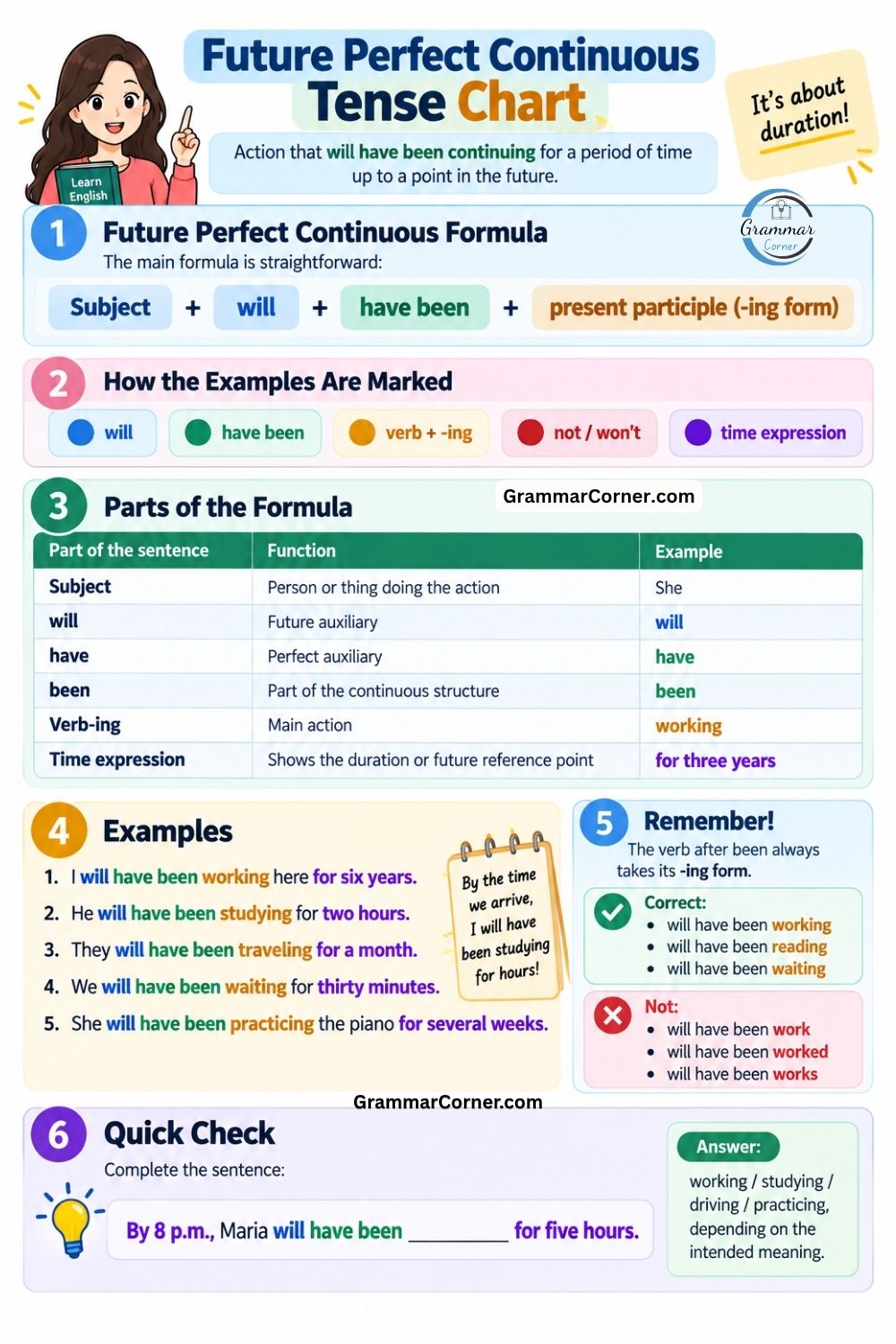
The future perfect continuous tense shows an action that will have been continuing for a period of time up to a particular point in the future. It focuses on the duration of an ongoing action, rather than simply saying that something will be completed.
For example:
By October, I will have been working here for five years.
The sentence looks ahead to October and then measures how long the action of working will have continued by that time.
Consider this sentence also:
By next June, Ali will have been teaching at the school for ten years.
The important information is not simply that Ali will teach. The sentence emphasizes the ten-year duration of his teaching by a particular future time.
This tense usually answers a question such as:
“How long will something have been happening by then?”
It commonly appears with expressions such as:
The tense is less common than the simple future or future continuous, but it is useful when the length of an ongoing activity matters.
Future Perfect Continuous Formula
The main formula is straightforward:
| Part of the sentence | Function | Example |
|---|---|---|
| Subject | Person or thing doing the action | She |
| will | Future auxiliary | will |
| have | Perfect auxiliary | have |
| been | Part of the continuous structure | been |
| Verb-ing | Main action | working |
| Time expression | Shows the duration or future reference point | for three years |
Examples
- I will have been working here for six years.
- He will have been studying for two hours.
- They will have been traveling for a month.
- We will have been waiting for thirty minutes.
- She will have been practicing the piano for several weeks.
Notice that the verb after been always takes its -ing form.
- will have been working
- will have been reading
- will have been waiting
Not:
Quick Check
Complete the sentence:
By 8 p.m., Maria will have been for five hours.
Answer
How to Form the Future Perfect Continuous
The tense follows the same basic pattern regardless of the subject. The main changes occur when we make sentences negative or ask questions.
Affirmative Sentences
Use:
| Subject | Structure | Example |
|---|---|---|
| I | will have been + verb-ing | I will have been studying. |
| You | will have been + verb-ing | You will have been studying. |
| He | will have been + verb-ing | He will have been studying. |
| She | will have been + verb-ing | She will have been studying. |
| We | will have been + verb-ing | We will have been studying. |
| They | will have been + verb-ing | They will have been studying. |
Examples:
- By next month, I will have been living here for two years.
- By Friday, she will have been preparing for the examination for a month.
- By noon, they will have been traveling for six hours.
Negative Sentences
Place not after will:
The contracted form won’t have been is also common.
| Affirmative | Negative |
|---|---|
| I will have been working. | I will not have been working. |
| She will have been studying. | She will not have been studying. |
| They will have been waiting. | They will not have been waiting. |
Examples:
- By 6 p.m., I will not have been working for eight hours.
- She won’t have been living there for very long.
- They will not have been waiting for more than twenty minutes.
Interrogative Sentences
To form a question, put will before the subject:
| Statement | Question |
|---|---|
| He will have been working. | Will he have been working? |
| She will have been studying. | Will she have been studying? |
| They will have been traveling. | Will they have been traveling? |
Examples:
- Will you have been working here for five years by July?
- Will she have been studying for three hours by the time we arrive?
- Will they have been traveling for a week by then?
Negative Questions
The negative question can be formed with will not or the more natural contraction won’t:
or
Examples:
- Will he not have been working here for ten years by then?
- Won’t she have been studying for several hours by midnight?
Quick Practice
Change each sentence as directed.
- She will have been teaching for ten years. → Make it negative.
Answer
She will not have been teaching for ten years. - They will have been waiting for an hour. → Make it a question.
Answer
Will they have been waiting for an hour? - He will have been working here for five years. → Make it a negative question.
Answer
Won’t he have been working here for five years?
All answers
When Do We Use the Future Perfect Continuous?
The future perfect continuous has one central idea:
There are several useful situations in which this idea appears.
1. To Show the Duration of an Activity at a Future Time
This is the most important use.
The sentence does not merely tell us that the person will work there. It tells us the length of time that the activity will have continued.
More examples:
- By 10 p.m., we will have been driving for six hours.
- Next January, she will have been living in London for three years.
- By the end of the semester, the students will have been studying English for six months.
- By Friday, I will have been exercising regularly for four weeks.
Which sentence emphasizes duration?
2. To Show How Long an Activity Will Continue Before Another Future Event
The future reference point does not always have to be a specific clock time or date. It can be another future event.
The first event is the waiting. The second event is the manager’s arrival. At the time of the arrival, the waiting will already have continued for an hour.
More examples:
- When the train arrives, we will have been standing here for forty minutes.
- By the time the exam starts, the students will have been sitting in the hall for half an hour.
- When you return, I will have been working on the report for three hours.
Complete the sentence:
3. To Explain a Future Result or Condition
The tense can also show that a long-running activity will help explain a future condition.
The future condition is being tired. The future perfect continuous explains the activity that has caused or contributed to it: traveling all night.
Examples:
- He will be exhausted because he will have been working since early morning.
- The children will be hungry because they will have been playing outside for hours.
- Her eyes will hurt because she will have been using the computer all day.
This use is especially helpful when the duration of the activity provides the reason for a future result.
Choose the best option:
Sarah will be tired when she arrives because she ______ all night.
Future Perfect Continuous Time Expressions
Time expressions are especially important with this tense because they help identify the future reference point and, often, the duration.
| Time expression | Purpose | Example |
|---|---|---|
| by 5 p.m. | Future deadline/reference point | By 5 p.m., I will have been working for eight hours. |
| by next month | Future point | By next month, she will have been studying here for a year. |
| by Friday | Future point | By Friday, they will have been training for six weeks. |
| by the end of the year | Future reference point | By the end of the year, he will have been running the business for a decade. |
| for two hours | Duration | I will have been waiting for two hours. |
| for five years | Duration | She will have been teaching for five years. |
| since Monday | Starting point | By Friday, he will have been working since Monday. |
| by the time… | Another future event | By the time you arrive, we will have been waiting for an hour. |
| when… | Another future event | When she returns, I will have been studying for three hours. |
Remember the Difference Between For and Since
Use for to show a period of time:
- for two hours
- for six months
- for ten years
Use since to identify the point when the activity began:
- since Monday
- since January
- since 2024
Compare:
Quick Practice
Choose for or since.
- By noon, I will have been waiting ___ two hours.
- By Friday, she will have been working ___ Monday.
- By next year, they will have been married ___ ten years.
- He will have been studying ___ 7 a.m. when the exam begins.
- for
- since
- for
- since
Future Perfect Continuous vs. Future Perfect
These two tenses are easy to confuse because both look toward a future point. The key difference is what the speaker wants to emphasize.
The future perfect focuses on a completed result.
The future perfect continuous focuses on the duration or ongoing activity leading up to that point.
| Future Perfect | Future Perfect Continuous |
|---|---|
| Focuses on completion or result | Focuses on duration or ongoing activity |
| will have + past participle | will have been + verb-ing |
| She will have finished the report. | She will have been working on the report for five hours. |
| They will have painted the house. | They will have been painting the house all day. |
| I will have read three books. | I will have been reading for six hours. |
A Simple Way to Choose
Ask yourself:
Am I interested in the result? Use the future perfect.
Am I interested in how long the activity will have continued? Use the future perfect continuous.
Compare:
The important point is the completed project.
The important point is the duration of his work.
Quick Check
Choose the correct tense.
By Friday, she ______ the report.
By Friday, she ______ on the report for five days.
- will have finished
- will have been working
Future Perfect Continuous vs. Future Continuous
The future continuous describes an activity that will be in progress at a particular future time.
The future perfect continuous looks back from that future point and emphasizes how long the activity will have continued.
| Future Continuous | Future Perfect Continuous |
|---|---|
| Focuses on an activity in progress | Focuses on duration up to a future point |
| will be + verb-ing | will have been + verb-ing |
| At 7 p.m., she will be working. | By 7 p.m., she will have been working for four hours. |
| They will be traveling tomorrow. | By tomorrow evening, they will have been traveling for two days. |
Quick Practice
Which sentence tells us the duration?
Future Perfect Continuous Examples
The best way to recognize this tense is to notice the relationship between the activity, the duration, and the future reference point.
Statements
- By next month, I will have been learning Spanish for a year.
- By 7 p.m., she will have been cooking for three hours.
- By the end of the season, the players will have been training together for six months.
- When the bus arrives, we will have been waiting for forty minutes.
- By next summer, they will have been living in this city for five years.
Negative Statements
- By noon, I will not have been working for eight hours.
- She won’t have been studying for very long when you call.
- They will not have been traveling for more than two days by then.
Questions
- Will you have been working here for ten years by December?
- Will she have been waiting for an hour when we arrive?
- How long will they have been living there by next year?
- Will he have been practicing long enough before the competition?
Questions Beginning with “How Long”
Because the tense emphasizes duration, how long is particularly useful.
- How long will you have been studying English by the end of the year?
- How long will she have been working here when she gets promoted?
- How long will they have been waiting when the train arrives?
Quick Check
Write a question using how long:
Common Mistakes with the Future Perfect Continuous
The continuous form requires been + verb-ing.
The main verb must be in the -ing form.
The standard structure contains only one will:
(This may be possible in a special context, but it does not clearly express the intended continuous structure.)
Use the future perfect continuous when you want to emphasize an activity’s duration.
Some verbs normally describe states rather than actions. These verbs generally do not work naturally in continuous forms.
For example:
Similarly:
When a verb is not normally used in a continuous form, the future perfect is usually the better choice.
Quick Correction Activity
Correct these sentences:
Answers:
He will have been working here for six years.
They will have been waiting for an hour.
I will have known him for ten years.
Practice Exercises
Now test whether you can form and use the tense without looking at the rules.
Exercise 1: Fill in the Blanks
Complete each sentence using the future perfect continuous form of the verb in parentheses.
- By 10 p.m., we __________ for six hours. (travel)
- By next June, she __________ at the company for five years. (work)
- When you arrive, I __________ for more than an hour. (wait)
- By the end of the month, they __________ the project for three weeks. (develop)
- How long __________ you __________ English by next year? (study)
- By midnight, he __________ for nearly twelve hours. (drive)
- will have been traveling
- will have been working
- will have been waiting
- will have been developing
- will you have been studying
- will have been driving
Exercise 2: Choose the Correct Form
Choose the best answer.
- C
- A
- A
- B
- C
Exercise 3: Find and Correct the Error
- By next month, I will have been work here for a year.
- Will she have been studied for three hours by midnight?
- They will have been wait for us for an hour.
- By Friday, he will have been know her for ten years.
- By next month, I will have been working here for a year.
- Will she have been studying for three hours by midnight?
- They will have been waiting for us for an hour.
- By Friday, he will have known her for ten years.
Exercise 4: Build Your Own Sentences
Use the prompts to make complete future perfect continuous sentences.
- I / study / for three hours / by 9 p.m.
- She / work / here / for five years / next July
- They / travel / for two days / when they arrive
- We / wait / for thirty minutes / by the time the bus comes
- By 9 p.m., I will have been studying for three hours.
- Next July, she will have been working here for five years.
- They will have been traveling for two days when they arrive.
- We will have been waiting for thirty minutes by the time the bus comes.
A Quick Way to Remember the Tense
Think of the future perfect continuous as a three-part idea:
For example:
If your sentence contains a future point and you want to show how long an activity will have continued by that point, this tense is a strong choice.
Future Perfect Continuous Tense Chart
| Sentence type | Formula | Example |
|---|---|---|
| Affirmative | Subject + will have been + verb-ing | She will have been working. |
| Negative | Subject + will not have been + verb-ing | She will not have been working. |
| Question | Will + subject + have been + verb-ing? | Will she have been working? |
| Negative question | Won’t + subject + have been + verb-ing? | Won’t she have been working? |
| WH-question | WH-word + will + subject + have been + verb-ing? | How long will she have been working? |
Frequently Asked Questions
What is the future perfect continuous tense?
The future perfect continuous tense describes an activity that will have continued for a period of time up to a particular point or event in the future.
By June, I will have been working here for five years.
What is the formula of the future perfect continuous tense?
The basic formula is:
Subject + will have been + verb-ingThey will have been studying for three hours.
When should I use the future perfect continuous tense?
Use it mainly when you want to emphasize the duration of an ongoing activity up to a future point.
By midnight, she will have been driving for six hours.
What is the difference between future perfect and future perfect continuous?
The future perfect usually emphasizes a completed result, while the future perfect continuous emphasizes the duration of an activity.
I will have finished the report by Friday.
I will have been working on the report for five days by Friday.
Can I use stative verbs in the future perfect continuous?
Generally, no. Stative verbs such as know, own, believe, understand, and belong are normally not used in continuous forms. Use the future perfect instead:
I will have been knowing her for ten years.
I will have known her for ten years.
Is “future perfect progressive” the same tense?
Yes. Future perfect progressive is another name for the future perfect continuous tense. “Continuous” and “progressive” describe the same grammatical idea.
Is the future perfect continuous commonly used?
It is less common than many other English tenses, so learners may encounter it less often. However, it is useful when the duration of an activity leading up to a future point is important.
Key Takeaway
The future perfect continuous is easier to understand when you stop thinking of it as a long formula and focus on its purpose.
It looks forward to a future point and looks back at an activity that will have continued for some time.
Formula:
Subject + will have been + verb-ingExample: By next August, I will have been teaching English for ten years.
Remember:
Future point + continuing action + duration = Future Perfect ContinuousAll 12 tenses, in one place
English builds every tense from the same two ingredients — when (present, past, future) and aspect (simple, continuous, perfect, perfect continuous). Each tense below links to its chart and a set of practice conversation questions.
| Present Tense | Past Tense | Future Tense |
|---|---|---|