Past Perfect Tense Chart (Formula, Rules, Examples)
What Is the Past Perfect Tense?
The past perfect tense shows that one action happened before another action or point in the past.
It is formed with had + past participle.
She had left before I arrived.
We had finished dinner when the guests came.
They had already started the meeting when I entered.
Think of it as the past before another past.
For example:
When I arrived at the station, the train had left.
There are two past events:
- The train left.
- I arrived.
The past perfect had left tells us that the train left first. The simple past arrived tells us what happened later.
The exact times do not always need to be stated. What matters is the order of the events.
Past Perfect Verb Forms
The auxiliary verb had stays the same with every subject. Only the past participle of the main verb changes.
| Base Verb | Past Participle | Past Perfect |
|---|---|---|
| finish | finished | had finished |
| work | worked | had worked |
| see | seen | had seen |
| go | gone | had gone |
| write | written | had written |
| take | taken | had taken |
Examples:
I had finished my work.
She had gone home.
They had written the report.
Quick Practice
Choose the sentence that correctly uses the past perfect.
- She had left / has left before I arrived.
- We had finished / finished had dinner when they called.
- He had seen / had saw the movie before.
Show Answers
- had left
- had finished
- had seen
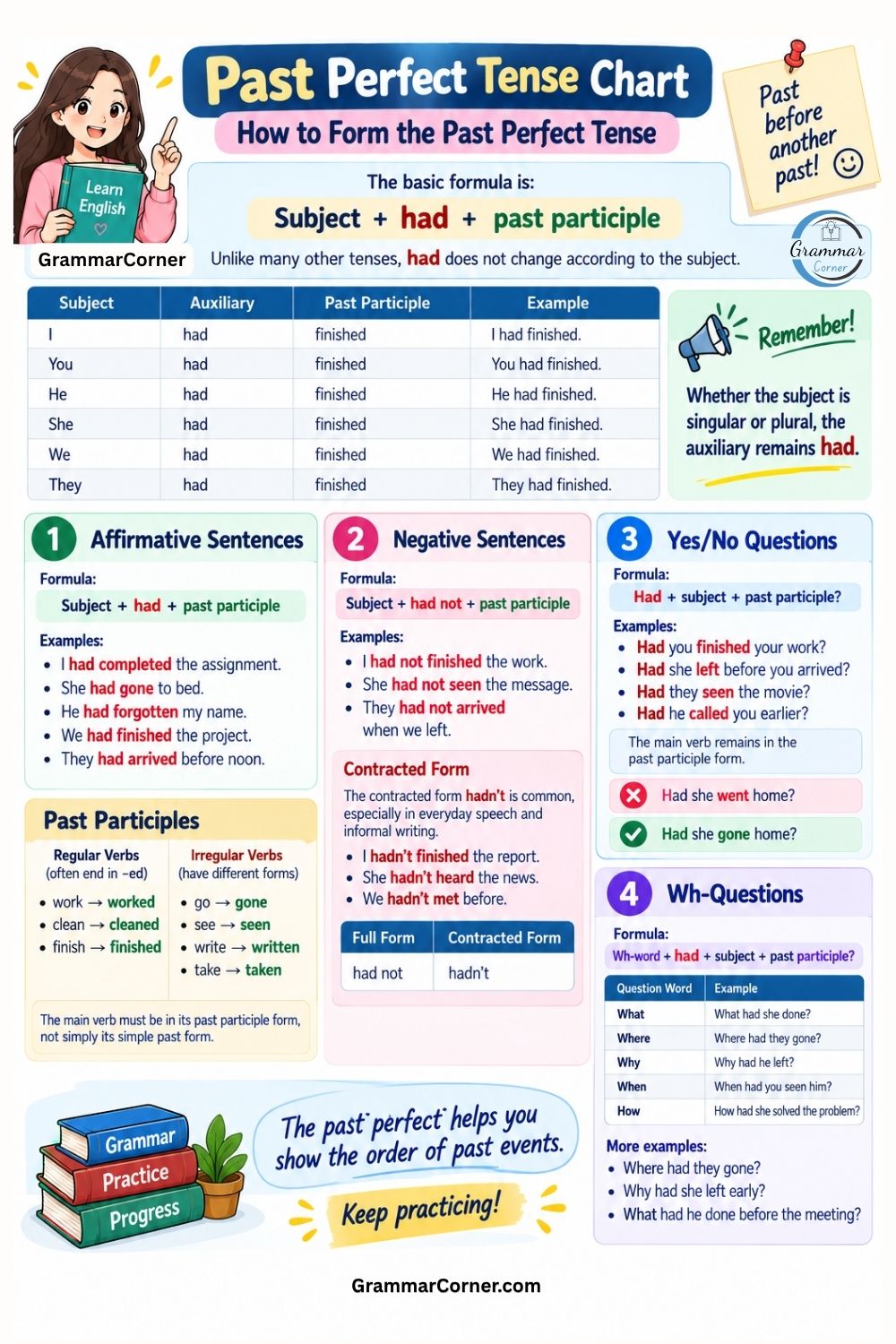
How to Form the Past Perfect Tense
The basic formula is:
Unlike many other tenses, had does not change according to the subject.
| Subject | Auxiliary | Past participle | Example |
|---|---|---|---|
| I | had | finished | I had finished. |
| You | had | finished | You had finished. |
| He | had | finished | He had finished. |
| She | had | finished | She had finished. |
| We | had | finished | We had finished. |
| They | had | finished | They had finished. |
Whether the subject is singular or plural, the auxiliary remains had.
Affirmative Sentences
Use:
Examples:
- I had completed the assignment.
- She had gone to bed.
- He had forgotten my name.
- We had finished the project.
- They had arrived before noon.
The main verb must be in its past participle form, not simply its simple past form.
For regular verbs, the past participle often ends in -ed:
- work → worked
- clean → cleaned
- finish → finished
Irregular verbs have different forms:
- go → gone
- see → seen
- write → written
- take → taken
Negative Sentences
To make the past perfect negative, place not after had.
Examples:
- I had not finished the work.
- She had not seen the message.
- They had not arrived when we left.
The contracted form hadn’t is common, especially in everyday speech and informal writing.
- I hadn’t finished the report.
- She hadn’t heard the news.
- We hadn’t met before.
| Full form | Contracted form |
|---|---|
| had not | hadn’t |
Yes/No Questions
For a question, place had before the subject.
Examples:
- Had you finished your work?
- Had she left before you arrived?
- Had they seen the movie?
- Had he called you earlier?
Notice that the main verb remains in the past participle form.
Wh-Questions
For information questions, use:
| Question word | Example |
|---|---|
| What | What had she done? |
| Where | Where had they gone? |
| Why | Why had he left? |
| When | When had you seen him? |
| How | How had she solved the problem? |
Examples:
- Where had they gone?
- Why had she left early?
- What had he done before the meeting?
Past Perfect Contractions
In informal English, had is often contracted with the subject.
| Full form | Contraction |
|---|---|
| I had | I’d |
| you had | you’d |
| he had | he’d |
| she had | she’d |
| it had | it’d |
| we had | we’d |
| they had | they’d |
Examples:
- I’d finished the work before lunch.
- She’d already left when I called.
- They’d eaten before they arrived.
Be careful with ‘d because it can also mean would.
She’d gone home. → She had gone home.
She’d visit us every summer. → She would visit us every summer.
The verb that follows usually makes the meaning clear. EnglishClub also notes this distinction in its treatment of past perfect contractions.
Quick Practice
Rewrite each sentence as directed.
- She had finished the work. → Negative
- They had left the building. → Question
- He had seen the film. → Wh-question using when
- She hadn’t finished the work.
- Had they left the building?
- When had he seen the film?
When Do We Use the Past Perfect Tense?
The main job of the past perfect is to show that one past event happened earlier than another past event.
An Action That Happened Before Another Past Action
This is the most important use of the past perfect.
- I had eaten before the guests arrived.
- She had finished her homework before she went outside.
- They had left when we reached the station.
- He had locked the door before he went to bed.
Consider this sentence:
- She had finished dinner before her friend arrived.
The order is:
The past perfect marks the earlier action.
Showing the Order of Past Events
Sometimes two events are both in the simple past, but the order may not be immediately clear. The past perfect can make that sequence unmistakable.
Compare:
- When I arrived, Sarah left.
This could mean Sarah left after I arrived.
Now compare:
- When I arrived, Sarah had left.
Here, Sarah left before I arrived.
The past perfect acts like a signpost that tells the reader, “This happened earlier.”
An Action Completed Before a Specific Time in the Past
The past perfect can describe something that was already completed by a particular point in the past.
Common expressions include:
- by then
- by that time
- by 8 p.m.
- by the end of the day
- before noon
- before the meeting
Examples:
- By 8 p.m., we had finished the work.
- By the time the teacher arrived, the students had completed the test.
- She had read three chapters by lunchtime.
- They had sold all the tickets by Friday.
The important point is that the reference time is in the past.
Actions That Happened Before a Past Result or Situation
The past perfect can explain why something was true at a particular moment in the past.
- He was tired because he had not slept well.
- She was nervous because she had never flown before.
- I knew the city well because I had lived there for several years.
- They were hungry because they had skipped breakfast.
In these sentences, the past perfect gives the earlier reason for a later past situation.
Past Perfect with Just, Already, and Never
The past perfect commonly appears with words that emphasize whether something had happened before a particular past moment.
Had Just
Use had just + past participle when something happened shortly before another past event.
- The train had just left when we arrived.
- She had just fallen asleep when the phone rang.
- I had just finished dinner when the guests arrived.
Had Already
Use had already + past participle to show that something was completed earlier than expected or before another past event.
- They had already started when we got there.
- She had already read the book before the class began.
- We had already eaten when he invited us to dinner.
Had Never
Use had never + past participle to say that something had not happened at any time before a particular point in the past.
- I had never seen snow before that trip.
- She had never visited the city before.
- They had never heard that song until then.
EF specifically highlights the use of just with the past perfect for an event that happened only a short time before another past event.
Quick Practice
Complete each sentence with the past perfect form of the verb.
- By the time we arrived, the movie ______. (start)
- She was tired because she ______ well. (not sleep)
- The bus ______ just ______ when I reached the stop. (leave)
- I ______ never ______ that place before. (visit)
- had started
- had not slept
- had just left
- had never visited
Past Perfect with Before, After, When, and By the Time
Certain time expressions appear frequently with the past perfect. They help show the relationship between two past events.
Past Perfect with Before
Use before to show that one action happened earlier than another.
- She had left before I arrived.
- We had finished the work before the manager came.
- They had eaten before the movie started.
You can reverse the clauses:
- Before I arrived, she had left.
- Before the manager came, we had finished the work.
Past Perfect with After
When after clearly establishes the order of two past events, the past perfect can emphasize the earlier action.
- After she had finished her homework, she went outside.
- After we had eaten, we went for a walk.
- After they had completed the project, they celebrated.
The simple past can sometimes be used after after when the sequence is already obvious:
- After she finished her homework, she went outside.
The past perfect is useful when you want to make the earlier event especially clear.
Past Perfect with When
The past perfect often appears with when when one action had already happened before another past event.
- When I arrived, they had already left.
- When she called, I had finished the report.
- When we reached the cinema, the film had started.
Past Perfect with By the Time
By the time is especially useful for showing that something was completed before a particular past moment.
- By the time I arrived, they had gone home.
- By the time the meeting started, everyone had taken their seats.
- By the time we reached the station, the train had left.
The structure makes the timeline easy to understand:
Earlier action → had + past participle
Later past point → simple past
Quick Practice
Complete the sentences.
- By the time I arrived, she ______ home. (go)
- After they ______ dinner, they watched a movie. (finish)
- When we reached the station, the train ______. (leave)
- He had completed the report ______ the manager arrived. (before)
Show Answers
- had gone
- had finished
- had left
- before
Past Perfect vs. Simple Past
The simple past and past perfect both refer to the past, but they serve different purposes.
| Simple Past | Past Perfect |
|---|---|
| Describes a completed past action | Describes an action completed before another past point |
| Usually moves the story forward | Often takes the reader further back |
| Example: She arrived. | Example: She had left before I arrived. |
Consider:
I arrived at the station, but the train had left.
The simple past tells us what happened at the later point:
I arrived.
The past perfect tells us what had already happened:
The train had left.
This is why the past perfect is sometimes described as the “past in the past.”
Do You Always Need the Past Perfect?
No.
If the order of events is already obvious, the simple past may be enough.
- After I finished dinner, I washed the dishes.
The word after already tells us which event came first.
But the past perfect can be useful when the sequence needs emphasis:
- After I had finished dinner, I washed the dishes.
The key is not to use the past perfect simply because two actions happened in the past. Use it when you need to place one action before another past reference point.
Quick Practice
Choose the better option.
- When I arrived, the meeting started / had started.
- I finished / had finished my homework before I went outside.
- She was upset because she lost / had lost her wallet.
- After they had eaten / ate dinner, they left.
Show Answers
- had started
- finished or had finished, depending on context; had finished clearly emphasizes the earlier action.
- had lost
- had eaten
When Not to Use the Past Perfect Tense
The past perfect is useful, but using it everywhere can make your writing awkward.
Do Not Use It for a Single Past Action
If there is no second past time or event to compare with, the simple past is normally enough.
Incorrect: Yesterday, I had cleaned my room.
Better: Yesterday, I cleaned my room.
The past perfect suggests that the cleaning happened before another past event. If no such reference exists, the simple past is more natural.
Do Not Use It for Every Verb in a Past Narrative
Once you have established the earlier past period, you do not need to keep every verb in the past perfect. For example:
I remembered that I had visited the town before. I walked through the old market and bought some fruit.
Once had visited establishes the earlier event, the simple past can continue the narrative.
Using had with every verb would make the passage unnecessarily heavy. Grammarly specifically notes that repeatedly using the past perfect after the earlier time has already been established can be distracting.
Do Not Use It Simply Because an Action Is “Older”
An action being old does not automatically require the past perfect.
Incorrect: I had lived in Lahore in 2018.
Better: I lived in Lahore in 2018.
The past perfect needs a relevant past reference point.
Quick Practice
Choose the more natural sentence.
- Yesterday, I finished/had finished the book.
- When I arrived, they left/had left.
- In 2019, she worked/had worked at the bank.
- He was disappointed because he missed/had missed the bus.
Show Answers
- finished
- had left
- worked
- had missed
Past Perfect with Regular and Irregular Verbs
The past perfect always uses had, but the main verb must be in its past participle form.
Regular verbs generally form the past participle with -ed.
| Base verb | Past participle | Past perfect |
|---|---|---|
| ask | asked | had asked |
| clean | cleaned | had cleaned |
| finish | finished | had finished |
| work | worked | had worked |
| call | called | had called |
Irregular verbs have different past participles.
| Base verb | Past participle | Past perfect |
|---|---|---|
| go | gone | had gone |
| see | seen | had seen |
| take | taken | had taken |
| write | written | had written |
| eat | eaten | had eaten |
| break | broken | had broken |
| speak | spoken | had spoken |
| choose | chosen | had chosen |
| do | done | had done |
| make | made | had made |
Pay particular attention to verbs whose simple past and past participle are different.
| Base | Simple Past | Past Participle |
|---|---|---|
| go | went | gone |
| see | saw | seen |
| write | wrote | written |
| take | took | taken |
| eat | ate | eaten |
For example:
The form after had must be the past participle.
Quick Practice
Complete each sentence.
- They had ______ the movie. (see)
- She had ______ the letter. (write)
- We had ______ lunch. (eat)
- He had ______ the door. (close)
- I had ______ the wrong bus. (take)
- seen
- written
- eaten
- closed
- taken
Common Mistakes with the Past Perfect Tense
After had, use the past participle.
If you are talking about an action completed before another past event, use had:
If this is simply a statement about a completed past action, the simple past is normally better:
If the intended meaning is that they left before your arrival, the natural sentence is:
The past perfect belongs to the event that happened earlier.
Quick Practice
Correct the mistakes.
- She had went to school.
- I have finished before he arrived.
- Yesterday, we had visited the museum.
- When I arrived, he had went home.
- They had saw the accident.
- She had gone to school.
- I had finished before he arrived.
- Yesterday, we visited the museum.
- When I arrived, he had gone home.
- They had seen the accident.
Past Perfect Tense Practice Exercises
Test what you have learned with these exercises.
Exercise 1: Complete the Sentences
Use the past perfect form of the verb in brackets.
- When I arrived, the class ______. (start)
- She was tired because she ______ all night. (work)
- They ______ the tickets before the concert began. (buy)
- We could not enter because someone ______ the door. (lock)
- He knew the city because he ______ there before. (live)
- By the time the police arrived, the thief ______. (run away)
Exercise 2: Choose the Correct Tense
Choose the simple past or past perfect.
- When we reached the station, the train left / had left.
- I finished / had finished my homework before dinner.
- She was / had been nervous because she had never flown before.
- They arrived / had arrived at the hotel at 9 p.m.
- By the time the teacher entered, the students sat / had sat down.
Exercise 3: Correct the Mistakes
- Had you went there before?
- She had saw the message.
- We had finished when he had arrived.
- I had visited the museum yesterday.
- They have left before we arrived.
Answers
Exercise 1
- had started
- had worked
- had bought
- had locked
- had lived
- had run away
Exercise 2
- had left
- had finished
- was
- arrived
- had sat
Exercise 3
- Had you gone there before?
- She had seen the message.
- We had finished when he arrived.
- I visited the museum yesterday.
- They had left before we arrived.
Frequently Asked Questions About the Past Perfect Tense
What is the past perfect tense?
The past perfect tense describes an action that happened before another past action or past point. It is often used to make the sequence of past events clear.
What is the formula for the past perfect tense?
The formula is subject + had + past participle. For example, “She had finished the assignment.”
Why is the past perfect called the “past in the past”?
It is called the “past in the past” because it describes an event that happened earlier than another event that is already in the past. For example, “The train had left when we arrived.”
What is the difference between simple past and past perfect?
The simple past describes a completed past event, while the past perfect places one completed event before another past reference point.
Can I use the past perfect without a specific time?
Yes. You do not need to state an exact time. The sentence only needs a clear past reference point, either stated directly or understood from the context.
For example:
The exact time of the cancellation is not given, but it happened before the past feeling of disappointment.
What words are commonly used with the past perfect?
Common expressions include before, after, when, by the time, already, just, never, and until. These words often help establish the relationship between two past events, although the past perfect is not automatically required whenever one of these words appears.
What is the past participle in the past perfect tense?
The past participle is the main verb form used after had. Regular verbs commonly end in -ed, while irregular verbs have different forms. For example, work → worked and go → gone.
Is “had” the same for every subject?
Yes. The auxiliary had is used with all subjects:
- I had
- you had
- he had
- she had
- we had
- they had
The form does not change accord
All 12 tenses, in one place
English builds every tense from the same two ingredients — when (present, past, future) and aspect (simple, continuous, perfect, perfect continuous). Each tense below links to its chart and a set of practice conversation questions.
| Present Tense | Past Tense | Future Tense |
|---|---|---|