Past Continuous Tense Chart (Formula, Rules, Examples)
What Is the Past Continuous Tense?
The past continuous tense describes an action that was in progress at a particular time in the past.
It is formed with was/were + the -ing form of a verb.
was/were + verb-ingThe important idea is not simply that something happened in the past. The past continuous shows that the action was already happening at a particular moment or during a particular period.
Compare:
The first sentence tells us about a completed event. The second places us in the middle of the action at a particular past time.
The past continuous is also called the past progressive tense.
Past Continuous Verb Forms
| Base verb | Past continuous |
|---|---|
| work | was/were working |
| read | was/were reading |
| write | was/were writing |
| cook | was/were cooking |
| play | was/were playing |
| study | was/were studying |
Quick Practice
- At 7 p.m., I was studying / studied.
- They were playing / played football when it started raining.
- She was cooking / cooked at that moment.
Answers
- was studying
- were playing
- was cooking
How to Form the Past Continuous Tense
The basic structure is:
Subject + was/were + verb-ingThe form of be changes according to the subject, but the main verb remains in its -ing form.
| Subject | Be | Main verb | Example |
|---|---|---|---|
| I | was | working | I was working. |
| You | were | working | You were working. |
| He | was | working | He was working. |
| She | was | working | She was working. |
| It | was | raining | It was raining. |
| We | were | working | We were working. |
| They | were | working | They were working. |
Affirmative Sentences
Use:
Subject + was/were + verb-ingExamples:
The choice between was and were is straightforward:
Negative Sentences
To make a negative sentence, add not after was or were.
Subject + was/were + not + verb-ingExamples:
Both full and contracted forms are possible:
| Full form | Short form |
|---|---|
| was not | wasn’t |
| were not | weren’t |
Yes/No Questions
For a question, place was or were before the subject.
Was/Were + subject + verb-ing?Examples:
Compare the statement and question:
Wh-Questions
When a question begins with what, where, why, when, or who, place the question word before was/were.
Wh-word + was/were + subject + verb-ing?| Question word | Example |
|---|---|
| What | What were you doing? |
| Where | Where was she going? |
| Why | Why were they laughing? |
| Who | Who was he talking to? |
| What time | What time were you leaving? |
Examples:
Quick Practice
- She was studying.
- They were waiting outside.
- He was talking to Ali.
Answers
- Was she studying?
- Were they waiting outside?
- Was he talking to Ali?
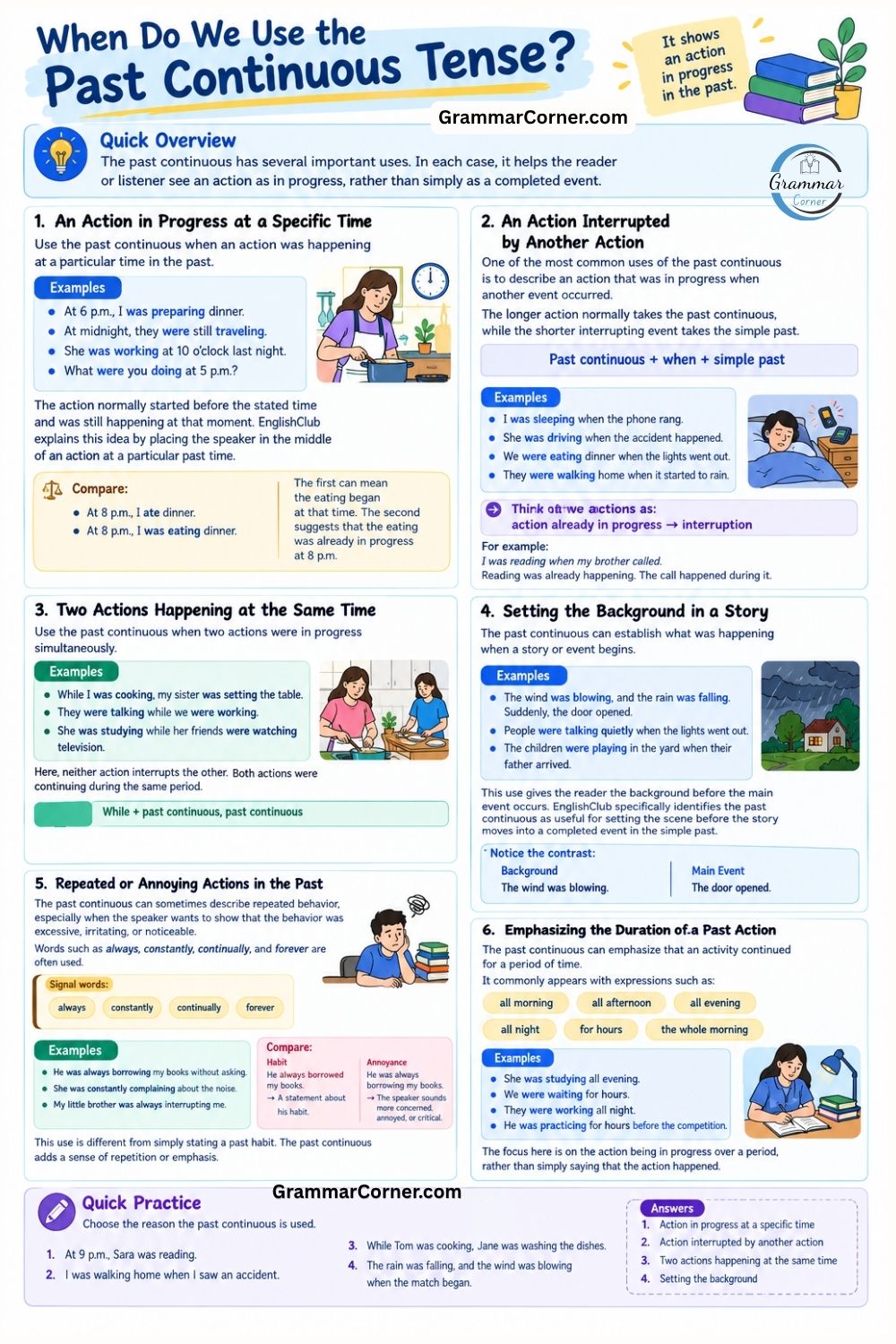
When Do We Use the Past Continuous Tense?
The past continuous has several important uses. In each case, it helps the reader or listener see an action as in progress, rather than simply as a completed event.
An Action in Progress at a Specific Time
Use the past continuous when an action was happening at a particular time in the past.
The action normally started before the stated time and was still happening at that moment. EnglishClub explains this idea by placing the speaker in the middle of an action at a particular past time.
Compare:
The first can mean the eating began at that time. The second suggests that the eating was already in progress at 8 p.m.
An Action Interrupted by Another Action
One of the most common uses of the past continuous is to describe an action that was in progress when another event occurred.
The longer action normally takes the past continuous, while the shorter interrupting event takes the simple past.
Past continuous + when + simple pastThink of the two actions as:
For example:
I was reading when my brother called.
Reading was already happening. The call happened during it.
Two Actions Happening at the Same Time
Use the past continuous when two actions were in progress simultaneously.
Here, neither action interrupts the other. Both actions were continuing during the same period.
A useful structure is:
While + past continuous, past continuousWhile he was driving, I was checking the map.
You can also reverse the order:
I was checking the map while he was driving.
Setting the Background in a Story
The past continuous can establish what was happening when a story or event begins.
This use gives the reader the background before the main event occurs. EnglishClub specifically identifies the past continuous as useful for setting the scene before the story moves into a completed event in the simple past.
Notice the contrast:
Repeated or Annoying Actions in the Past
The past continuous can sometimes describe repeated behavior, especially when the speaker wants to show that the behavior was excessive, irritating, or noticeable.
Words such as always, constantly, continually, and forever are often used.
This use is different from simply stating a past habit. The past continuous adds a sense of repetition or emphasis.
Compare:
→ A statement about his habit.
→ The speaker sounds more concerned, annoyed, or critical.
Emphasizing the Duration of a Past Action
The past continuous can emphasize that an activity continued for a period of time.
It commonly appears with expressions such as:
Examples:
The focus here is on the action being in progress over a period, rather than simply saying that the action happened.
Quick Practice
Choose the reason the past continuous is used.
- At 9 p.m., Sara was reading.
- I was walking home when I saw an accident.
- While Tom was cooking, Jane was washing the dishes.
- The rain was falling, and the wind was blowing when the match began.
Answers
- Action in progress at a specific time
- Action interrupted by another action
- Two actions happening at the same time
- Setting the background
Past Continuous Tense with When and While
When and while are both common with the past continuous, but they do not always introduce the same type of action.
When + Simple Past
When often introduces the shorter event that happens during an ongoing action.
I was sleeping when the alarm rang.
She was cooking when her friend arrived.
We were walking when it started to rain.
While + Past Continuous
While commonly introduces an action that was already in progress.
While I was sleeping, the alarm rang.
While she was cooking, her friend arrived.
While we were walking, it started to rain.
The two forms can communicate essentially the same event:
I was reading when he called.
He called while I was reading.
LSI and EnglishClub both highlight this relationship between when, the shorter event, and while, the ongoing action.
When Both Actions Are Ongoing
If two actions were happening at the same time, while can connect two past continuous clauses.
While I was studying, my brother was playing video games.
While they were talking, we were waiting outside.
When does not automatically mean simple past, and while does not automatically mean past continuous. The tense depends on the meaning and whether an action is viewed as ongoing or completed.
Quick Practice
Complete each sentence with the correct form.
- I was watching TV ______ the phone rang.
- ______ she was driving, her friend was talking.
- They were eating dinner ______ the guests arrived.
- when
- While
- when
Past Continuous vs. Simple Past
The past continuous and simple past can both describe past events, but they present those events differently.
| Past Continuous | Simple Past |
|---|---|
| Shows an action in progress | Shows a completed event |
| Focuses on what was happening | Focuses on what happened |
| Often gives background | Often gives the main event |
| Can show an action interrupted by another | Can show the interrupting event |
Compare:
I watched television at 8 p.m.
I was watching television at 8 p.m.
The simple past treats watched as a completed event. The past continuous puts the listener inside the activity at 8 p.m.
Another common pattern is:
She was walking home when she fell.
We were having dinner when the doorbell rang.
He was driving when he received the message.
The distinction is about how the speaker views the action, not simply about whether the action was “long” or “short.”
Quick Practice
Choose the correct tense.
- At 10 p.m., I was reading / read a book.
- I was reading / read the book from beginning to end yesterday.
- She was walking / walked home when she saw her teacher.
- They were playing / played football when it began to rain.
- was reading
- read
- was walking
- were playing
Stative Verbs That Are Not Usually Used in the Past Continuous
Not every verb can naturally be used in the past continuous.
Stative verbs describe states rather than actions in progress. Common examples include:
Normally, use these verbs in the simple past, not the past continuous.
❌ I was knowing the answer.
✅ I knew the answer.
❌ She was understanding the problem.
✅ She understood the problem.
❌ They were owning a large house.
✅ They owned a large house.
However, some verbs can have both a stative and an action meaning. In that case, the continuous form may be correct.
Compare:
| Sentence | What it means |
|---|---|
| I thought he was right. | thought = held an opinion |
| I was thinking about the problem. | thinking = actively considering something |
Another example:
| Sentence | What it means |
|---|---|
| She had a car. | possession |
| She was having a great time. | experiencing/enjoying something |
So the important question is not simply, “Is this verb on a list of stative verbs?” Consider what the verb means in the sentence.
Quick Practice
Correct the sentences if necessary.
- I was knowing the answer.
- She was thinking about the problem.
- They were owning a shop.
- We were having a wonderful time.
Show Answers
- I knew the answer.
- Correct.
- They owned a shop.
- Correct.
Past Continuous Tense Spelling Rules
The main verb in the past continuous always takes the -ing form, but adding -ing sometimes requires a spelling change.
Most Verbs
Simply add -ing.
| Base verb | -ing form |
|---|---|
| work | working |
| read | reading |
| play | playing |
| help | helping |
Verbs Ending in Silent -e
Usually remove the final e before adding -ing.
| Base verb | -ing form |
|---|---|
| make | making |
| write | writing |
| take | taking |
| drive | driving |
She was writing a letter.
He was driving home.
Short Verbs Ending in a Consonant-Vowel-Consonant Pattern
Some short verbs double the final consonant before adding -ing.
| Base verb | -ing form |
|---|---|
| run | running |
| sit | sitting |
| swim | swimming |
| stop | stopping |
The children were running outside.
He was sitting near the window.
Verbs Ending in -ie
Change -ie to -y before adding -ing.
| Base verb | -ing form |
|---|---|
| lie | lying |
| die | dying |
| tie | tying |
He was lying on the sofa.
She was tying her shoes.
Quick Practice
Write the correct -ing form.
- make → ______
- run → ______
- lie → ______
- write → ______
- swim → ______
Show Answers
- making
- running
- lying
- writing
- swimming
Common Mistakes with the Past Continuous Tense
Using the Wrong Form of Be
❌ She were studying. ✅ She was studying.
❌ They was waiting. ✅ They were waiting.
Forgetting Was or Were
❌ I studying at 8 p.m. ✅ I was studying at 8 p.m.
The past continuous requires both the past form of be and the -ing form of the main verb.
Using the Past Form Instead of the -ing Form
❌ They were played football. ✅ They were playing football.
Using the Past Continuous for Every Past Action
The past continuous should not replace the simple past whenever you talk about the past.
❌ The door was opening and I was entered the room.
✅ The door opened, and I entered the room.
Use the past continuous when you want to show an action as ongoing.
Using Stative Verbs in the Continuous Form
❌ I was knowing the answer. ✅ I knew the answer.
Stative verbs generally describe states rather than actions in progress.
Using the Past Continuous for the Interrupting Action
❌ I was sleeping when the alarm was ringing.
This can be grammatically possible in a different meaning, but if the intended meaning is one brief event interrupting sleep, the natural form is:
✅ I was sleeping when the alarm rang.
The ongoing action is in the past continuous; the brief interrupting event is normally in the simple past.
Quick Practice
Correct the mistakes.
- She were watching television.
- I was read a book.
- They was playing outside.
- I was knowing the answer.
- We were walking when the car was stopped.
Show Answers
- She was watching television.
- I was reading a book.
- They were playing outside.
- I knew the answer.
- We were walking when the car stopped.
Past Continuous Tense Practice Exercises
Test yourself without looking at the previous sections.
Exercise 1: Complete the Sentences
Use the past continuous form of the verb in brackets.
- At 9 p.m., I ______ a book. (read)
- They ______ football when it started to rain. (play)
- She ______ dinner at that time. (cook)
- We ______ for the bus at 7 o’clock. (wait)
- He ______ to music when I called. (listen)
- The children ______ in the garden. (run)
Exercise 2: Choose the Correct Tense
Choose the simple past or past continuous.
- I ______ TV when my brother called. (watched / was watching)
- She ______ the door when she heard a noise. (opened / was opening)
- At midnight, they ______ home. (were driving / drove)
- We ______ dinner when the lights went out. (had / were having)
- He ______ the office at 5 p.m. (left / was leaving)
Exercise 3: Correct the Mistakes
- Were she sleeping?
- They was watching a movie.
- I was know the answer.
- She was cook when I arrived.
- We were walk home when it started raining.
Answers
Show All Answers
Exercise 1
- was reading
- were playing
- was cooking
- were waiting
- was listening
- were running
Exercise 2
- was watching
- opened
- were driving
- were having
- left
Exercise 3
- Was she sleeping?
- They were watching a movie.
- I knew the answer.
- She was cooking when I arrived.
- We were walking home when it started raining.
Frequently Asked Questions About the Past Continuous Tense
What is the past continuous tense?
The past continuous tense describes an action that was in progress at a particular time in the past. It is formed with was/were + verb-ing.
What is the formula for the past continuous tense?
The basic formula is subject + was/were + verb-ing. For example, “She was studying.“
What is the difference between past continuous and simple past?
The past continuous presents an action as ongoing at a particular past time, while the simple past normally presents an action as completed. For example, “I was eating when he called.“
When should I use was and were?
Use was with I, he, she, and it. Use were with you, we, and they.
What is the difference between when and while?
When commonly introduces a shorter event that occurs during an ongoing action, while while commonly introduces the ongoing action itself. For example, “I was sleeping when he called” and “He called while I was sleeping.“
Can stative verbs be used in the past continuous?
Stative verbs are generally not used in the past continuous because they describe states rather than actions in progress. For example, say “I knew the answer,” not “I was knowing the answer.” Some verbs, however, can take the continuous form when they have an action meaning.
Is the past continuous the same as the past progressive?
Yes. Past continuous and past progressive are two names for the same tense. Both refer to the structure was/were + verb-ing.
All 12 tenses, in one place
English builds every tense from the same two ingredients — when (present, past, future) and aspect (simple, continuous, perfect, perfect continuous). Each tense below links to its chart and a set of practice conversation questions.
| Present Tense | Past Tense | Future Tense |
|---|---|---|