Past Perfect Continuous Tense Chart (Formula, Rules & Examples)
What Is the Past Perfect Continuous Tense?
The past perfect continuous tense describes an action that had been continuing for some time before another point or event in the past.
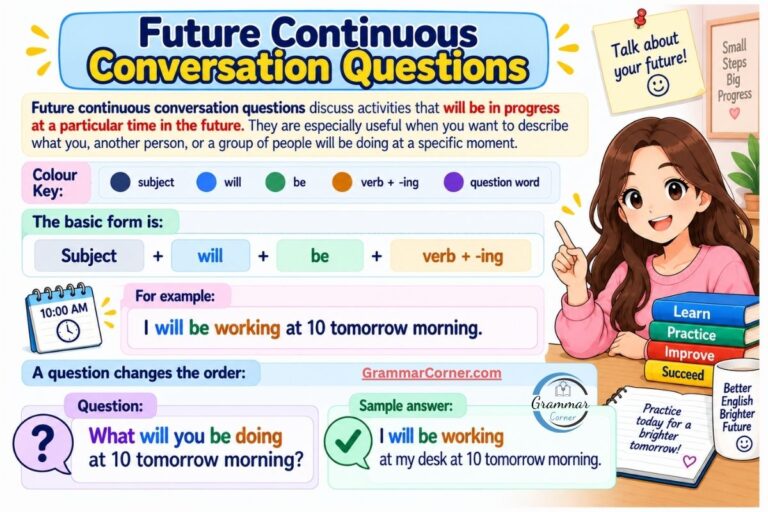
It is formed with:
Examples:
- I had been waiting for an hour when the bus arrived.
- She had been studying before her friend called.
- They had been working all morning when the manager came.
- It had been raining for several hours before the match was cancelled.
The tense has two important ideas:
Consider this sentence:
Past Perfect Continuous Verb Forms
The structure stays the same with every subject.
| Subject | Structure | Example |
|---|---|---|
| I | had been + verb-ing | I had been working. |
| You | had been + verb-ing | You had been working. |
| He | had been + verb-ing | He had been working. |
| She | had been + verb-ing | She had been working. |
| We | had been + verb-ing | We had been working. |
| They | had been + verb-ing | They had been working. |
Quick Practice
Choose the correct form.
- She had been waiting / has been waiting for an hour when the bus arrived.
Answer
had been waiting - They had been working / had working all morning.
Answer
had been working - I had been studying / was been studying before dinner.
Answer
had been studying
All answers
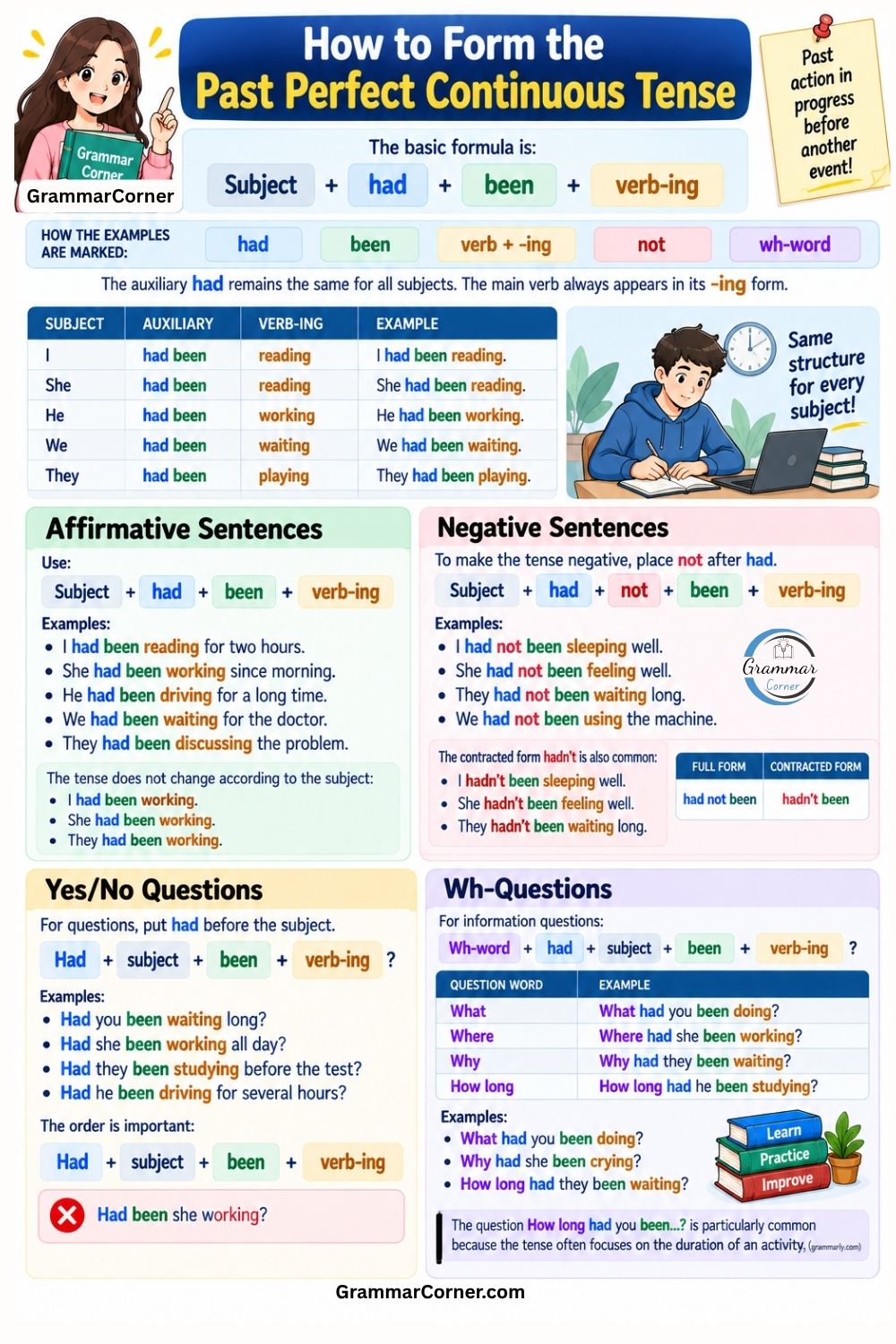
How to Form the Past Perfect Continuous Tense
The basic formula is:
The auxiliary had remains the same for all subjects. The main verb always appears in its -ing form.
| Subject | Auxiliary | Verb-ing | Example |
|---|---|---|---|
| I | had been | reading | I had been reading. |
| She | had been | reading | She had been reading. |
| He | had been | working | He had been working. |
| We | had been | waiting | We had been waiting. |
| They | had been | playing | They had been playing. |
Affirmative Sentences
Use:
Examples:
- I had been reading for two hours.
- She had been working since morning.
- He had been driving for a long time.
- We had been waiting for the doctor.
- They had been discussing the problem.
The tense does not change according to the subject:
Negative Sentences
To make the tense negative, place not after had.
Examples:
- I had not been sleeping well.
- She had not been feeling well.
- They had not been waiting long.
- We had not been using the machine.
The contracted form hadn’t is also common:
- I hadn’t been sleeping well.
- She hadn’t been feeling well.
- They hadn’t been waiting long.
| Full form | Contracted form |
|---|---|
| had not been | hadn’t been |
Yes/No Questions
For questions, put had before the subject.
Examples:
- Had you been waiting long?
- Had she been working all day?
- Had they been studying before the test?
- Had he been driving for several hours?
The order is important:
Not:
Wh-Questions
For information questions:
| Question | Example |
|---|---|
| What | What had you been doing? |
| Where | Where had she been working? |
| Why | Why had they been waiting? |
| How long | How long had he been studying? |
Examples:
- What had you been doing?
- Why had she been crying?
- How long had they been waiting?
Past Perfect Continuous Contractions
In informal English, had is often contracted.
| Full form | Contraction |
|---|---|
| I had been | I‘d been |
| you had been | you‘d been |
| he had been | he‘d been |
| she had been | she‘d been |
| we had been | we‘d been |
| they had been | they‘d been |
Examples:
- I‘d been waiting for thirty minutes.
- She‘d been studying all night.
- They‘d been working since morning.
Quick Practice
Change each sentence as directed.
- She had been working all day. → Negative
Answer
She hadn’t been working all day. - They had been waiting outside. → Question
Answer
Had they been waiting outside? - He had been driving for three hours. → Wh-question using how long
Answer
How long had he been driving?
All answers
When Do We Use the Past Perfect Continuous Tense?
The past perfect continuous is mainly used when we want to emphasize an ongoing activity, its duration, or its effect before a past point.
An Action That Continued Before Another Past Action
Use the tense when an activity was continuing before another past event occurred.
- I had been reading when the phone rang.
- She had been cooking when the guests arrived.
- They had been playing football when it started to rain.
- We had been discussing the issue before the manager entered.
The later event is usually expressed in the simple past:
Past perfect continuous + when + simple past- We had been waiting when the bus arrived.
The waiting was already in progress. The bus arrival happened later.
Emphasizing the Duration of a Past Action
The past perfect continuous is especially useful when the length of an activity matters.
- She had been studying for five hours before she took a break.
- We had been driving for six hours when we stopped.
- He had been working since early morning when the meeting began.
- They had been waiting for nearly an hour before the doctor arrived.
Expressions such as for, since, all morning, all day, for hours, and for several weeks often make the duration clear.
Compare:
- She had finished the report before lunch.
- She had been working on the report for three hours before lunch.
The first focuses on completion. The second focuses on the activity and its duration.
An Action That Had Recently Stopped
The past perfect continuous can describe an activity that had been happening up to a point in the past and had recently stopped.
- His clothes were wet because he had been walking in the rain.
- She was tired because she had been running.
- The kitchen smelled wonderful because they had been cooking.
- His hands were dirty because he had been repairing the car.
The activity may have stopped shortly before the past situation, but its effects were still noticeable.
Explaining a Past Result or Situation
Use the past perfect continuous when an earlier ongoing activity explains a condition or result in the past.
- He was exhausted because he had been working all night.
- She was angry because she had been waiting for hours.
- The ground was muddy because it had been raining.
- They were tired because they had been traveling since dawn.
The pattern is often:
Past result + because + past perfect continuousThe earlier activity explains the later past condition.
Quick Practice
Identify the main reason for using the past perfect continuous.
- I had been waiting for an hour when the bus arrived.
- She was exhausted because she had been running.
- They had been working since morning before the manager came.
- The road was wet because it had been raining.
Show Answers
- An ongoing action before another past event; duration is emphasized.
- Explaining a past result.
- An ongoing action before another past event.
- Explaining a past result.
Past Perfect Continuous with For and Since
For and since are particularly useful with the past perfect continuous because they tell us how long an activity had continued before a past reference point.
Using For
Use for to give a length of time.
- for two hours
- for three days
- for several weeks
- for a long time
- for five years
Examples:
- I had been studying for three hours when you called.
- They had been traveling for two days before they reached the city.
- She had been working there for five years when she resigned.
Using Since
Use since to identify the point when an activity began.
- since morning
- since Monday
- since 2020
- since breakfast
- since 8 a.m.
Examples:
- He had been working since 7 a.m. when the office closed.
- We had been living there since 2018 when we moved.
- She had been waiting since noon when the doctor finally arrived.
The difference is simple:
| For | Since |
|---|---|
| for two hours | since 8 a.m. |
| for three days | since Monday |
| for five years | since 2021 |
| for a long time | since morning |
Quick Practice
Choose for or since.
- She had been studying ______ three hours.
- They had been waiting ______ 9 a.m.
- He had been working there ______ five years.
- We had been living in the city ______ 2020.
Show Answers
- for
- since
- for
- since
Past Perfect Continuous with Before, When, and Until
Time expressions can connect the ongoing earlier action with another event or point in the past.
Past Perfect Continuous with Before
Use before to show that an activity continued up to an earlier point before another past event.
- She had been studying before her parents came home.
- We had been waiting before the manager arrived.
- They had been working before the power went out.
The order is:
Earlier ongoing activity → later past eventPast Perfect Continuous with When
When commonly introduces the later event that occurs during or after the earlier ongoing activity.
- I had been sleeping when the phone rang.
- She had been driving when the accident happened.
- They had been talking when the teacher entered.
The past perfect continuous shows what had already been happening. The simple past shows the later event.
Past Perfect Continuous with Until
Until can show how long an activity continued before it stopped at a particular past point.
- He had been working until midnight.
- They had been waiting until the store opened.
- She had been studying until her father asked her to stop.
The exact choice of tense can depend on the intended meaning, so until does not automatically require the past perfect continuous.
Quick Practice
Complete the sentences using the correct form.
- I had been reading ______ the phone rang.
- She had been working ______ her manager arrived.
- They had been waiting ______ the gates opened.
Show Possible Answers
- when
- before
- until
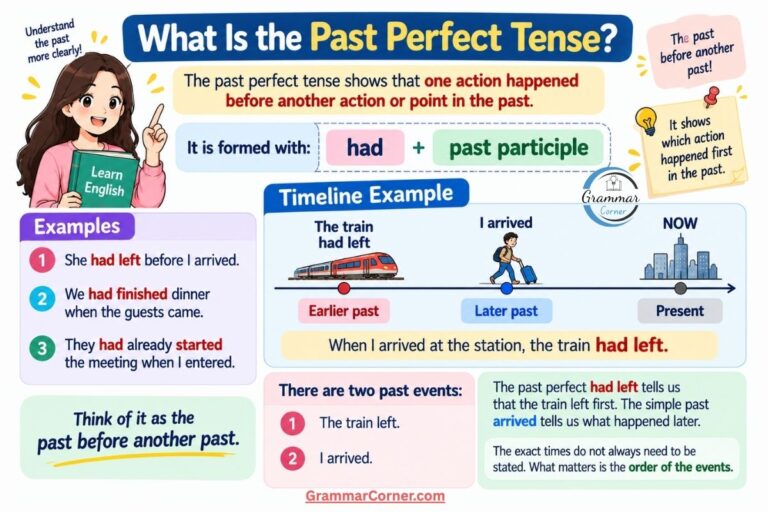
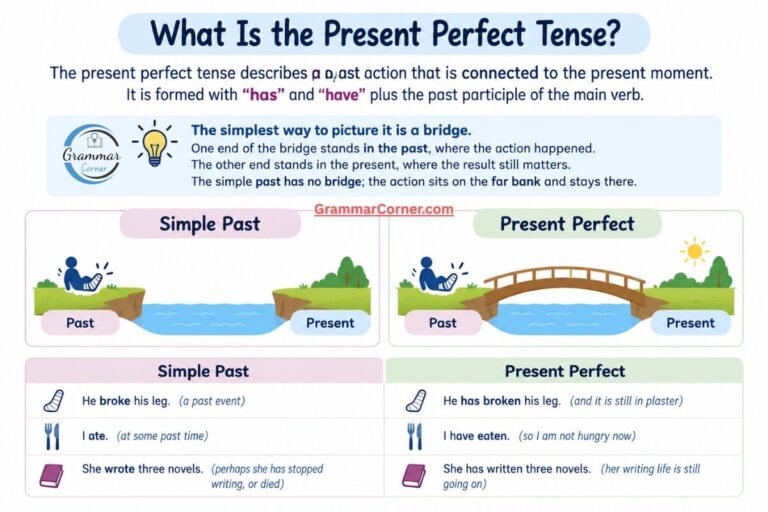
Past Perfect Continuous vs. Past Perfect
Both tenses can describe an earlier action, but they emphasize different things.
| Past Perfect | Past Perfect Continuous |
|---|---|
| Focuses on completion or result | Focuses on activity or duration |
| had + past participle | had been + verb-ing |
| She had finished the report. | She had been writing the report. |
| They had painted the room. | They had been painting the room. |
Compare:
The focus is on the completed amount.
The focus is on the activity and its duration.
Another example:
The first emphasizes the result. The second emphasizes the activity.
Quick Practice
Choose the better tense.
- She the report before the meeting. (had finished / had been finishing)
Answer
had finished - He was tired because he all morning. (had worked / had been working)
Answer
had been working - They the house before they sold it. (had painted / had been painting)
Answer
had painted
All answers
Past Perfect Continuous vs. Past Continuous
Both tenses describe actions in progress, but they refer to different points in the past.
The past continuous describes an action that was in progress at a particular past time.
The past perfect continuous describes an action that had been in progress before a particular past time or event.
| Past Continuous | Past Perfect Continuous |
|---|---|
| was/were + verb-ing | had been + verb-ing |
| Action in progress at a past time | Action continuing before a past reference point |
| I was studying at 8 p.m. | I had been studying for two hours when you called. |
Compare:
The first tells us what was happening at 8 p.m. The second tells us how long the activity had already continued before that point.
Quick Practice
Choose the correct tense.
- At 7 p.m., she dinner. (was cooking / had been cooking)
Answer
was cooking - She dinner for an hour when the guests arrived. (was cooking / had been cooking)
Answer
had been cooking - At midnight, they . (were working / had been working for five hours)
Answer
were working / had been working for five hours, depending on the intended meaning
All answers
Past Perfect Continuous vs. Simple Past
The simple past normally presents a completed event. The past perfect continuous presents an activity as having continued before another past point.
| Simple Past | Past Perfect Continuous |
|---|---|
| completed event | ongoing earlier activity |
| She worked all day. | She had been working all day before she went home. |
| They waited for an hour. | They had been waiting for an hour when the bus arrived. |
Compare:
This simply tells us about a completed period of work.
This places the three-hour period before another past event.
Quick Practice
Choose the better sentence.
- Yesterday, I worked / had been working for five hours.
Answer
worked - I had been working / worked for five hours when my friend called.
Answer
had been working - She visited / had been visiting her aunt last Sunday.
Answer
visited
All answers
Stative Verbs and the Past Perfect Continuous
The past perfect continuous is generally not used with stative verbs because these verbs describe states rather than ongoing physical or mental activities.
Common stative verbs include:
- know
- believe
- understand
- want
- need
- like
- love
- hate
- own
- remember
- prefer
For example:
Incorrect: I had been knowing him for years.
Correct: I had known him for years.
Incorrect: She had been owning the house for ten years.
Correct: She had owned the house for ten years.
Incorrect: They had been understanding the problem.
Correct: They had understood the problem.
However, some verbs can be either stative or dynamic depending on their meaning.
Compare:
I had thought the plan was a good idea.
→ thought expresses an opinion.
I had been thinking about the plan all morning.
→ thinking describes an ongoing mental activity.
Similarly:
She had had the car for five years.
→ possession
She had been having problems with the car.
→ experiencing problems
The meaning of the verb matters more than memorizing a rigid list.
Quick Practice
Correct the sentences if necessary.
- I had been knowing him for years.
- She had been thinking about the problem all day.
- They had been owning the business since 2015.
- He had been feeling tired.
Show Answers
- I had known him for years.
- Correct.
- They had owned the business since 2015.
- Correct.
Common Mistakes with the Past Perfect Continuous
Leaving Out Been
The correct structure is had been + verb-ing.
Incorrect: She had working all day.
Correct: She had been working all day.
Using Was/Were Instead of Had Been
Incorrect: They were been waiting for an hour.
Correct: They had been waiting for an hour.
The past perfect continuous always uses had been, regardless of the subject.
Using the Past Participle Instead of -ing
Incorrect: He had been worked all morning.
Correct: He had been working all morning.
After had been, use the -ing form.
Using the Wrong Verb Form After Had
Incorrect: She had went home.
This is not past perfect continuous. If the intended tense is past perfect, the correct form is:
Correct: She had gone home.
If the intended tense is past perfect continuous, you need:
Correct: She had been going home.
The choice depends on the meaning.
Confusing For and Since
Incorrect: She had been waiting since three hours.
Correct: She had been waiting for three hours.
Use for with a period of time and since with a starting point.
Using the Tense Without a Past Reference Point
Incorrect: I had been working all day yesterday.
This can sound unnatural if there is no later past reference point. In a simple statement about yesterday, the simple past is often more natural:
Correct: I worked all day yesterday.
But the past perfect continuous becomes appropriate when another past reference point is present:
Correct: I had been working all day when my manager called.
Quick Practice
Correct the mistakes.
- She had working since morning.
- They were been waiting for an hour.
- He had been worked all day.
- I had been waiting since two hours.
- We had been studying when the teacher had arrived.
Show Answers
- She had been working since morning.
- They had been waiting for an hour.
- He had been working all day.
- I had been waiting for two hours.
- We had been studying when the teacher arrived.
Past Perfect Continuous Tense Spelling Rules
Because the main verb appears in the -ing form, the usual spelling rules for adding -ing apply.
Most Verbs
Add -ing:
| Base Verb | -ing Form |
|---|---|
| work | working |
| read | reading |
| play | playing |
| wait | waiting |
Verbs Ending in Silent -e
Usually remove the final e:
| Base Verb | -ing Form |
|---|---|
| make | making |
| write | writing |
| drive | driving |
| take | taking |
Short Verbs with a Doubled Final Consonant
Some short verbs double the final consonant:
| Base Verb | -ing Form |
|---|---|
| run | running |
| sit | sitting |
| stop | stopping |
| swim | swimming |
Examples:
- She had been running for an hour.
- They had been swimming all afternoon.
Verbs Ending in -ie
Change -ie to -y:
| Base Verb | -ing Form |
|---|---|
| lie | lying |
| tie | tying |
| die | dying |
Example:
- He had been lying on the sofa for an hour.
Quick Practice
Write the correct -ing form.
- write → ______
- run → ______
- lie → ______
- make → ______
- swim → ______
Show Answers
- writing
- running
- lying
- making
- swimming
Past Perfect Continuous Tense Practice Exercises
Use these exercises to check whether you can choose and form the tense correctly.
Exercise 1: Complete the Sentences
Use the past perfect continuous form of the verb in brackets.
- She ______ for two hours when I called. (study)
- They ______ all morning before they took a break. (work)
- He was tired because he ______ all night. (drive)
- We ______ for thirty minutes when the bus arrived. (wait)
- It ______ for several hours before the roads became flooded. (rain)
- I ______ since early morning when my friend arrived. (clean)
Exercise 2: Choose the Correct Tense
Choose the better answer.
- She was tired because she had worked / had been working all day.
- I was reading / had been reading for two hours when he called.
- They had finished / had been finishing the project before the deadline.
- At 8 p.m., we were watching / had been watching television.
- He had known / had been knowing her for years.
Exercise 3: Correct the Mistakes
- She had been study for three hours.
- We had working all morning.
- They had been waited for an hour.
- He had been knowing the answer.
- I had been waiting since two hours.
Show Answers
Exercise 1
- had been studying
- had been working
- had been driving
- had been waiting
- had been raining
- had been cleaning
Exercise 2
- had been working
- had been reading
- had finished
- were watching
- had known
Exercise 3
- She had been studying for three hours.
- We had been working all morning.
- They had been waiting for an hour.
- He had known the answer.
- I had been waiting for two hours.
Frequently Asked Questions About the Past Perfect Continuous Tense
What is the past perfect continuous tense?
The past perfect continuous tense describes an activity that had been continuing before another point or event in the past. It often emphasizes how long the activity had continued.
What is the formula for the past perfect continuous tense?
The formula is subject + had + been + verb-ing. For example, “She had been studying for two hours.”
What is the difference between past perfect and past perfect continuous?
The past perfect generally emphasizes a completed action or result, while the past perfect continuous emphasizes an ongoing activity or its duration. Compare “She had finished the report” with “She had been working on the report for three hours.”
What is the difference between past continuous and past perfect continuous?
The past continuous describes an action in progress at a particular past time. The past perfect continuous describes an action that had been in progress before another past point or event.
When should I use for and since with the past perfect continuous?
Use for to state a duration, such as “for three hours,” and since to state the starting point, such as “since 8 a.m.”
Can stative verbs be used in the past perfect continuous?
Stative verbs are generally not used in the continuous form. For example, say “I had known her for years,” not “I had been knowing her for years.” Some verbs can take the continuous form when their meaning describes an activity.
Does the past perfect continuous always describe an action that stopped?
No. It can describe an action that continued up to a past event or point, and it can also describe an activity whose effects were still noticeable at that time. The context determines whether the activity had stopped or was still continuing.
What is another name for the past perfect continuous tense?
It is also called the past perfect progressive tense. Both names refer to the same structure: had been + verb-ing.
All 12 tenses, in one place
English builds every tense from the same two ingredients — when (present, past, future) and aspect (simple, continuous, perfect, perfect continuous). Each tense below links to its chart and a set of practice conversation questions.
| Present Tense | Past Tense | Future Tense |
|---|---|---|