Present Perfect Tense Chart, Rules, Structure & Examples
Two sentences, one small difference:
I lost my keys.
A closed story — it happened, it ended.
I have lost my keys.
A problem you still have right now.
The first one is a closed story. It happened, it ended, and you may well have found the keys an hour later. The second one is a problem you still have. The door is still locked. That link to right now is the whole point of the present perfect tense.
What You’ll Learn in This Article
- Present perfect structure and formula
- The has/have rule
- Past participles
- All eight uses
- For and since
- Already, yet, just
- Ever and never
- Been versus gone
- Passive voice
- British and American differences
- Over 100 example sentences by topic
- Practice Exercises
- Quiz with answers
What Is the Present Perfect Tense?
The present perfect tense describes a past action that is connected to the present moment. It is formed with “has” or “have” plus the past participle of the main verb.
The simplest way to picture it is a bridge. One end of the bridge stands in the past, where the action happened. The other end stands in the present, where the result still matters. The simple past has no bridge; the action sits on the far bank and stays there.
| Simple past | Present perfect |
|---|---|
| He broke his leg. (a past event) | He has broken his leg. (and it is still in plaster) |
| I ate. (at some past time) | I have eaten. (so I am not hungry now) |
| She wrote three novels. (perhaps she has stopped writing, or died) | She has written three novels. (her writing life is still going on) |
- The helping verb — has or have, which changes with the subject.
- The past participle — the third form of the verb, which never changes no matter who the subject is.
Why Is It Called the Present Perfect Tense?
The name confuses learners because the tense describes past actions. The two words explain themselves once you split them.
Where the word “perfect” comes from
Perfect comes from the Latin perfectum, meaning finished or completed. In grammar it has nothing to do with being flawless. It simply signals a completed action.
Present refers to the helping verb, not the main verb. In She has written, the word has is a present-tense form. Change it to had and you get the past perfect: She had written. The tense is named after the part that carries the time.
Modern reference grammars describe the same structure as the present tense combined with perfect aspect.
Tense tells you when, aspect tells you how the action is viewed.
That is why the present perfect can talk about the past while still counting as a present tense, and it is also why finished past time words such as yesterday clash with it.
When Do We Use the Present Perfect Tense?
The eight main uses are explained in full further down, but here is the map:
| Use | Example |
|---|---|
| Completed action with a present result | I have lost my wallet. |
| Life experience | She has visited four continents. |
| Action continuing from past to present | We have known each other since school. |
| Repeated action up to now | He has called me three times today. |
| Recent action | The bus has just left. |
| News and announcements | The government has announced new taxes. |
| Achievement | Our team has won the championship. |
| Unfinished time period | I have drunk two cups of tea this morning. |
Present Perfect Tense Table
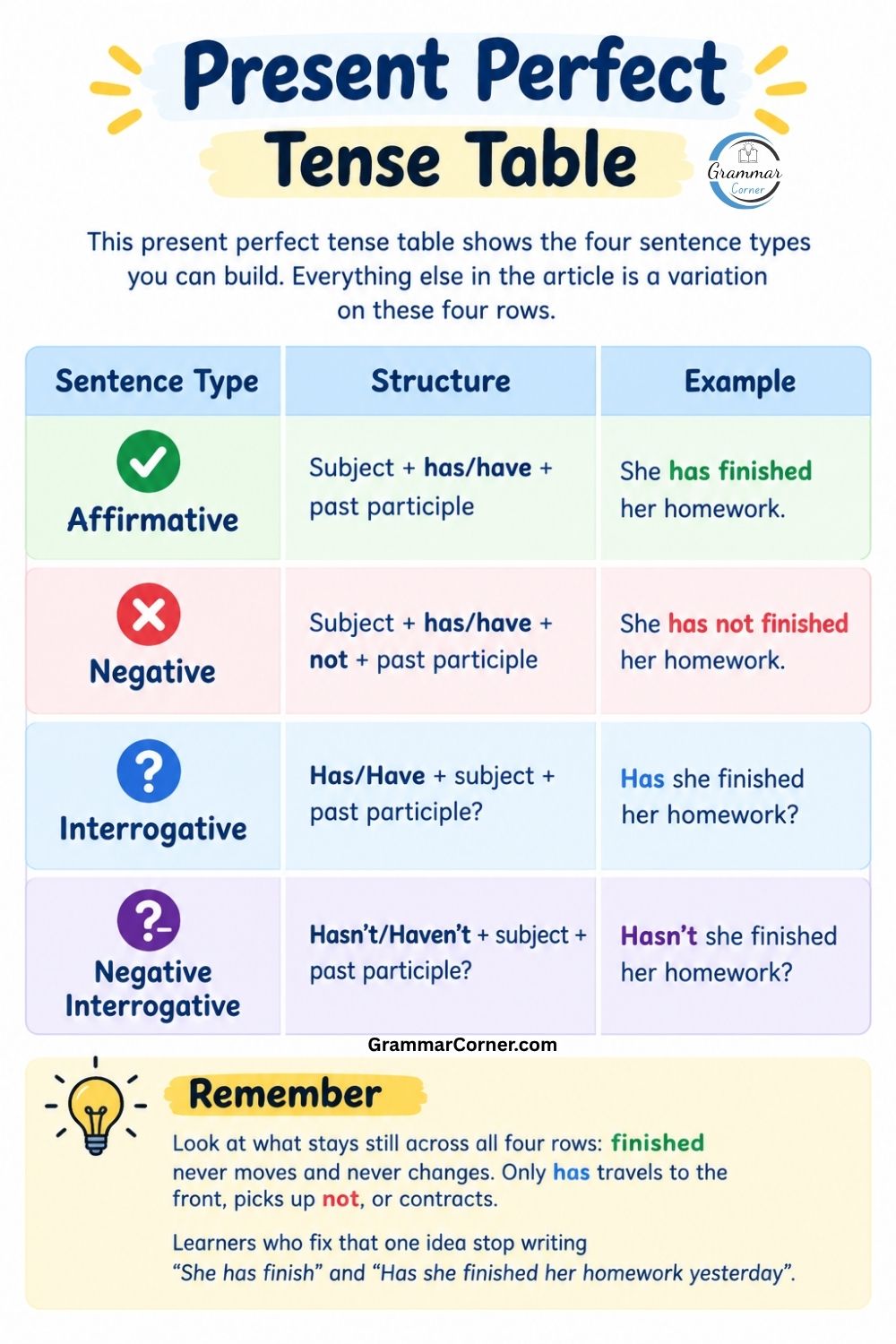
This present perfect tense table shows the four sentence types you can build. Everything else in the article is a variation on these four rows.
| Sentence Type | Structure | Example |
|---|---|---|
| Affirmative | Subject + has/have + past participle | She has finished her homework. |
| Negative | Subject + has/have + not + past participle | She has not finished her homework. |
| Interrogative | Has/Have + subject + past participle? | Has she finished her homework? |
| Negative Interrogative | Hasn’t/Haven’t + subject + past participle? | Hasn’t she finished her homework? |
Remember
Look at what stays still across all four rows: finished never moves and never changes. Only has travels to the front, picks up not, or contracts. Learners who fix that one idea stop writing “She has finish” and “Has she finished her homework yesterday”.
Present Perfect Rules: How to Form the Present Perfect Tense
Six present perfect rules cover the whole tense:
-
Use has with he, she, it, and all singular subjects. Use have with I, you, we, they, and all plural subjects.
-
Always use the third form of the verb, not the past simple.
Gone, not went.
-
Put not straight after has or have to make a negative.
-
Move has or have in front of the subject to make a question.
-
Never use a finished past time with this tense: no yesterday, last year, in 2015, two days ago.
-
Use since with a point in time and for with a length of time.
Choosing Between “Has” and “Have”
| Subject | Helping Verb | Example |
|---|---|---|
| I | have | I have eaten. |
| You | have | You have arrived. |
| We | have | We have completed the work. |
| They | have | They have left. |
| He | has | He has finished. |
| She | has | She has written. |
| It | has | It has stopped raining. |
Extra points that exam questions like to test:
- Singular nouns take has. The parcel has arrived.
- Plural nouns take have. The parcels have arrived.
- Two subjects joined by and take have. Ali and Sara have applied for the same job.
- Uncountable nouns take has. The water has boiled away.
- Words sitting between the subject and the verb change nothing. The list of names has been updated. The subject is list, not names.
- Everybody, somebody, nobody, each, and everyone take has. Everyone has signed the register.
Mini challenge: has or have?
Find the real subject first, then choose.
- The box of chocolates arrived.
- My uncle and my cousin opened a shop.
- Nobody answered the door.
- The milk gone sour.
- The students in my class finished the test.
Using the Correct Past Participle
| Base Verb | Past Simple | Past Participle |
|---|---|---|
| go | went | gone |
| eat | ate | eaten |
| write | wrote | written |
| see | saw | seen |
| work | worked | worked |
The past participle is the third form of a verb, the one you were told to memorise in columns at school. Regular verbs make it by adding -ed, so the second and third forms look identical: work, worked, worked. Irregular verbs follow no single rule and have to be learned.
The single most common error in this tense
Putting the past simple where the participle belongs:
- She has went home. She has gone home.
- I have wrote the letter. I have written the letter.
- They have took my seat. They have taken my seat.
- He has drank all the juice. He has drunk all the juice.
A quick self-test
If you can say I have ___ and it sounds like a complet
Mini challenge: second form or third?
After has or have, only the third form works.
- She has to Karachi twice.
- I have that film before.
- The glass has .
- We have to the manager already.
- He has here for six years.
Key takeaways
- Six rules run the whole tense: pick has/have, use the third form, not after the helping verb, helping verb first in questions, no finished past times, since for points and for for lengths.
- Find the real subject before choosing has or have — words in between change nothing.
- Regular verbs repeat the second form; irregular ones have to be memorised.
- If a second form ever appears after has or have, the sentence is wrong.
When to Use the Present Perfect Tense
Completed Actions with Present Results
The action is over, but its effect is visible now. This is the tense’s core job.
- I have lost my wallet. I cannot pay
- She has cut her hair. it is short now
- The lift has broken down. we must take the stairs
- He has passed his driving test. he can drive legally today
- They have painted the office. the walls look different
Life Experiences
Use it for things that have happened at some point in a person’s life, when the exact date does not matter and is not mentioned.
- I have travelled by helicopter.
- She has met the prime minister.
- We have tried Korean food.
- He has never broken a bone.
- Have you ever swum in the sea?
Add a date and the tense changes
If you add a date, the sentence must switch to the simple past: I travelled by helicopter in 2021.
Actions That Started in the Past and Continue Today
The action began earlier and is still true at this moment. This use almost always carries for or since.
- We have lived in this city for nine years.
- She has worked at the bank since 2018.
- I have known him since we were children.
- They have owned that shop for two generations.
- He has been ill all week.
Worth noticing
Stative verbs like know, own, and belong use the present perfect here, not the present perfect continuous.
Repeated Actions Up to the Present
The action has happened more than once between the past and now, and it may happen again.
- I have watched that film four times.
- She has applied for six jobs this month.
- The phone has rung three times since lunch.
- We have visited them twice this year.
- He has failed the test on two occasions.
Recent Actions
With just, recently, and lately, the present perfect reports something fresh.
- The train has just left.
- I have recently changed my number.
- She has just finished her shift.
- We have not heard from him lately.
News and Announcements
Headlines and first reports use the present perfect because the news is new. The details that follow usually switch to the simple past.
- Scientists have discovered a new species of frog.
- The company has launched its first electric car.
- Heavy rain has flooded three districts.
- The board has approved the budget.
Achievements and Accomplishments
- She has won two gold medals.
- Our school has produced three national champions.
- He has published forty research papers.
- The charity has built two hundred homes.
A natural partner
This use pairs naturally with superlatives: That is the finest speech I have ever heard.
Unfinished Time Periods
If the time frame is still running, the present perfect fits. If it has closed, use the simple past.
| Unfinished (present perfect) | Finished (simple past) |
|---|---|
| I have made six calls today. | I made six calls yesterday. |
| She has been late this week. | She was late last week. |
| We have earned well this year. | We earned well last year. |
| He has not eaten this morning. it is still morning | He did not eat this morning. it is now evening |
Read the clock, not the words
Look at the last row. The same three words — this morning — take different tenses depending on what time it is when you speak. The phrase does not decide; the clock does.
Mini challenge: which use is this?
Same tense every time. Only the job it’s doing changes.
- The board has approved the budget.
- I have watched that film four times.
- She has cut her hair.
- We have lived in this city for nine years.
Mini challenge: is the time frame still open?
Check the time word first. If that stretch has closed, the present perfect cannot be used.
- I three emails today.
- She late last week.
- We him in 2019.
- He two cups of tea this morning. (It is only eight o’clock.)
Key takeaways
- Eight jobs, one shape: results now, life experience, still continuing, repeated, recent, news, achievements, unfinished time.
- Name a date and the sentence must move to the simple past.
- For and since belong to use 3; just, recently, and lately to use 5.
- Whether a time word is open or closed decides the tense — sometimes only the clock can tell you.
Present Perfect Tense Chart
Keep this present perfect tense chart beside you while you write. Every sentence in the tense comes from one of these ten lines.
Signal Words Used with the Present Perfect
Signal words are clues. When one of these appears in a question, the present perfect is usually the answer.
| Signal Word | Example |
|---|---|
| already | She has already eaten. |
| yet | Have you finished yet? |
| just | I have just arrived. |
| ever | Have you ever visited Italy? |
| never | He has never seen snow. |
| recently | We have recently moved. |
| lately | She has been busy lately. |
| so far | We have completed five chapters so far. |
| until now | Nothing has changed until now. |
| since | I have lived here since 2020. |
| for | They have worked here for five years. |
Three more that behave the same way
- this week / this month / this year — when the period has not ended
- how long — in questions
- it is the first time — as a sentence opener
Present Perfect Sentence Patterns
Affirmative Sentences
- I have submitted the application.
- She has repaired the fan.
- The guests have arrived.
- We have finished the first draft.
- It has rained all morning.
Negative Sentences
- I have not received your message.
- He has not replied to my email.
- They have not paid the bill.
- The parcel has not arrived yet.
- We have not decided anything.
Short forms
Contractions are normal in speech and friendly writing: hasn’t, haven’t, and the split forms he’s not and they’ve not, which are common in British English. Both He hasn’t finished and He’s not finished are correct.
Interrogative Sentences
- Have you seen my glasses?
- Has she taken her medicine?
- Have they left already?
- Has the meeting started?
- Have we met before?
The helping verb jumps to the front. The participle stays exactly where it was.
WH Questions
- What have you done?
- Where has he gone?
- Why have they cancelled the trip?
- How long have you lived here?
- How many books have you read this year?
- Which course has she chosen?
When the question word is the subject
Nothing gets inverted and has is the default:
- Who has taken my charger?
- What has caused the delay?
- How many people have applied?
Short Answers
Repeat the helping verb only, never the main verb.
| Question | Positive Answer | Negative Answer |
|---|---|---|
| Have you finished? | Yes, I have. | No, I haven’t. |
| Has he called? | Yes, he has. | No, he hasn’t. |
| Have they arrived? | Yes, they have. | No, they haven’t. |
| Has it stopped raining? | Yes, it has. | No, it hasn’t. |
Never contract a positive short answer
✅ Yes, I have is correct; ❌ Yes, I’ve is not. Negative short answers are almost always contracted.
Tag Questions
A positive statement takes a negative tag, and a negative statement takes a positive tag.
- You have finished the report, haven’t you?
- She has already left, hasn’t she?
- They haven’t paid, have they?
- He hasn’t seen the notice, has he?
- We have met before, haven’t we?
Careful with have as a main verb
You have a car, don’t you? uses don’t, because there have means possess. In You have driven a car, haven’t you?, have is the helping verb, so the tag repeats it.
Watch the helping verb move
Tap a statement to turn it into a question. Only one word travels.
Pick a statement above to see its question form.
Mini challenge: finish the tag
Positive sentence, negative tag — and the other way round. Watch out for the last one.
- She has posted the letter, ?
- They haven’t answered, ?
- We have met before, ?
- You have two sisters, ?
Key takeaways
- Signal words point to the tense, but the meaning decides it.
- Negatives slot not between the helping verb and the participle; questions send the helping verb to the front.
- When the question word is the subject, nothing is inverted: Who has taken my charger?
- Short answers and tags repeat the helping verb — unless have is the main verb, which takes don’t.
Present Perfect with “For” and “Since”
Since points to a starting moment. For measures a length of time. Both answer how long?
One dot on the calendar — the moment it started.
The whole stretch — how much time it fills.
| For | Since |
|---|---|
| for two hours | since Monday |
| for a year | since 2019 |
| for five weeks | since childhood |
| for ten minutes | since this morning |
| for a long time | since we met |
| for three days | since last Friday |
| for ages | since I was ten |
Sentences in pairs, so you can see the swap:
- I have waited for forty minutes. I have waited since four o’clock.
- She has taught for twelve years. She has taught since 2013.
- We have not spoken for months. We have not spoken since the wedding.
Two rules worth memorising:
-
Since can be followed by a whole clause with a past-tense verb.
I have felt better since I changed my diet.
-
In informal speech, for is sometimes dropped: I have known her ten years.
This is acceptable in conversation but keep for in exams and formal writing.
The classic error, and the fix:
- I have lived here since five years. I have lived here for five years.
- He has worked here for 2020. He has worked here since 2020.
Mini challenge: for or since?
Ask one question: is this a length of time, or the moment it started?
- She has been ill three days.
- They have known each other university.
- I have not seen him last Eid.
- We have lived in Lahore ages.
- He has felt better he started walking daily.
Present Perfect with Already, Yet, Just, Ever, and Never
These five words do different jobs and sit in different places in the sentence.
Four of the five share one seat. Yet waits at the end of the sentence.
| Word | Meaning | Used in | Position | Example |
|---|---|---|---|---|
| already | sooner than expected | positive sentences, surprised questions | between has/have and the participle | She has already left. / Have you already finished? |
| yet | up to now, still waiting | negatives and questions | at the end of the sentence | I haven’t eaten yet. / Have they called yet? |
| just | a very short time ago | positive sentences | between has/have and the participle | The film has just started. |
| ever | at any time in your life | questions, and after superlatives | between has/have and the participle | Have you ever flown business class? |
| never | at no time in your life | positive sentences with negative meaning | between has/have and the participle | He has never eaten beef. |
Points that trip learners up:
Never is already negative
❌ I haven’t never been there.
✅ I have never been there.
Or use ever: I haven’t ever been there.
Ever is not used in plain statements
❌ I have ever been to Nepal.
✅ I have been to Nepal.
Yet goes at the end
❌ Have you yet finished?
✅ Have you finished yet?
Already at the end changes the tone
She has left already is natural in speech and adds surprise. In writing, keep it in the middle.
Already in a question expresses shock
Have you already spent the money?
Mini challenge: the right word in the right seat
Five quick decisions about meaning and position.
- I haven’t paid the bill .
- Have you ridden a camel?
- Which one is correct?
- Which one is correct?
- The bus left — we missed it by seconds.
Key takeaways
- Since marks the point it began; for measures the stretch. Both answer how long?
- A whole clause can follow since, and its verb goes into the past.
- Already, just, ever, and never share one seat between the helping verb and the participle.
- Yet lives at the end, and never is negative on its own.
Been vs Gone in the Present Perfect
Both are participles of movement verbs, and swapping them changes who is in the room.
She has been to Paris. back now
- = she went and has come back
- a completed visit, an experience
She has gone to Paris. away now
- = she is there now, or on the way
- an incomplete journey, an absence
More pairs:
- My parents have been to Makkah. back now they are home, they made the pilgrimage
- My parents have gone to Makkah. away now they are away right now
- I have been to the market. back now I am back, with the shopping
- He has gone to the doctor. away now do not expect him at his desk
Two extra notes:
You cannot use gone about yourself
Not in the present, if you are speaking. ❌ I have gone to the bank. If you are here talking, you came back, so it is ✅ I have been to the bank.
Been to vs been in
Been to means visited. Been in means stayed inside something for a period: She has been in hospital for a week.
Mini challenge: is the person here or away?
Read the situation, then choose the participle that fits.
- Sara isn’t at her desk. She has to the bank.
- Welcome back! Where have you ?
- I to Turkey twice, and I’d go again.
- Don’t ring the shop. The owner has to Multan for a wedding.
- She has in hospital for a week.
Regular vs Irregular Past Participles
Regular verbs add -ed and their second and third forms match. Irregular verbs do not follow the pattern and must be memorised, but they fall into helpful groups.
Find a verb fast
Fifty-two verbs below. Type any form — drank, drunk or drink — to jump straight to its row.
Showing all 52 verbs.
Regular verbs 8 verbs
| Base Verb | Past Simple | Past Participle |
|---|---|---|
| work | worked | worked |
| play | played | played |
| finish | finished | finished |
| watch | watched | watched |
| decide | decided | decided |
| study | studied | studied |
| stop | stopped | stopped |
| travel | travelled / traveled | travelled / traveled |
No match in this group.
Spelling reminders for the -ed form:
- Silent eAdd nothing but -d: decide → decided
- Consonant + yChange y to i: study → studied
- Short CVC verbsDouble the final consonant: stop → stopped
Irregular verbs, group 1: all three forms the same 8 verbs
| Base | Past Simple | Past Participle |
|---|---|---|
| cut | cut | cut |
| put | put | put |
| let | let | let |
| set | set | set |
| hit | hit | hit |
| cost | cost | cost |
| shut | shut | shut |
| read | read pronounced red | read pronounced red |
No match in this group.
Irregular verbs, group 2: past simple and participle the same 16 verbs
| Base | Past Simple | Past Participle |
|---|---|---|
| buy | bought | bought |
| bring | brought | brought |
| teach | taught | taught |
| catch | caught | caught |
| think | thought | thought |
| find | found | found |
| sell | sold | sold |
| tell | told | told |
| leave | left | left |
| sleep | slept | slept |
| meet | met | met |
| pay | paid | paid |
| build | built | built |
| hear | heard | heard |
| lose | lost | lost |
| sit | sat | sat |
No match in this group.
Irregular verbs, group 3: all three forms different 21 verbs
| Base | Past Simple | Past Participle |
|---|---|---|
| go | went | gone |
| eat | ate | eaten |
| write | wrote | written |
| see | saw | seen |
| take | took | taken |
| speak | spoke | spoken |
| give | gave | given |
| break | broke | broken |
| drink | drank | drunk |
| begin | began | begun |
| swim | swam | swum |
| drive | drove | driven |
| know | knew | known |
| grow | grew | grown |
| fly | flew | flown |
| choose | chose | chosen |
| forget | forgot | forgotten |
| ride | rode | ridden |
| wear | wore | worn |
| do | did | done |
| be | was / were | been |
No match in this group.
How to learn group 3
Group 3 causes almost every error in this tense, because learners reach for the middle column. Say the third form aloud with I have in front of it until it feel
Mini challenge: reach past the middle column
Every option here is a real form of the verb. Only one follows has or have.
- He has all the juice.
- The match has .
- She has across the lake twice.
- I have that shirt only once.
- They have a new captain.
Key takeaways
- Been means the person came back; gone means they are still away.
- You can never say I have gone about yourself while you are speaking.
- Regular verbs repeat the second form; irregular verbs split into three memorisation groups.
- Group 3 is where the errors live — the middle column is never the one you want after has or have.
Present Perfect Passive Voice
Use the passive when the action matters more than the person who performed it, or when the doer is unknown.
Formula: subject + has/have + been + past participle
| Active | Passive |
|---|---|
| They have completed the work. | The work has been completed. |
| Someone has stolen my bicycle. | My bicycle has been stolen. |
| The committee has approved the plan. | The plan has been approved. |
| Engineers have repaired the bridge. | The bridge has been repaired. |
| The company has sold all the tickets. | All the tickets have been sold. |
| Doctors have treated forty patients. | Forty patients have been treated. |
| They have not announced the results. | The results have not been announced. |
Three points to remember
Naming the doer
To name the doer, add by: The plan has been approved by the committee.
Flip it: active → passive
Read the active sentence, decide the passive twin in your head, then tap to check. Watch which word the helping verb has to agree with.
Contractions in the Present Perfect
| Full Form | Contraction |
|---|---|
| I have | I’ve |
| You have | You’ve |
| We have | We’ve |
| They have | They’ve |
| He has | He’s |
| She has | She’s |
| It has | It’s |
| has not | hasn’t |
| have not | haven’t |
The one that causes confusion: he’s can mean he is or he has. What follows tells you which.
- He’s working. → is, because working is an -ing form.
- He’s worked here for years. → has, because worked is a past participle.
- It’s raining. → is.
- It’s stopped raining. → has.
Teacher tip
Contractions of have are also used with not in two ways in British English: they haven’t finished and they’ve not finished. Both are standard.
Is it is or has?
Look at the word straight after the apostrophe-s. An -ing form means is. A past participle means has.
Correct so far: 0 of 5She’s taken the wrong bus.
He’s waiting outside.
It’s been a long day.
She’s a doctor.
He’s gone to Karachi.
Present Perfect vs Other English Tenses
Present Perfect vs Present Perfect Continuous
| Point | Present Perfect | Present Perfect Continuous |
|---|---|---|
| Form | has/have + participle | has/have + been + verb-ing |
| Focus | the result, the completed amount | the activity itself and its duration |
| Question it answers | how many? how much? | how long? what have you been doing? |
| Example | I have written three emails. | I have been writing emails all morning. |
| Example | She has read the report. | She has been reading the report since nine. |
| Example | They have painted the room. | They have been painting the room. (maybe unfinished) |
| Stative verbs | used: I have known him for years. | not used: ❌ I have been knowing him. |
The test: choose the continuous when the effort or the stretch of time is the point, and the simple present perfect when the outcome is the point. He has been running explains why he is out of breath. He has run five kilometres tells you the achievement.
Present Perfect vs Simple Present
| Point | Present Perfect | Simple Present |
|---|---|---|
| Meaning | started in the past, still true | a habit, routine, or general fact |
| Duration | takes for and since | does not take for and since for duration |
| Example | I have lived here for six years. | I live here. |
| Example | She has worked at the clinic since May. | She works at the clinic. |
| Example | We have known them a long time. | We know them. |
This is the error that carries over from many other languages, where the present tense is used for duration:
Present Perfect vs Past Perfect
| Point | Present Perfect | Past Perfect |
|---|---|---|
| Form | has/have + participle | had + participle |
| Reference point | now | a moment in the past |
| Example | The train has left. (I am on the platform now) | The train had left. (when I reached the platform) |
| Example | She has finished her degree. | She had finished her degree before she married. |
| Typical partner | just, already, yet, since, for | before, after, by the time, when |
The train has left. I am standing on the platform as I speak.
The train had left. The sentence stops at the moment I reached the platform.
The test: one reference point, one tense. If your sentence is anchored to the present, use the present perfect. If it is anchored to an earlier past event, step back to the past perfect.
Capstone: one question from every section above
Five questions covering the passive, contractions, and all three comparisons.
Correct so far: 0 of 51. Choose the correct passive: Someone has taken my umbrella.
2. In She’s finished the report, the apostrophe-s stands for…
3. Your friend is out of breath. Which sentence explains why?
4. Which sentence is correct?
5. By the time we reached the hall, the speech ______.
Key takeaways from this section
- Passive present perfect is always three parts: has/have + been + participle. Drop been and the meaning flips.
- Only verbs with an object can go passive, and the helping verb agrees with the new subject, not the old one.
- He’s means is before an -ing form and has before a participle.
- Continuous for the activity, simple present perfect for the result.
- Duration up to now needs has/have, never the simple present.
- One reference point, one tense: now takes the present perfect, an earlier past takes the past perfect.
American English vs British English Usage
Both varieties use the present perfect, but American English allows the simple past in several places where British English requires the perfect. Neither is wrong; the difference is preference, and exam boards such as Cambridge and IELTS follow the British pattern.
| Situation | British English | American English |
|---|---|---|
| With yet | Have you eaten yet? | Did you eat yet? (also “Have you eaten yet?”) |
| With just | I have just seen him. | I just saw him. |
| With already | She has already left. | She already left. |
| Participle of get | He has got better. | He has gotten better. |
| Possession | I have got two brothers. | I have two brothers. |
A Few Extra Observations
- Gotten survives only in American English, and only for the meaning obtained or became. Even Americans say I’ve got a headache for possession, not gotten.
- In American writing, the present perfect is still normal with since, for, ever, and never. The relaxation applies mainly to just, already, and yet.
- For a global audience, the present perfect is the safer choice in all these sentences, because British readers find Did you eat yet? odd while American readers accept Have you eaten yet? without blinking.
Time Expressions Commonly Used with the Present Perfect
| Time Expression | Points To | Example |
|---|---|---|
| since 2019 / since Monday | a starting point | I have taught here since 2019. |
| for six months | a length of time | He has been away for six months. |
| so far | progress up to now | We have sold ninety tickets so far. |
| up to now / until now | the same | Up to now, nobody has complained. |
| today / this morning | an unfinished period | She has not called today. |
| this week / this month / this year | an unfinished period | I have read four books this month. |
| recently / lately | the near past | Have you seen him recently? |
| in the last few days | a period reaching now | Prices have risen in the last few days. |
| over the past decade | a period reaching now | The city has doubled in size over the past decade. |
| ever since | continuously from a point | He has avoided me ever since. |
| never before | emphasis on experience | Never before has the team played so well. |
| how long | duration questions | How long have you waited? |
| the first / second time | a repeated experience | This is the first time I have flown. |
| always | a whole life up to now | I have always wanted to learn Arabic. |
Time Expressions That Block the Present Perfect
yesterday, last night, last week, last year, in 2015, two hours ago, when I was young, at 6 o’clock. A specific past time word always signals the simple past, not the present perfect.
100+ Present Perfect Examples
The present perfect examples below are grouped by everyday topic so you can borrow whole sentences for speaking practice, homework, or writing.
Showing 105 of 105 sentences.
Daily Life
- I have finished my breakfast.
- She has already washed the dishes.
- We have not been to the new bakery yet.
- The milkman has just arrived.
- He has forgotten his umbrella again.
- They have painted their gate green.
- I have cleaned the whole house today.
- My neighbour has bought a second car.
- The shop has closed early.
- Have you paid the electricity bill?
- It has rained every day this week.
- She has lost her house keys.
- We have lived on this street for eleven years.
- The cat has knocked over the plant.
- I have never learned to cook properly.
No sentences of that shape in this group.
School
- I have completed my assignment.
- She has topped the class three times.
- The students have not returned their library books.
- Our teacher has explained this chapter twice.
- He has failed only one paper so far.
- Have you revised for the maths test?
- The results have been announced.
- I have learned two hundred new words this term.
- They have chosen science as their stream.
- The principal has approved the trip.
- We have never missed a single class.
- She has just handed in her project.
- The exam schedule has changed again.
- How many chapters have you covered?
- He has improved a lot since January.
No sentences of that shape in this group.
Office
- I have sent you the report.
- The manager has approved my leave.
- We have not received the payment yet.
- She has worked here since 2017.
- They have hired three new engineers.
- Has the client replied?
- The meeting has been postponed.
- I have attended four interviews this month.
- He has just stepped out for lunch.
- Our team has finished ahead of schedule.
- The files have been backed up.
- She has never taken a sick day.
- Sales have risen by twelve per cent.
- I have already updated the spreadsheet.
- They have not decided on the budget.
No sentences of that shape in this group.
Travel
- I have been to Turkey twice.back now
- She has gone to Islamabad for a wedding.away now
- We have booked our tickets.
- Have you ever travelled by ship?
- The flight has been delayed.
- He has lost his boarding pass.
- They have visited six countries so far.
- My passport has expired.
- The bus has just left the terminal.
- I have never driven on a motorway.
- Our luggage has not arrived.
- She has stayed in that hotel before.
- The road has been closed for repairs.
- We have walked ten kilometres today.
- Have they reached the airport yet?
No sentences of that shape in this group.
Sentences 46 and 47 sit side by side on purpose
Both describe a journey, but they put the traveller in different places. I have been to Turkey means the trip is over and the speaker is home. She has gone to Islamabad means she is still there. Read the two aloud one after the other and the difference stops being a grammar point and becomes a fact about who is in the room.
Health
- I have had a headache since morning.
- He has recovered from his surgery.
- She has not eaten anything all day.
- The doctor has prescribed new medicine.
- My father has given up smoking.
- Have you taken your tablets?
- I have joined a gym.
- He has lost eight kilos this year.
- The pain has gone.
- She has been ill for a fortnight.
- We have not seen a specialist yet.
- His fever has come down.
- I have never broken a bone.
- The hospital has treated hundreds of patients today.
- She has just come out of the clinic.
No sentences of that shape in this group.
Family
- My sister has moved to another city.
- We have known each other since childhood.
- My parents have been married for thirty years.
- He has become a father.
- They have not visited us since Eid.
- My cousin has finished her degree.
- Grandmother has told that story a hundred times.
- Have your relatives arrived?
- The children have grown so fast.
- I have always admired my uncle.
- She has invited the whole family.
- My brother has just got engaged.
- We have never celebrated so grandly.
- Their son has started walking.
- Has anyone called mother today?
No sentences of that shape in this group.
Technology
- My phone has stopped charging.
- She has downloaded the wrong app.
- We have upgraded the office computers.
- The website has crashed twice this week.
- I have not backed up my photos.
- He has deleted the whole folder.
- The update has been installed.
- Have you changed your password?
- Technology has changed the way we work.
- My laptop battery has died.
- They have launched a new version.
- I have never used that software.
- The company has blocked social media on office wifi.
- She has just posted the video.
- Hackers have targeted three banks so far this year.
No sentences of that shape in this group.
Why the never sentences count as positive
Seven of the sentences above use never: numbers 15, 26, 42, 55, 73, 88 and 102. Look at the shape and you will see no not anywhere. Never already carries the negative meaning by itself, which is why I haven’t never been is wrong and I have never been is right. Grammatically these are positive sentences; only the meaning is negative.
Spot the six passives
Numbers 22, 37, 41, 50, 58 and 97 all follow has/have + been + participle. In every one, the doer has disappeared: nobody is told who announced the results, postponed the meeting, or delayed the flight. That is usually the reason a writer chooses the passive in the first place.
One thing to watch: been is green here because it links the passive together. In numbers 3, 46, 70 and 78 the same word is amber, because there it is the main verb, the participle of be.
Drill 1: add a finished past time
Each sentence below is taken from the lists above. Add the finished past time in bold and the tense has to change. Pick the version that works.
Correct so far: 0 of 51. I have cleaned the whole house today. → now say it about yesterday.
2. She has worked here since 2017. → now say she left in 2019.
3. The flight has been delayed. → now add last night.
4. Have you paid the electricity bill? → now ask about last month.
5. He has just stepped out for lunch. → now say it happened at one o’clock.
Drill 2: never or not?
Three quick checks on the seven never sentences you saw above.
Correct so far: 0 of 31. Which sentence is correct?
2. I have never met him can also be written as…
3. Where does never go in She has taken a sick day?
What the 105 sentences show
- Every single one contains has or have plus a past participle. Nothing else changes.
- Not one of them names a finished past time. That absence is what makes them present perfect.
- Ten are questions, and in each one the helping verb simply moved to the front.
- Six are passive, and all six keep been in the middle.
- Seven use never with no not anywhere, because never is negative on its own.
- The purple words are the ones that gave the tense away: already, just, yet, ever, never, so far, since, for, today, this week.
Common Mistakes with the Present Perfect
❌ I have seen him yesterday. ✅ I saw him yesterday.
Yesterday is a finished past time, so the sentence must use the simple past.
❌ She has went home. ✅ She has gone home.
Went is the past simple. The present perfect needs the third form, gone.
❌ I have lived here since five years. ✅ I have lived here for five years.
Since takes a starting point; for takes a length of time.
❌ He have finished the work. ✅ He has finished the work.
Singular subjects take has.
❌ Have you ate lunch? ✅ Have you eaten lunch?
Questions still need the participle, not the past simple.
❌ I haven’t never met her. ✅ I have never met her.
Never is already negative, so a second negative is wrong.
❌ The work has completed. ✅ The work has been completed.
Passive sentences need been between the helping verb and the participle.
❌ I live in Lahore since 2020. ✅ I have lived in Lahore since 2020.
Duration up to now needs the present perfect, not the simple present.
❌ Yes, I’ve. ✅ Yes, I have.
Positive short answers are never contracted.
❌ She has gone to the market and she is back now. ✅ She has been to the market.
Gone means still away; been means went and returned.
| Common Error | Correction | Reason |
|---|---|---|
| I have seen him yesterday. | I saw him yesterday. | finished past time |
| She has went home. | She has gone home. | wrong verb form |
| I have lived here since five years. | I have lived here for five years. | for vs since |
| He have finished. | He has finished. | subject–verb agreement |
| Have you ate lunch? | Have you eaten lunch? | participle needed in questions |
| I haven’t never met her. | I have never met her. | double negative |
| The work has completed. | The work has been completed. | missing been in passive |
| I live here since 2020. | I have lived here since 2020. | wrong tense for duration |
| Yes, I’ve. | Yes, I have. | no contraction in positive short answers |
| I have gone to the bank. (speaking from home) | I have been to the bank. | been vs gone |
| Have you yet finished? | Have you finished yet? | yet goes at the end |
| I have ever been to Nepal. | I have been to Nepal. | ever is for questions |
Present Perfect Exercises
Fill in the Blanks
Write the correct present perfect form of the verb in brackets.
- She __________ (not / call) me since Tuesday.
- __________ you ever __________ (ride) a horse?
- We __________ (live) in this house for twelve years.
- He __________ (just / leave) the office.
- They __________ (not / finish) the report yet.
- The train __________ (already / arrive).
- I __________ (know) her since childhood.
- My phone __________ (break) twice this year.
- __________ the doctor __________ (see) the patient yet?
- Prices __________ (rise) sharply since January.
Choose the Correct Answer
-
1. I ______ my keys. I can’t open the door.
- a lost
- b have lost
- c have lose
-
2. She has worked here ______ 2018.
- a for
- b since
- c from
-
3. Have you finished your lunch ______?
- a already
- b yet
- c since
-
4. He has ______ to Japan and will return next month.
- a been
- b gone
- c went
-
5. Which sentence is correct?
- a I have met him last week.
- b I met him last week.
- c I have meet him last week.
-
6. The bridge ______ repaired.
- a has been
- b has being
- c have been
-
7. I have ______ eaten octopus.
- a ever
- b never
- c yet
-
8. Answer this: Have they arrived?
- a Yes, they’ve.
- b Yes, they have.
- c Yes, they are.
Correct the Mistakes
- I have saw that film twice.
- She has went to the bank.
- We have studied here since five years.
- He has finished the work yesterday.
- Have you ate breakfast?
- I haven’t never been to Turkey.
- She have completed the form.
- All the tickets have sold.
Rewrite the Sentences
- He has repaired the bike. (Make it negative.)
- They have signed the contract. (Make it a yes/no question.)
- The team has won the trophy. (Change to passive voice.)
- I started working here in 2019. (Rewrite using the present perfect with since.)
- She has finished her lunch. (Add a question tag.)
- Have you cleaned the room? (Give a negative short answer.)
Sentence Completion
Finish each sentence in your own words, keeping the present perfect.
- I have never __________.
- My family has lived __________.
- She has just __________.
- We haven’t __________ yet.
- Have you ever __________?
- This is the best film I have ever __________.
Conversation Practice
Read this dialogue aloud with a partner, then build your own using the same shape.
You look tired. What have you been up to?
I have just finished my exams. I have written six papers this week.
Have you got your results yet?
No, I haven’t. They haven’t announced anything so far.
Have you thought about a holiday?
Yes. My brother has invited me to Skardu. I have never been there.
Lucky you. I have always wanted to see the north.
Rule for Your Own Version
Every reply must contain at least one has or have plus a past participle.
Show Answer Key
Fill in the Blanks
1. has not called 2. Have … ridden 3. have lived 4. has just left 5. have not finished 6. has already arrived 7. have known 8. has broken 9. Has … seen 10. have risen
Choose the Correct Answer
1. b 2. b 3. b 4. b 5. b 6. a 7. b 8. b
Correct the Mistakes
- I have seen that film twice.
- She has gone to the bank.
- We have studied here for five years.
- He finished the work yesterday.
- Have you eaten breakfast?
- I have never been to Turkey. (or: I haven’t ever been to Turkey.)
- She has completed the form.
- All the tickets have been sold.
Rewrite the Sentences
- He has not repaired the bike.
- Have they signed the contract?
- The trophy has been won by the team.
- I have worked here since 2019.
- She has finished her lunch, hasn’t she?
- No, I haven’t.
Sentence Completion and Conversation Practice
Answers will vary. Check that every sentence contains has or have plus a correct past participle, and that no finished past time word has slipped in.
Frequently Asked Questions
What is the present perfect tense?
The present perfect tense describes a past action that still matters now. It is made with has or have plus a past participle, as in “They have finished the project.” It covers finished actions with present results, life experiences, and situations that began earlier and continue today.
How do you form the present perfect tense?
Use the formula subject + has/have + past participle. Take has for he, she, it, and singular nouns, and have for I, you, we, they, and plural nouns. Add not after the helping verb for negatives, and move the helping verb in front of the subject for questions.
What is the difference between the present perfect and the simple past?
The simple past describes an action at a finished time, usually stated: “I met him last week.” The present perfect describes an action linked to now, with no finished time mentioned: “I have met him.” If the sentence contains yesterday, last month, or in 2010, use the simple past.
When should I use “has” and “have”?
Use has with third-person singular subjects: he, she, it, a person’s name, or any singular noun. Use have with I, you, we, they, and every plural noun. Words placed between the subject and the verb do not change the choice, so it is “the box of tools has arrived.”
Can I use the present perfect with “yesterday”?
No. Yesterday is a closed past time and the present perfect refuses closed past times. Write “I saw the doctor yesterday,” not “I have seen the doctor yesterday.” The same rule blocks last week, in 2019, an hour ago, and when I was a child.
What is the difference between “been” and “gone”?
Been means the person went and has already returned: “She has been to Paris,” and she is home now. Gone means the person is still away: “She has gone to Paris,” so do not expect her at the office. If you are speaking about yourself in the present, always use been.
How do I use “for” and “since” correctly?
Use for with a length of time: for three hours, for a year, for ages. Use since with the moment the action started: since Monday, since 2019, since we met. The frequent error is “since five years,” which mixes the two. Both words answer the question how long?
When should I use “already”, “yet”, and “just”?
Use already in positive sentences for something that happened sooner than expected: “She has already left.” Use yet at the end of negatives and questions for something still awaited: “Have they replied yet?” Use just for something that finished moments ago: “The bus has just gone.”
Can the present perfect describe future events?
Not on its own, but it appears in time clauses that point to the future. After when, after, as soon as, once, and until, English uses the present perfect instead of a future form: “I will call you once I have finished.” The main clause carries the future meaning.
Can the present perfect be used in passive voice?
Yes. The passive formula is has/have + been + past participle: “The results have been announced.” Only verbs that take an object can be made passive, and been can never be dropped. “The work has completed” is wrong; “the work has been completed” is right.
What are the most common mistakes learners make?
Five errors cover most of them: using a past simple form instead of the participle (“has went”), adding a finished past time (“have seen him yesterday”), swapping for and since, dropping been from the passive, and using the simple present for duration (“I live here since 2020”). Each one is fixable with a single-word change.
All 12 tenses, in one place
English builds every tense from the same two ingredients — when (present, past, future) and aspect (simple, continuous, perfect, perfect continuous). Each tense below links to its chart and a set of practice conversation questions.
| Present Tense | Past Tense | Future Tense |
|---|---|---|