Present Perfect Conversation Questions with Answers
When Do We Use the Present Perfect in Conversations?
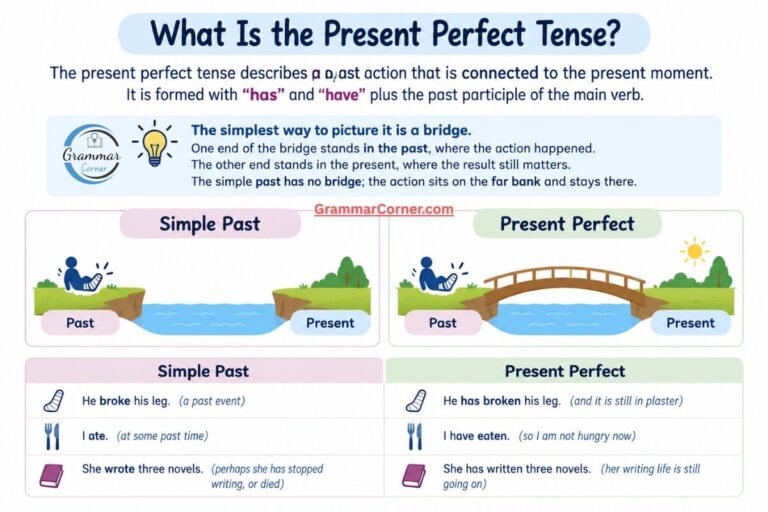
The present perfect tense is common in everyday English conversations because it connects the past with the present. We use it when the exact time of an action is unknown, unimportant, or still connected to the present moment. Whether you’re talking about experiences, recent activities, or achievements, the present perfect helps make your conversations sound more natural.
You cannot say when it happened, and it does not matter.
Someone has taken my pen.
You know when, but the date adds nothing to the point.
I have read that book.
The action is over but its effect is sitting in the room with you.
She has broken her glasses.
Why this makes speech sound natural
Learners who avoid the present perfect end up saying I saw that film when they mean I have seen that film. Both are English, but the second one answers the question that was actually asked: have you seen it, at any point, ever? Reaching for the present perfect in these moments is one of the fastest ways to stop sounding like a textbook.
Present Perfect Question Structure
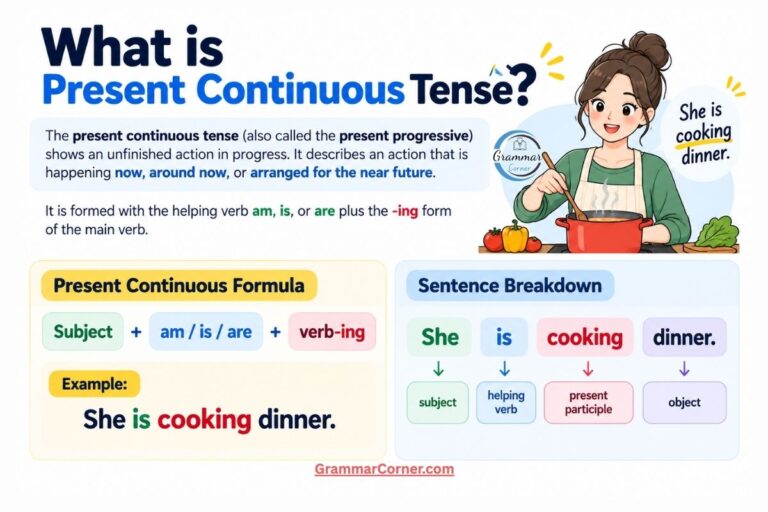
The present perfect has two common question forms: yes/no questions and wh-questions. Both use have or has followed by the past participle of the main verb.
| Question Type | Structure | Example |
|---|---|---|
| Yes/No Question | Have/Has + subject + past participle? | Have you eaten breakfast? |
| Wh-Question | Wh-word + have/has + subject + past participle? | What have you learned today? |
Common Question Formulas
These six formulas cover almost every present perfect question you will need in conversation.
| Question Type | Formula | Example |
|---|---|---|
| Yes/No Question | Have/Has + subject + past participle? | Have they finished the report? |
| What Question | What + have/has + subject + past participle? | What have you bought today? |
| Where Question | Where + have/has + subject + past participle? | Where has he traveled recently? |
| When Question* | When + have/has + subject + past participle?* | When have you felt most confident?* |
| Why Question | Why + have/has + subject + past participle? | Why have you decided to study English? |
| How Long Question | How long + have/has + subject + past participle? | How long have you lived here? |
* About the When row
Your table marks this row with an asterisk, and it deserves one. When asks for a specific point in time, and a specific past time is precisely what the present perfect refuses to hold. For ordinary questions about when something happened, English uses the simple past:
So why does When have you felt most confident? work? Because it is not really asking for a date. It means in which situations, across your whole life, have you felt most confident? That is a life-experience question wearing a when costume, and it is common in interviews and coaching. Treat it as the exception, not the pattern — and teach beginners When did you…? first.
How long is the one wh-word that belongs to this tense
Where when fights the present perfect, how long was made for it. The question asks about a stretch of time reaching the present, so the answer almost always comes back with for or since.
- How long have you lived here? — I have lived here for six years.
- How long has she worked at the bank? — She has worked there since May.
- How long have they known each other? — They have known each other since school.
Build the question: tap a question word
Watch what changes and what stays still. The helping verb and the participle never move.
Have you lived here?
A plain yes/no question. The helping verb opens the sentence, and the answer will be Yes, I have or No, I haven’t.
Drill: build it correctly
Five questions on word order and on choosing the right helping verb.
Correct so far: 0 of 51. Which order is right?
2. Complete: Where ______ he travelled recently?
3. You want to know the time your friend reached home. Ask:
4. Complete: How long ______ they known each other?
5. Which is a correct yes/no question?
Key takeaways from this section
- Use the present perfect in conversation when the time is unknown, unimportant, or still attached to now.
- A yes/no question is have/has + subject + participle.
- A wh-question is the same thing with a question word in front. Nothing else changes.
- How long is the natural partner of this tense, and its answers take for or since.
- When is the awkward one: for a specific past time, ask When did you…? instead.
Present Perfect Conversation Questions with Answers
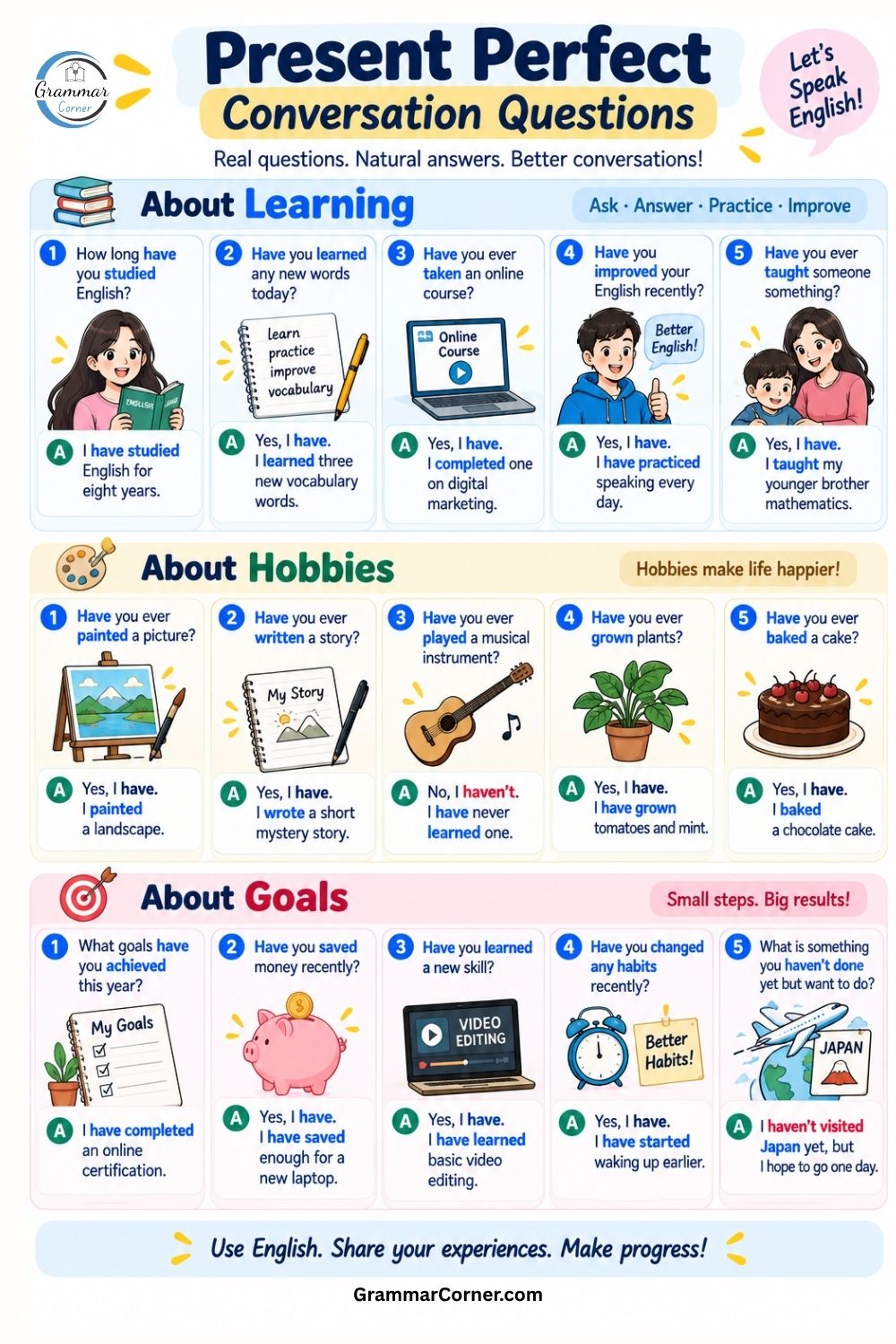
These present perfect conversation questions help learners practice talking about life experiences, recent events, achievements, and unfinished situations. Each question includes a sample answer. Students should also create their own answers for speaking practice.
Read the answers closely — they teach a second lesson
Every question below is in the present perfect, but only about half of the sample answers stay there. The rest slide into the simple past. That is not an error. It is how English conversation actually works: the present perfect opens a topic, and the simple past fills in the details once a finished time is named.
Have you ever travelled by plane? — Yes, I have.
I flew to Karachi last year.
Turn on Explain the tense switch in the bar below and every answer that drops into the simple past will tell you which word made it drop.
Easy Present Perfect Conversation Questions
Have you ever visited another city?
Yes, I have. I have visited Lahore twice.
Have you ever eaten sushi?
No, I haven’t. I have never tried sushi.
Have you finished your homework today?
Yes, I have. I finished it this morning.
Once the morning is over it is a closed slice of time, so the detail takes the simple past.
Have you ever ridden a horse?
Yes, I have. I rode one during a family trip.
During a family trip points at one finished occasion, which pulls the verb into the simple past.
Have you ever seen snow?
No, I haven’t. I have never seen snow in real life.
Have you read any books this month?
Yes, I have. I have read two novels.
Have you ever traveled by plane?
Yes, I have. I flew to Karachi last year.
Last year is finished, so have flown would be wrong here.
Have you ever lost your phone?
No, I haven’t. I have always kept it safe.
Have you met a famous person?
No, I haven’t. I haven’t met anyone famous.
Have you ever cooked dinner for your family?
Yes, I have. I cooked pasta last weekend.
Last weekend closes the time frame and the verb steps back to the simple past.
Present Perfect Conversation Questions About Life Experiences
What is the most interesting place you have visited?
I have visited Hunza Valley, and it was beautiful.
Have you ever won a competition?
Yes, I have. I won a school spelling competition.
Naming the particular competition turns it into a single past event.
Have you ever tried a new hobby?
Yes, I have. I have started painting recently.
Have you ever stayed awake all night?
Yes, I have. I stayed awake before an exam.
One specific night, one finished event, one simple past verb.
Have you ever forgotten someone’s birthday?
Yes, I have. I forgot my cousin’s birthday once.
Once here means on one occasion in the past, not at any time up to now.
Have you ever helped a stranger?
Yes, I have. I helped an elderly man cross the road.
The speaker has a particular afternoon in mind, so the detail is a past event.
Have you ever learned another language?
Yes, I have. I have learned some basic Arabic.
Have you ever broken a bone?
No, I haven’t. I have never broken a bone.
Have you ever been on television?
No, I haven’t. I have never appeared on TV.
Have you ever forgotten your homework?
Yes, I have. I forgot it once in middle school.
In middle school is a period that has ended, so the simple past is the only choice.
Present Perfect Conversation Questions About Recent Activities
What have you done today?
I have finished my work and talked to my friends.
Have you eaten lunch yet?
Yes, I have. I ate lunch an hour ago.
Ago always fixes a finished point in the past, so it blocks the present perfect.
Have you checked your emails today?
Yes, I have. I checked them this morning.
The question keeps the day open; the answer narrows it to a morning that has passed.
Have you exercised this week?
Yes, I have. I have gone for three walks.
Have you spoken to your best friend recently?
Yes, I have. We talked yesterday.
Yesterday is the clearest blocker of them all.
Have you watched any good movies lately?
Yes, I have. I watched a comedy last weekend.
Lately keeps the question open, but last weekend closes the answer.
Have you cleaned your room yet?
No, I haven’t. I will clean it this evening.
Here the answer looks forward instead of back. Yet in the question means the job is still waiting, so a future plan is a natural reply.
Have you learned anything new this week?
Yes, I have. I have learned how to edit videos.
Have you visited your grandparents recently?
Yes, I have. I visited them last Sunday.
Same verb, two tenses, one sentence apart — the time word decides which.
Have you started any new projects?
Yes, I have. I have started learning graphic design.
Present Perfect Conversation Questions About Travel
Which countries have you visited?
I have visited Turkey and the UAE.
Have you ever missed a flight?
No, I haven’t. I have always arrived on time.
Have you ever traveled alone?
Yes, I have. I traveled alone during college.
College is over, so the detail sits in a finished period.
Have you ever stayed in a hotel?
Yes, I have. I stayed in a beach hotel last summer.
Last summer closes the frame, exactly like last year and last weekend.
Have you ever gone camping?
No, I haven’t. I would like to try it someday.
A second answer that faces forward. After a no, adding a wish keeps the conversation alive.
Present Perfect Conversation Questions About Learning
How long have you studied English?
I have studied English for eight years.
Have you learned any new words today?
Yes, I have. I learned three new vocabulary words.
The speaker is thinking of the moment in the lesson when it happened, so the simple past fits.
Have you ever taken an online course?
Yes, I have. I completed one on digital marketing.
One named, finished course — a past event rather than a life record.
Have you improved your English recently?
Yes, I have. I have practiced speaking every day.
Have you ever taught someone something?
Yes, I have. I taught my younger brother mathematics.
A particular person and a particular subject make it one finished episode.
Present Perfect Conversation Questions About Hobbies
Have you ever painted a picture?
Yes, I have. I painted a landscape.
The speaker has one painting in mind, so the second sentence reports it as a past act.
Have you ever written a story?
Yes, I have. I wrote a short mystery story.
Notice the pair: written in the question, wrote in the answer. Same verb, different job.
Have you ever played a musical instrument?
No, I haven’t. I have never learned one.
Have you ever grown plants?
Yes, I have. I have grown tomatoes and mint.
Have you ever baked a cake?
Yes, I have. I baked a chocolate cake.
One specific cake, so the detail is a finished act.
Present Perfect Conversation Questions About Goals
What goals have you achieved this year?
I have completed an online certification.
Have you saved money recently?
Yes, I have. I have saved enough for a new laptop.
Have you learned a new skill?
Yes, I have. I have learned basic video editing.
Have you changed any habits recently?
Yes, I have. I have started waking up earlier.
What is something you haven’t done yet but want to do?
I haven’t visited Japan yet, but I hope to go one day.
Every short answer follows the same two rules
- The positive is written in full: Yes, I have. Never Yes, I’ve. A contraction cannot end a sentence like that.
- The negative is contracted: No, I haven’t. You can say No, I have not, but it sounds heavy in conversation.
- The main verb never appears in the short answer. It is Yes, I have, not Yes, I have visited.
For teachers: how to run these in class
- Switch on Practice mode above to hide all fifty answers, then use the questions as speaking prompts.
- Ask for the short answer first, then push for one extra sentence. That second sentence is where the tense choice gets made, and where the real learning is.
- Set a rule for pair work: if the answer names a day, a year, or an occasion, the verb must be simple past. Students catch this faster by hearing it break than by reading the rule.
Drill: which reply works?
Five conversation openers. Pick the answer a native speaker would give.
Correct so far: 0 of 51. Have you ever been to Japan?
2. Have you eaten lunch yet? — you have not eaten.
3. How long have you studied English?
4. Have you ever won a competition? — you won a debate in Class 9.
5. What is something you haven’t done yet?
Key takeaways from this section
- All fifty questions use the same shape: have/has + subject + participle.
- Twenty-six answers stay in the present perfect because they name no finished time.
- Twenty-two switch to the simple past the moment a day, year, or occasion appears.
- Two answers face forward instead, using will and would like to after a no.
- Short answers never contract on the positive side and never repeat the main verb.
All 12 tenses, in one place
English builds every tense from the same two ingredients — when (present, past, future) and aspect (simple, continuous, perfect, perfect continuous). Each tense below links to its chart and a set of practice conversation questions.
| Present Tense | Past Tense | Future Tense |
|---|---|---|