Adjective Clauses (Types, Structure and Examples)
What Is an Adjective Clause?
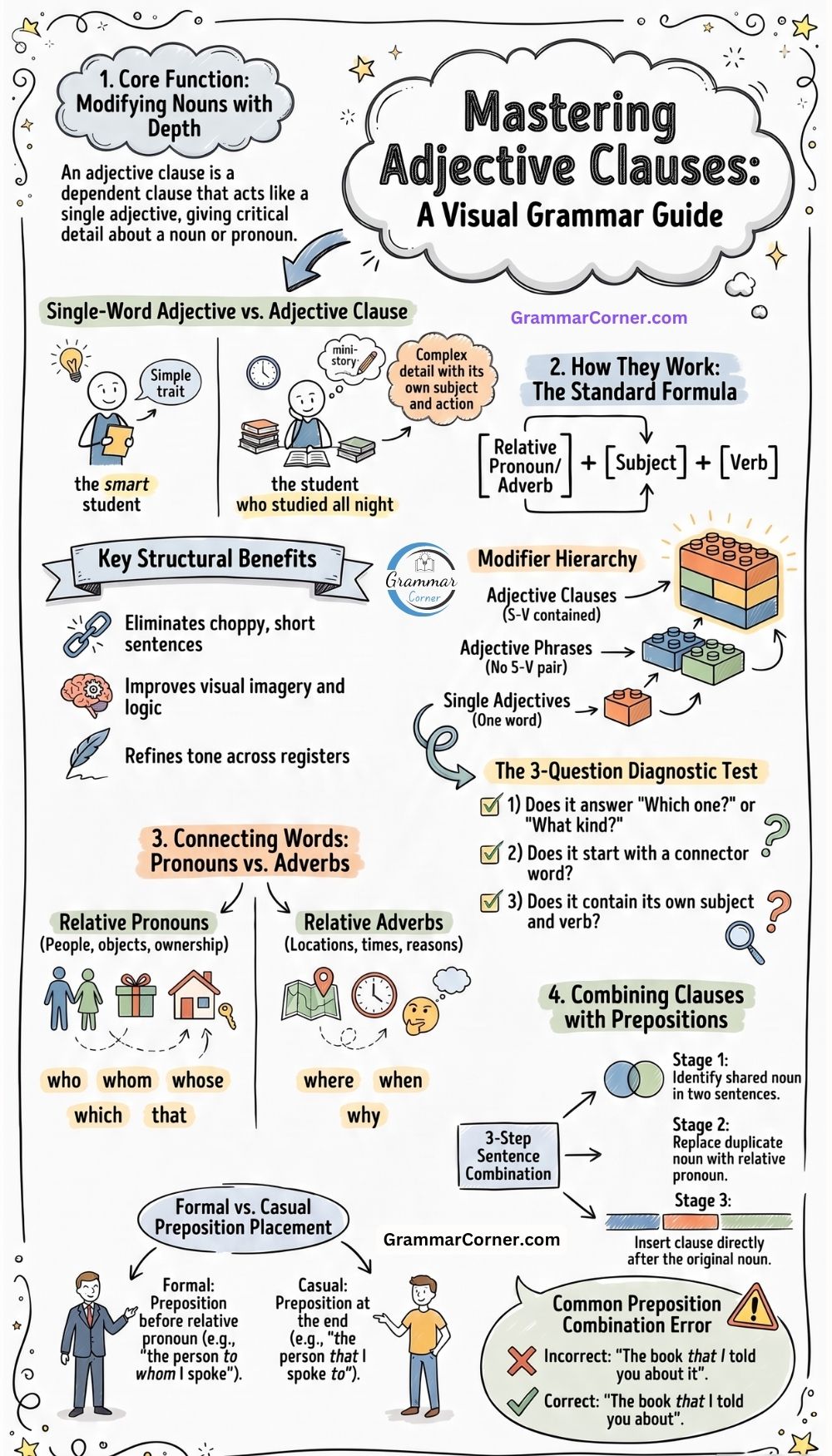
An adjective does not always have to be a single word. An adjective clause is a dependent clause that functions just like an adjective by modifying, describing, or identifying a noun or pronoun.
Adjective clauses are essential when a single descriptive word is not enough to capture the full detail you have in mind. They allow writers to:
Comparing a Single-Word Adjective vs. an Adjective Clause
Notice how both structures fulfill the exact same descriptive role, but the clause provides greater depth:
Adjective Clauses in Action
Examine how adjective clauses identify and describe their target nouns in everyday sentences:
• Adjective Clause: who teaches chemistry (describes which woman is meant)
• Adjective Clause: that you were looking for (specifically identifies the keys)
✨ Quick Challenge
In which of the following sentences does the highlighted clause function as an adjective clause (modifying a preceding noun)? Tap your answer.
See the full answer
Answer: “The architect who designed the building won an award.”
An adjective clause (or relative clause) modifies and describes a specific noun or pronoun (the antecedent):
- “The architect who designed the building…” ➔ Identifies which architect won the award (Adjective clause).
- “when the bell rang” and “because the road was icy” modify verbs to give circumstances (Adverbial clauses).
- “what she said” acts as the direct object of the verb (Noun clause).
How Does an Adjective Clause Work?
An adjective clause usually comes immediately after the noun or pronoun it modifies. It functions as an integrated descriptive unit that tells the reader which one, what kind, or whose.
The 3-Question Diagnostic Test
- Does the group contain both a subject and a verb?
- Does it describe or identify a specific noun or pronoun?
- Does it depend on another clause to form a complete sentence?
If the answer to all three questions is YES, you have an adjective clause!
Adjective vs. Adjective Phrase vs. Adjective Clause
All three structures perform the exact same core task—modifying a noun—but their internal grammar differs substantially:
| Structure | What It Contains | Example in Context |
|---|---|---|
| Adjective | A single descriptive modifier word | a careful driver |
| Adjective Phrase | A word group centered around an adjective (no finite verb) | a very careful driver |
| Adjective Clause | A dependent unit with its own subject + verb relationship | a driver who is very careful |
Comparing the Three Structures in Full Sentences
“The talented musician performed tonight.”
“The extremely talented musician performed tonight.”
“The musician who won the national competition performed tonight.”
A Quick Way to Tell Phrases and Clauses Apart
Check for the presence of a subject-verb pair:
- “a highly skilled carpenter” ➔ Adjective Phrase (No verb).
- “a carpenter who builds traditional furniture” ➔ Adjective Clause (Contains subject who + verb builds).
Where Do Adjective Clauses Appear?
An adjective clause normally sits immediately following the noun or pronoun it modifies:
The clause immediately follows house.
The clause immediately follows teacher.
Why Placement Matters: Avoiding Misplaced Modifiers
Maintaining close proximity between the noun and its modifier ensures clear, unambiguous meaning:
Placing the clause right next to dress makes it instantly clear that the dress—not the buyer—was covered in flowers. If placed too far away, descriptive clauses can create confusing or unintentionally comedic sentences.
What Words Introduce Adjective Clauses?
Adjective clauses (relative clauses) are linked to the nouns they modify using two categories of connector words: relative pronouns and relative adverbs.
Substitute for nouns and function as subjects, objects, or possessives:
Connect adjective clauses that describe places, times, or reasons:
Relative Pronouns in Adjective Clauses
Every relative pronoun serves a distinct functional role depending on what it refers to and its grammatical job inside the clause:
| Relative Word | Common Reference | Typical Function | Example in a Sentence |
|---|---|---|---|
| who | People | Subject of clause | The nurse who helped me was kind. |
| whom | People | Object of verb/preposition | The lawyer whom we consulted was experienced. |
| whose | People or things | Possession | The student whose project won was delighted. |
| which | Things or animals | Subject or object | The camera which I bought is reliable. |
| that | People or things | Subject or object (defining clauses) | The film that we watched was funny. |
Who vs. Whom in Adjective Clauses
Choosing between who and whom depends entirely on whether the pronoun acts as the subject or the object inside the adjective clause:
“The scientist who discovered the error reported it.” Inside the clause, who performs the action of the verb discovered.
“The scientist whom we interviewed answered every question.” Inside the clause, we is the subject and whom is the object receiving the action of interviewed.
To confirm whether to use who or whom, isolate the clause and test with subject vs. object pronouns:
- “The woman [who/whom] called me…” ➔ She called me (Subject) ➔ Use who.
- “The woman [who/whom] I called…” ➔ I called her (Object) ➔ Use whom.
Note: In casual, informal speech, “who” is often used in place of “whom,” but standard and academic writing retains “whom” for objects.
How Is “Whose” Used?
Whose indicates possession or direct association. While primarily used for people, it can also refer to non-human entities and inanimate objects:
- “the writer whose books inspire millions”
- “the company whose products are exported worldwide”
How Is “Which” Used?
Which is used exclusively to refer to animals, objects, and abstract ideas:
- “The laptop which I repaired yesterday is working again.”
- “We adopted a dog which had been abandoned.”
Style Note: While “which” can introduce defining clauses in British English, formal American English style guides prefer “which” for non-defining clauses (with commas) and “that” for defining clauses.
How Is “That” Used?
That introduces essential defining (restrictive) adjective clauses that refer to things or people:
- “The book that I ordered arrived today.”
- “The employee that solved the problem received an award.”
“That” is never used to introduce a non-defining clause set off by commas.
How to Combine Two Sentences With an Adjective Clause
Adjective clauses are one of the most effective tools for combining short, choppy sentences into unified, fluent prose.
The 3-Step Sentence Combination Method
Use this straightforward method to connect any two related sentences:
Example: “I bought a camera. The camera takes excellent photographs.”
➔ that takes excellent photographs
➔ “I bought a camera that takes excellent photographs.”
Adjective Clauses With Prepositions: Formal vs. Conversational
When a relative pronoun serves as the object of a preposition, you can place the preposition in one of two positions depending on the desired tone:
| More Formal Style (Preposition Fronted) | More Conversational Style (Preposition Stranded) |
|---|---|
| The colleague with whom I worked was very helpful. | The colleague who I worked with was very helpful. |
| The organization for which she works operates globally. | The organization which she works for operates globally. |
| The person to whom I spoke was polite. | The person who I spoke to was polite. |
| The issue about which we talked remains unresolved. | The issue which we talked about remains unresolved. |
Style Note: In academic and formal professional contexts, placing the preposition before “whom” or “which” is widely preferred. In spoken and informal digital writing, stranding the preposition at the end is standard.
Rewriting Adjective Clauses With “Where,” “When,” and “Why”
Clauses introduced by relative adverbs can often be restructured using formal prepositional pairings or concise omissions:
✨ Quick Challenge
Which sentence uses the most formal structure with a fronted preposition when referring to a person? Tap your answer.
See the full answer
Answer: “The manager to whom I spoke was helpful.”
When forming formal adjective clauses with fronted prepositions:
- For people: Use preposition + whom (to whom, with whom, about whom). Using to who or to that is grammatically incorrect in standard formal writing.
- For things: Use preposition + which (in which, for which, about which).
- Conversational alternative: Strand the preposition at the end (“The manager who I spoke to…”).
Adjective Clause vs. Adverb Clause
Adjective clauses and adverb clauses are easy to confuse because both can begin with identical connector words like when or where. The defining difference is always their functional role within the sentence:
- An adjective clause modifies or identifies a specific noun or pronoun.
- An adverb clause modifies a verb, adjective, adverb, or the entire main clause.
Adjective vs. Adverb Clauses at a Glance
| Feature | Adjective Clause | Adverb Clause |
|---|---|---|
| Primary Function | Modifies a noun or pronoun | Modifies a verb, action, or whole clause |
| Typical Position | Usually immediately follows the noun | Flexible (can begin or end a sentence) |
| Introductory Words | Relative pronouns / Relative adverbs | Subordinating conjunctions |
| Example | The park where we played | We played where the grass was soft |
Adjective Clause vs. Noun Clause
To tell these two apart, determine whether the clause is acting as a descriptive modifier or as a core grammatical argument (subject, object, complement):
The Three Dependent Clause Types Compared
| Clause Type | Grammatical Role | Example in Context |
|---|---|---|
| Noun Clause | Acts as a noun (subject / object) | I know what he wants. |
| Adjective Clause | Describes / modifies a noun | I know the man who helped him. |
| Adverb Clause | Modifies an action / verb | I left because it was late. |
Common Mistakes With Adjective Clauses
How Adjective Clauses Make Writing Better
Adjective clauses are not merely mechanical grammar exercises. They solve a practical writing challenge: how to weave vital descriptive details into your prose without creating a repetitive series of short, choppy sentences.
Where Adjective Clauses Are Essential
Adjective clauses allow writers to layer nuanced information cleanly across all forms of prose:
When Should You Use an Adjective Clause?
Reach for an adjective clause whenever you want to accomplish one of these five core writing goals:
Adjective Clause Formulas & Patterns
While adjective clauses adapt to various sentence roles, these five structural formulas cover the vast majority of patterns in English:
Adjective Clause Examples
Here is a curated collection of adjective clauses illustrating various connectors (who, whom, whose, which, that, where, when, why) across defining and non-defining structures:
Practice Exercises
Practice Exercise 1: Identify the Adjective Clause
Find the complete adjective clause in each sentence:
- The woman who lives upstairs is a doctor.
- I returned the book that you lent me.
- We visited the town where my mother was born.
- The player whose ankle was injured left the field.
- I remember the day when we received the news.
- The restaurant which opened last month is already popular.
- The person whom you recommended called this morning.
- The house that stands beside the lake belongs to my cousin.
Practice Exercise 2: Restrictive or Nonrestrictive?
Decide whether each highlighted adjective clause is restrictive (defining / no commas) or nonrestrictive (non-defining / with commas):
- The employees who arrived early attended the briefing.
- My sister, who lives in Canada, is visiting us.
- The laptop that has a damaged screen needs repair.
- Mr. Ahmed, who taught me English, recently retired.
- The houses that face the river are expensive.
- Our school library, which was renovated last year, is much larger now.
Practice Exercise 3: Combine the Sentences
Combine each pair of simple sentences into a single fluent sentence using an adjective clause:
Practice Exercise 4: Correct the Errors
Identify and correct the grammatical or punctuation error in each sentence:
Frequently Asked Questions About Adjective Clauses
The clause who won the prize directly describes the noun student.
Identifies or limits the noun. It is essential to the sentence meaning and does not take commas.
Adds extra, non-vital background detail about an already identified noun. It is always set off by commas.
“The film that we watched was excellent.” ➔ “The film we watched was excellent.”
“The woman who called me left a message.” (Who is needed as the subject of called).
Used when the speaker has only one brother; the clause simply adds extra background.
Used when the speaker has multiple brothers; the clause identifies which specific brother is meant.