Future Continuous Tense Chart (Formula, Rules & Examples)
What Is the Future Continuous Tense?
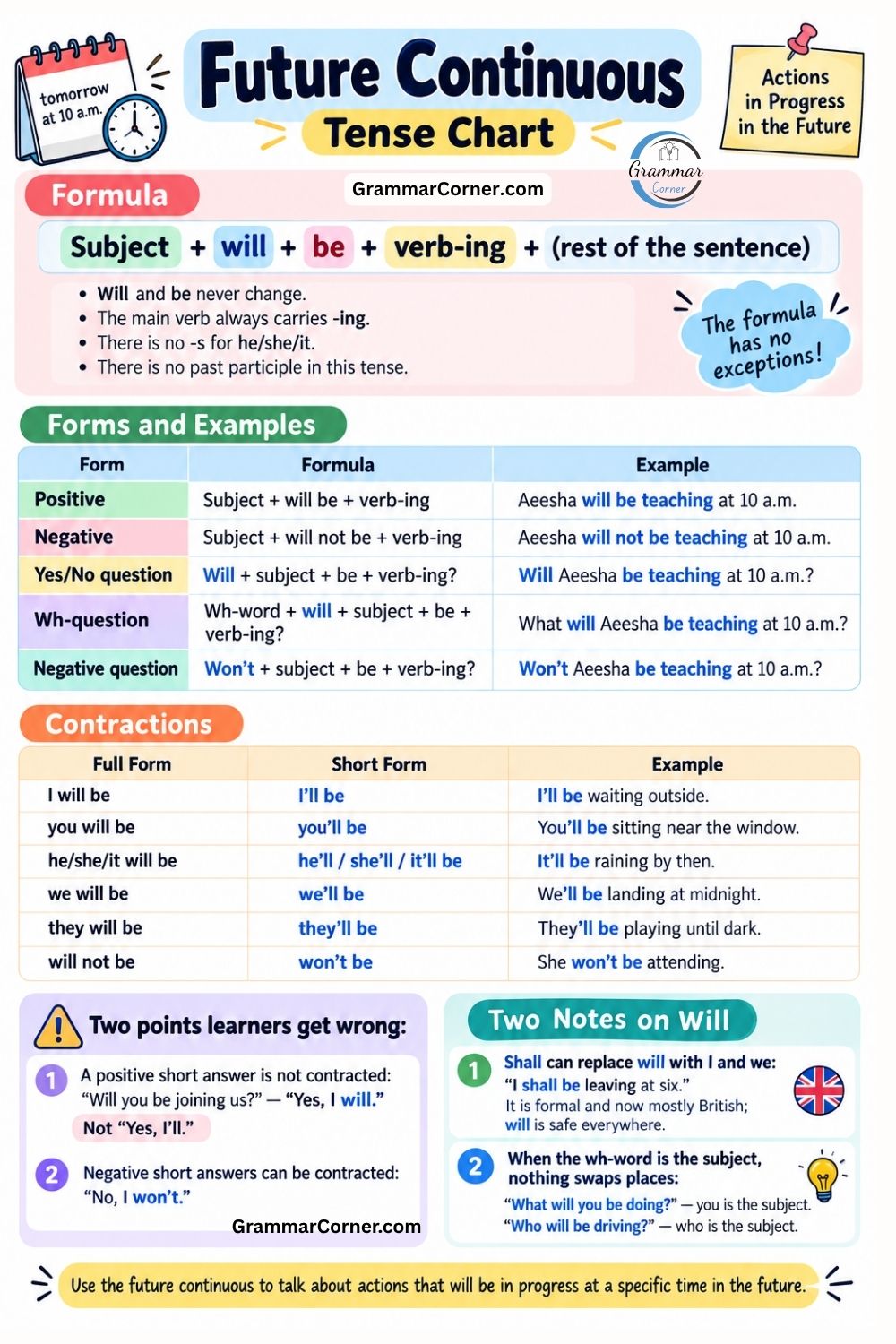
The future continuous tense is also called the future progressive tense. It describes an action that will be in progress at a point in the future. It is constituted from three parts that never change: will + be + the -ing form of the main verb.
Whether the subject is I, she, the students or my parents, the shape stays the same:
Compare the three sentences below. Each one places the same action at a different distance from that future point.
| Sentence | What it tells you about 9 p.m. |
|---|---|
| I will study tonight. | Studying will happen at some time tonight. No fixed moment. |
| I will be studying at 9 p.m. | At 9 p.m. exactly, the studying is already under way. |
| I will have studied by 9 p.m. | Before 9 p.m., the studying is finished. |
Practice
Choose what each sentence tells you about 6 p.m.
- She will be cooking at 6 p.m. — (a) starts at 6 (b) in progress at 6 (c) finished by 6
Answer
(b) in progress at 6 - She will cook at 6 p.m. — (a) starts at 6 (b) in progress at 6 (c) finished by 6
Answer
(a) starts at 6 - She will have cooked by 6 p.m. — (a) starts at 6 (b) in progress at 6 (c) finished by 6
Answer
(c) finished by 6
All answers
Future Continuous Tense Formula
The core formula has no exceptions:
Will and be never change. The main verb never changes either — it always carries -ing and nothing else. There is no -s for he/she/it, and there is no past participle anywhere in this tense.
| Form | Formula | Example |
|---|---|---|
| Positive | Subject + will be + verb-ing | Aeesha will be teaching at 10 a.m. |
| Negative | Subject + will not be + verb-ing | Aeesha will not be teaching at 10 a.m. |
| Yes/No question | Will + subject + be + verb-ing? | Will Aeesha be teaching at 10 a.m.? |
| Wh- question | Wh-word + will + subject + be + verb-ing? | What will Aeesha be teaching at 10 a.m.? |
| Negative question | Won’t + subject + be + verb-ing? | Won’t Aeesha be teaching at 10 a.m.? |
Contractions
| Full Form | Short Form | Example |
|---|---|---|
| I will be | I’ll be | I’ll be waiting outside. |
| you will be | you’ll be | You’ll be sitting near the window. |
| he / she / it will be | he’ll / she’ll / it’ll be | It’ll be raining by then. |
| we will be | we’ll be | We’ll be landing at midnight. |
| they will be | they’ll be | They’ll be playing until dark. |
| will not be | won’t be | She won’t be attending. |
Two points learners get wrong:
- A positive short answer is never contracted. “Will you be joining us?” — “Yes, I will.” Not “Yes, I’ll.”
- Negative short answers can be contracted: “No, I won’t.”
Two Notes on Will
- Shall can replace will with I and we: “I shall be leaving at six.” It is formal and now mostly British; will is safe everywhere.
- When the wh-word is the subject, nothing swaps places. Compare: “What will you be doing?” — you is the subject, so will jumps in front of it. “Who will be driving?” — who is the subject, so the word order stays exactly as a statement.
Practice
Rewrite each sentence in the form given in brackets.
- Bilal will be revising his notes tonight. (negative)
- The children will be sleeping by nine. (yes/no question)
- You will be staying at the hotel. (wh- question, asking where)
- Sana will be leading the meeting. (negative question)
Show Answers
- Bilal will not be (won’t be) revising his notes tonight.
- Will the children be sleeping by nine?
- Where will you be staying?
- Won’t Sana be leading the meeting?
Spelling the -ing Form
The tense fails if the -ing form is spelled wrongly, and five rules cover almost every verb.
| Rule | What Happens | Examples |
|---|---|---|
| Most verbs | just add -ing | wait → waiting, sleep → sleeping |
| Verb ends in silent -e | drop the e, add -ing | write → writing, drive → driving |
| One syllable, consonant–vowel–consonant | double the last consonant | sit → sitting, run → running, plan → planning |
| Two syllables, stress on the last one | double the last consonant | begin → beginning, prefer → preferring |
| Verb ends in -ie | change ie to y, add -ing | lie → lying, die → dying |
Three verbs that look like exceptions but are not: see → seeing and agree → agreeing keep the -ee because the e is not silent, and visit → visiting does not double because the stress falls on the first syllable, not the last.
British and American English split on one group: verbs ending in -l after a single vowel double the l in British spelling but not American — travel → travelling (BrE) / traveling (AmE). Both are correct; pick one and stay with it.
Practice
Write the -ing form.
- shop
- hope
- tie
- offer
- forget
Show Answers
- shopping
- hoping
- tying
- offering (stress is on the first syllable)
- forgetting
When to Use the Future Continuous Tense
There are six situations where this tense is the right choice. The last two are the ones most course books leave out, and they are the ones fluent speakers use most.
1. An action in progress at a stated future time
The time is named, and the action surrounds it.
- At 4 p.m. tomorrow, the doctors will be operating.
- This time next week, we will be sitting our final paper.
2. A longer action interrupted by a shorter one
The long action takes the future continuous; the short one that cuts into it takes the present simple, not will.
- I will be having lunch when you reach the office.
- The train will be pulling out just as she arrives.
3. Two actions running side by side
Both actions stretch across the same period, so both take the future continuous.
- While I am marking papers, my colleague will be entering the results.
- Some of us will be setting up the chairs, and others will be printing the passes.
4. A fixed arrangement, stated neutrally
This use reports a plan as settled fact, without any hint of choice or intention behind it.
- The team will be flying to Karachi on Thursday.
- Our office will be closing early on Friday.
5. A polite or neutral enquiry
This is the tense’s most useful everyday job and the one that separates natural English from textbook English. A future continuous question asks about a plan. A simple future question can sound like a request or even pressure.
| Question | How it lands |
|---|---|
| Will you be joining us for dinner? | A neutral enquiry about your plans. |
| Will you join us for dinner? | An invitation, or a request for a decision. |
| Will you be using the printer? | Just checking; no pressure either way. |
| Will you use the printer? | Sounds like an instruction. |
This is why shop assistants, waiters and receptionists reach for it constantly: Will you be paying by card? Will you be staying the full week?
6. An action that will happen as a matter of course
Here the tense says the action is going to happen anyway, as part of the normal run of things — no plan, no decision, no favour involved.
- I’ll be passing the post office anyway, so I can post your letter.
- Don’t buy a ticket. We’ll be driving right past your college.
Swap in the simple future and the meaning shifts: I’ll pass the post office sounds like you are making a special trip.
Practice
Match each sentence to the use above (1–6).
- Will you be needing the projector after lunch?
- At midnight, the crew will be loading the last container.
- I’ll be going to the market later anyway, so I’ll pick up the eggs.
- He will be waiting at the gate when the bell rings.
- My sister will be studying while I am cooking.
- 1 → use 5 (neutral enquiry)
- 2 → use 1 (progress at a stated time)
- 3 → use 6 (matter of course)
- 4 → use 2 (interrupted action)
- 5 → use 3 (two parallel actions)
Time Expressions That Signal the Future Continuous
The tense usually comes with a time marker. If none appears, the listener is expected to already know which future moment you mean.
| Time expression | Example |
|---|---|
| at + clock time (tomorrow, tonight) | At 7 a.m. tomorrow, I will be catching my bus. |
| this time tomorrow / next week / next year | This time next year, she will be teaching in Doha. |
| when / while / as + clause | I will be resting when you call. |
| all day / all morning / all night | They will be rehearsing all evening. |
| from … to … / between … and … | He will be presenting from 2 to 4 p.m. |
| by then / around then | The results will be coming out around then. |
| soon / shortly | We will be boarding shortly. |
Notice that from 2 to 4 p.m. and all evening mark a stretch, while at 7 a.m. marks a single point. The future continuous handles both — it simply means “unfinished at that time.”
Practice
Fill each gap with a time expression from the table so the sentence makes sense.
- ______________, I will be sitting in an exam hall in Islamabad.
- The builders will be working ______________, so the noise will not stop.
- Please don’t ring at eight; I will be praying ______________.
- This time tomorrow
- all day
- around then / at that time
Future Continuous vs Other Future Forms
Most confusion with this tense is really confusion between four forms that all point forward. This table settles it.
| Form | What it signals | Example |
|---|---|---|
| Future continuous (will be + -ing) | In progress at a future moment | At 8 p.m. I will be watching the match. |
| Simple future (will + verb) | A fact, a decision made now, or a prediction | I will watch the match tonight. |
| Be going to (going to + verb) | An earlier intention, or evidence you can see now | I am going to watch the match — I’ve booked the seat. |
| Future perfect continuous (will have been + -ing) | How long an action will have lasted up to a future point | By 10 p.m. I will have been watching for two hours. |
Future continuous vs simple future: the certainty difference
The future continuous often sounds more settled than the simple future, because it treats the action as already arranged rather than newly decided.
Arranged; the date is fixed.
A prediction, no date.
Future continuous vs be going to
Both can describe the future, but going to keeps the speaker’s intention visible, while the future continuous removes it.
I have decided to; it is my plan.
It is on the schedule; no intention is being announced.
Practice
Choose the better form.
- Look at those clouds — it (will be raining / is going to rain) any minute.
Answer
is going to rain (evidence in front of us) - At this time tomorrow we (will be flying / will have been flying) over the Arabian Sea.
Answer
will be flying - By December, he (will be working / will have been working) here for ten years.
Answer
will have been working - Don’t worry, I (will help / will be helping) you with that bag right now.
Answer
will help (a decision made at the moment of speaking)
All answers
Stative Verbs and the Future Continuous
The usual advice is that stative verbs — verbs of thinking, feeling, owning and the senses — do not take continuous forms. That advice is a good starting point, but it is not the whole truth, and stating it as an absolute rule causes its own errors.
Use the simple future with a genuinely stative meaning:
| ❌ Incorrect | ✅ Correct |
|---|---|
| I will be knowing the result by Friday. | I will know the result by Friday. |
| She will be owning the shop from March. | She will own the shop from March. |
| They will be believing you. | They will believe you. |
But several verbs have a second, active meaning, and in that meaning the continuous is correct:
| Verb | Stative meaning (no continuous) | Active meaning (continuous is fine) |
|---|---|---|
| have | She will have three brothers. | We will be having dinner at eight. |
| be | He will be tall. | He will be being difficult, as usual. (rare; usually rephrased) |
| think | I will think it is true. | I will be thinking about your offer all week. |
| see | You will see the difference. | I will be seeing the dentist on Monday. |
| taste | It will taste salty. | The chef will be tasting each dish. |
Practice
Correct the sentences that need correcting. One is already right.
- He will be owning a car by next year.
Answer
He will own a car by next year. - We will be having a meeting at eleven.
Answer
Correct — have a meeting is an activity, not possession. - I will be understanding the topic after the class.
Answer
I will understand the topic after the class. - She will be seeing her supervisor on Tuesday.
Answer
Correct — see here means meet by appointment.
All answers
Never Use Will After When, While and As Soon As
This single rule is behind more future continuous errors than anything else. When a clause opens with when, while, as soon as, until, before, after, by the time or the moment, the verb inside that clause takes a present form — even though the meaning is future.
| Incorrect | Correct |
|---|---|
| I will be sleeping when you will arrive. | I will be sleeping when you arrive. |
| While she will be cooking, I will be studying. | While she is cooking, I will be studying. |
| Call me as soon as you will reach. | Call me as soon as you reach. |
The pattern to memorise: one will per sentence, and it never sits inside the time clause. The future continuous goes in the main clause; the time clause takes the present simple or present continuous.
Practice
Fix the error in each sentence.
- They will be eating when the guests will come.
- While I will be driving, you can read the map.
- He will be waiting until the train will leave.
- …when the guests come.
- While I am driving…
- …until the train leaves.
Common Mistakes with the Future Continuous
| Incorrect | Correct | Why |
|---|---|---|
| She will be worked tomorrow. | She will be working tomorrow. | The main verb takes -ing, never a past participle. |
| He will being studying. | He will be studying. | After will, be stays in its base form. |
| They will studying at nine. | They will be studying at nine. | Be cannot be dropped. |
| She wills be coming. | She will be coming. | Will never takes -s. |
| I will be go to college. | I will be going to college. | The -ing is the whole point of the tense. |
| Will she coming tomorrow? | Will she be coming tomorrow? | Questions keep all three parts: will + subject + be + -ing. |
| Yes, I’ll. | Yes, I will. | Positive short answers are never contracted. |
| Who will he be arriving with? (when asking about the subject) | Who will be arriving? | When the wh-word is the subject, the word order does not swap. |
Practice
Find and fix the mistake.
- My cousins will be arrive on Sunday.
- Will you coming to the seminar?
- He wills be presenting the report.
- The team will being training all week.
- will be arriving
- Will you be coming…?
- He will be presenting…
- The team will be training…
Passive Voice in the Future Continuous
The passive form exists — will be being + past participle — and it is grammatically correct, but almost nobody uses it, because three helping verbs in a row sound clumsy.
| Active | Passive (technically correct) | What people actually say |
|---|---|---|
| Workers will be repairing the road at noon. | The road will be being repaired at noon. | The road will be under repair at noon. |
| The staff will be cleaning the hall then. | The hall will be being cleaned then. | They will be cleaning the hall then. |
If an exam asks for the passive of a future continuous sentence, will be being + past participle is the answer. In your own writing, rephrase.
Practice
Change to the passive, then suggest a more natural rewrite.
- The technicians will be testing the machines at 10 a.m.
Passive — The machines will be being tested at 10 a.m. Natural rewrite — The machines will be under testing at 10 a.m. or keep it active
Mixed Practice Test
Fill in the blanks with the correct future continuous form, or the correct alternative where the future continuous does not fit.
- This time next Friday, we ______________ (celebrate) Eid with our grandparents.
- Please don’t call at six — I ______________ (drive) home then.
- ______________ you ______________ (use) the meeting room after lunch?
- While the guests ______________ (arrive), the caterers will be laying the tables.
- He ______________ (not / attend) the workshop; he has an exam that day.
- By the time you land, I ______________ (wait) at the arrivals gate.
- I ______________ (know) my result by Tuesday.
- ______________ (who / take) the register tomorrow?
- The shop ______________ (close) at seven all through Ramadan.
- Don’t take a taxi — we ______________ (pass) your street anyway.
Answer key
- will be celebrating
- will be driving
- Will … be using
- are arriving (no will after while)
- will not be attending / won’t be attending
- will be waiting
- will know (know is stative)
- Who will be taking (wh-word is the subject — no inversion)
- will be closing
- will be passing
Frequently Asked Questions
What is the future continuous tense in simple words?
It is the tense used for an action that will be happening at a future moment — started before that moment, not finished at it. Its formula is will + be + verb-ing, as in At 8 p.m. I will be studying.
Is the future continuous the same as the future progressive?
Yes. They are two names for one tense. British course books usually say continuous; American and academic sources often say progressive.
Does the main verb take -ing or a past participle?
Always -ing — the present participle. Will be working is correct; will be worked is a different structure altogether (it is a passive simple future).
Can I use shall instead of will?
Yes, with I and we: I shall be leaving shortly. It is formal and chiefly British. Will works with every subject and in every variety of English.
Can the future continuous be used with stative verbs?
Not in their stative meaning — say I will know, not I will be knowing. But verbs with a second, active meaning do take it: We will be having lunch, I will be seeing the doctor. And Will you be needing…? is standard in polite service English.
Why do we say when you arrive and not when you will arrive?
Because time clauses opening with when, while, until, before, after, as soon as and by the time take a present form even when the meaning is future. The will belongs in the main clause only.
What is the difference between I will call you and I will be calling you?
I will call you announces a decision or a promise. I will be calling you reports it as something already scheduled, or as something that will happen in the normal course of events — softer, and with no sense of a favour being offered.
Can the future continuous show an unfinished action’s duration?
Only loosely, through phrases like all day or from 2 to 4. To state exactly how long an action will have lasted by a future point, use the future perfect continuous: By June, I will have been teaching here for five years.
All 12 tenses, in one place
English builds every tense from the same two ingredients — when (present, past, future) and aspect (simple, continuous, perfect, perfect continuous). Each tense below links to its chart and a set of practice conversation questions.
| Present Tense | Past Tense | Future Tense |
|---|---|---|