Declarative Sentences (Types, Structure & Examples)
What Is a Declarative Sentence?
A declarative sentence is used to make a statement or communicate information. It can state a fact, give information, describe an event, express an opinion, or explain an idea.
This sentence does not ask a question, give an instruction, or express strong emotion. It simply makes a statement. That is what makes it declarative.
This sentence gives information about what the students are doing. It does not ask the reader anything or tell the reader to do something.
Examples of Declarative Sentences
✨ Quick Challenge
Which of the following functions as a declarative sentence by stating a fact or sharing information? Tap your answer.
See the full answer
Answer: “The research team completed the laboratory analysis yesterday.”
Understanding declarative sentences:
- Purpose: It conveys factual information or expresses an idea directly without issuing a command, asking a question, or delivering an emotional outburst.
- Structure & Punctuation: Follows standard subject-verb order (“The research team completed…”) and ends with a period (.).
What Are the Characteristics of a Declarative Sentence?
A declarative sentence has several key structural and functional features that make it easily recognizable:
Its primary purpose is to tell or state something.
In standard English, it ends with a period (.) or full stop.
The usual base pattern is Subject + Verb + Object (e.g., “Maria opened the window.”). However, declarative sentences are flexible and frequently include complements, adverbials, or subordinate clauses.
Declarative vs. Other Sentence Types
Declarative Sentence Structure
A standard declarative sentence often follows the basic Subject + Verb + Object (SVO) pattern:
| Part | Function | Example |
|---|---|---|
| Subject | Tells who or what the sentence is about | The boy |
| Verb | Shows the action or state | kicked |
| Object | Receives the action | the ball |
Beyond the Basic SVO Pattern
While SVO is a fundamental starting point, declarative sentences are not restricted to a single structure:
There is no object because the verb fly is intransitive here.
The adjective blue describes the subject rather than receiving an action.
Summary: Although Subject + Verb + Object is common, declarative sentences accommodate various complement and adverbial arrangements.
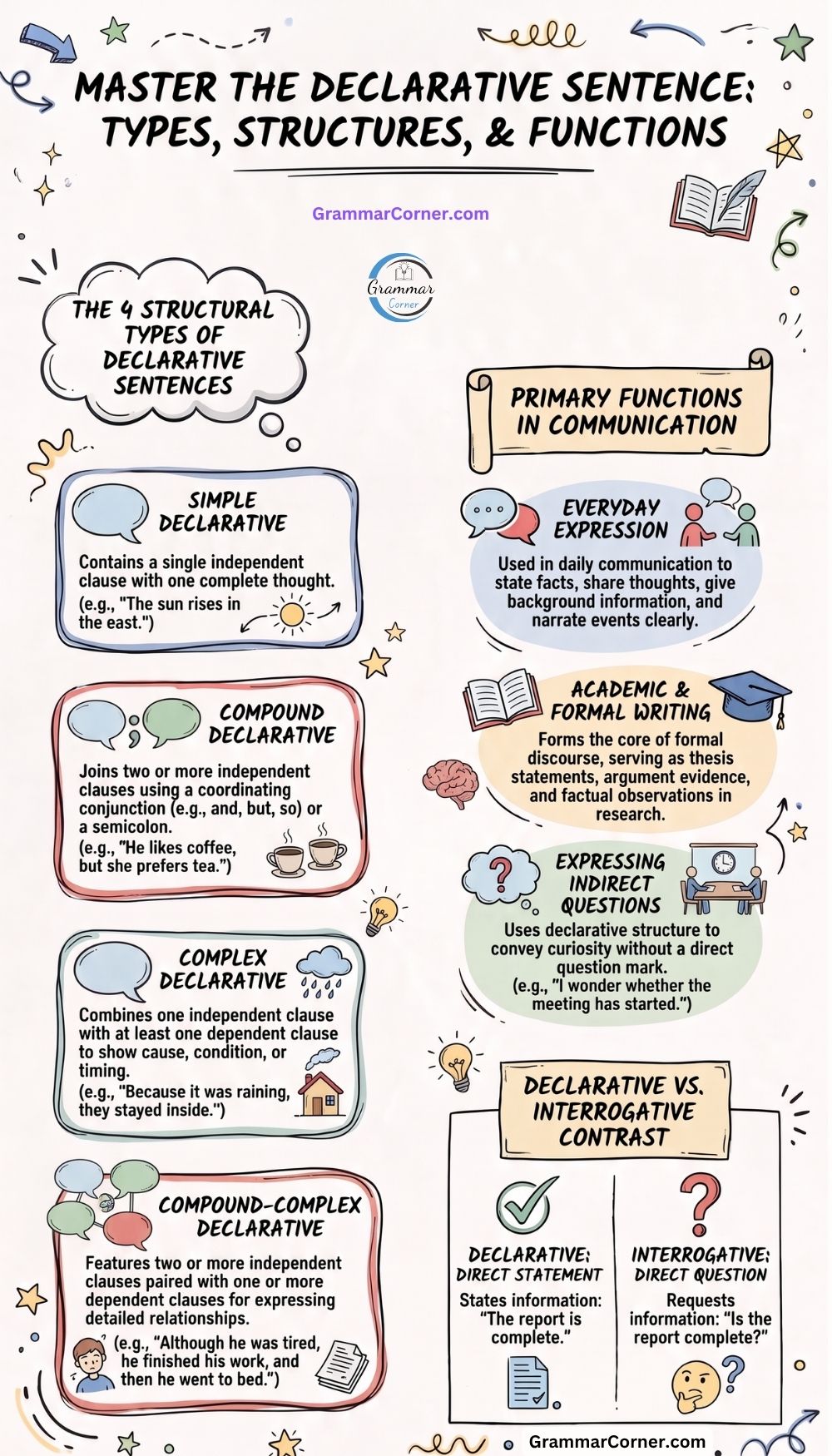
Types of Declarative Sentences
Declarative sentences can be classified according to their clause structure. This classification is essential because a declarative statement can be a concise expression or a multi-part sentence linking several complex ideas together:
- Simple declarative sentences
- Compound declarative sentences
- Complex declarative sentences
- Compound-complex declarative sentences
A simple declarative sentence contains one independent clause and expresses a complete thought. Its defining feature is having a single independent clause, not its length.
Breakdown: Subject (The baby) + Verb phrase (is sleeping)
Other Examples:
- The shop opens at nine.
- My brother plays cricket.
- The weather looks pleasant.
- The students completed the exercise.
Common Simple Declarative Patterns
| Pattern | Example |
|---|---|
| Subject + Verb | Birds fly. |
| Subject + Verb + Object | Ali reads books. |
| Subject + Linking Verb + Complement | The soup is hot. |
| Subject + Verb + Adverbial | The children played outside. |
| Adverbial + Subject + Verb | Yesterday, Sara arrived. |
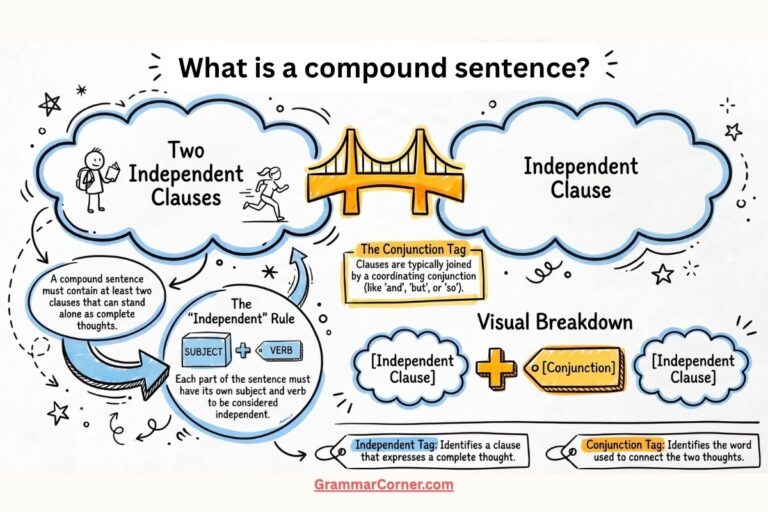
A compound declarative sentence contains two or more independent clauses joined together by a coordinating conjunction (FANBOYS: and, but, so, yet, etc.) or a semicolon.
Clause 1: The sun was setting | Clause 2: The birds were returning to their nests
Other Examples:
- I wanted to call you, but my phone was dead.
- The class ended early, so the students went home.
- The road was crowded, yet we reached the station on time.
- The shop was closed; we returned home.
A complex declarative sentence contains one independent clause and at least one dependent (subordinate) clause. Complex sentences are particularly useful for showing clear relationships such as time, cause, condition, contrast, or reason.
Independent: We stayed indoors | Dependent: Because it was raining
Other Examples:
- When the bell rang, the students left the classroom.
- I finished the assignment before the teacher arrived.
- She believes that the plan will succeed.
A compound-complex declarative sentence contains at least two independent clauses and at least one dependent clause. This allows a writer to seamlessly connect multiple related ideas within a single sentence structure.
Independent 1: We went for a walk
Independent 2: We stayed outside until sunset
Dependent: Although the weather was cold
Declarative Sentence Types at a Glance
This comprehensive breakdown improves on traditional simplified approaches by organizing declarative statements across all four structural categories:
| Type | Clause Structure | Example |
|---|---|---|
| Simple | One independent clause | The children laughed. |
| Compound | Two or more independent clauses | The children laughed, and the teacher smiled. |
| Complex | One independent + one or more dependent clauses | When the teacher arrived, the children laughed. |
| Compound-Complex | Two or more independent + one or more dependent clauses | When the teacher arrived, the children laughed, and the lesson began. |
What Do Declarative Sentences Do?
Declarative sentences form the backbone of daily expression, carrying out a wide range of essential communication functions:
An opinion is a statement of belief, making it declarative.
A sentence remains declarative regardless of whether the reader agrees with the statement.
Declarative Sentences in Everyday Communication
Much of ordinary conversation relies on simple declarative statements to convey thoughts, update others, and share daily realities:
This structural simplicity is why declarative sentences are the most frequent sentence type in English—they provide the essential framework for telling someone something directly.
Declarative Sentences in Academic Writing
Declarative sentences are indispensable in formal and academic contexts. Essays, reports, and research papers require clear statements to build arguments and present evidence effectively:
Examples in Research & Writing:
Academic Framework Roles
• Thesis Statement: “Regular exercise can improve both physical fitness and mental well-being.”
• Topic Sentence: “One major advantage of online learning is its flexibility.”
Declarative vs. Interrogative Sentences
The primary distinction between declarative and interrogative sentences lies in their core function: stating information versus requesting information.
| Feature | Declarative | Interrogative |
|---|---|---|
| Function | Makes a statement | Asks a question |
| Punctuation | Usually ends with a period (.) | Ends with a question mark (?) |
| Word Order | Subject normally precedes the verb | Auxiliary verb often precedes the subject |
| Example | The meeting starts at ten. | Does the meeting start at ten? |
Declarative Sentences With Indirect Questions
Understanding the distinction between declarative and interrogative forms is crucial when handling indirect questions.
A sentence containing the idea of a question is still declarative if it makes a statement rather than asking the reader directly:
Directly asks for information.
States what the speaker is wondering.
Declarative vs. Imperative Sentences
An imperative sentence gives a command, instruction, request, or direction, whereas a declarative sentence simply tells or states something.
Tells the reader what is needed.
Directly commands the reader what to do.
| Feature | Declarative | Imperative |
|---|---|---|
| Function | Gives information | Gives a command or request |
| Punctuation | Usually ends with a period | May end with a period or exclamation mark |
| Subject Presence | Subject is normally expressed | Subject “you” is often understood (implied) |
| Example | You need to submit the form. | Submit the form. |
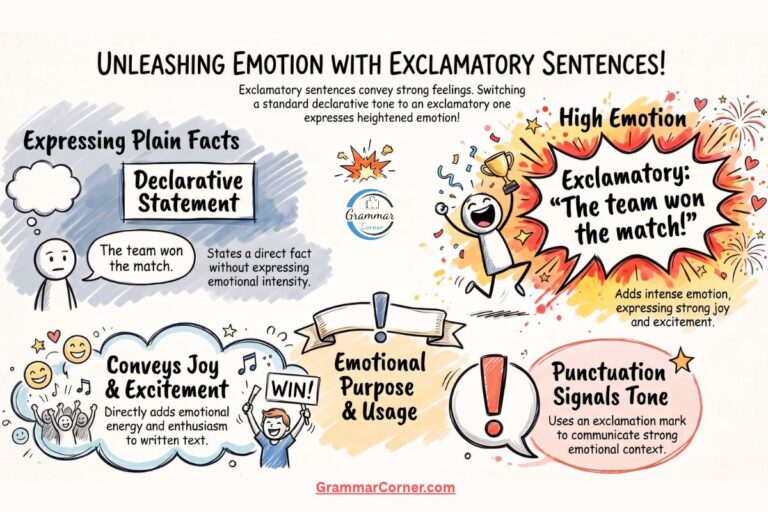
Declarative vs. Exclamatory Sentences
Declarative and exclamatory sentences can sometimes contain nearly identical word choices, but their primary purpose and emotional weight differ significantly.
Presents the idea as a straightforward statement.
Presents the statement with strong emotion or emphasis.
Consider another comparison where word order shifts to express emotion:
Key Takeaway: The distinction isn’t always based solely on subject-verb arrangements—purpose, tone, and punctuation together determine sentence type.
Declarative, Interrogative, Imperative, and Exclamatory Sentences
Here is a side-by-side comparison of the four primary sentence types in English grammar:
| Sentence Type | Main Purpose | Typical Ending | Example |
|---|---|---|---|
| Declarative | Makes a statement | Period (.) | The room is quiet. |
| Interrogative | Asks a question | Question mark (?) | Is the room quiet? |
| Imperative | Gives a command/request | Period (.) or Exclamation mark (!) | Keep the room quiet. |
| Exclamatory | Expresses strong emotion | Exclamation mark (!) | What a quiet room! |
Declarative Sentences and Punctuation
The standard punctuation mark for a declarative sentence is the period (full stop).
“The children are waiting outside.”
Punctuation Common Mistake: Indirect Questions
A frequent error is placing a question mark at the end of a sentence simply because it contains question words like when, whether, if, or why.
Why? The clause “when the train would arrive” functions as an indirect question within a larger declarative statement. Because the entire sentence makes a statement rather than asking the reader a direct question, it must end with a period.
Can a Declarative Sentence Be Negative?
Yes. A declarative sentence can be either affirmative or negative. Both forms make statements and convey information, so adding negative particles does not alter the sentence category.
Additional Negative Declarative Examples:
- I do not understand the question.
- She has not finished the report.
- They did not attend the meeting.
Summary: Adding the word not modifies the meaning from affirmative to negative, but the sentence remains declarative because it continues to state a fact or idea.
Can a Declarative Sentence Be a Long Sentence?
Yes. Sentence length does not determine whether a sentence is declarative. The defining factor is always sentence function: What is the sentence doing? If it makes a statement, it is declarative regardless of word count.
Contains only 3 words, but expresses a complete, independent statement.
Multi-clause structure, yet still fundamentally makes a statement.
How to Write a Clear Declarative Sentence
A declarative sentence should communicate its statement directly without forcing the reader to decipher complex or bloated phrasing.
1. Start With a Clear Subject
Position the core subject near the start so the reader immediately knows who or what is performing the action.
2. Choose a Precise Verb
Strong verbs eliminate wordiness and increase directness.
Precise: The researcher analyzed the results.
3. Include Only Useful Details
Avoid cluttering your sentence with details that do not add value to the main point.
4. Keep the Main Idea Visible
Stacking too many clauses inside one sentence can obscure the main idea. Splitting complex thoughts into multiple sentences often improves clarity.
“The report, which was prepared after several meetings that involved members of different departments and which was revised several times before submission, explains the changes.”
Clear & Direct:
“The report explains the changes. It was revised several times before submission.”
Common Mistakes With Declarative Sentences
Statements that contain indirect question clauses are declarative and must end with a period.
An object is not required for a sentence to be declarative. Intransitive verbs form complete declarative statements without objects.
Examine word order to verify whether a sentence gives information or requests it.
Interrogative: “Do you know where she lives?” (Requests information)
Punctuation is a helpful signal, but purpose determines category. Imperative sentences often end with periods as well.
Ends with a period, but functions as a request/instruction → Imperative.
Adding extra subordinate clauses solely to extend sentence length decreases readability. Strive for concise, informative expression.
Examples of Declarative Sentences
Declarative sentences are used across virtually all domains of communication. Here is how they appear in different everyday context settings:
- My brother is at home.
- The grocery store closes at nine.
- We are leaving tomorrow.
- The examination begins at ten o’clock.
- The students submitted their assignments.
- The teacher explained the new lesson.
- Water expands when it freezes.
- Plants require light for photosynthesis.
- The manager approved the request.
- The company will announce the results tomorrow.
- The study examines the effects of social media on student learning.
- The results support the proposed explanation.
Declarative Sentence Examples by Structure
Observe how declarative sentences adapt across various structural, modal, and verb combinations while maintaining their core declarative identity:
| Structure / Type | Example Sentence |
|---|---|
| Simple | The child smiled. |
| Simple with object | The child opened the door. |
| Compound | The child opened the door, and the dog ran outside. |
| Complex | When the child opened the door, the dog ran outside. |
| Compound-complex | When the child opened the door, the dog ran outside, and the neighbors looked on. |
| Negative | The child did not open the door. |
| With a modal verb | The child can open the door. |
| With a linking verb | The child is tired. |
Practice: Identify the Declarative Sentences
Test your knowledge! Decide whether each statement below is a Declarative or Not Declarative sentence.
Practice Answer Key
Review the answers and structural explanations for each item:
| # | Sentence Category | Reason |
|---|---|---|
| 1 | Declarative | It gives information about a schedule. |
| 2 | Not Declarative | It asks a direct question (Interrogative). |
| 3 | Not Declarative | It gives an instruction/request (Imperative). |
| 4 | Declarative | It makes a statement of fact or observation. |
| 5 | Not Declarative | It expresses strong emotion (Exclamatory). |
| 6 | Declarative | It makes a negative statement about understanding. |
| 7 | Not Declarative | It asks a direct question (Interrogative). |
| 8 | Declarative | It provides information about an ongoing action. |
✨ Quick Challenge
Which of the following sentences functions as a declarative sentence across complex structural variations? Tap your answer.
See the full answer
Answer: “Although the schedule was revised, the team completed the audit, and the client approved the final report.”
Declarative sentences make statements and express thoughts across all structural levels:
- Structural Versatility: Declarative sentences can be simple, compound, complex, or compound-complex while retaining their core purpose—stating facts and ideas.
- Function: Unlike questions (interrogative), instructions (imperative), or emotional outbursts (exclamatory), declarative sentences communicate information directly.
Practice: Change the Sentence Into a Declarative Sentence
Practice converting direct questions into clear statements. Your goal is to rewrite each sentence so that it provides information rather than requesting it.
Turn each question into a statement:
Note: The exact wording may adjust slightly depending on intended meaning, but the sentence must always state information rather than ask for it.
Frequently Asked Questions About Declarative Sentences
Find quick answers to common questions regarding declarative sentence structure, rules, and usage:
What is a declarative sentence?
A declarative sentence makes a statement. It can provide information, state a fact, express an opinion, describe something, or explain an idea.
What punctuation does a declarative sentence use?
A standard declarative sentence normally ends with a period (.).
What is the basic structure of a declarative sentence?
A common pattern is Subject + Verb + Object, but declarative sentences can follow many structures. An object is not required in every declarative sentence.
What are the four types of declarative sentences?
Based on clause structure, declarative sentences can be classified as simple, compound, complex, or compound-complex.
Can a declarative sentence be negative?
Yes. The addition of negative words does not alter the sentence type because it still makes a statement.
Can a declarative sentence contain an indirect question?
Yes. Even if it expresses the idea of a question, the overall sentence remains declarative if it functions as a statement.
Are declarative sentences always factual?
No. A declarative sentence can state a fact, opinion, belief, claim, or even a statement that is factually false. Its defining feature is its function as a statement, not the factual accuracy of its content.
What is the difference between a declarative and an interrogative sentence?
A declarative sentence makes a statement, whereas an interrogative sentence asks a direct question.
Interrogative: Does she live in Lahore?
What is the difference between a declarative and an imperative sentence?
A declarative sentence provides information, while an imperative sentence gives an instruction or command.
Imperative: Submit the form.
What is the difference between a declarative and an exclamatory sentence?
A declarative sentence presents information normally, while an exclamatory sentence conveys heightened emotion or emphasis.
Exclamatory: What an excellent performance!
Are declarative sentences used in academic writing?
Yes. They are essential in formal writing for stating claims, defining concepts, presenting evidence, explaining ideas, and structuring thesis statements and topic sentences.
Can a declarative sentence be very short or very long?
Yes. Length does not dictate sentence classification. A two-word sentence like “Birds fly.” is declarative, as is a long, multi-clause sentence—provided its primary job is to make a statement.