Present Simple Conversation Questions with Answers
The present simple tense is one of the most commonly used tenses in everyday English. Practicing conversation questions is one of the best ways to become comfortable using this tense in real-life situations.
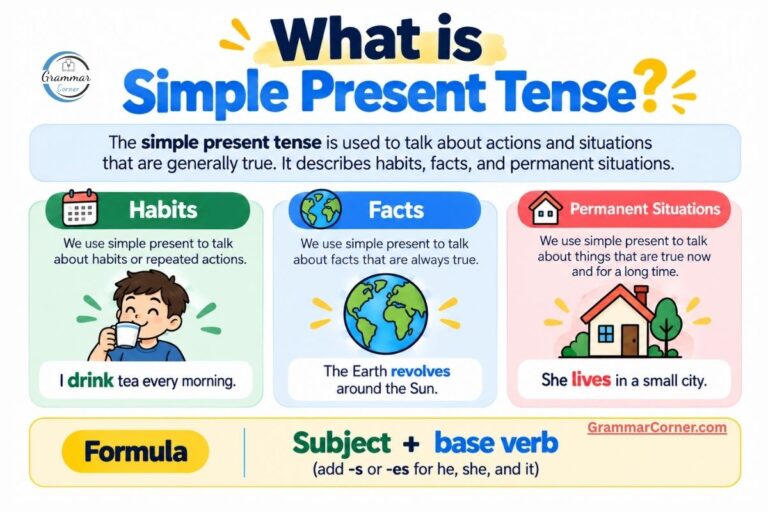
I get up at six.
She works every day.
Water boils at 100°C.
They live in Faisalabad.
What You Will Find in this Article?
- Conversation questions with sample answersReady to use for speaking practice or class.
- Common mistakesThe errors learners repeat most, each with the fix.
- Speaking tipsPractical advice for sounding natural, not scripted.
- Frequently asked questionsShort answers to the questions learners ask about this tense.
In this article, you’ll find a wide variety of present simple conversation questions with sample answers, common mistakes, speaking tips and frequently asked questions about the topic.
The two shapes you need before you start
What time do you start work?
I start at nine. My brother starts an hour later.
The one rule that causes most spoken errors
There is exactly one -s per sentence, and it never appears twice. When does shows up, it has already taken the -s, so the main verb goes back to its base form.
Statement takes the -s. Question and negative hand it to does. Learners who fix this one habit sound noticeably more accurate straight away.
Short answers: do and does, never the main verb
Yes, I do.
Yes, she does.
Yes, they do.
No, I don’t.
No, he doesn’t.
No, we don’t.
The main verb never appears in a short answer. It is Yes, I do, not Yes, I do work.
Why conversation practice works better than rules
A learner can recite he, she, it takes an -s and still say my father work in a bank two seconds later. The rule sits in one part of the mind; speech comes from another. Answering real questions out loud is what moves it across — which is why every question below comes with a sample answer to copy the shape from before you build your own.
Warm-up: four questions before you begin
Check that the basic shape is solid.
Correct so far: 0 of 41. Where does your sister study?
2. Which question is correct?
3. Do you drink coffee? — you don’t.
4. Your father has worked at the same bank for twenty years. Say so.
Before you start the question lists
- I, you, we, they take the base verb. He, she, it add -s.
- One -s per sentence: if does or doesn’t is there, the main verb drops it.
- Short answers use do and does only, never the main verb.
- Positive short answers stay full: Yes, I do. Negatives contract: No, I don’t.
- Use this tense for habits, routines, facts and permanent situations — not for what is happening this second.
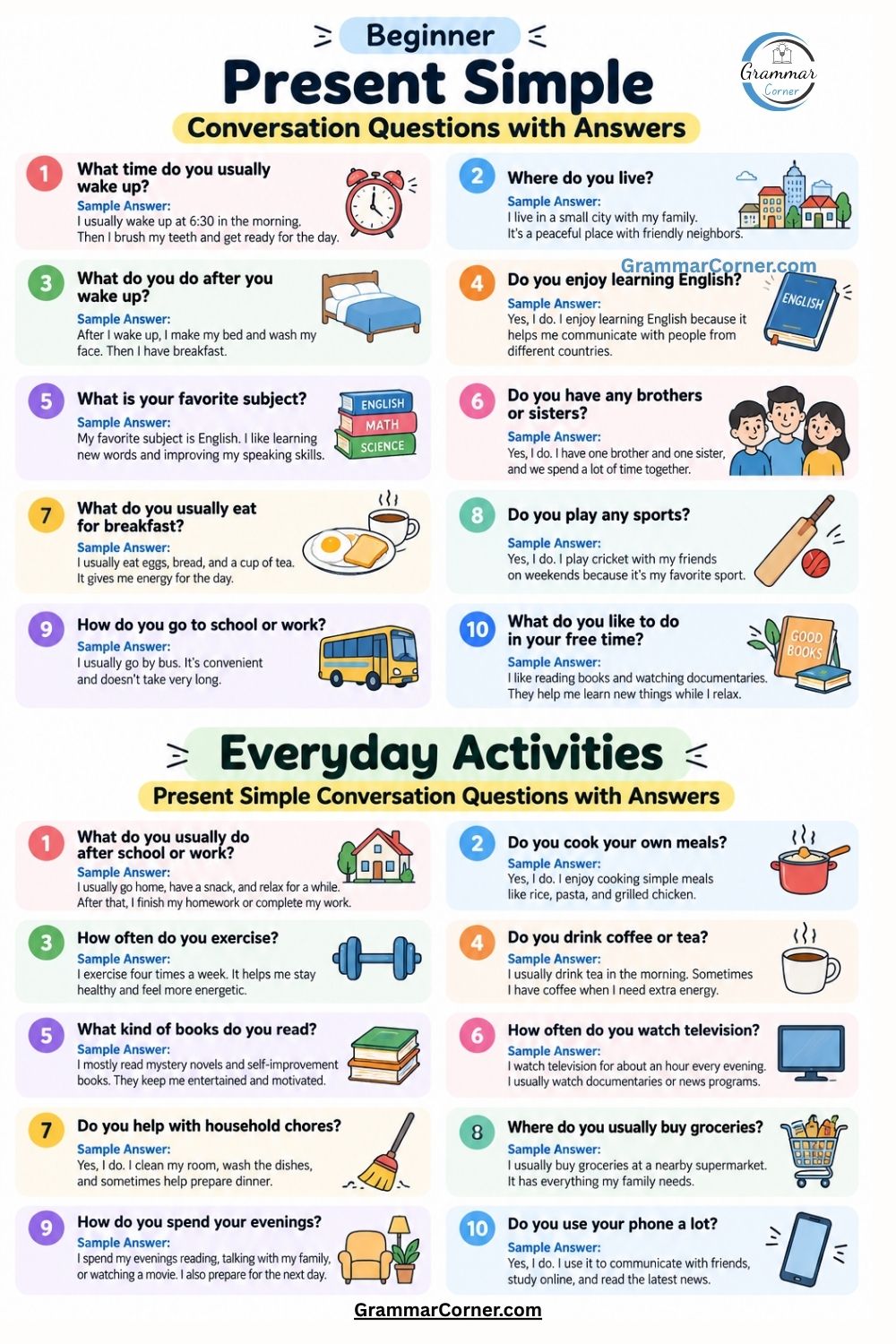
Beginner Present Simple Conversation Questions with Answers
Everyday Activities Present Simple Conversation Questions with Answers
These questions focus on everyday routines and habits. They help learners practice speaking about activities they do regularly.
Family and Friends Present Simple Conversation Questions with Answers
These questions help learners talk about their family members, friends, relationships, and everyday family life using the present simple tense.
What does your father do?
My father works as a bank manager. He enjoys helping customers and managing his team.
What does your mother like to do in her free time?
My mother likes gardening and cooking. She grows beautiful flowers and enjoys trying new recipes.
Do you spend a lot of time with your family?
Yes, I do. We usually have dinner together and talk about our day every evening.
How often do you visit your grandparents?
I visit my grandparents once or twice a month. They always make me feel welcome.
What do you usually do with your friends?
We usually play cricket, watch movies, or eat at a nearby restaurant. We always have a good time together.
Does your best friend enjoy sports?
Yes, he does. He plays football every weekend and watches almost every major match.
Who helps you the most at home?
My mother helps me the most. She always supports me with my studies and gives me useful advice.
Do your family members celebrate birthdays together?
Yes, we do. We usually have a family dinner, cut a cake, and take lots of pictures.
How do you stay in touch with your relatives?
I usually call them or send messages through social media. We also visit each other during holidays.
What do you like most about your family?
I like the love and support we share. We always help one another during difficult times.
School and College Present Simple Conversation Questions with Answers
These questions help students talk about their school life, subjects, teachers, and study habits using the present simple tense.
What subjects do you enjoy the most?
I enjoy English and science the most. Both subjects are interesting and help me learn useful skills.
What time does your school or college start?
My school starts at 8:00 every morning. I usually arrive about fifteen minutes early.
Do you complete your homework every day?
Yes, I do. I finish my homework before dinner so I can relax later in the evening.
Who is your favorite teacher?
My favorite teacher is my English teacher. She explains every lesson clearly and encourages us to ask questions.
Do you enjoy working on group projects?
Yes, I do. Group projects help me learn from my classmates and improve my teamwork skills.
How do you prepare for your exams?
I make a study schedule and review my notes every day. I also solve practice questions before each exam.
What do you usually do during your lunch break?
I eat lunch with my friends and talk about our classes. Sometimes we also play outdoor games.
Does your school organize extracurricular activities?
Yes, it does. The school organizes sports competitions, debates, and science exhibitions throughout the year.
Which subject do you find the most difficult?
I find mathematics the most difficult. I practice regularly to improve my understanding.
Why do you enjoy going to school or college?
I enjoy meeting my friends, learning new things, and participating in different activities. Every day brings something new.
School and College Present Simple Conversation Questions with Answers
These questions help students talk about their school life, subjects, teachers, and study habits using the present simple tense.
1What subjects do you enjoy the most?
Sample answerI enjoy English and science the most. Both subjects are interesting and help me learn useful skills.
2What time does your school or college start?
Sample answerMy school starts at 8:00 every morning. I usually arrive about fifteen minutes early.
The rule in one pair: does in the question takes the -s, so start stays bare. The answer has no does, so starts takes it back.
3Do you complete your homework every day?
Sample answerYes, I do. I finish my homework before dinner so I can relax later in the evening.
4Who is your favorite teacher?
Sample answerMy favorite teacher is my English teacher. She explains every lesson clearly and encourages us to ask questions.
No do anywhere in this question, for two reasons: who is the subject, and be never uses do to form questions.
5Do you enjoy working on group projects?
Sample answerYes, I do. Group projects help me learn from my classmates and improve my teamwork skills.
6How do you prepare for your exams?
Sample answerI make a study schedule and review my notes every day. I also solve practice questions before each exam.
7What do you usually do during your lunch break?
Sample answerI eat lunch with my friends and talk about our classes. Sometimes we also play outdoor games.
Two dos in one question. The blue one is the helper that builds the question; the amber one is the real verb meaning “perform an activity”.
8Does your school organize extracurricular activities?
Sample answerYes, it does. The school organizes sports competitions, debates, and science exhibitions throughout the year.
The same swap as question 2: organize in the question, organizes in the answer.
9Which subject do you find the most difficult?
Sample answerI find mathematics the most difficult. I practice regularly to improve my understanding.
10Why do you enjoy going to school or college?
Sample answerI enjoy meeting my friends, learning new things, and participating in different activities. Every day brings something new.
Every day works as a singular subject here, so brings takes the -s.
Work and Office Present Simple Conversation Questions with Answers
These questions are useful for adult learners and professionals who want to discuss their work routines and responsibilities.
1What do you do for a living?
Sample answerI work as an accountant. I prepare financial reports and manage company accounts.
The double do again, and this time it is a fixed expression: What do you do? is how English asks about someone’s job.
2What time do you usually start work?
Sample answerI usually start work at 9:00 in the morning. I like to arrive a little early to prepare for the day.
3Do you enjoy your job?
Sample answerYes, I do. My job is interesting, and I enjoy working with supportive colleagues.
4What responsibilities do you have at work?
Sample answerI manage customer records, prepare reports, and respond to emails. I also attend team meetings.
5How do you travel to your workplace?
Sample answerI usually drive my car to work. It saves time and is more comfortable than public transportation.
6Do you work alone or in a team?
Sample answerI mostly work in a team. We share ideas and help each other complete our tasks.
7What do you usually do during your lunch break?
Sample answerI have lunch with my coworkers and chat for a while. It helps me relax before returning to work.
8Does your job require computer skills?
Sample answerYes, it does. I use different computer programs every day to complete my work efficiently.
9What do you like most about your workplace?
Sample answerI like the friendly environment and supportive colleagues. Everyone works together respectfully.
Everyone looks plural but counts as singular, so it takes works. The same goes for everybody, somebody and nobody.
10What skills help you succeed in your job?
Sample answerGood communication, organization, and problem-solving skills help me perform my job effectively. I also believe teamwork is very important.
No do here either. What skills is the subject of the sentence, so the verb follows it directly.
Shopping and Food Present Simple Conversation Questions with Answers
These questions help learners discuss food, cooking, restaurants, and shopping habits using the present simple tense.
What is your favorite food?
My favorite food is biryani because it is full of flavor and spices. I enjoy eating it with my family.
Do you enjoy cooking?
Yes, I do. I usually cook simple meals like pasta, fried rice, and grilled chicken.
How often do you eat at a restaurant?
I usually eat at a restaurant once or twice a month. I like trying different types of food.
Where do you usually buy your groceries?
I usually buy groceries from a supermarket near my house. It has fresh fruits, vegetables, and other daily essentials.
Do you prefer homemade food or fast food?
I prefer homemade food because it’s healthier and tastes better. My family also enjoys cooking together.
What do you usually drink with your meals?
I usually drink water or fresh juice with my meals. Sometimes I also have a cup of tea afterward.
Do you like spicy food?
Yes, I do. I enjoy moderately spicy food because it adds more flavor without being too hot.
How often do you go shopping?
I usually go shopping every weekend. I buy groceries, household items, and sometimes new clothes.
What do you always buy when you visit a supermarket?
I always buy milk, bread, eggs, and fresh fruit. These are the items my family needs every week.
Why do you enjoy shopping?
I enjoy shopping because I like discovering new products and spending time with my family. It also helps me plan for the week ahead.
Travel and Transportation Present Simple Conversation Questions with Answers
These questions help learners talk about their travel habits, transportation, and favorite destinations using the present simple tense.
How do you usually travel to work or school?
I usually travel by bus because it’s affordable and convenient. It also helps me avoid traffic.
Do you enjoy traveling?
Yes, I do. I love visiting new places and learning about different cultures.
What is your favorite place to visit?
My favorite place is the northern mountains. The beautiful scenery and cool weather make every trip memorable.
How often do you go on vacation?
I usually go on vacation once a year with my family. We always choose a peaceful place to relax.
Do you like traveling by plane?
Yes, I do. Flying is fast and gives me a wonderful view from above the clouds.
Which type of transportation do you prefer?
I prefer traveling by car because it’s comfortable and allows me to stop whenever I want.
What do you usually pack for a trip?
I pack clothes, toiletries, my phone charger, and a camera. I also carry a few snacks for the journey.
Do you enjoy road trips?
Yes, I do. Road trips are relaxing because I can enjoy the scenery along the way.
Who do you usually travel with?
I usually travel with my family. We enjoy exploring new places together.
Why do you like traveling?
Traveling helps me relax and experience different cultures. It also creates unforgettable memories with the people I love.
Weather and Nature Present Simple Conversation Questions with Answers
These questions help learners talk about the weather, seasons, nature, and the environment using the present simple tense.
What is your favorite season?
My favorite season is spring because the weather is pleasant and flowers bloom everywhere.
Does it rain a lot where you live?
No, it doesn’t. We usually receive most of our rainfall during the monsoon season.
What do you like to do on sunny days?
I like to go for a walk or spend time in the park. Sunny weather always improves my mood.
Do you enjoy cold weather?
Yes, I do. I enjoy wearing warm clothes and drinking hot tea during the winter.
Which animals do you like the most?
I like dogs because they are loyal and friendly. They also make wonderful pets.
Do you have any plants at home?
Yes, I do. I grow flowers and a few small indoor plants because they make my home look fresh and beautiful.
How often do you visit parks or gardens?
I usually visit a nearby park every weekend. It’s a great place to relax and enjoy nature.
Why do people plant trees?
People plant trees because they provide fresh air, reduce pollution, and make the environment greener.
What kind of weather do you enjoy the most?
I enjoy cool and sunny weather because it’s comfortable for outdoor activities.
Why is it important to protect nature?
It’s important to protect nature because it provides clean air, water, and food. A healthy environment also benefits future generations.
Habits and Daily Routine Present Simple Conversation Questions with Answers
The present simple tense is commonly used to talk about routines and habits. These questions help learners describe what they do regularly.
What time do you usually go to bed?
I usually go to bed around 10:30 at night. I try to get at least seven hours of sleep.
Do you make your bed every morning?
Yes, I do. It only takes a few minutes and helps keep my room tidy.
How often do you exercise?
I exercise three or four times a week. It helps me stay fit and healthy.
Do you eat breakfast every day?
Yes, I do. I believe breakfast gives me energy to start the day.
How do you usually spend your evenings?
I usually have dinner with my family, finish my work, and read for a while before bed.
Do you check your emails every day?
Yes, I do. I check them every morning and again before I finish work.
What do you usually do before going to bed?
I brush my teeth, prepare my clothes for the next day, and read a few pages of a book.
Do you keep a daily schedule?
Yes, I do. I write down my important tasks so I can manage my time better.
How often do you clean your room?
I clean my room every Saturday. It helps me keep everything organized.
What habit helps you stay productive?
I make a to-do list every morning. It helps me stay focused and complete my work on time.
Preferences and Opinions Present Simple Conversation Questions with Answers
These questions encourage learners to express their likes, dislikes, preferences, and opinions using the present simple tense.
Personality and Lifestyle Present Simple Conversation Questions with Answers
These questions help learners describe their personality, lifestyle, values, and personal habits using the present simple tense.
Pair Work Present Simple Conversation Questions with Answers
These questions are perfect for pair work in the classroom. Students can interview each other and practice speaking naturally using the present simple tense.
What do you usually do after school or work?
I usually go home, have dinner, and spend some time reading or watching educational videos.
Do you enjoy learning English?
Yes, I do. I enjoy learning English because it helps me communicate with people from around the world.
What hobby do you spend the most time on?
I spend most of my free time reading books. I especially enjoy mystery and history books.
What food do you cook best?
I cook fried rice and pasta quite well. My family enjoys both dishes.
How often do you exercise?
I exercise three times a week. It helps me stay healthy and energetic.
Which subject do you enjoy the most?
I enjoy English the most because I like improving my grammar and speaking skills.
What do you usually do on weekends?
I usually spend time with my family, play cricket with friends, and complete my household chores.
Do you like traveling?
Yes, I do. I enjoy visiting new places and learning about different cultures.
What is your favorite book or movie?
My favorite book is The Alchemist. I like its inspiring message about following your dreams.
What goal do you work toward every day?
I work toward improving my English and learning new professional skills. I believe consistent effort leads to success.
Present Simple Discussion Questions with Answers
These open-ended questions encourage learners to express opinions and give longer answers. They are ideal for speaking clubs, classrooms, and group discussions.
Why do people learn English?
People learn English because it helps them communicate internationally, continue their education, and find better career opportunities. It is also one of the most widely spoken languages in the world.
Why do many people prefer online shopping?
Many people prefer online shopping because it saves time and offers a wide variety of products. They can compare prices without leaving home.
Why do healthy habits matter?
Healthy habits improve physical and mental well-being. They also reduce the risk of many illnesses and increase energy levels.
What makes a good teacher?
A good teacher explains lessons clearly, listens to students, and encourages everyone to participate. Patience and kindness are also important qualities.
Why do people enjoy traveling?
People enjoy traveling because they experience new cultures, meet different people, and create unforgettable memories. Traveling also helps them relax and learn.
What qualities make a good friend?
A good friend is honest, supportive, and trustworthy. Good friends respect each other and remain together during both happy and difficult times.
Why do people read books?
People read books to gain knowledge, improve their imagination, and relax. Reading also strengthens vocabulary and communication skills.
How does technology improve everyday life?
Technology makes communication faster, provides easy access to information, and simplifies many daily tasks. It also supports online learning and remote work.
Why do people need hobbies?
Hobbies help people reduce stress, develop new skills, and enjoy their free time. They also improve creativity and overall happiness.
What makes a happy life?
A happy life includes good health, supportive relationships, meaningful work, and time for personal interests. Appreciating small moments also brings lasting happiness.
Classroom Activities for Practicing Present Simple Conversation Questions
These classroom activities help students use the present simple tense naturally while improving their speaking, listening, and communication skills.
Activity 1: Find Someone Who…
Objective
Instructions
- Give each student the checklist below.
- Students walk around the classroom and ask classmates questions.
- When they find someone who answers “Yes,” they write that student’s name.
- Encourage students to ask one follow-up question after each answer.
Watch what happens to the -s
Every line on the checklist is written in the third person — gets up before 6:00. To ask the question, the student has to hand that -s over to do: Do you get up before 6:00? To write the name down, the -s comes straight back: Ayesha gets up before 6:00.
One ending, three sentences, appearing and disappearing exactly as the rule says it should. Tap any line below to watch it move.
Find Someone Who…
- gets up before 6:00 a.m.
- drinks tea every morning
- plays a sport every week
- enjoys reading books
- cooks dinner at home
- walks to school or work
- speaks more than one language
- listens to music every day
- watches documentaries
- keeps a daily planner
One of these ten takes -es, not -s
watch ends in ch, so it becomes watches. The same happens after s, sh, x and o: misses, washes, fixes, goes. The other nine on the sheet just add a plain -s.
Example Conversation
Do you drink tea every morning?
Yes, I do. I usually drink a cup of tea with my breakfast.
What kind of tea do you like?
I usually drink black tea.
Activity 2: Daily Routine Interview
Objective
Instructions
- Students work in pairs.
- They ask each other the questions below.
- After the interview, each student introduces their partner to the class.
Interview Questions
| Ask your partner | Then tell the class |
|---|---|
| What time do you usually wake up? | He usually wakes up at 6:00 a.m. |
| What do you eat for breakfast? | He eats eggs and toast for breakfast. |
| How do you travel to school or work? | He goes to work by bus. |
| What do you usually do after school or work? | He spends his evenings reading books. |
| What time do you go to bed? | He usually goes to bed at 10:30 p.m. |
Example Introduction
Five verbs, five endings — the mistake happens after the first one
Count the -s endings in that introduction: wakes, eats, goes, spends, goes. Every verb in the list belongs to He, so every verb needs the ending.
Students remember the first ending and drop the rest. When a sentence lists several actions by the same person, each verb carries its own -s.
Speaking Tips for Answering Present Simple Conversation Questions
Answering present simple conversation questions is easier when you use complete sentences and speak naturally. The following tips will help you communicate more confidently and make your conversations more engaging.
Answer in Complete Sentences
Instead of replying with only “Yes” or “No,” answer using a complete sentence.
Complete answers improve your grammar, vocabulary, and speaking confidence.
Add One or Two Extra Details
After answering the question, provide additional information to keep the conversation going.
Example
What do you usually do after dinner?
I usually read a book for about thirty minutes. After that, I prepare for the next day and go to bed.
Adding extra details makes your answers sound more natural.
Use Frequency Adverbs Naturally
Frequency adverbs help describe how often something happens. Some common frequency adverbs include:
Example
I usually eat breakfast at home, but I sometimes have breakfast at a café on weekends.
Where the adverb goes
Before an ordinary verb — I usually eat — but after the verb be: I am usually late, not I usually am late. That single swap catches most learners out.
Give Real and Honest Answers
Don’t worry about creating perfect answers. Talk about your real habits, interests, and opinions.
Example
Instead of memorizing:
“I play football every weekend.”
Say what is true for you:
“I usually spend my weekends reading books and watching documentaries.”
Honest answers make conversations easier and more enjoyable.
Ask a Follow-up Question
Good conversations are two-way. After answering, ask your partner a related question.
What do you usually do on weekends?
I usually visit my grandparents and spend time with my cousins. What do you usually do on weekends?
This keeps the conversation flowing naturally.
Speak Clearly and Don’t Rush
Take your time while speaking. Focus on clear pronunciation instead of speaking too quickly.
If you need a moment to think, pause briefly before answering. Clear communication is more important than speed.
Practice Different Everyday Topics
The more topics you practice, the more confident you become. Try talking about:
Regular practice helps you answer questions more naturally in real conversations.
Drill: from the sheet to the sentence
Five checks drawn from the activities and tips above.
Correct so far: 0 of 51. The sheet says cooks dinner at home. How do you ask?
2. Sara says yes to watches documentaries. Write it on your sheet.
3. Introduce your partner: he gets up early, eats fruit, and takes the bus.
4. Where does the frequency adverb go? I ______ am ______ late for class.
5. Do you keep a daily planner? — you don’t.
Key takeaways from this section
- Activity 1 moves one sentence through three forms: gets → Do you get? → Ayesha gets. The -s leaves and comes back.
- watch takes -es — as do verbs ending in s, sh, x and o.
- In Activity 2, every verb in a list about one person keeps its own ending.
- Frequency adverbs go before an ordinary verb but after be.
- Answer in a full sentence, add a detail, then hand a question back.
Common Mistakes When Using the Present Simple in Conversations
Many English learners make similar mistakes when speaking in the present simple tense. Understanding these common errors will help you communicate more accurately.
When the subject is he, she, or it, the main verb usually takes -s or -es in affirmative sentences.
Use does with he, she, and it in present simple questions.
After does, always use the base form of the main verb.
Most present simple questions require the helping verb do or does.
Use the present continuous tense for actions happening at the moment of speaking. The present simple describes habits, routines, and general facts.
English normally uses only one negative word in a sentence.
Longer answers improve your speaking fluency and make conversations more interesting.
Practice Exercises
Test your understanding of the present simple tense with these speaking and writing activities.
Exercise 1: Answer the Questions
Answer each question in two or three complete sentences.
- What time do you usually wake up?
- What do you like to do after work or school?
- How often do you exercise?
- What is your favorite meal?
- Do you enjoy reading books?
Exercise 2: Complete the Answers
Write a suitable answer for each question.
1. What do you usually eat for breakfast?
Answer: ____________________________
2. Where do you spend your weekends?
Answer: ____________________________
3. Do you play any sports?
Answer: ____________________________
4. How do you travel to work or school?
Answer: ____________________________
5. What hobbies do you enjoy?
Answer: ____________________________
Exercise 3: Create Your Own Questions
Write five present simple conversation questions using the prompts below.
- daily routine
- hobbies
- family
- food
- travel
Exercise 4: Correct the Mistakes
Rewrite each sentence correctly.
- She go to school by bus.
- Do your brother like football?
- He doesn’t likes coffee.
- You usually wake up early?
- My father work in a hospital.
Exercise 5: Complete a Short Conversation
Complete the dialogue using the present simple tense.
What __________ you usually __________ after work?
I usually __________ home and __________ dinner with my family.
__________ you watch television every evening?
Yes, I __________. I usually __________ the news before I go to bed.
Frequently Asked Questions
What are present simple conversation questions?
Present simple conversation questions are speaking prompts that help learners practice talking about habits, routines, preferences, facts, and everyday activities using the present simple tense.
Do I always need do or does to ask a present simple question?
No. Most present simple questions use do or does, but questions with the verb be do not.
Examples:
- Do you like coffee?
- Does she work here?
- Are you a student?
- Is he your teacher?
Can I answer with only “Yes” or “No”?
You can, but it’s better to answer in complete sentences.
Instead of saying:
Say:
This helps improve your speaking skills and keeps the conversation going.
What topics can I practice with present simple conversation questions?
You can practice many everyday topics, including:
- Daily routines
- Family
- Friends
- School
- Work
- Hobbies
- Food
- Shopping
- Travel
- Health
- Weather
- Personal preferences
What’s the difference between the present simple and the present continuous in conversations?
The present simple describes habits, routines, facts, and general truths.
The present continuous describes actions happening now or temporary situations.
How can I improve my speaking with present simple conversation questions?
Practice answering questions aloud every day. Try to:
- Speak in complete sentences.
- Add extra details to your answers.
- Use frequency adverbs naturally.
- Ask follow-up questions.
- Practice with a friend, teacher, or language partner.
The more you practice, the more natural and confident your English conversations will become.
All 12 tenses, in one place
English builds every tense from the same two ingredients — when (present, past, future) and aspect (simple, continuous, perfect, perfect continuous). Each tense below links to its chart and a set of practice conversation questions.
| Present Tense | Past Tense | Future Tense |
|---|---|---|

Similar Posts
Simple Present Tense Chart (All Rules Explained With Examples)
The simple present tense (also called the present simple tense) describes actions and situations that are generally true. It talks about facts or situations that are true in general, not just what is happening right now. Look at the simple present examples: I drink tea every morning. What does this one describe? A habit —…
Present Perfect Continuous Tense Chart (Structure, Rules & Examples)
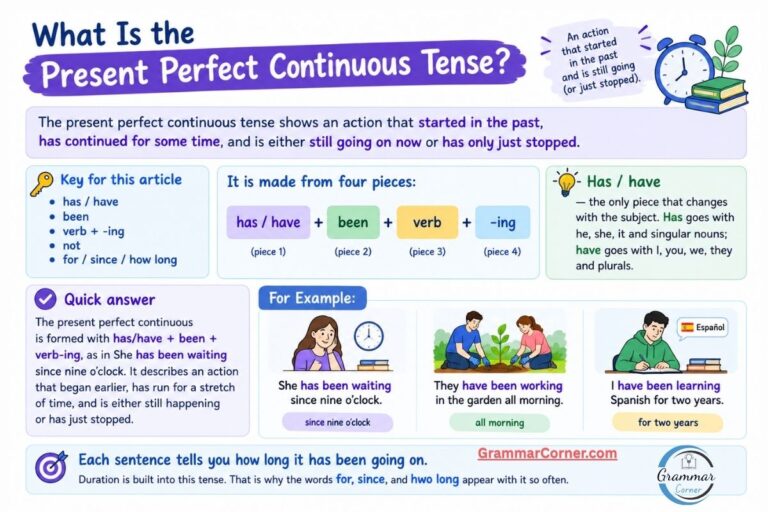
What Is the Present Perfect Continuous Tense? The present perfect continuous tense shows an action that started in the past, has continued for some time, and is either still going on now or has only just stopped. Key for this article has / have been verb + -ing not for / since / how long…
Past Continuous Tense Chart (Formula, Rules, Examples)
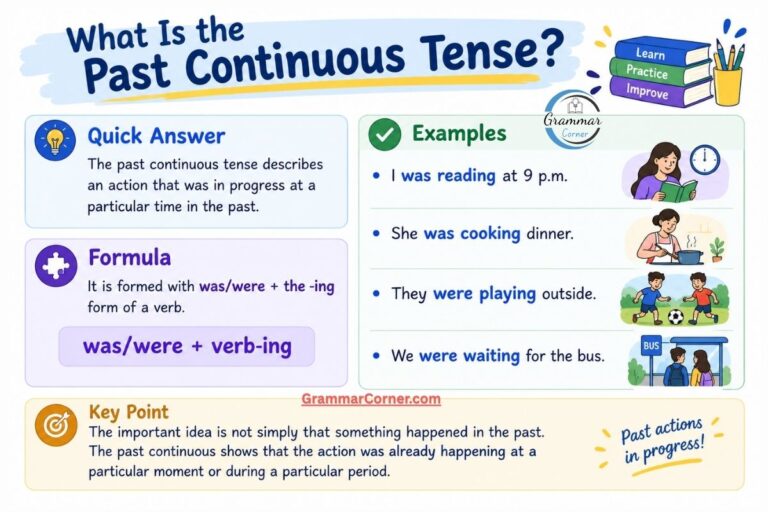
What Is the Past Continuous Tense? 🟦 Quick Answer The past continuous tense describes an action that was in progress at a particular time in the past. 🧩 Formula It is formed with was/were + the -ing form of a verb. was/were + verb-ing I was reading at 9 p.m. She was cooking dinner. They…
Future Continuous Conversation Questions with Answers
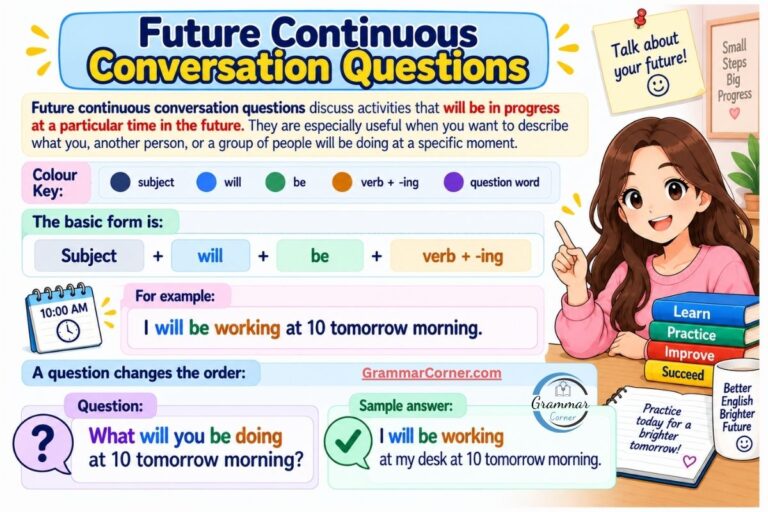
What Are Future Continuous Conversation Questions? subject will be verb + -ing question word Future continuous conversation questions discuss activities that will be in progress at a particular time in the future. They are especially useful when you want to describe what you, another person, or a group of people will be doing at a…
Past Perfect Continuous Tense Chart (Formula, Rules & Examples)
What Is the Past Perfect Continuous Tense? The past perfect continuous tense describes an action that had been continuing for some time before another point or event in the past. How the examples are marked had been verb + -ing duration phrase the later past event It is formed with: had + been + verb-ing…
Present Continuous Conversation Questions With Answers
The easiest way to learn grammar is to use it in real conversations instead of simply memorizing rules. While learning grammar rules is important, using them in everyday speaking helps you understand and remember them much more effectively. Among the English tenses, the present continuous tense is one of the most useful because it allows…