Conditional Sentences (Structure, Types and Examples)
What Is a Conditional Sentence?
A conditional sentence connects a condition with a result. It informs us what happens, may happen, could happen, or could have happened when a particular condition is met.
A conditional sentence usually consists of two distinct parts:
- Conditional clause (if-clause): States the condition (dependent clause; cannot stand alone).
- Main clause: States the outcome or result (independent clause; can stand on its own).
Deconstructing Example Sentences
Condition: “If you study regularly” | Result: “you will improve your English”
Condition: “If it rains” | Result: “we will stay indoors”
Conditional sentences aren’t limited to imaginary situations. We use them to express scientific facts, general habits, real possibilities, unlikely hypothetical scenarios, past regrets, and mixed temporal relationships. English traditionally organizes these into Zero, First, Second, and Third Conditionals, alongside Mixed Conditionals.
Conditional Sentence at a Glance
| Part | What It Does | Example |
|---|---|---|
| Conditional clause | Gives the condition | If it rains |
| Main clause | Gives the result | we will stay indoors |
| Connector | Introduces the condition | if |
Common Condition Connectors
While “if” is the most common connector, English regularly uses other expressions to express different types of conditions:
✨ Quick Challenge
In the sentence: “Unless the client signs the contract today, the project will be delayed.” Which part functions as the conditional clause (stating the condition)? Tap your answer.
See the full answer
Answer: “Unless the client signs the contract today”
Structural breakdown of the conditional sentence:
- Condition Connector: Unless (equivalent to if… not).
- Conditional Clause: Unless the client signs the contract today (dependent clause establishing the prerequisite).
- Main Result Clause: the project will be delayed (independent clause showing the consequence).
Conditional Sentence Structure & Punctuation
The standard conditional sentence follows a simple positional pattern. You can place either clause first, but the ordering directly changes your punctuation:
“If you leave now, you will catch the bus.”
“You will catch the bus if you leave now.”
The Four Main Types of Conditional Sentences
English traditionally divides conditional sentences into four primary types. While memorizing patterns helps, always pay attention to the meaning and time reference.
| Type | Main Use | Common Pattern | Example |
|---|---|---|---|
| Zero conditional | Facts, rules, general truths | If + present, present | If you heat ice, it melts. |
| First conditional | Real or possible future | If + present, will + verb | If it rains, we will stay home. |
| Second conditional | Unreal or unlikely situations | If + past, would + verb | If I had more time, I would travel. |
| Third conditional | Unreal past situations | If + past perfect, would have + past participle | If she had left earlier, she would have caught the train. |
1. Zero Conditional (Facts & Habits)
The zero conditional expresses general facts, scientific truths, habits, instructions, and predictable outcomes that occur whenever the condition is met.
“If you heat water to 100°C, it boils.”
Examples:
- If you mix blue and yellow, you get green. (Scientific fact)
- If people do not drink enough water, they become thirsty. (General truth)
- If the temperature drops below zero, water freezes. (Physical law)
- If I drink coffee late at night, I cannot sleep. (Personal habit)
Replacing “If” With “When”
In zero conditionals, “when” can frequently replace “if” because the condition is expected or certain to produce the outcome:
- If you press this button, the machine starts.
- When you press this button, the machine starts.
Zero Conditional With Imperatives (Commands)
When giving instructions, the result clause can use an imperative verb instead of the simple present:
- If the alarm rings, leave the building immediately.
- If you see any problems, tell the supervisor.
2. First Conditional (Real Future Possibilities)
The first conditional deals with real, realistic future events and their likely consequences.
“If you study tonight, you will be ready for the test.”
Notice that the conditional clause uses the simple present tense even though it refers to a future event.
Using Modals in the Result Clause
While will is standard, other modal verbs express varying degrees of certainty or permission:
| Modal | Meaning / Degree | Example |
|---|---|---|
| will | Expected result (High certainty) | If you practice, you will improve. |
| may | Possible result | If you hurry, you may catch the train. |
| might | Less certain possibility | If it rains, we might cancel the match. |
| can | Possible ability or opportunity | If you finish early, you can leave. |
Negative First Conditional & Using “Unless”
You can make either clause negative using standard auxiliary verbs or use unless (which means “if … not”):
Equivalent Expressions:
- “If you do not hurry, you will miss the bus.”
- “Unless you hurry, you will miss the bus.”
Caution: Do not combine unless with another negative expression in the same clause!
3. Second Conditional (Unreal / Hypothetical Present or Future)
The second conditional imagines present or future scenarios that are hypothetical, unreal, or unlikely. It allows you to explore situations that differ from current reality.
“If I had more free time, I would learn another language.”
Implied Reality: I do not currently have free time.Examples:
- If I lived near the sea, I would go swimming every morning.
- If she knew the answer, she would tell us.
- If we had a larger house, we would invite more people.
- If he worked harder, he could get a better position.
Using “Were” in the Second Conditional (Past Subjunctive)
In formal or careful English, were replaces was for all subjects when expressing hypothetical conditions:
- If I were you, I would apologize. (Most common advice pattern)
- If she were here, she would help us.
- If he were more careful, he would make fewer mistakes.
Note: While was is heard in casual everyday speech, were remains the standard past subjunctive form in formal writing.
First Conditional vs. Second Conditional
Choose between the first and second conditional based on how realistic you consider the possibility to be:
| Feature | First Conditional | Second Conditional |
|---|---|---|
| Context | Realistic / Possible future | Unlikely / Unreal situation |
| Condition Structure | If + present tense | If + past tense |
| Result Structure | will / may / can + verb | would / could / might + verb |
| Example Comparison | If I save enough, I will buy it. | If I had enough, I would buy it. |
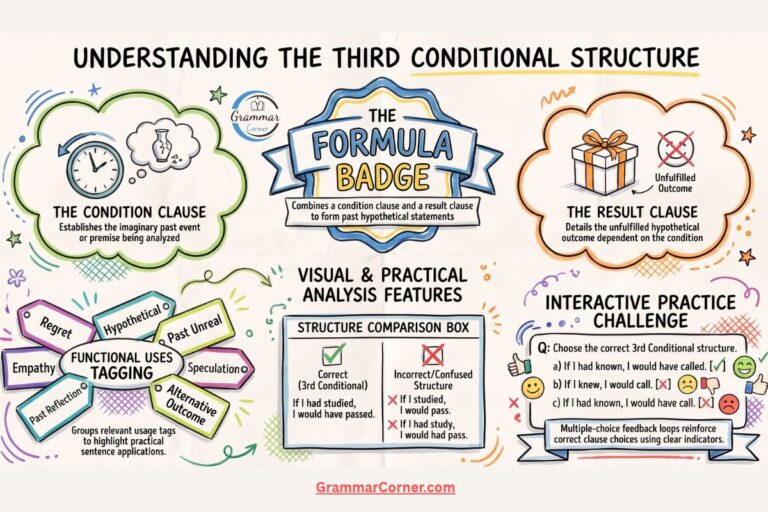
4. Third Conditional (Unreal Past Situations)
The third conditional describes an imagined past scenario and its result. Because the condition never happened, the result never occurred either. It is ideal for expressing regrets, missed opportunities, or alternative history.
“If she had left earlier, she would have caught the train.”
Implied Reality: She didn’t leave earlier, so she didn’t catch the train.Examples:
- If I had known about the meeting, I would have attended it.
- If they had taken the earlier road, they would have arrived sooner.
Third Conditional With Modal Verbs
You can swap would have with other past modals to adjust meaning:
| Modal Form | Meaning | Example |
|---|---|---|
| would have | Expected hypothetical result | If I had known, I would have helped. |
| could have | Hypothetical ability or opportunity | If we had left earlier, we could have arrived on time. |
| might have | Possible hypothetical result | If she had called, I might have gone. |
Mixed Conditional Sentences
A mixed conditional blends timeframes, connecting a condition from one time period with a result in another. Two patterns are especially common:
“If I had studied medicine, I would be a doctor now.”
- Unreal Past Cause: I did not study medicine.
- Present Consequence: I am not a doctor today.
“If I were more organized, I would have finished the project yesterday.”
- General Present State: I am not very organized.
- Unreal Past Consequence: I did not finish the project yesterday.
How Conditional Clauses Work
Every conditional sentence relies on a balanced partnership between two clauses: a dependent clause that sets the condition, and an independent clause that delivers the result.
Flexible Clause Ordering & Punctuation
You can swap the order of these clauses without changing the core meaning of your sentence, but keep an eye on the comma:
Condition First (Comma Required):
“If you need help, call me.”
Result First (No Comma Needed):
“Call me if you need help.“
Conditional Words and Expressions Other Than “If”
While “if” is the most common word used to introduce a condition, English offers several expressional alternatives that allow for greater precision:
Roughly means “if … not”.
“Unless you hurry, you will miss the bus.”
(= If you do not hurry…)
Emphasizes that a specific condition must be satisfied.
“You can use my car as long as you drive carefully.”
Introduces a formal condition that must be met.
“We will go ahead with the plan provided that everyone agrees.”
Shows the result happens regardless of the condition.
“Even if it rains, we will continue the event.”
Indicates that the outcome does not depend on which of two possibilities occurs.
“I will attend whether or not you come.”
Conditional Expressions at a Glance
| Expression | General Meaning | Example |
|---|---|---|
| if | Standard condition | If you call, I will answer. |
| unless | if not | Unless you call, I will leave. |
| as long as | on the condition that | You can stay as long as you are quiet. |
| provided that | if a condition is met | We can go provided that the weather improves. |
| even if | regardless of a possible condition | Even if he apologizes, she may not forgive him. |
| whether or not | either possibility occurs | I will go whether or not they agree. |
Note: Although these expressions share logical structures with standard conditional sentences, they are not always strictly interchangeable. Always evaluate the nuanced relationship between your two clauses!
Can You Use “Then” in a Conditional Sentence?
Yes, but using “then” in the main clause is entirely optional. It serves to emphasize the direct connection between the condition and result, but omitting it is equally correct.
With “Then”: If you study hard, then you will improve.
Without “Then”: If you study hard, you will improve.
Note: When the main clause comes first, “then” is normally omitted entirely (e.g., “You will improve if you study hard.”).
Conditional Sentences With Imperatives (Commands)
In daily instructions, requests, and emergency rules, conditional clauses often pair with an imperative main clause to state when a specific command applies:
- If you see John, tell him to call me.
- If the alarm rings, leave the building immediately.
- If you finish the form, hand it to the receptionist.
Conditional Sentences With Modal Verbs
By swapping out standard modals like will or would, you can fine-tune the exact level of certainty, ability, or permission in your result clause:
“If you finish early, you can leave.”
“If the weather improves, we may go outside.”
“If the traffic is heavy, we might arrive late.”
“If we had more time, we could visit the museum.”
“If you should need assistance, please contact the office.”
Inverted Conditional Sentences (Omitting “If”)
In formal writing, business correspondence, and literature, you can drop the word “if” by inverting the position of the subject and auxiliary verb:
Inversion Patterns
1. Inversion with “Had” (Past Unreal)
If you had told me, I would have helped. → Had you told me, I would have helped.
2. Inversion with “Were” (Present/Future Unreal)
If I were in your position, I would wait. → Were I in your position, I would wait.
3. Inversion with “Should” (Formal Request)
If you should have questions, contact us. → Should you have questions, contact us.
Conditional Sentence Punctuation Rules
The punctuation rule for conditional sentences remains completely consistent regardless of sentence length:
“If you study regularly, you will make progress.”
Long Example: “If you complete the application before Friday, the office will process your request next week.”
“You will make progress if you study regularly.”
Long Example: “The office will process your request next week if you complete the application before Friday.”
Key Takeaway: Never add a comma simply because a sentence is long—only add it when the conditional clause leads!
✨ Quick Challenge
Which of the following sentences correctly demonstrates an inverted conditional structure (omitting “if”) with proper punctuation? Tap your answer.
See the full answer
Answer: “Had you notified the supervisor, the delay would have been prevented.”
Key rules for inverted conditionals:
- Omit “If”: Drop the connector if entirely and place the auxiliary verb (Had / Were / Should) before the subject.
- Punctuation Rule: Because the conditional clause leads the sentence, a comma is mandatory before the main result clause.
- Formula (Past Unreal):
Had + subject + past participle, [main clause]
Common Mistakes With Conditional Sentences
Even advanced English speakers make errors when forming conditionals. Here are five of the most common pitfalls to watch out for in your writing:
The condition clause normally uses the simple present tense when expressing a future possibility.
The standard second conditional uses the simple past in the if-clause, reserving would for the main clause.
Make sure you are clear on whether your situation refers to the unreal present or an unreal past:
“If I had more money, I would travel more.”
Refers to an unreal present situation.“If I had saved more money, I would have traveled last year.”
Refers to an unreal past situation.The condition clause requires the past perfect (had + past participle), not would have.
Because unless already carries the negative meaning “if not,” adding another negative verb creates an unintended double negative.
How to Choose the Correct Conditional
When you’re unsure which structure to use, don’t start by memorizing complex formulas. Instead, analyze when the condition belongs and how real or unreal it is.
Ask These 5 Questions
Use the Zero Conditional: “If you heat ice, it melts.”
Use the First Conditional: “If I finish early, I will call you.”
Use the Second Conditional: “If I had more time, I would join you.”
Use the Third Conditional: “If I had known, I would have helped.”
Consider a Mixed Conditional: “If I had taken that job, I would live abroad now.”
Quick Decision Table
| Situation | Conditional Type |
|---|---|
| General fact or habit | Zero |
| Realistic future possibility | First |
| Unreal / unlikely present or future | Second |
| Unreal past scenario | Third |
| Different time relationships (e.g., past condition, present result) | Mixed |
Conditional Sentences in Everyday English
Conditional sentences aren’t just abstract grammar rules—they appear organically in everyday conversation to serve specific communication goals:
“If the weather is good, we’ll go to the park.”
“If I were you, I would talk to the teacher.”
“If I had left earlier, I wouldn’t have been late.”
“If she calls, I’ll let you know.”
“If you need anything, just ask.”
“If plants don’t get enough water, they wilt.”
Key Takeaway: The specific conditional structure you choose depends on the intended meaning and timeframe you want to communicate, rather than the topic itself.
Conditional Sentences in Formal & Academic Writing
In academic papers, policy documentation, and business communications, conditional structures provide essential precision by outlining exact cause-and-effect relationships:
Examples of Formal Usage:
Practice: Identify the Conditional Type
Test your understanding by identifying the conditional type (Zero, First, Second, Third, or Mixed) for each sentence below.
- If you freeze water, it becomes ice.
- If I finish my work early, I will call you.
- If I lived closer, I would visit more often.
- If they had left earlier, they would have caught the train.
- If I had accepted that offer, I would live in another city now.
- If the alarm rings, leave the building.
- If she were more confident, she could speak in front of the audience.
- If you had told me yesterday, I would have helped you.
Click to reveal Answer Key & Explanations
| No. | Type | Reason |
|---|---|---|
| 1 | Zero | General scientific fact |
| 2 | First | Realistic future possibility |
| 3 | Second | Unreal/hypothetical present situation |
| 4 | Third | Unreal past situation |
| 5 | Mixed | Past condition affecting present result |
| 6 | Zero | Instruction/Command with imperative |
| 7 | Second | Hypothetical present condition & ability |
| 8 | Third | Unreal past condition and unreal past result |
Practice: Complete the Conditional Sentences
Complete each sentence with a suitable verb form based on the context provided.
- If you study regularly, you ? your English.
- If I ? more free time, I would learn another language.
- If she had left earlier, she ? the train.
- If you heat metal, it ?.
- If the weather is good tomorrow, we ? outside.
- If I had known about the problem, I ? you.
- If he were more careful, he ? fewer mistakes.
Click to reveal Suggested Answers & Explanations
| No. | Suggested Answer | Conditional Type & Explanation |
|---|---|---|
| 1 | will improve | First Conditional (Real future result) |
| 2 | had | Second Conditional (Unreal present state) |
| 3 | would have caught | Third Conditional (Unreal past result) |
| 4 | expands | Zero Conditional (Scientific general fact) |
| 5 | will go | First Conditional (Future plan based on condition) |
| 6 | would have helped | Third Conditional (Unreal past scenario) |
| 7 | would make | Second Conditional (Hypothetical present behavior) |
Note: More than one answer may sometimes be possible depending on the exact nuance or intended timeframe you wish to express.
Frequently Asked Questions About Conditional Sentences
A conditional sentence connects a condition with its result. It normally contains a dependent conditional clause (usually starting with if or unless) and an independent main clause.
English grammar traditionally identifies four main types: zero, first, second, and third conditional. Mixed conditionals are also commonly taught because they connect conditions and results from different time periods.
The zero conditional is mainly used for general truths, facts, habits, rules, and predictable scientific results.
The first conditional describes a realistic or possible future condition and its likely result.
The second conditional describes an unreal, hypothetical, or unlikely present or future situation.
The third conditional describes an unreal past condition and its imagined past result.
A mixed conditional combines time patterns from different conditional types. It is often used when a past condition has a present result or a present condition has a past result.
Sometimes. Unless generally means “if not.” The two structures are not interchangeable in every context, so always check the intended meaning.
No. Zero conditionals use the present simple in both clauses, second conditionals use would, and third conditionals use would have. Modal verbs such as can, could, may, and might are also frequently used.
Use a comma when the conditional clause comes first. When the main clause comes first, a comma is normally unnecessary.
Main Clause First: “Wait outside if you arrive early.”
Yes, the order is flexible. You can place either the condition or the result first without changing the core meaning (e.g., “I will call you if I need help.”).
Focus on the timeframe and level of reality rather than memorizing rigid formulas: