Simple Future Tense Chart (Formula, Rules & Examples)
What Is the Simple Future Tense?
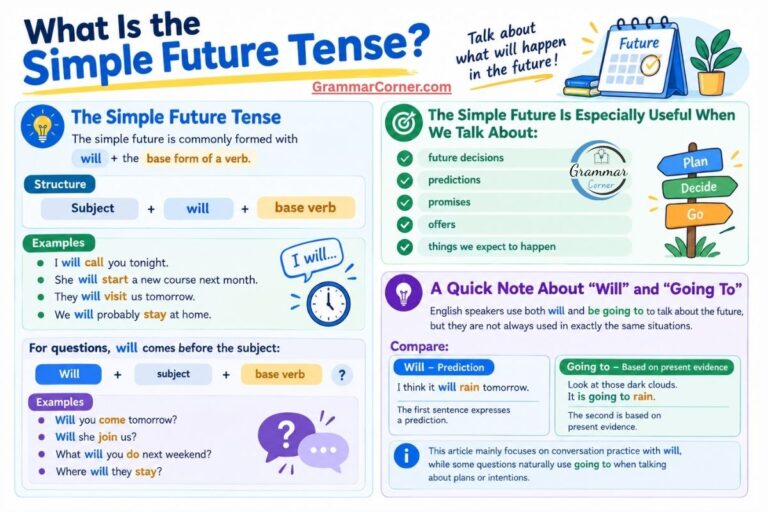
The simple future tense talks about an action, event, or situation that is expected to happen after now.
The most common way to form it is:
Examples:
- I will call you tomorrow.
- She will finish the work later.
- They will visit us next week.
- We will discuss the matter tomorrow.
The verb after will always stays in its base form. It does not take -s, -ed, or -ing.
| Subject | Correct Form | Example |
|---|---|---|
| I | will + work | I will work. |
| You | will + work | You will work. |
| He | will + work | He will work. |
| She | will + work | She will work. |
| We | will + work | We will work. |
| They | will + work | They will work. |
Notice that will work is the same with every subject.
Simple Future at a Glance
| Sentence | Example |
|---|---|
| Positive | She will arrive tomorrow. |
| Negative | She will not arrive tomorrow. |
| Question | Will she arrive tomorrow? |
| Wh-question | When will she arrive? |
Quick Practice
Choose the correct form.
- He will go / goes tomorrow.
- They will finish / finished the project.
- She will come / coming later.
Show Answers
- go
- finish
- come
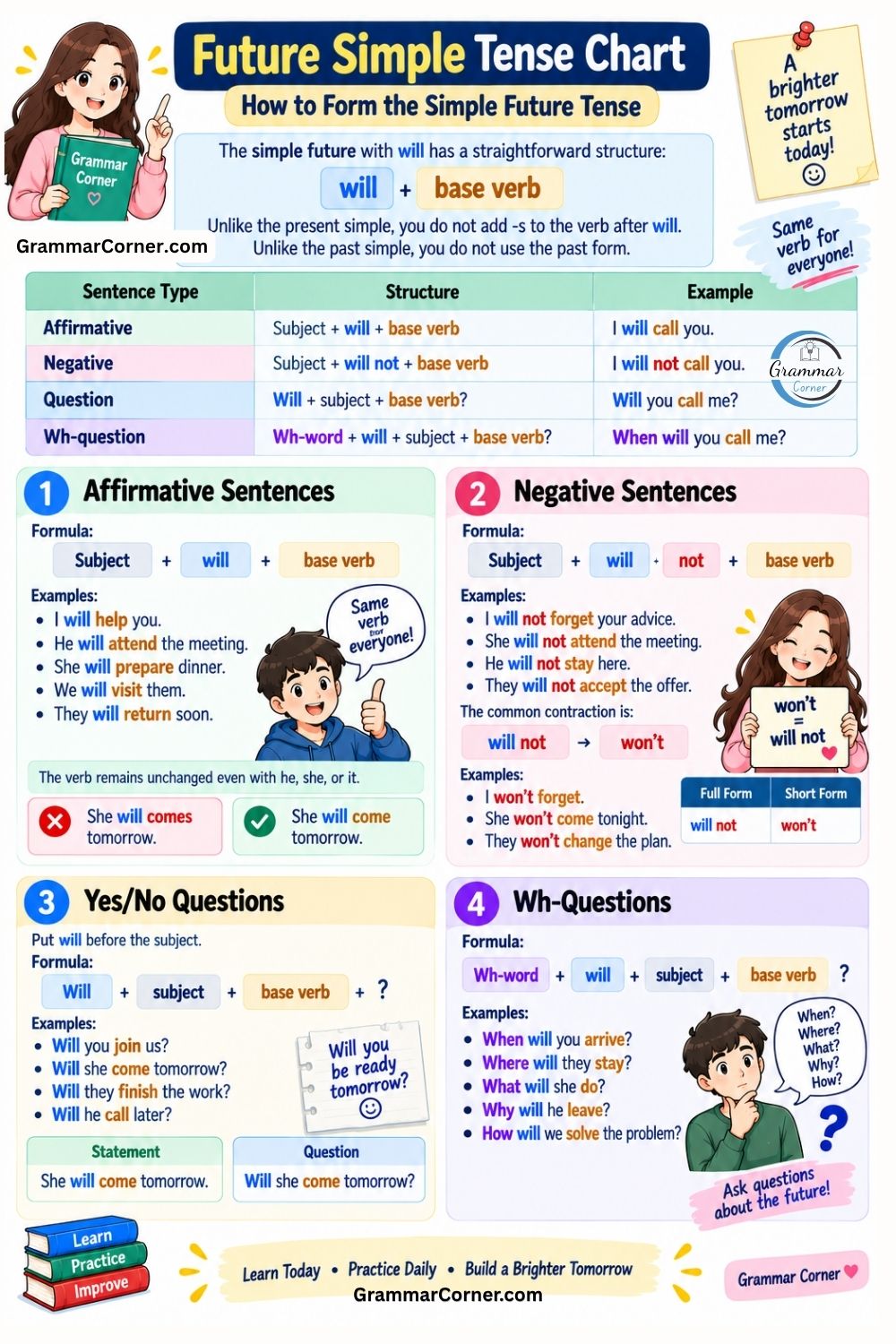
How to Form the Simple Future Tense
The simple future with will has a straightforward structure.
Unlike the present simple, you do not add -s to the verb after will. Unlike the past simple, you do not use the past form.
| Sentence type | Structure | Example |
|---|---|---|
| Affirmative | Subject + will + base verb | I will call you. |
| Negative | Subject + will not + base verb | I will not call you. |
| Question | Will + subject + base verb? | Will you call me? |
| Wh-question | Wh-word + will + subject + base verb? | When will you call me? |
Affirmative Sentences
Use:
Examples:
- I will help you.
- He will attend the meeting.
- She will prepare dinner.
- We will visit them.
- They will return soon.
The verb remains unchanged even with he, she, or it.
Negative Sentences
Use:
Examples:
- I will not forget your advice.
- She will not attend the meeting.
- He will not stay here.
- They will not accept the offer.
The common contraction is:
Examples:
- I won’t forget.
- She won’t come tonight.
- They won’t change the plan.
| Full form | Short form |
|---|---|
| will not | won’t |
Yes/No Questions
Put will before the subject.
Examples:
- Will you join us?
- Will she come tomorrow?
- Will they finish the work?
- Will he call later?
Compare:
Wh-Questions
Use:
Examples:
- When will you arrive?
- Where will they stay?
- What will she do?
- Why will he leave?
- How will we solve the problem?
| Wh-word | Example |
|---|---|
| What | What will you do? |
| Where | Where will she go? |
| When | When will they arrive? |
| Why | Why will he leave? |
| How | How will you manage it? |
Contractions with Will
In everyday English, will is frequently shortened.
| Full form | Contraction |
|---|---|
| I will | I‘ll |
| you will | you‘ll |
| he will | he‘ll |
| she will | she‘ll |
| it will | it‘ll |
| we will | we‘ll |
| they will | they‘ll |
Examples:
- I‘ll call you tonight.
- She‘ll help us.
- We‘ll meet tomorrow.
- They‘ll arrive soon.
Quick Practice
Change the sentences as directed.
- He will attend the meeting. → Negative
Answer
He will not / won’t attend the meeting. - She will visit us tomorrow. → Question
Answer
Will she visit us tomorrow? - They will leave at six. → Wh-question using when
Answer
When will they leave?
All answers
When Do We Use the Simple Future Tense?
The simple future is used for several different purposes. The important thing is to understand why the speaker chooses will, rather than treating every future statement as the same.
For Predictions
Use will when you think or believe something will happen in the future.
Examples:
Words such as think, believe, expect, probably, and sure often appear with this type of prediction.
I think you will like this book.
The speaker is expressing a belief about the future, not reporting a confirmed arrangement.
For Decisions Made While Speaking
Use will when you decide to do something at the moment you speak.
Imagine this situation:
The decision was not made earlier. You made it as you spoke.
More examples:
This is one of the clearest situations in which will is used.
For Promises
Use will when making a promise about something you intend to do.
A promise can be positive or negative:
For Offers
Will can be used when you offer to do something for someone.
The offer is usually made in response to a situation that exists at the moment.
For Requests
Questions beginning with will can ask someone to do something.
Here, will is not simply asking about a future event. It can ask whether someone is willing to perform an action.
For Willingness or Refusal
Will can also express willingness.
The negative form won’t can express unwillingness:
In these sentences, won’t can mean refuses to rather than simply will not happen.
Quick Practice
Identify the use of will in each sentence.
- I think the price will increase.
- “Someone is calling.” “I will answer.”
- I will always support you.
- Will you help me with this box?
Answers
- Prediction
- Decision made at the moment
- Promise
- Request
Will vs. Be Going To
Both will and be going to can talk about the future, but they often communicate different ideas.
Use Will for a Decision Made Now
If the decision is made at the moment of speaking, will is natural.
The speaker has just made the decision.
Use Be Going To for an Earlier Plan
If you decided on the plan before speaking, be going to is often more suitable.
I am going to buy a new phone next month.
The decision already existed before the sentence was spoken.
The structure is:
am/is/are + going to + base verbExamples:
Use Going To for Evidence-Based Predictions
Use be going to when something in the present gives you evidence about what will happen.
Look at the dark sky:
You can see evidence now.
Compare:
This is simply a prediction or opinion.
Will and Going To Compared
| Situation | Common choice | Example |
|---|---|---|
| Decision made now | will | I’ll make some tea. |
| Offer | will | I’ll carry that for you. |
| Promise | will | I’ll call you tonight. |
| Personal prediction | will | I think she’ll win. |
| Earlier plan | going to | I’m going to study tonight. |
| Evidence-based prediction | going to | Look at those clouds. It’s going to rain. |
The distinction is useful, but it is not an unbreakable rule. In natural English, will and going to can sometimes both work, with the context influencing the choice.
Quick Practice
Choose will or going to.
- “The doorbell is ringing.” “I ______ open it.”
- I have already planned my trip. I ______ travel next Friday.
- Look at that child on the wall! He ______ fall.
- I think our team ______ win.
Answers
- will
- am going to
- is going to
- will
Simple Future with Time Expressions
Future sentences often contain words or phrases that tell us when an event will happen.
Common future time expressions include:
Examples:
| Time expression | Sentence |
|---|---|
| tomorrow | I will call you tomorrow. |
| tonight | She will arrive tonight. |
| later | We will discuss it later. |
| soon | He will return soon. |
| next week | They will start next week. |
| next year | We will move next year. |
| in two days | The course will begin in two days. |
Remember that the time expression itself does not form the tense.
will + base verbgives us the simple future structure.
Position of Time Expressions
A time expression can appear at the beginning or end of a sentence.
Both are correct.
Another example:
Quick Practice
Rewrite each sentence by moving the time expression to the beginning.
- I will visit my uncle tomorrow.
- She will start the course next month.
- They will arrive tonight.
Answers
- Tomorrow, I will visit my uncle.
- Next month, she will start the course.
- Tonight, they will arrive.
Simple Future in If and Time Clauses
A common mistake is to put will in every part of a sentence that refers to the future.
When if, when, before, after, until, or as soon as introduces a future condition or time clause, the subordinate clause normally uses the simple present, not will.
After When
The arrival is future in meaning, but the clause beginning with when uses the simple present.
After Before
After After
After As Soon As
In If Clauses
The future result appears in the main clause:
| Incorrect | Correct |
|---|---|
| If he will come, I will talk to him. | If he comes, I will talk to him. |
| When she will arrive, we will eat. | When she arrives, we will eat. |
| After they will finish, we will leave. | After they finish, we will leave. |
| Before you will go, call me. | Before you go, call me. |
Quick Practice
Correct these sentences.
- When he will arrive, we will begin.
Answer
When he arrives, we will begin. - If she will call, I will answer.
Answer
If she calls, I will answer. - We will leave after the rain will stop.
Answer
We will leave after the rain stops. - I will speak to him before he will go.
Answer
I will speak to him before he goes.
All answers
Simple Future vs. Other Future Forms
English has several ways to talk about the future. Choosing the right one depends on what you want to communicate.
Simple Future vs. Simple Present
The simple present can refer to future events when they are part of a fixed timetable or schedule.
- The train leaves at 7:00.
- The examination starts at 9:00.
- The plane arrives at noon.
The simple future is also possible when simply talking about what will happen:
- The train will leave at 7:00.
- The examination will start at 9:00.
Simple Future vs. Present Continuous
The present continuous is often used for a future arrangement that has already been made.
- I am meeting the manager tomorrow.
- She is visiting her parents this weekend.
- We are traveling next Friday.
Compare:
This can simply state a future event.
This suggests that the meeting is already arranged.
Simple Future vs. Going To
| Form | Typical use | Example |
|---|---|---|
| will | decision now | I‘ll call him. |
| will | prediction | I think she‘ll win. |
| going to | prior plan | I’m going to call him tonight. |
| going to | present evidence | It’s going to rain. |
| present continuous | arrangement | I’m meeting him tomorrow. |
| simple present | timetable | The train leaves at 8. |
Quick Practice
Choose the form that best fits the situation.
- The train at 6:30 according to the timetable.
Answer
leaves - “We need more water.” “I buy some.”
Answer
will - I have arranged a meeting with Ali for tomorrow. I Ali tomorrow.
Answer
am meeting - Look at those clouds. It rain.
Answer
is going to - I think she get the job.
Answer
will
All answers
Common Mistakes with the Simple Future Tense
Adding -s After Will
After will, always use the base form.
Using the Past Form After Will
The verb does not change to the past form after will.
Adding To After Will
The structure is:
not:
Using Will in a Future If Clause
The condition clause normally uses the simple present.
Using Will After When
The future meaning does not require will in the when clause.
Treating Every Future Plan as Will
A future plan that was decided earlier can often be expressed more naturally with going to or the present continuous.
Instead of automatically writing:
- I will visit my friend tomorrow.
you may use:
- I am going to visit my friend tomorrow.
or:
- I am visiting my friend tomorrow.
The best choice depends on whether the sentence expresses a plan, an arrangement, or simply a future event.
Quick Practice
Correct the mistakes.
- He will comes tomorrow.
Answer
He will come tomorrow. - I will to help you.
Answer
I will help you. - She will went home later.
Answer
She will go home later. - If it will rain, we will stay inside.
Answer
If it rains, we will stay inside. - When they will arrive, we will start.
Answer
When they arrive, we will start.
Simple Future Tense Practice Exercises
Exercise 1: Complete the Sentences
Use will + the correct base form of the verb.
- I you after work. (call)
- She the report tonight. (finish)
- They us next Sunday. (visit)
- We the problem tomorrow. (discuss)
- He the results soon. (receive)
- The meeting at 10 a.m. (begin)
Exercise 2: Choose Will or Going To
- “The phone is ringing.” “I answer it.”
- We have already planned the trip. We travel on Friday.
- Look at that glass! It fall.
- I think he pass the exam.
- She has decided to learn Spanish. She take classes next month.
Exercise 3: Correct the Sentences
- She will goes to school tomorrow.
- They will to arrive at noon.
- When he will call, I will tell him.
- If she will study, she will pass.
- I will went there next week.
Exercise 4: Identify the Use
What is will expressing in each sentence?
- I will help you with those boxes.
- I think the price will increase.
- “There is no bread.” “I will buy some.”
- Will you close the window?
- I will never forget your kindness.
Answers
Exercise 1
- will call
- will finish
- will visit
- will discuss
- will receive
- will begin
Exercise 2
- will
- are going to
- is going to
- will
- is going to
Exercise 3
- She will go to school tomorrow.
- They will arrive at noon.
- When he calls, I will tell him.
- If she studies, she will pass.
- I will go there next week.
Exercise 4
- Offer
- Prediction
- Decision made at the moment
- Request
- Promise
Frequently Asked Questions About the Simple Future Tense
What is the simple future tense?
The simple future tense is used to talk about actions, events, or situations that will happen after the present. Its most common structure is will + base verb.
What is the formula for the simple future tense?
The basic formula is:
Subject + will + base verb
For example: “She will arrive tomorrow.”
What is the negative form of the simple future?
Use will not + base verb.
For example: “They will not attend the meeting.”
The common contracted form is: “They won’t attend the meeting.”
How do you make a question in the simple future?
Put will before the subject:
Will + subject + base verb?
For example: “Will you come tomorrow?”
What is the difference between will and going to?
Will is commonly used for decisions made at the moment, offers, promises, and predictions. Going to is commonly used for plans already made and predictions based on present evidence.
Can we use will after if?
Normally, we do not use will in an ordinary future condition clause beginning with if.
If it will rain, we will stay home.
If it rains, we will stay home.
Can we use will after when?
Normally, no, when when introduces a future time clause.
When she will arrive, we will start.
When she arrives, we will start.
Does the verb change after will?
No. The verb remains in its base form.
- I will go.
- She will go.
- They will go.
Not “will goes,” “will went,” or “will going.”
Is will the only way to talk about the future?
No. English also uses be going to, the present continuous, and the simple present, among other structures, to express different kinds of future meaning.
For example:
- “I will call you.” → future decision/promise
- “I am going to call you.” → prior intention
- “I am calling him tomorrow.” → arranged event
- “The train leaves at 8.” → timetable
The form you choose depends on the meaning and context.
All 12 tenses, in one place
English builds every tense from the same two ingredients — when (present, past, future) and aspect (simple, continuous, perfect, perfect continuous). Each tense below links to its chart and a set of practice conversation questions.
| Present Tense | Past Tense | Future Tense |
|---|---|---|