Present Participle (Functions, Formula & Examples)
What Is a Present Participle?
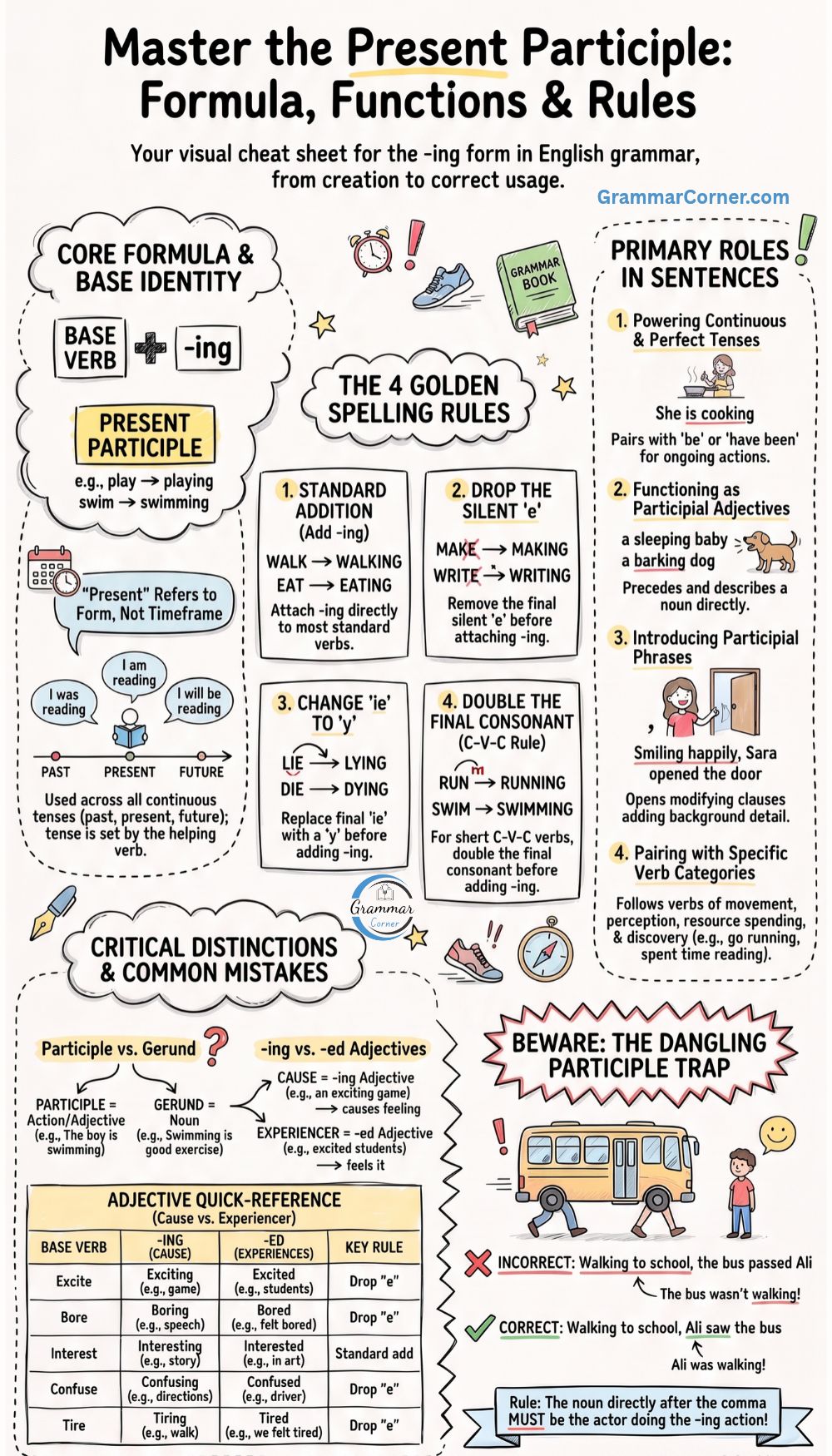
A present participle is a non-finite verb form created by adding -ing to the base verb. Unlike irregular past participles, both regular and irregular verbs take the uniform -ing suffix when forming the present participle.
Common Verb Conjugations
| Base Verb (V1) | Present Participle (-ing Form) |
|---|---|
| play | playing |
| read | reading |
| eat | eating |
| write | writing |
| swim | swimming |
| run | running |
| talk | talking |
Three Functions of a Present Participle
A single -ing word can fulfill different grammatical roles depending on its position and function within the sentence:
Pairs with auxiliary verbs (is, are, was, were) to express ongoing action.
Functions directly as an adjective to modify and describe a noun.
Introduces a modifying phrase to provide concise contextual detail.
Quick Challenge
Which word is the present participle in the sentence: “The children are playing outside.”? Tap your answer.
See the full explanation
Answer: C. playing
Sentence structure breakdown:
- Subject: The children (Plural noun performing the action).
- Helping Verb (Auxiliary): are (Marks present tense and agrees with plural subject).
- Present Participle: playing (The -ing verb form completing the present continuous action).
- Adverb: outside (Describes the location of the action).
How to Form Present Participles
For most verbs, forming the present participle simply involves adding -ing to the base form (play ➔ playing, work ➔ working). However, specific word endings require precise spelling adjustments.
Attach -ing directly to the base verb:
- walk ➔ walking | talk ➔ talking
- eat ➔ eating | wash ➔ washing | open ➔ opening
“The children are playing in the garden.”
Remove the final e before adding -ing:
- make ➔ making (not makeing)
- write ➔ writing | ride ➔ riding
- come ➔ coming | dance ➔ dancing
Replace final -ie with y, then add -ing:
- lie ➔ lying (“The baby is lying on the bed.”)
- die ➔ dying | tie ➔ tying
Short C-V-C verbs double the final consonant:
- run ➔ running (not runing)
- swim ➔ swimming | sit ➔ sitting
- stop ➔ stopping | get ➔ getting
Present Participles in Continuous Tenses
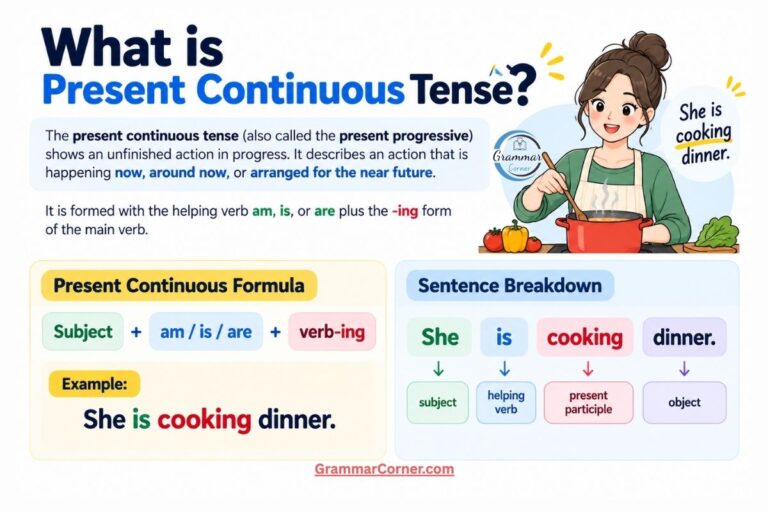
Continuous tenses describe ongoing actions unfolding over time. Every continuous structure pairs a form of be with the present participle (-ing).
- I am reading.
- She is cooking dinner.
- They are playing football.
- We are learning English.
- I was sleeping when you called.
- She was reading a book.
- They were playing outside.
- I will be studying tonight.
- She will be traveling tomorrow.
- They will be playing at 5 o’clock.
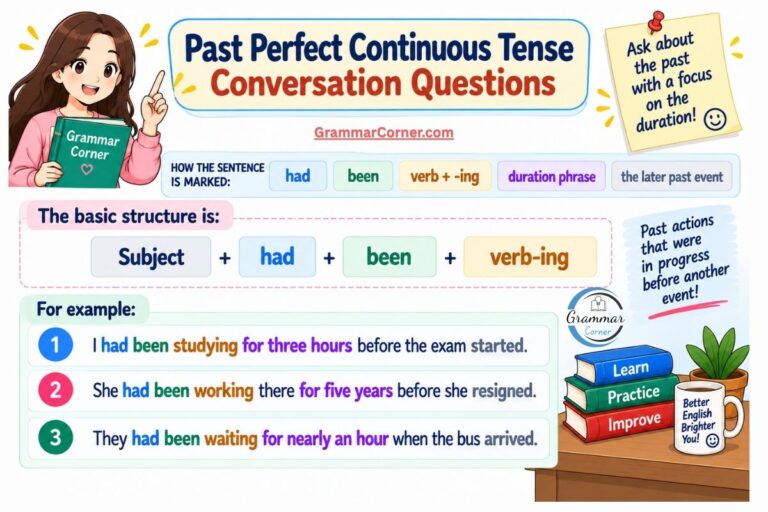
- I have been studying for two hours.
- She had been waiting for an hour.
- They will have been working all day.
Present Participle as an Adjective
A present participle can directly precede and modify a noun, acting as a descriptive participial adjective:
- The barking dog woke me up. (Describes the dog).
- We saw a flying bird. (Describes the bird).
- The crying baby needs milk. (Describes the baby).
Quick Challenge
Which of the following sentences correctly uses a present participle as an adjective and follows proper C-V-C consonant-doubling spelling? Tap your answer.
See the full explanation
Answer: “The sleeping baby was undisturbed by the running water.”
Grammar and spelling breakdown:
- Participial Adjective: sleeping acts as an adjective describing the noun baby.
- Consonant Doubling: run ➔ running (one-syllable consonant-vowel-consonant structure doubles the n).
- Spelling Rules: make drops silent e ➔ making; swim doubles final m ➔ swimming.
Participial Phrases
A participial phrase is a modifying clause that begins with a participle (such as a present participle ending in -ing) and provides extra background detail about a noun or pronoun in the main sentence.
Consider these examples of participial phrases in action:
- Running down the road, Ali dropped his bag. (Explains what Ali was doing).
- Smiling happily, Sara opened the door. (Gives descriptive detail about Sara).
- Holding an umbrella, Tom walked home. (Modifies Tom).
- Looking through the window, Maria saw a bird.
- Laughing loudly, the children entered the classroom.
“Walking to school, Ali met his friend.”
Avoiding Dangling Participles
The noun or pronoun appearing immediately after the comma must be the exact subject performing the -ing action. If the subject is mismatched, the participle “dangles” and creates an illogical sentence.
✅ Corrected: “Walking to school, Ali saw the bus pass by.” (Ali is doing the walking).
Present Participle for Simultaneous Actions
A present participle can show two actions happening at the exact same time performed by the same subject:
Present Participle to Explain a Reason
A participial phrase can replace a clause of reason (starting with because, since, or as) to create concise writing:
- Feeling hungry, Ali made a sandwich.
- Feeling tired, Sara went to bed early.
- Knowing the answer, Ahmed raised his hand.
- Being sick, Tom stayed at home.
- Seeing the rain, Maria took an umbrella.
- Because he was hungry, Ali made a sandwich.
- Since she felt tired, Sara went to bed early.
- Because he knew the answer, Ahmed raised his hand.
- As he was sick, Tom stayed at home.
- Because she saw the rain, Maria took an umbrella.
Present Participle After Verbs of Movement & Position
Present participles regularly follow verbs of movement or physical posture (go, come, sit, stand, lie, walk) to describe the secondary activity:
- She went shopping with her sister.
- I go running every morning.
- He came running into the room.
- Dad sat reading the newspaper.
Present Participle After Verbs of Perception
Verbs of sensory perception (see, hear, watch, smell, notice) pair with a direct object and an -ing participle to describe an action in progress:
- I heard the baby crying. (Heard the crying in progress).
- She saw her brother running.
- We watched the birds flying.
- I smelled something burning in the kitchen.
- I saw Ali crossing the road.
Quick Challenge
Which of the following sentences correctly avoids a dangling participle and properly uses a present participle after a verb of perception? Tap your answer.
See the full explanation
Answer: “Walking home, Ali smiled as he heard the children playing in the park.”
Grammar breakdown:
- Modifier Attachment: Walking home is immediately followed by Ali, who is the person actually walking.
- Perception Verb Pattern:
heard (Verb) + the children (Object) + playing (Present Participle)depicts an action observed in progress. - Avoid Dangling Modifiers: Ensure the subject following the comma is the performer of the introductory participle phrase.
Present Participle with “Spend” and “Waste”
When discussing resource allocation—such as allocating or misusing time or money—the verbs spend and waste regularly pair with a present participle (-ing).
- I spent two hours reading.
- She spent the afternoon playing games.
- He wasted his time watching television.
- We spent the weekend traveling across the coast.
- Don’t waste your money buying things you do not need.
- She spent an hour doing her homework.
Present Participle with “Catch” and “Find”
Verbs of discovery like catch and find take an object followed by a present participle to describe the ongoing action observed at that moment:
Often implies discovering someone doing something prohibited:
- Mom caught me eating chocolate.
- The teacher caught the students talking.
- The teacher caught Ali cheating on the test.
Indicates discovering someone or something mid-activity:
- We found the baby sleeping peacefully.
- They found their dog sitting under the table.
- We found Ali reading in the quiet study room.
Present Participles and “-ed” Adjectives
• -ed Adjective: The person who experiences that feeling.
Common Participle Adjective Pairs
| -ing Adjective (Cause of Feeling) | -ed Adjective (Experiencing Feeling) |
|---|---|
| exciting (“an exciting game”) | excited (“The students were excited.”) |
| boring (“a boring speech”) | bored (“I felt bored during the lecture.”) |
| interesting (“The lesson was interesting.”) | interested (“I was interested in the lesson.”) |
| confusing (“confusing directions”) | confused (“The driver was confused.”) |
| surprising (“surprising test results”) | surprised (“We were surprised by the gift.”) |
| frightening (“a frightening storm”) | frightened (“The child was frightened.”) |
| tiring (“The long walk was tiring.”) | tired (“We were tired after the walk.”) |
| amazing (“an amazing performance”) | amazed (“The audience was amazed.”) |
Present Participles vs. Gerunds
Both present participles and gerunds share the -ing suffix, but they serve completely different grammatical functions in a sentence:
- Forms Continuous Tense: “The boy is running.”
- Modifies a Noun: “The running water is cold.”
- Subject of Sentence: “Swimming is good exercise.”
- Direct Object: “I enjoy reading.”
Present Participle vs. Past Participle
Compare how present participles (continuous/ongoing) differ from past participles (completed/perfect):
The Five Principal Forms of English Verbs
Understanding all five verb forms allows you to see exactly where present participles fit into English grammar:
| Verb Form | Grammatical Role | Example: “write” | Example: “run” |
|---|---|---|---|
| Base Form (V1) | Infinitive / Present Plural | write | run |
| Third-Person Singular | Present Simple with He/She/It | writes | runs |
| Simple Past (V2) | Completed Past Action | wrote | ran |
| Past Participle (V3) | Perfect Tenses & Passive Voice | written | run |
| Present Participle (-ing) | Continuous Tenses & Gerunds | writing | running |
Quick Challenge
Which of the following sentences correctly demonstrates an -ing word functioning as a gerund (noun role) rather than a present participle? Tap your answer.
See the full explanation
Answer: “Singing is her favorite weekend activity.”
Grammar breakdown:
- Gerund Function: When an -ing word acts as a noun (functioning as the subject, direct object, or object of a preposition), it is classified as a gerund.
- Present Participle Function: When the -ing word forms part of a continuous verb tense (is singing) or modifies a noun as an adjective (singing bird), it is a present participle.
- Verb Pattern Check: With verbs like spend, waste, catch, and find, always follow with the present participle form (spent time doing, caught someone talking).
Is the Present Participle Always About the Present?
No. The word “present” in present participle identifies the form of the verb (the -ing form), not necessarily the timeframe in which the action takes place.
Present participles are used across past, present, and future timeframes whenever an action is ongoing:
- Past Action: “I was reading yesterday.” (Happened in the past, but reading is still a present participle).
- Future Action: “I will be reading tomorrow.” (Takes place in the future, yet reading remains a present participle).
- Present Action: “I am reading right now.”
Common Mistakes with Present Participles
While forming present participles is straightforward, watch out for these five common spelling, structural, and grammatical errors:
✅ Correct: She is reading a book.
✅ Correct: He is making dinner.
✅ Correct: The boy is running.
✅ Correct: I am excited about the trip. (The trip is exciting; I feel excited).
✅ Correct: Walking to school, Ali saw the bus. (Places the person walking right after the comma).
Why Are Present Participles Important?
Present participles are essential grammatical tools used across multiple core sentence structures:
Powers present, past, and future continuous structures (is playing, was watching, will be traveling).
Expresses duration up to a point in time (has been studying, had been waiting).
Combines related clauses smoothly (“Smiling happily, Sara entered the room.”).
Describes nouns by highlighting their active quality (an interesting story, running water).
- I am learning English.
- My brother is playing football.
- We were watching television.
- She has been studying all morning.
- It was an interesting story.
Quick Challenge
Identify which sentence correctly applies the present participle in a past continuous timeframe and uses accurate spelling. Tap your answer.
See the full explanation
Answer: “Ali was running in the park yesterday morning.”
Grammar and spelling analysis:
- Participle Identity: running is a present participle even though the sentence takes place in the past.
- Spelling Rule: run ➔ running (doubles the final n).
- Continuous Tense:
was + runningcreates the past continuous tense.
Practice Exercises on Present Participles
Test your mastery of present participles (-ing forms) across identification, spelling transformations, continuous tenses, gerund differentiation, participial phrases, and error correction.
- Ali is reading a book. ➔ reading
- The children are playing outside. ➔ playing
- We were watching a movie. ➔ watching
- She is cooking dinner. ➔ cooking
- The barking dog woke me up. ➔ barking
- I saw the birds flying. ➔ flying
- The crying baby needs milk. ➔ crying
- They will be traveling tomorrow. ➔ traveling
- play ➔ playing
- eat ➔ eating
- make ➔ making
- write ➔ writing
- run ➔ running
- swim ➔ swimming
- lie ➔ lying
- dance ➔ dancing
- sit ➔ sitting
- tie ➔ tying
- Sara is reading a book. (read)
- They are playing football. (play)
- I was cooking dinner. (cook)
- He was walking to school. (walk)
- We will be traveling tomorrow. (travel)
- She has been studying for two hours. (study)
- Swimming is my favorite sport. ➔ Gerund
- The boy is swimming in the pool. ➔ Present Participle
- I enjoy reading books. ➔ Gerund
- The girl is reading a book. ➔ Present Participle
- The barking dog scared me. ➔ Present Participle
- Running is good exercise. ➔ Gerund
- The movie was boring. (Cause)
- I was bored by the movie. (Experiencer)
- The children were excited about the trip. (Experiencer)
- The trip was exciting. (Cause)
- The lesson was confusing. (Cause)
- The students were confused. (Experiencer)
- runing ➔ running
- makeing ➔ making
- writeing ➔ writing
- swiming ➔ swimming
- siting ➔ sitting
- lieing ➔ lying
- danceing ➔ dancing
- stoping ➔ stopping
- Running quickly, Ali caught the bus.
- Smiling happily, Sara opened the gift.
- Laughing loudly, the children entered the room.
- Holding his umbrella, Tom walked home.
- She is makeing… ➔ She is making dinner.
- They are swiming… ➔ They are swimming in the pool.
- He was runing… ➔ He was running to school.
- I am exciting… ➔ I am excited about the trip.
- Walking to school, the bus passed Ali. ➔ Walking to school, Ali saw the bus.
- She is write a letter. ➔ She is writing a letter.
Frequently Asked Questions About Present Participles
- be ➔ being (“You are being very helpful.”)
- lie ➔ lying (The ie shifts to y before adding -ing: “The book is lying on the desk.”)
- Present Participle: Functions as an active verb or adjective (“The boy is running.” / “The running water is cold.”).
- Gerund: Functions as a noun (“Running is good exercise.” / “I enjoy reading.”).
Quick Challenge
Which of the following sentences correctly uses a present participle in an introductory participial phrase without creating a dangling modifier? Tap your answer.
See the full explanation
Answer: “Holding his umbrella, Tom walked briskly through the morning rain.”
Grammar breakdown:
- Participial Phrase: Holding his umbrella begins with the present participle Holding.
- Clear Subject Alignment: Tom is placed immediately after the comma, correctly linking the actor with the participial action.
- Avoid Dangling Modifiers: When starting with an -ing phrase, ensure the immediate subject is the entity performing the action.
Understanding Participial Adjectives & Key Spelling Patterns
Review the essential distinction between emotional adjective pairs (-ing vs. -ed) and the core spelling transformations required when forming present participles.
What Is the Difference Between “Exciting” and “Excited”?
Describes the person, event, or thing that causes excitement:
Describes the person or animal that feels the excitement:
Common Present Participle Spelling Questions
C-V-C Rule Because run is a short one-syllable verb ending in a single consonant preceded by a single vowel, the final n is doubled before adding -ing.
Drop Silent “e” Rule The final silent e is removed before attaching -ing (never write makeing).
C-V-C Rule The final consonant m is doubled before adding -ing (never write swiming).
Quick Challenge
Which sentence uses the correct participial adjective and accurate present participle spelling? Tap your answer.
See the full explanation
Answer: “The excited children are swimming in the community pool.”
Rule summary:
- Adjective Role: excited describes the children feeling the emotion.
- Spelling Rule: swim ➔ swimming (C-V-C consonant doubling).
- Spelling Patterns to Remember: run ➔ running (double n), make ➔ making (drop e), swim ➔ swimming (double m).