Phrases That Start With I (Meaning & Examples)
English phrases make communication easy and natural. It is the best source for students of every grade to understand how words are used together in sentences and conversations.
This article covers phrases that start with I. Here, the simple meaning of every phrase is being provided along with an example sentence so that you can easily understand how to use them correctly.
These phrases are useful in conversations, feelings and opinions, school and work, advice, and everyday situations. Read through the examples, practice each expression, and start adding them to your daily spoken and written English.
Complete List of Phrases That Start with I
| Phrase | Phrase | Phrase |
|---|---|---|
| 1.I agree | 55.In demand | 108.It doesn’t mean |
| 2.I believe | 56.In detail | 109.It goes without saying |
| 3.I bet | 57.In fact | 110.It looks like |
| 4.I can’t believe it | 58.In favor of | 111.It seems like |
| 5.I can’t wait | 59.In general | 112.It sounds good |
| 6.I dare say | 60.In hand | 113.It sounds like |
| 7.I don’t care | 61.In line | 114.It turns out |
| 8.I don’t mind | 62.In love | 115.It’s about time |
| 9.I don’t think so | 63.In need | 116.It’s a deal |
| 10.I doubt it | 64.In no time | 117.It’s a shame |
| 11.I feel like | 65.In order | 118.It’s a piece of cake |
| 12.I guess | 66.In other words | 119.It’s a pleasure |
| 13.I hope so | 67.In particular | 120.It’s all good |
| 14.I hope not | 68.In person | 121.It’s all right |
| 15.I know | 69.In place | 122.It’s amazing |
| 16.I mean | 70.In practice | 123.It’s better than nothing |
| 17.I suppose | 71.In private | 124.It’s beyond me |
| 18.I think so | 72.In public | 125.It’s none of my business |
| 19.I understand | 73.In reality | 126.It’s not fair |
| 20.I wonder | 74.In return | 127.It’s not my fault |
| 21.If I were you | 75.In short | 128.It’s not worth it |
| 22.If you ask me | 76.In silence | 129.It’s no use |
| 23.If you don’t mind | 77.In sight | 130.It’s up to you |
| 24.If possible | 78.In spite of | 131.It’s worth it |
| 25.If necessary | 79.In style | 132.I’m afraid so |
| 26.If so | 80.In time | 133.I’m afraid not |
| 27.If not | 81.In trouble | 134.I’m all ears |
| 28.If I remember correctly | 82.In touch | 135.I’m back |
| 29.If I were in your shoes | 83.In turn | 136.I’m coming |
| 30.If all goes well | 84.In use | 137.I’m done |
| 31.If you like | 85.In vain | 138.I’m glad |
| 32.If you wish | 86.In view of | 139.I’m getting there |
| 33.If you don’t mind me asking | 87.In writing | 140.I’m good |
| 34.If that’s the case | 88.In your opinion | 141.I’m looking forward to it |
| 35.If necessary | 89.In your place | 142.I’m not sure |
| 36.If anything | 90.Inside out | 143.I’m on my way |
| 37.If only | 91.Ins and outs | 144.I’m sorry |
| 38.If only I knew | 92.Into account | 145.I’m sorry to hear that |
| 39.If only I could | 93.Into action | 146.I’m sure |
| 40.If nothing else | 94.Into effect | 147.I’m telling you |
| 41.In a hurry | 95.Into practice | 148.I’m thinking about it |
| 42.In a minute | 96.Into trouble | 149.I’m with you |
| 43.In a moment | 97.Into the bargain | 150.I’m working on it |
| 44.In a nutshell | 98.Into the future | 151.I’d rather |
| 45.In a way | 99.Into the open | 152.I’d like to |
| 46.In advance | 100.Into the unknown | 153.I’d love to |
| 47.In addition | 101.Is that so? | 154.I’d better |
| 48.In brief | 102.Is that right? | 155.I’ll be back |
| 49.In case | 103.Is everything okay? | 156.I’ll take it |
| 50.In case of | 104.Is there a problem? | 157.I’ll think about it |
| 51.In charge | 105.Is it okay? | 158.I’ll see you |
| 52.In common | 106.It depends | 159.I’ve got it |
| 53.In conclusion | 107.It doesn’t matter | 160.I’ve got to go |
| 54.In danger |
Everyday “I” Phrases You Can Use
These phrases are useful in everyday conversations with family, friends, classmates, teachers, and other people.
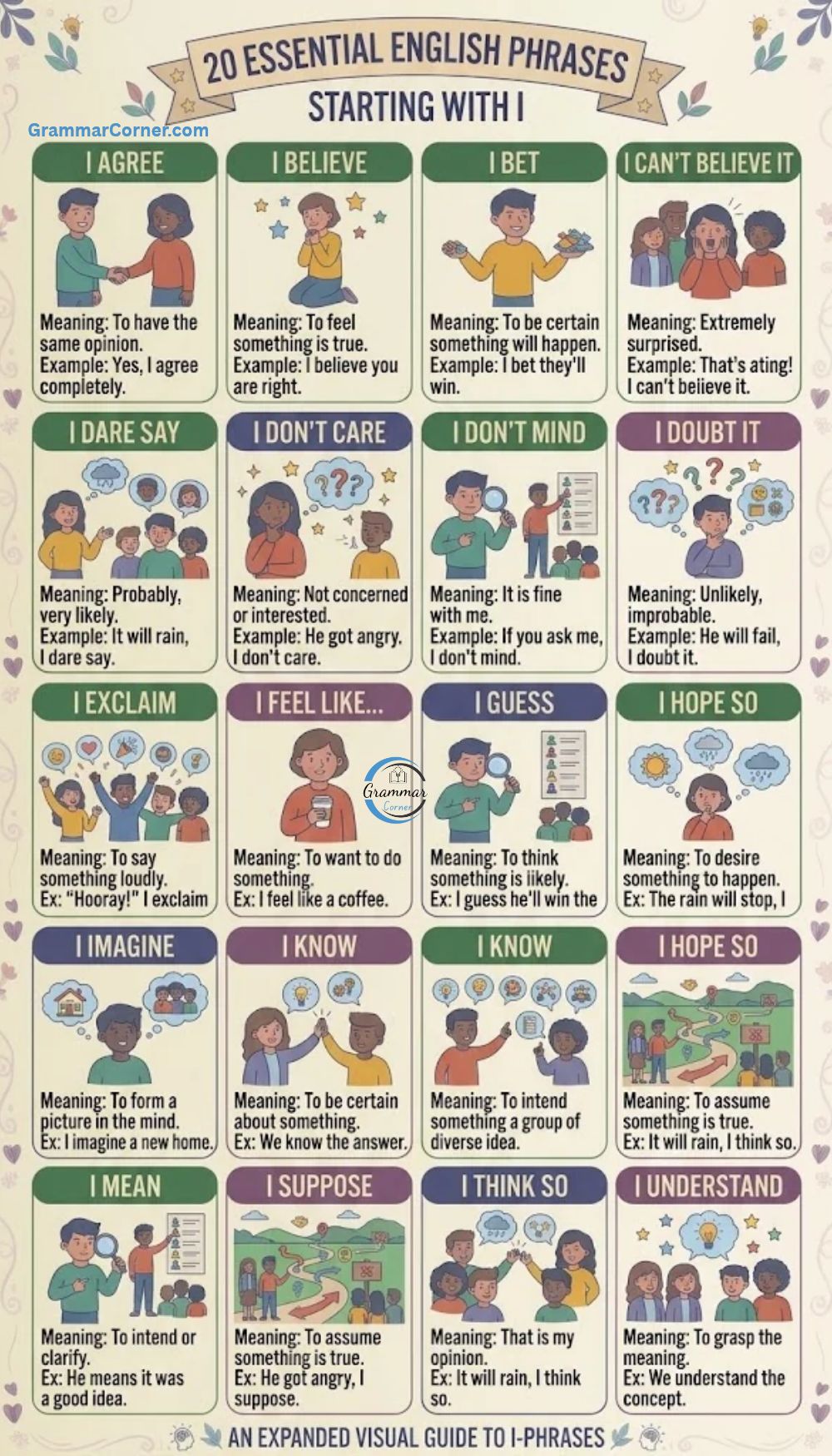
I agree
Meaning: I have the same opinion.
“I agree with you about the plan.”
I believe
Meaning: I think something is true.
“I believe we can finish the work today.”
I bet
Meaning: I am quite sure about something.
“I bet she will win the competition.”
I can’t believe it
Meaning: I am very surprised.
“I can’t believe it! We won the match.”
I can’t wait
Meaning: I am very excited about something.
“I can’t wait for the school trip.”
I don’t care
Meaning: Something does not matter to me.
“I don’t care which movie we watch.”
I don’t mind
Meaning: I am happy with either choice.
“I don’t mind waiting for you.”
I don’t think so
Meaning: I do not believe that is true.
“\”Will it rain today?\” \”I don’t think so.\””
I guess
Meaning: I think something is probably true.
“I guess we should leave now.”
I hope so
Meaning: I hope something is true or happens.
“\”Will you come tomorrow?\” \”I hope so.\””
I hope not
Meaning: I hope something does not happen.
“\”Will we miss the bus?\” \”I hope not.\””
I know
Meaning: I understand or already have the information.
“I know the answer.”
I mean
Meaning: Used to explain or correct what you have said.
“I mean, we could try again tomorrow.”
I suppose
Meaning: I think something is probably true.
“I suppose you are right.”
I think so
Meaning: I believe that is true.
“\”Is this the right road?\” \”I think so.\””
I understand
Meaning: I know what someone means.
“I understand what you are saying.”
I wonder
Meaning: I want to know or think about something.
“I wonder where Sara is.”
I feel like
Meaning: I want to do or have something.
“I feel like eating pizza.”
I’m good
Meaning: I am fine or I do not need anything.
“\”Would you like some more?\” \”No, thanks. I’m good.\””
I’ve got it
Meaning: I understand or can handle something.
“Don’t worry. I’ve got it.”
“I” Phrases for Natural Conversations
These expressions can make your everyday conversations sound more natural.
If I were you
Meaning: Used to give advice.
“If I were you, I would study a little every day.”
If you ask me
Meaning: Used to give your personal opinion.
“If you ask me, this is the best option.”
If you don’t mind
Meaning: Used to make a polite request.
“If you don’t mind, I’d like to sit here.”
If possible
Meaning: If something can be done.
“Please come early if possible.”
If necessary
Meaning: If something becomes needed.
“We can stay late if necessary.”
If so
Meaning: If that is true.
“If so, we should start now.”
If not
Meaning: If that is not true or does not happen.
“We can take the bus; if not, we’ll walk.”
If I remember correctly
Meaning: Used when you believe you remember something correctly.
“If I remember correctly, the test is on Monday.”
If all goes well
Meaning: If everything happens as planned.
“If all goes well, we will finish tomorrow.”
If you like
Meaning: If you want to.
“We can go for a walk if you like.”
If you wish
Meaning: If you want to.
“You can leave now if you wish.”
Is that so?
Meaning: A way of showing interest or surprise.
“\”He won the prize.\” \”Is that so?\””
Is that right?
Meaning: Used to ask for confirmation.
“You are moving next month? Is that right?”
Is everything okay?
Meaning: Asking whether there is a problem.
“You look worried. Is everything okay?”
Is there a problem?
Meaning: Asking whether something is wrong.
“You seem upset. Is there a problem?”
It depends
Meaning: The answer changes according to the situation.
“It depends on the weather.”
It doesn’t matter
Meaning: It is not important.
“It doesn’t matter which seat you choose.”
It looks like
Meaning: It seems that something is true.
“It looks like it will rain.”
It sounds good
Meaning: A suggestion seems good.
“\”Let’s meet at six.\” \”It sounds good.\””
It’s up to you
Meaning: You can decide.
“We can watch a movie or play a game. It’s up to you.”
Friendly Greetings and Social I Phrases
Many I phrases are useful when meeting people, showing kindness, or talking socially.
I’m glad
Meaning: I am happy about something.
“I’m glad you came.”
I’m good
Meaning: I am fine.
“\”How are you?\” \”I’m good, thanks.\””
I’m sorry
Meaning: Used to apologize.
“I’m sorry I was late.”
I’m sorry to hear that
Meaning: Used to show sympathy.
“I’m sorry to hear that your friend is sick.”
I’m sure
Meaning: I strongly believe something is true.
“I’m sure everything will be fine.”
I’m all ears
Meaning: I am ready and willing to listen.
“Tell me what happened. I’m all ears.”
I’m with you
Meaning: I agree with you or support your idea.
“I understand your point, and I’m with you.”
I’d love to
Meaning: I would really like to do something.
“Would you like to come with us? I’d love to.”
I’d like to
Meaning: I want to do something politely.
“I’d like to order some food.”
I’d rather
Meaning: I would prefer.
“I’d rather stay at home tonight.”
I’ll see you
Meaning: A friendly way to say goodbye.
“I have to go now. I’ll see you tomorrow.”
I’ll be back
Meaning: I will return soon.
“I’m going to the shop. I’ll be back soon.”
I’m on my way
Meaning: I am going or coming to the place now.
“Don’t worry. I’m on my way.”
I’m coming
Meaning: I am moving toward you or the place.
“Wait for me! I’m coming.”
Have a good time
Meaning: Enjoy yourself.
“Have a good time at the party.”
I’m looking forward to it
Meaning: I am excited about something that will happen.
“I’m looking forward to the school trip.”
I hope so
Meaning: I hope something happens or is true.
“\”Will she join us?\” \”I hope so.\””
I hope not
Meaning: I hope something does not happen.
“\”Will we be late?\” \”I hope not.\””
I’ll take it
Meaning: I choose or accept something.
“This shirt looks good. I’ll take it.”
I’ve got to go
Meaning: I need to leave.
“Sorry, I’ve got to go now.”
Common I Idioms and Their Meanings
Idioms are expressions whose meanings are sometimes different from the literal meanings of their words.
In a nutshell
Meaning: In a very short and simple form.
“In a nutshell, we need more time.”
In hot water
Meaning: In trouble.
“He is in hot water because he broke the rules.”
In the same boat
Meaning: In the same difficult situation.
“We are all in the same boat.”
In the long run
Meaning: Over a long period of time.
“Saving money will help you in the long run.”
In the nick of time
Meaning: Just before it is too late.
“We arrived in the nick of time.”
In the blink of an eye
Meaning: Very quickly.
“The car disappeared in the blink of an eye.”
In black and white
Meaning: Clearly written or shown.
“The rules are in black and white.”
In deep water
Meaning: In serious trouble.
“He is in deep water after losing the important file.”
In one’s shoes
Meaning: In another person’s situation.
“If I were in your shoes, I would apologize.”
In the same boat
Meaning: In the same situation as someone else.
“We are all in the same boat, so let’s work together.”
Inside out
Meaning: With the inner part on the outside; also knowing something very well.
“He knows this computer program inside out.”
Ins and outs
Meaning: All the details of something.
“She knows the ins and outs of the business.”
In love
Meaning: Having strong romantic feelings.
“They are deeply in love.”
In no time
Meaning: Very soon or very quickly.
“We will finish the work in no time.”
In hot pursuit
Meaning: Chasing someone closely.
“The police were in hot pursuit of the suspect.”
It goes without saying
Meaning: Something is so obvious that it does not need to be said.
“It goes without saying that you should be careful.”
It’s a piece of cake
Meaning: Something is very easy.
“The homework was a piece of cake.”
It’s about time
Meaning: Something should have happened earlier.
“It’s about time you cleaned your room.”
It’s not worth it
Meaning: Something is not valuable enough to justify the effort or trouble.
“Don’t argue with him. It’s not worth it.”
It’s up to you
Meaning: You are free to decide.
“We can go now or later. It’s up to you.”
“I” Phrases for Feelings and Opinions
These phrases help you talk about your emotions, thoughts, and personal opinions.
I feel like
Meaning: I want to do something or have a particular feeling.
“I feel like going for a walk.”
I guess
Meaning: I think something is probably true.
“I guess he is busy today.”
I believe
Meaning: I think something is true.
“I believe everyone deserves a chance.”
I doubt it
Meaning: I do not think something is likely to be true.
“Will he arrive on time? I doubt it.”
I don’t care
Meaning: Something is not important to me.
“I don’t care what others think.”
I don’t mind
Meaning: I am not bothered by something.
“I don’t mind helping you.”
I think so
Meaning: I believe something is true.
“\”Is this your book?\” \”I think so.\””
I don’t think so
Meaning: I believe something is not true.
“I don’t think so. The shop is probably closed.”
I wonder
Meaning: I think about something because I want to know.
“I wonder why she is late.”
I suppose
Meaning: I think something is probably true.
“I suppose we should leave now.”
I’m afraid so
Meaning: Used to politely say that something unpleasant is true.
“\”Is the shop closed?\” \”I’m afraid so.\””
I’m afraid not
Meaning: Used to politely say no.
“\”Can we leave early?\” \”I’m afraid not.\””
I’m glad
Meaning: I am happy about something.
“I’m glad you are feeling better.”
I’m not sure
Meaning: I do not know exactly or I am uncertain.
“I’m not sure what time he will arrive.”
I’m sure
Meaning: I am confident that something is true.
“I’m sure she will help you.”
I’m thinking about it
Meaning: I am considering something.
“I’m thinking about joining the school club.”
I’m with you
Meaning: I agree with or support someone.
“I understand your idea, and I’m with you.”
I’d rather
Meaning: I would prefer one thing over another.
“I’d rather stay at home.”
I’d love to
Meaning: I would really like to do something.
“I’d love to visit that museum.”
It’s a shame
Meaning: Used to express disappointment or sadness.
“It’s a shame that you missed the match.”
“I” Phrases for Work, School, and Professional English
These phrases are useful for students, teachers, employees, and people in formal situations.
In advance
Meaning: Before something happens.
“Please tell me in advance if you cannot attend.”
In addition
Meaning: Also or as another point.
“In addition, we need to complete the report.”
In brief
Meaning: In a short form.
“In brief, the project was successful.”
In charge
Meaning: Responsible for something.
“Ms. Khan is in charge of the project.”
In conclusion
Meaning: Used to introduce the final point or summary.
“In conclusion, regular practice is important.”
In detail
Meaning: With complete information.
“The teacher explained the topic in detail.”
In fact
Meaning: Used to introduce information that is true or important.
“In fact, he completed the work early.”
In general
Meaning: Usually or generally.
“In general, students enjoy group activities.”
In particular
Meaning: Especially or specifically.
“I like science, in particular biology.”
In practice
Meaning: In real situations.
“The idea sounds simple, but it is difficult in practice.”
In person
Meaning: Physically present rather than online or by phone.
“The teacher wants to speak to you in person.”
In writing
Meaning: In written form.
“Please send your request in writing.”
In order
Meaning: Organized or arranged correctly.
“Make sure all the documents are in order.”
In time
Meaning: Before it is too late.
“We arrived in time for the exam.”
In touch
Meaning: In communication with someone.
“Please stay in touch after you leave school.”
Into action
Meaning: Put into active use.
“The new plan will soon be put into action.”
Into practice
Meaning: Start using an idea or skill in a real situation.
“Students should put what they learn into practice.”
I’m working on it
Meaning: I am currently trying to complete something.
“\”Have you finished the report?\” \”I’m working on it.\””
I’ll think about it
Meaning: I will consider something before deciding.
“Thank you for the suggestion. I’ll think about it.”
I’d better
Meaning: I should do something because it is the sensible choice.
“I’d better finish my homework before going out.”
“I” Phrases for Advice, Warnings, and Difficult Situations
These phrases are useful when giving advice, discussing problems, or dealing with difficult situations.
If I were you
Meaning: Used to give advice.
“If I were you, I would talk to the teacher.”
If I were in your shoes
Meaning: If I were in your situation.
“If I were in your shoes, I would wait.”
If you ask me
Meaning: In my opinion.
“If you ask me, you should try again.”
If necessary
Meaning: If something becomes needed.
“Ask for help if necessary.”
If possible
Meaning: If something can be done.
“Finish the work today if possible.”
If that’s the case
Meaning: If that situation is true.
“If that’s the case, we should change our plan.”
If only
Meaning: Used to express a wish or regret.
“If only I had more time.”
If only I knew
Meaning: Used when wishing you had information.
“If only I knew the answer.”
If only I could
Meaning: Used to express a wish about something you cannot do.
“If only I could help you.”
If nothing else
Meaning: At least one particular thing is true.
“If nothing else, we learned an important lesson.”
In case
Meaning: Because something might happen.
“Take an umbrella in case it rains.”
In danger
Meaning: In a situation where harm may happen.
“The hikers were in danger.”
In trouble
Meaning: In a difficult situation.
“He is in trouble for breaking the rules.”
In need
Meaning: Needing help or something important.
“We should help people in need.”
In spite of
Meaning: Even though something happened.
“In spite of the rain, we went outside.”
It doesn’t matter
Meaning: Something is not important.
“It doesn’t matter if you make a small mistake.”
It’s no use
Meaning: Something will not help.
“It’s no use arguing about it now.”
It’s not worth it
Meaning: Something is not worth the trouble.
“Don’t worry about that small mistake. It’s not worth it.”
It’s not my fault
Meaning: I am not responsible for what happened.
“It’s not my fault that the bus was late.”
It’s all right
Meaning: Everything is okay.
“Don’t worry. It’s all right.”
Short and Easy I Phrases for Beginners
These simple expressions are useful for students who are just beginning to speak English confidently.
I agree
Meaning: I have the same opinion.
“I agree with you.”
I know
Meaning: I have the information.
“I know the answer.”
I understand
Meaning: I understand what you mean.
“I understand the question.”
I think so
Meaning: I believe it is true.
“I think so.”
I hope so
Meaning: I hope it is true.
“I hope so.”
I hope not
Meaning: I hope it is not true.
“I hope not.”
I’m sorry
Meaning: Used to apologize.
“I’m sorry I am late.”
I’m ready
Meaning: I am prepared.
“I’m ready for the test.”
I’m coming
Meaning: I am coming to the place.
“Wait for me. I’m coming.”
I’m back
Meaning: I have returned.
“I’m back from school.”
I’m good
Meaning: I am fine.
“I’m good, thank you.”
I’m sure
Meaning: I am confident.
“I’m sure you can do it.”
I’m not sure
Meaning: I am uncertain.
“I’m not sure about the answer.”
I’m on my way
Meaning: I am coming or going there now.
“I’m on my way home.”
I’ve got it
Meaning: I understand or can do it.
“Don’t explain again. I’ve got it.”
I’ve got to go
Meaning: I need to leave.
“I’ve got to go now.”
It depends
Meaning: It changes according to the situation.
“It depends on the weather.”
It sounds good
Meaning: A suggestion seems good.
“Let’s meet at five. It sounds good.”
It’s all right
Meaning: Everything is okay.
“Don’t worry. It’s all right.”
It’s up to you
Meaning: You can decide.
“Choose the color. It’s up to you.”
Common Mistakes to Avoid When Using I Phrases
Pay close attention to these easily confused expressions and usage rules to avoid common errors.
“I hope so” vs. “I hope not”
I hope so: Use when you want something to happen or be true.
“\”Will you pass the test?\” \”I hope so.\””
I hope not: Use when you do not want something to happen.
“\”Will it rain tomorrow?\” \”I hope not.\””
“I think so” vs. “I don’t think so”
I think so: Means you believe something is true.
“\”Is Ahmed at home?\” \”I think so.\””
I don’t think so: Means you believe something is not true.
“\”Is the shop open?\” \”I don’t think so.\””
“I don’t mind” vs. “I don’t care”
These phrases are not always the same.
I don’t mind: Usually means something is acceptable to you.
“I don’t mind waiting.”
I don’t care: Can mean that something is not important to you. Depending on your tone, it may sound unfriendly.
“I don’t care what they say.”
For polite conversations, “I don’t mind” is often the better choice.
“In time” vs. “On time”
In time: Means before it is too late.
“We arrived in time to catch the train.”
On time: Means at the planned or expected time.
“The train arrived on time.”
“In fact” vs. “In general”
In fact: Introduces a specific fact or confirms information.
“In fact, I finished the work yesterday.”
In general: Means usually or generally.
“In general, children enjoy playing games.”
“If I were you”
Usage: When giving advice, we normally say: If I were you, I would…
“If I were you, I would apologize.”
Do not say “If I was you” in this standard conditional advice structure.
“It’s up to you”
Meaning: This phrase means that the other person can decide (it does not mean that you are responsible for someone else’s decision).
“We can eat at home or outside. It’s up to you.”
Practice Exercises: Fill in the Blanks
Fill in each blank with the correct word or phrase to complete the sentence.
Question 1
I ______ so.
Question 2
I ______ not.
Question 3
If I ______ you, I would apologize.
Question 4
Please call me ______ advance.
Question 5
Take an umbrella ______ case it rains.
Question 6
I am looking ______ to the trip.
Question 7
It’s ______ to you.
Question 8
I don’t ______ waiting.
Question 9
I hope to hear ______ you soon.
Question 10
I’m ______ my way home.
Choose the Right I Phrase
Select the most appropriate I expression for each scenario.
You want to say that you have the same opinion.
Answer: B. I agree
You are not sure about something.
Answer: C. I’m not sure
You want to give someone advice.
Answer: A. If I were you
You want someone else to make the decision.
Answer: B. It’s up to you
You want to say that you hope something is true.
Answer: B. I hope so
You want to say that you are ready to listen.
Answer: A. I’m all ears
You want to say that something is not important.
Answer: A. It doesn’t matter
You want to say that you will consider something.
Answer: B. I’ll think about it
You want to say that you need to leave.
Answer: B. I’ve got to go
You want to say that you are coming now.
Answer: C. I’m on my way
Match the I Phrase With Its Meaning
Match each numbered I phrase in the first column with its correct definition letter in the second column.
| Phrase | Meaning |
|---|---|
| 1. I agree | A. I am not certain |
| 2. I hope so | B. I have the same opinion |
| 3. I’m not sure | C. I hope it is true |
| 4. I’m all ears | D. I am ready to listen |
| 5. It’s up to you | E. You can decide |
| 6. It depends | F. The answer changes according to the situation |
| 7. In advance | G. Before something happens |
| 8. In fact | H. Actually |
| 9. In a nutshell | I. In a short and simple form |
| 10. I’ve got to go | J. I need to leave |
Frequently Asked Questions About I Phrases
Find quick answers to common questions about phrases starting with I, their meanings, and how to use them.
What are some common English phrases that start with I?
Some common I phrases include I agree, I think so, I hope so, I don’t mind, I don’t think so, I can’t wait, I’m sorry, It’s up to you, It depends, and I’ve got to go.
What does “I can’t wait” mean?
Meaning: It means that you are very excited about something.
“I can’t wait for the holidays.”
What does “I don’t mind” mean?
Meaning: It means that something is acceptable to you.
“I don’t mind helping you.”
What does “I guess” mean?
Meaning: It means I think or I suppose, usually when you are not completely certain.
“I guess he is at home.”
What does “I hope so” mean?
Meaning: It means that you hope something is true or will happen.
“\”Will you come to the party?\” \”I hope so.\””
What does “If I were you” mean?
Meaning: It is used to give advice.
“If I were you, I would study harder.”
What does “It’s up to you” mean?
Meaning: It means that another person can make the decision.
“We can go by bus or train. It’s up to you.”
What does “It depends” mean?
Meaning: It means that the answer changes according to the situation.
“It depends on the weather.”
What does “I’m all ears” mean?
Meaning: It means that you are ready and willing to listen.
“Tell me your story. I’m all ears.”
What does “In a nutshell” mean?
Meaning: It means in a very short and simple form.
“In a nutshell, we need more time.”
What does “in advance” mean?
Meaning: It means before something happens.
“Please book your ticket in advance.”
What does “in fact” mean?
Meaning: It is used to introduce information that is true or important.
“In fact, she finished the project early.”
What does “I’ve got it” mean?
Meaning: It can mean that you understand something or that you can handle it yourself.
“\”Do you need help?\” \”No, thanks. I’ve got it.\””
What does “I’ve got to go” mean?
Meaning: It means that you need to leave.
“I’ve got to go now. See you tomorrow.”
What is an easy I phrase for beginners?
Some easy phrases include I agree, I know, I understand, I hope so, I’m sorry, I’m ready, I’m good, It depends, It’s all right, and It’s up to you.