Phrases That Start With C
Learning phrases is one of the easiest ways to get better at English, because they show you how words actually fit together in real conversation. The letter C has plenty of good ones. Some you’ll hear every day, like “come on” and “calm down,” and others are colorful idioms like “cost an arm and a leg” or “cry over spilled milk.”
Common Everyday Phrases That Start With C
These phrases are frequently heard in everyday English and are useful for ordinary conversations.
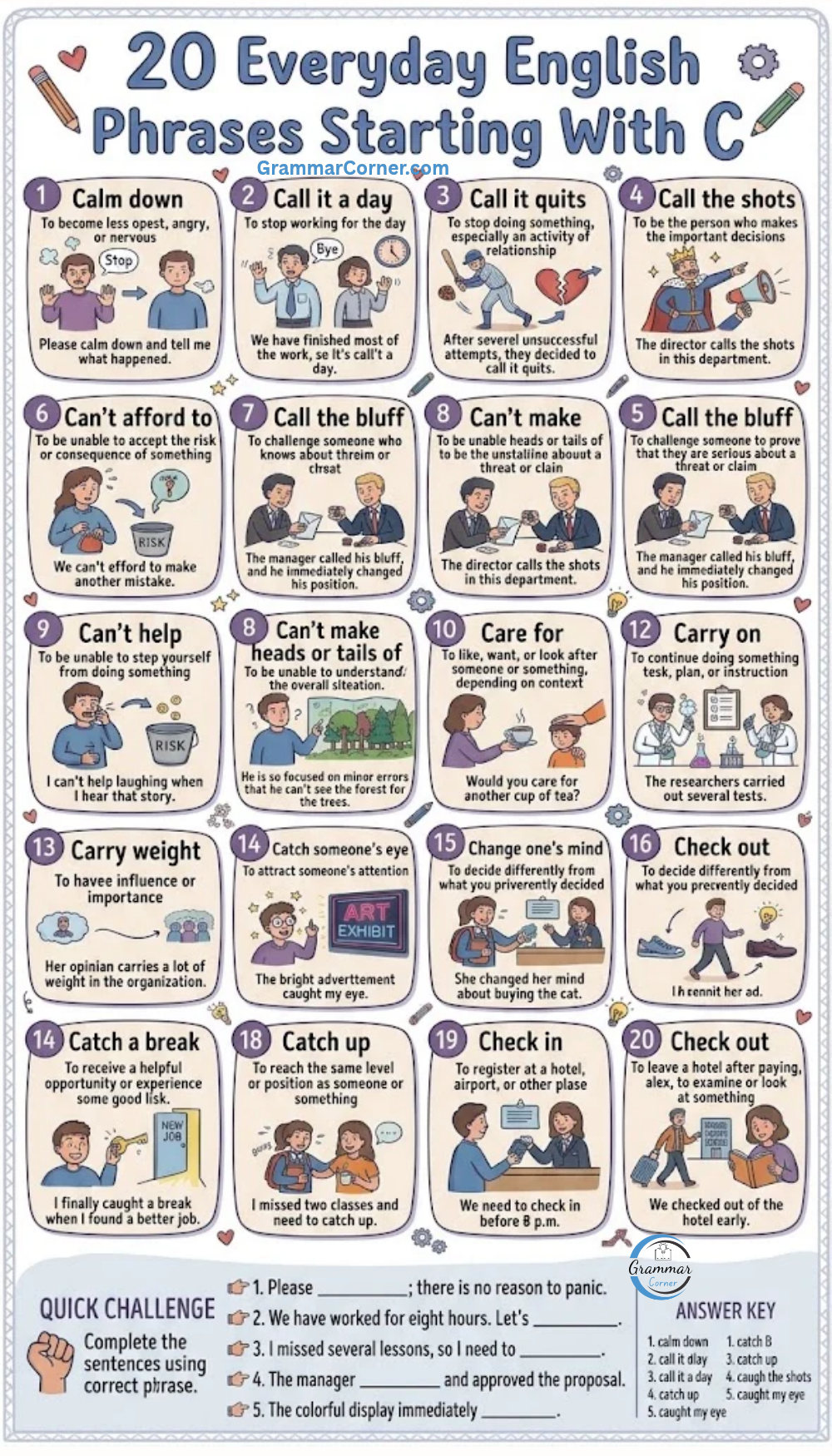
Calm down
Meaning: To become less upset, angry, or nervous.
“Please calm down and tell me what happened.”
Call it a day
Meaning: To stop working for the day.
“We have finished most of the work, so let’s call it a day.”
Call it quits
Meaning: To stop doing something, especially an activity or relationship.
“After several unsuccessful attempts, they decided to call it quits.”
Call the shots
Meaning: To be the person who makes the important decisions.
“The director calls the shots in this department.”
Call the bluff
Meaning: To challenge someone to prove that they are serious about a threat or claim.
“The manager called his bluff, and he immediately changed his position.”
Can’t afford to
Meaning: To be unable to accept the risk or consequence of something.
“We can’t afford to make another mistake.”
Can’t help
Meaning: To be unable to stop yourself from doing something.
“I can’t help laughing when I hear that story.”
Can’t make heads or tails of
Meaning: To be unable to understand something.
“I can’t make heads or tails of these instructions.”
Can’t see the forest for the trees
Meaning: To focus so much on details that you fail to understand the overall situation.
“He is so focused on minor errors that he can’t see the forest for the trees.”
Care for
Meaning: To like, want, or look after someone or something, depending on context.
“Would you care for another cup of tea?”
Carry on
Meaning: To continue doing something.
“Please carry on with your work.”
Carry out
Meaning: To perform or complete a task, plan, or instruction.
“The researchers carried out several tests.”
Carry weight
Meaning: To have influence or importance.
“Her opinion carries a lot of weight in the organization.”
Catch a break
Meaning: To receive a helpful opportunity or experience some good luck.
“I finally caught a break when I found a better job.”
Catch someone’s eye
Meaning: To attract someone’s attention.
“The bright advertisement caught my eye.”
Catch up
Meaning: To reach the same level or position as someone or something.
“I missed two classes and need to catch up.”
Catch up with
Meaning: To meet someone after not seeing them for some time, or to reach someone.
“Let’s catch up with each other over coffee.”
Change one’s mind
Meaning: To decide differently from what you previously decided.
“She changed her mind about buying the car.”
Check in
Meaning: To register at a hotel, airport, or other place.
“We need to check in before 8 p.m.”
Check out
Meaning: To leave a hotel after paying; also, to examine or look at something.
“We checked out of the hotel early.”
Quick Challenge
Complete the sentences using the correct phrase.
- 1. Please ________; there is no reason to panic.
- 2. We have worked for eight hours. Let’s ________.
- 3. I missed several lessons, so I need to ________.
- 4. The manager ________ and approved the proposal.
- 5. The colorful display immediately ________.
- calm down
- call it a day
- catch up
- called the shots
- caught my eye
Useful Conversational Phrases Beginning With C
Many C phrases are especially useful when talking to friends, colleagues, family members, or acquaintances.
Come about
Meaning: To happen or take place.
“How did this misunderstanding come about?”
Come across
Meaning: To find something by chance or to give a particular impression.
“I came across an interesting article yesterday.”
Come along
Meaning: To make progress or accompany someone.
“Your English is coming along nicely.”
Come around
Meaning: To change one’s opinion or visit someone.
“He eventually came around to our way of thinking.”
Come by
Meaning: To obtain something or visit briefly.
“Good opportunities are difficult to come by.”
Come clean
Meaning: To tell the truth about something you have kept secret.
“He finally came clean about the mistake.”
Come down to
Meaning: To depend on a particular factor.
“Success often comes down to preparation.”
Come forward
Meaning: To offer information or help, especially when it is needed.
“Several witnesses came forward after the incident.”
Come in handy
Meaning: To be useful at a particular time.
“This small tool may come in handy later.”
Come into effect
Meaning: To begin to operate or become legally effective.
“The new regulations will come into effect next month.”
Come into play
Meaning: To become relevant or begin to have an effect.
“Experience comes into play when making difficult decisions.”
Come to an end
Meaning: To finish.
“The meeting finally came to an end.”
Come to terms with
Meaning: To accept a difficult situation.
“She eventually came to terms with the decision.”
Come what may
Meaning: Whatever happens.
“Come what may, I will support my family.”
Come within reach
Meaning: To become possible to obtain or achieve.
“After years of hard work, his goal finally came within reach.”
Count on
Meaning: To depend on or trust someone or something.
“You can count on me whenever you need help.”
Count one’s blessings
Meaning: To be grateful for the good things in one’s life.
“Instead of complaining, we should count our blessings.”
Cross one’s mind
Meaning: To occur as a thought.
“It never crossed my mind that he would leave.”
Cross paths
Meaning: To meet someone, usually unexpectedly.
“We crossed paths several times before becoming friends.”
Cut corners
Meaning: To do something cheaply or carelessly by skipping necessary steps.
“Good builders never cut corners.”
Quick Challenge
Choose the correct phrase.
- 1. The truth eventually ________ when the investigation continued.
- 2. The new law will ________ next month.
- 3. You can ________ me to keep your secret.
- 4. It never ________ that she would resign.
- 5. We should not ________ just to save money.
- came forward
- come into effect
- count on
- crossed my mind
- cut corners
Common Idioms That Start With C
Idioms make English colorful and expressive. Their meanings are often different from the literal meanings of their individual words.
Cost an arm and a leg
Meaning: To be extremely expensive.
“That luxury watch cost an arm and a leg.”
Cry over spilled milk
Meaning: To be upset about something that has already happened and cannot be changed.
“The mistake has been made, so there is no use crying over spilled milk.”
Cut to the chase
Meaning: To get directly to the main point.
“Let’s cut to the chase and discuss the real problem.”
Cut someone some slack
Meaning: To be less critical or strict toward someone.
“Cut him some slack; he is new to the job.”
Call the tune
Meaning: To control a situation or make the important decisions.
“The owner calls the tune in the company.”
Change of heart
Meaning: A change in one’s opinion, feeling, or decision.
“She had a change of heart and accepted the offer.”
Chip in
Meaning: To contribute money, effort, or help.
“Everyone chipped in to buy a gift.”
Clear the air
Meaning: To discuss a problem openly in order to remove misunderstanding or tension.
“We need to meet and clear the air.”
Close call
Meaning: A situation in which something bad almost happened.
“Missing the accident was a close call.”
Close to the bone
Meaning: Uncomfortably accurate or directly related to a sensitive issue.
“His joke hit close to the bone.”
Cloud nine
Meaning: A state of extreme happiness.
“She was on cloud nine after receiving the scholarship.”
Cold feet
Meaning: Fear or nervousness about doing something you had planned to do.
“He got cold feet before the wedding.”
Cold shoulder
Meaning: An unfriendly attitude or deliberate ignoring of someone.
“She gave me the cold shoulder after the disagreement.”
Come rain or shine
Meaning: Regardless of what happens or what the weather is like.
“He goes for a walk every morning, come rain or shine.”
Cool as a cucumber
Meaning: Very calm, especially in a stressful situation.
“Despite the pressure, she remained as cool as a cucumber.”
Crack the whip
Meaning: To make people work harder or obey rules more strictly.
“The supervisor had to crack the whip to meet the deadline.”
Cross that bridge when you come to it
Meaning: Deal with a problem when it actually happens rather than worrying about it in advance.
“We will cross that bridge when we come to it.”
Cut no ice
Meaning: To have no influence or effect.
“His excuses cut no ice with the committee.”
Cut a long story short
Meaning: To give only the important points of a long story.
“To cut a long story short, we missed the train.”
Cut from the same cloth
Meaning: To be very similar in character or behavior.
“The two brothers are cut from the same cloth.”
Quick Challenge
Match each phrase with its meaning.
| Phrase | Options |
|---|---|
| Cut to the chase | a. Contribute |
| Cold feet | b. Discuss a problem openly |
| Clear the air | c. Get directly to the main point |
| Chip in | d. Regret something that cannot be changed |
| Cry over spilled milk | e. Become nervous before doing something |
- c — Cut to the chase: Get directly to the main point
- e — Cold feet: Become nervous before doing something
- b — Clear the air: Discuss a problem openly
- a — Chip in: Contribute
- d — Cry over spilled milk: Regret something that cannot be changed
Phrases Starting With C for Work and Professional English
Knowing professional expressions can make workplace communication clearer and more natural.
Call for action
Meaning: A request or demand that something should be done.
“The report contains a strong call for action.”
Call into question
Meaning: To make people doubt something.
“The new evidence called the earlier findings into question.”
Carry out an investigation
Meaning: To conduct an investigation.
“The authorities carried out an investigation into the complaint.”
Case in point
Meaning: An example that illustrates or supports an argument.
“His recent promotion is a case in point.”
Case-by-case basis
Meaning: Considering each situation individually.
“Applications will be reviewed on a case-by-case basis.”
Cause concern
Meaning: To make people worried.
“The sudden decline in sales caused concern among investors.”
Center of attention
Meaning: The person or thing receiving the most attention.
“The new product became the center of attention at the exhibition.”
Change course
Meaning: To alter a plan, direction, or strategy.
“The company decided to change course after reviewing the data.”
Clear-cut case
Meaning: A situation that is easy to understand or decide.
“The evidence made it a clear-cut case.”
Close cooperation
Meaning: Working together closely.
“The project requires close cooperation between the two departments.”
Come to a conclusion
Meaning: To reach a decision or judgment after considering information.
“The committee came to a conclusion after reviewing the evidence.”
Common practice
Meaning: Something that is regularly or normally done.
“Working remotely has become common practice in many industries.”
Competitive advantage
Meaning: Something that gives a person or organization an advantage over competitors.
“Innovation can provide a competitive advantage.”
Conflict of interest
Meaning: A situation in which personal interests may interfere with professional responsibilities.
“The official declared a conflict of interest.”
Contingency plan
Meaning: A plan prepared for a possible future problem.
“The company has a contingency plan for emergencies.”
Cost-effective solution
Meaning: A solution that provides good results without excessive expense.
“We need a cost-effective solution.”
Critical issue
Meaning: A very important problem requiring attention.
“Security has become a critical issue.”
Current affairs
Meaning: Recent political, social, and economic events.
“Students should follow current affairs to stay informed.”
Cut costs
Meaning: To reduce spending.
“The company must cut costs without reducing quality.”
Customer satisfaction
Meaning: The degree to which customers are happy with a product or service.
“Customer satisfaction is our top priority.”
Quick Challenge
Fill in the blanks.
- 1. The matter will be considered on a ________.
- 2. The company needs to ________ to remain competitive.
- 3. The manager declared a ________.
- 4. We need a ________ in case the system fails.
- 5. The new technology gives the company a ________.
- case-by-case basis
- cut costs
- conflict of interest
- contingency plan
- competitive advantage
More Useful Phrases Beginning With C
The following expressions can be useful in everyday, academic, and professional English.
By comparison
Meaning: When compared with something else.
“By comparison, the second option is much cheaper.”
By coincidence
Meaning: As a result of chance rather than planning.
“We met by coincidence at the airport.”
By contrast
Meaning: In a way that shows a difference between two things.
“The first plan is expensive; by contrast, the second is affordable.”
By definition
Meaning: According to the basic meaning of a word or concept.
“A square is, by definition, a four-sided figure with equal sides.”
By degrees
Meaning: Gradually.
“The weather improved by degrees.”
By design
Meaning: Intentionally.
“The system was created by design to protect user information.”
By far
Meaning: By a large amount or degree.
“This is by far the easiest option.”
By force of habit
Meaning: Because something has become a regular habit.
“By force of habit, he checked the door twice.”
By means of
Meaning: Using something as a method.
“The message was sent by means of electronic communication.”
By no means
Meaning: Not at all.
“The task is by no means easy.”
By nature
Meaning: Naturally or as part of someone’s basic character.
“She is by nature very patient.”
By necessity
Meaning: Because something is necessary.
“The changes were made by necessity.”
By oneself
Meaning: Alone or without assistance.
“He completed the entire project by himself.”
By the same token
Meaning: In the same way or for the same reason.
“We expect honesty and, by the same token, we must be honest ourselves.”
By the time
Meaning: Before or when a particular time is reached.
“By the time we arrived, the meeting had ended.”
By virtue of
Meaning: Because of or as a result of a particular quality, position, or condition.
“She qualified by virtue of her professional experience.”
By way of
Meaning: Through or as a form of.
“He gave some advice by way of introduction.”
By word of mouth
Meaning: Through people telling others rather than through formal advertising.
“The restaurant became popular by word of mouth.”
Can’t be bothered
Meaning: To not want to make the effort to do something.
“I can’t be bothered to argue about it.”
Can’t put your finger on
Meaning: To be unable to identify or explain something exactly.
“I can’t put my finger on what is wrong with the plan.”
100 Unique Phrases That Start With C
The following table brings together 100 useful phrases beginning with the letter C, complete with clear definitions and contextual example sentences.
| # | Phrase | Meaning | Example Sentence |
|---|---|---|---|
| 1 | Call someone’s attention to | Make someone notice something | Please call his attention to the error. |
| 2 | Call someone’s bluff | Challenge someone to prove a claim | She called his bluff during the negotiation. |
| 3 | Call someone’s name | Say someone’s name aloud | I heard someone call my name. |
| 4 | Call to mind | Cause someone to remember | The photograph called my childhood to mind. |
| 5 | Call upon | Ask or require someone to do something | The leader called upon everyone to cooperate. |
| 6 | Calm before the storm | Quiet period before difficulty | The silence felt like the calm before the storm. |
| 7 | Can hardly wait | Be very excited about something | I can hardly wait for the holidays. |
| 8 | Can’t help but | Be unable to avoid doing something | I can’t help but admire her courage. |
| 9 | Can’t hold a candle to | Be much less capable than someone or something | This model can’t hold a candle to the newer version. |
| 10 | Can’t judge a book by its cover | Do not judge by appearance | You can’t judge a book by its cover. |
| 11 | Can’t make an omelet without breaking eggs | Results may require unpleasant consequences | Major reforms can involve difficulties; you can’t make an omelet without breaking eggs. |
| 12 | Can’t put a price on | Be impossible to value in money | You can’t put a price on true friendship. |
| 13 | Can’t stomach | Be unable to tolerate something | I can’t stomach that kind of behavior. |
| 14 | Can’t take it | Be unable to tolerate a situation | I can’t take it anymore. |
| 15 | Capitalize on | Take advantage of an opportunity | The company capitalized on the growing demand. |
| 16 | Care to explain | Ask someone to explain something | Would you care to explain what happened? |
| 17 | Careful consideration | Thorough thought before making a decision | The proposal requires careful consideration. |
| 18 | Carry a torch for | Continue to have romantic feelings for someone | He still carries a torch for his former classmate. |
| 19 | Carry one’s weight | Do one’s fair share of work | Everyone must carry their weight. |
| 20 | Carry the day | Win or succeed | Her argument carried the day. |
| 21 | Carry the torch | Continue supporting a cause or tradition | She carries the torch for environmental education. |
| 22 | Carve out | Create or establish something through effort | He carved out a successful career. |
| 23 | Cast doubt on | Make something seem uncertain | The evidence cast doubt on the original theory. |
| 24 | Cast one’s mind back | Remember something from the past | Cast your mind back to your school days. |
| 25 | Cast a wide net | Search broadly for possibilities | The company cast a wide net for new talent. |
| 26 | Cast aside | Reject or discard | She cast aside her doubts. |
| 27 | Cast in stone | Fixed and impossible to change | The schedule is not cast in stone. |
| 28 | Catch someone red-handed | Find someone doing something wrong | The guard caught him red-handed. |
| 29 | Catch someone’s drift | Understand someone’s meaning | I think I catch your drift. |
| 30 | Catch someone off guard | Surprise someone | The question caught me off guard. |
| 31 | Catch wind of | Hear about something indirectly | We caught wind of the proposed changes. |
| 32 | Catch your breath | Rest after physical effort or shock | Give me a moment to catch my breath. |
| 33 | Cater to | Provide what someone wants or needs | The hotel caters to business travelers. |
| 34 | Caught in the act | Discovered while doing something wrong | He was caught in the act of stealing. |
| 35 | Caught in the middle | Trapped between opposing sides | She was caught in the middle of the dispute. |
| 36 | Caught short | Unprepared when something is needed | I was caught short without enough cash. |
| 37 | Cause a stir | Create excitement or controversy | The announcement caused a stir. |
| 38 | Cease and desist | Stop an activity immediately | The company received a cease-and-desist notice. |
| 39 | Center stage | Receive the greatest attention | The issue took center stage during the meeting. |
| 40 | Certain to | Very likely or sure to happen | The decision is certain to attract attention. |
| 41 | Change hands | Pass from one owner or person to another | The property changed hands last year. |
| 42 | Change tack | Adopt a different approach | We need to change tack if this strategy fails. |
| 43 | Change the subject | Start discussing something different | He changed the subject when I asked about the money. |
| 44 | Change the game | Significantly alter a situation | The new discovery could change the game. |
| 45 | Chase rainbows | Pursue unrealistic goals | He spent years chasing rainbows. |
| 46 | Chase one’s tail | Waste time dealing with the same problem repeatedly | We are chasing our tails instead of solving the issue. |
| 47 | Check for | Look to see whether something exists or is correct | Please check for errors. |
| 48 | Check on | Find out about the condition or progress of something | I will check on the patient. |
| 49 | Check over | Examine carefully | Please check over the document. |
| 50 | Check up on | Investigate or make sure someone is safe | The teacher checked up on the students. |
| 51 | Chew the fat | Have a friendly conversation | We sat outside and chewed the fat. |
| 52 | Chew over | Think carefully about something | I need time to chew over your proposal. |
| 53 | Chicken out | Decide not to do something because of fear | He chickened out at the last minute. |
| 54 | Child’s play | Something extremely easy | The exercise was child’s play. |
| 55 | Chill out | Relax | Let’s stay home and chill out. |
| 56 | Clam up | Suddenly stop talking | He clammed up when asked about the incident. |
| 57 | Claw one’s way back | Struggle to recover a position | The team clawed its way back into the competition. |
| 58 | Clean up one’s act | Improve one’s behavior | He needs to clean up his act. |
| 59 | Clear as crystal | Extremely clear | Her explanation was clear as crystal. |
| 60 | Clear the way | Remove an obstacle | The new road will clear the way for development. |
| 61 | Close ranks | Unite in defense of a group | The members closed ranks after the criticism. |
| 62 | Close the door on | End an opportunity or possibility | The decision closed the door on further negotiations. |
| 63 | Close to home | Personally affecting someone | The story hit close to home. |
| 64 | Come apart at the seams | Fail emotionally or structurally | The old organization seemed to come apart at the seams. |
| 65 | Come full circle | Return to the original position or situation | Her career has come full circle. |
| 66 | Come hell or high water | Despite any difficulty | I will finish the work, come hell or high water. |
| 67 | Come into one’s own | Reach a stage of success or confidence | She came into her own as a leader. |
| 68 | Come off | Succeed or happen as planned | The event came off perfectly. |
| 69 | Come out on top | Finish in the best position | After a difficult season, the team came out on top. |
| 70 | Come out of nowhere | Appear unexpectedly | The opportunity came out of nowhere. |
| 71 | Come to grips with | Begin to understand or accept something difficult | He is learning to come to grips with the situation. |
| 72 | Come to light | Become known or discovered | New evidence came to light. |
| 73 | Come to nothing | Fail to produce a result | Their plans came to nothing. |
| 74 | Come to one’s senses | Start thinking sensibly again | He eventually came to his senses. |
| 75 | Come under fire | Receive strong criticism | The company came under fire for its decision. |
| 76 | Come under scrutiny | Be examined closely | The decision came under scrutiny. |
| 77 | Come up against | Face a problem or opposition | We came up against strong competition. |
| 78 | Come up short | Fail to reach a required standard | The proposal came up short. |
| 79 | Come up with | Think of or produce an idea | She came up with a practical solution. |
| 80 | Command attention | Attract strong attention | The speaker commanded attention from the audience. |
| 81 | Compare notes | Exchange information or opinions | We met to compare notes. |
| 82 | Compensate for | Make up for something | The bonus compensated for the inconvenience. |
| 83 | Comply with | Act according to a rule or request | Everyone must comply with the regulations. |
| 84 | Concede defeat | Admit that one has lost | The team eventually conceded defeat. |
| 85 | Confront the issue | Deal directly with a problem | We need to confront the issue immediately. |
| 86 | Connect the dots | Understand the relationship between facts | The investigator connected the dots. |
| 87 | Consistent with | In agreement with something | His statement is consistent with the evidence. |
| 88 | Contend with | Deal with a difficult person or problem | We had to contend with several delays. |
| 89 | Cook the books | Falsify financial records | The company was accused of cooking the books. |
| 90 | Cool one’s heels | Wait for a long time | We were left cooling our heels outside. |
| 91 | Cool one’s jets | Calm down or slow down | Cool your jets and listen first. |
| 92 | Corner the market | Gain control over a particular market | The company hopes to corner the market. |
| 93 | Count heads | Count the number of people present | The organizer counted heads before departure. |
| 94 | Count pennies | Be very careful with money | We are counting pennies this month. |
| 95 | Cover all bases | Prepare for every possibility | We need to cover all bases before launching the product. |
| 96 | Cover for someone | Do someone’s work while they are absent | Can you cover for me tomorrow? |
| 97 | Crack down on | Take strict action against something | Authorities are cracking down on illegal activity. |
| 98 | Create an impression | Cause someone to form an opinion | Her confidence created a strong impression. |
| 99 | Cross one’s fingers | Hope for a positive result | Cross your fingers that everything goes well. |
| 100 | Cry wolf | Give a false alarm repeatedly | If you keep crying wolf, people may stop believing you. |
Practice Exercises
Exercise 1: Fill in the Blanks
Use the correct phrase from the list to complete each sentence.
-
1. I don’t want to ________ and make the same mistake again.
-
2. The two sides finally ________ after several months of disagreement.
-
3. She was ________ after receiving the good news.
-
4. We need to ________ before discussing minor details.
-
5. He ________ when the interviewer asked about the missing money.
-
6. The company decided to ________ after reviewing the financial results.
-
7. You can always ________ me when you need assistance.
-
8. The new evidence ________ about the case.
-
9. He is trying to ________ the difficult situation.
-
10. The manager asked the team to ________ the investigation immediately.
- cut corners
- cleared the air
- on cloud nine
- cut to the chase
- came clean
- change course
- count on
- came to light
- come to terms with
- carry out
Exercise 2: Choose the Correct Phrase
Select the best phrase for each given scenario.
-
1. If something is extremely expensive, it:
-
2. If you meet someone unexpectedly, you:
-
3. If someone is very calm under pressure, they are:
-
4. If you stop working for the day, you:
-
5. If you accept a difficult situation, you:
- b) costs an arm and a leg
- a) cross paths
- b) cool as a cucumber
- a) call it a day
- a) come to terms with it
Exercise 3: Match the Phrase With Its Meaning
Match each numbered phrase with its correct lettered definition.
| Phrase | Meaning |
|---|---|
| 1. Catch someone off guard | a. Stop working for the day |
| 2. Call it a day | b. Surprise someone |
| 3. Chip in | c. Contribute |
| 4. Clear the air | d. Resolve tension through discussion |
| 5. Cut corners | e. Skip necessary steps |
- b — Catch someone off guard: Surprise someone
- a — Call it a day: Stop working for the day
- c — Chip in: Contribute
- d — Clear the air: Resolve tension through discussion
- e — Cut corners: Skip necessary steps
Frequently Asked Questions About Phrases That Start With C
What are phrases that start with C?
Phrases that start with C are groups of words beginning with C, Can, or other C-based forms that work together to express a particular meaning. They include everyday expressions, idioms, phrasal verbs, and professional expressions.
What is an easy phrase that starts with C?
Calm down is a simple and commonly used C phrase. It means to become less angry, upset, or nervous.
“Please calm down and listen to me.”
What are some common C idioms?
Some popular idioms beginning with C include cost an arm and a leg, cry over spilled milk, cut to the chase, cold feet, cloud nine, cool as a cucumber, and cross that bridge when you come to it.
What does “cut to the chase” mean?
It means to stop discussing unnecessary details and get directly to the main point.
“Let’s cut to the chase and discuss the actual problem.”
What does “come clean” mean?
Come clean means to admit the truth about something, especially something that a person has been hiding.
“He finally came clean about the mistake.”
What does “cut corners” mean?
Cut corners means to save time, effort, or money by skipping necessary steps or doing something carelessly.
“The company should never cut corners when it comes to safety.”
What does “count on” mean?
Count on means to depend on or trust someone or something.
“You can count on your friends during difficult times.”
What is the difference between “come across” and “come by”?
Come across can mean finding something unexpectedly or giving a particular impression. Come by can mean obtaining something or visiting a place briefly.
- “I came across an old photograph.”
- “Good opportunities are difficult to come by.”
Are C phrases useful in formal English?
Yes. Some C phrases are especially suitable for formal and professional contexts, including case-by-case basis, conflict of interest, contingency plan, competitive advantage, comply with, by contrast, and by virtue of.
However, informal idioms such as chill out, chew the fat, and cool your jets are generally more suitable for casual conversations.