Present Perfect Continuous Tense Chart (Structure, Rules & Examples)
What Is the Present Perfect Continuous Tense?
The present perfect continuous tense shows an action that started in the past, has continued for some time, and is either still going on now or has only just stopped.
It is made from four pieces:
has / have — the only piece that changes with the subject. Has goes with he, she, it and singular nouns; have goes with I, you, we, they and plurals.
For Example:
- She has been waiting since nine o’clock.
- They have been working in the garden all morning.
- I have been learning Spanish for two years.
Each sentence tells you how long it has been going on. Duration is built into this tense. That is why the words for, since, and how long appear with it so often.
Continuous or progressive?
This tense is also called the present perfect progressive. The two names mean the same thing. British course books usually say continuous, while American books and language researchers often say progressive. If your teacher uses one word and your textbook uses the other, nothing has changed.
Why Do We Use the Present Perfect Continuous Tense?
We use it when the activity itself matters more than the result.
Compare these two replies to the question:
Both are correct English, but they answer different questions. The first explains the dirty hands: I have spent time on this activity. The second announces a finished job: the motorbike works now.
So the present perfect continuous is the tense you reach for when you want to say:
The two-second test
Ask yourself what the listener is meant to picture. If it is you, mid-activity — sweating, covered in oil, still at it — use the continuous. If it is the finished thing — a working motorbike, a clean room, twelve emails sent — use the plain present perfect.
Drill: activity or result?
Five situations. Choose the reply that fits what the listener needs to know.
Correct so far: 0 of 51. Why are you out of breath?
2. How many emails have you written?
3. Your eyes are red. What happened?
4. The room looks wonderful! — the job is finished.
5. Complete: She ______ Spanish for two years.
Key takeaways from this section
- Four pieces, none optional: has/have + been + verb + -ing.
- Duration is built into the tense, which is why for, since and how long keep it company.
- Continuous and progressive are two names for one tense.
- Choose it when the activity matters; choose the plain present perfect when the finished result matters.
- Numbers and amounts push you back to the present perfect: I have written twelve emails, not I have been writing twelve.
Present Perfect Continuous Tense Formula
Every sentence in this tense follows one of four shapes. Learn these four rows and you can build any sentence you need.
| Sentence Type | Formula | Example |
|---|---|---|
| Positive | Subject + has/have + been + verb (-ing) + object | She has been reading for two hours. |
| Negative | Subject + has/have + not + been + verb (-ing) + object | She has not been reading for two hours. |
| Yes/No Question | Has/Have + subject + been + verb (-ing) + object? | Has she been reading for two hours? |
| Wh-Question | Wh-word + has/have + subject + been + verb (-ing)? | What has she been reading? |
Choosing Between Has and Have
Match the helping verb to the subject before you touch anything else in the sentence. Get this one choice right, and the rest of the formula falls into place.
| Subject | Helping Verb | Example |
|---|---|---|
| I | have | I have been cooking. |
| You | have | You have been cooking. |
| He / She / It | has | She has been cooking. |
| We | have | We have been cooking. |
| They | have | They have been cooking. |
| Singular noun (my brother, the machine) | has | The machine has been running all day. |
| Plural noun (my brothers, the machines) | have | The machines have been running all day. |
Present Perfect Continuous Tense Chart

Structure of the Present Perfect Continuous Tense
Positive Sentences
I have been waiting for the bus.
Ahmed has been practising the guitar since morning.
We have been living in Lahore for six years.
The children have been playing outside all afternoon.
It has been raining since Friday.
Three points to remember in positive sentences:
- Been is fixed. It never becomes being, is, or was.
- The main verb always carries -ing, never -ed and never the third form.
- Only has and have react to the subject.
❌ She has being cooking.→✅ She has been cooking.
❌ She has been cooked.→✅ She has been cooking.
❌ They has been cooking.→✅ They have been cooking.
Negative Sentences
I have not been sleeping well this week.
He has not been coming to class regularly.
They have not been answering my messages.
The tap has not been working since Tuesday.
Not sits directly after has or have, before been. In speech and informal writing we almost always contract it:
I haven’t been sleeping well this week.
He hasn’t been coming to class regularly.
A note worth having
Negatives in this tense are less common than positives. When an action has not been happening, English speakers often prefer the present perfect instead — I haven’t slept well sounds just as natural as I haven’t been sleeping well. Both are correct. Use the continuous when you want to stress the whole stretch of time.
Interrogative Sentences
Have you been waiting long?
Has she been studying all evening?
Have they been living here since 2019?
Has it been raining all night?
To make a question, lift has or have over the subject and put it at the front. Nothing else moves.
Statement:You have been waiting long.
Question:Have you been waiting long?
Negative Interrogative Sentences
Or, in formal writing: Has / Have + subject + not + been + verb-ing?
Haven’t you been feeling well lately?
Hasn’t he been working on that report since Monday?
Have you not been taking your medicine?
These questions are not really asking for information. They usually carry surprise, worry, or gentle complaint:
| Question | What the speaker really means |
|---|---|
| Haven’t you been sleeping? | You look tired. I am worried. |
| Hasn’t she been studying at all? | I expected her to study, and it seems she has not. |
| Haven’t they been paying the rent? | I am surprised, and a little annoyed. |
When to Use the Present Perfect Continuous Tense
Actions That Started in the Past and Continue Now
This is the main use. The action began at some earlier point and has not stopped.
- I have been working here since 2021. (I still work here.)
- She has been reading that novel for a week. (She has not finished it.)
- We have been waiting for the doctor for forty minutes. (We are still waiting.)
- He has been saving money for a laptop since January. (He is still saving.)
Temporary Ongoing Situations
Use the tense for arrangements that are true now but are not permanent.
- I have been staying with my uncle while my flat is repaired.
- She has been teaching the junior class because the regular teacher is ill.
- They have been using the old office until the new building opens.
- He has been driving his brother’s car this month.
Recently Finished Actions with Present Results
Sometimes the action has just stopped, but you can still see or feel its effect.
- Her eyes are red. She has been crying.
- The ground is wet. It has been raining.
- You smell of smoke. Have you been cooking over a fire?
- I am exhausted. I have been carrying boxes all morning.
In these sentences the action is over, yet the present perfect continuous still fits, because the point is the visible result of a stretch of activity.
Repeated Actions Over a Period of Time
Use it for something that has happened many times in a period that is still open.
- She has been calling me every day this week.
- The team has been losing matches all season.
- He has been going to the gym since Ramadan ended.
- They have been visiting their grandmother every Sunday.
The action is not literally non-stop. It repeats, and the repetitions add up inside a period that has not closed yet.
To Emphasize the Duration of an Action
Even when another tense would be possible, speakers choose this one to push time forward.
- I have been trying to reach you all day. (Stress on the long, tiring effort.)
- We have been discussing this problem for three hours.
- She has been standing in that queue since eight o’clock.
Whenever you can insert for, since, all day, or how long comfortably, the present perfect continuous is doing its job.
Time Expressions Commonly Used with the Present Perfect Continuous
| Time Expression | Type | Example Sentence |
|---|---|---|
| for | length of time | She has been sewing for two hours. |
| since | starting point | She has been sewing since noon. |
| lately | recent open period | Have you been sleeping well lately? |
| recently | recent open period | He has been coughing recently. |
| all morning | whole stretch of today | I have been baking all morning. |
| all week | whole stretch of this week | They have been painting the house all week. |
| all year | whole stretch of this year | Prices have been rising all year. |
| this month | current month | She has been saving money this month. |
| up to now | from an earlier point until this moment | Up to now, we have been managing on our own. |
Two useful habits:
Keep the timing clean
- Put the time phrase at the end in most sentences: I have been reading since morning. Front position is possible for emphasis: Since morning, I have been reading.
- Do not mix in a finished past time. Words such as yesterday, last night, two years ago, and in 2020 close the time period, and this tense needs the period open.
❌ I have been studying yesterday.
✅ I was studying yesterday. (past continuous)
✅ I have been studying since yesterday. (the stretch reaches now)
Present Perfect Continuous vs Present Perfect
This is the comparison that matters most, so read it slowly.
| Feature | Present Perfect | Present Perfect Continuous |
|---|---|---|
| Focus | Completed result | Ongoing activity |
| Form | have/has + past participle | have/has been + verb-ing |
| Example | I have painted the wall. | I have been painting the wall. |
| Question it answers | How much? How many? How often? | How long? |
| Feeling | The job is finished | The job is in progress or just stopped |
| Typical partners | already, just, yet, ever, never, twice | for, since, all day, lately, how long |
| With numbers | ✅ I have read three chapters. | ❌ I have been reading three chapters. |
| With stative verbs | ✅ I have known him for years. | ❌ I have been knowing him for years. |
When Both Tenses Are Possible
With a small group of verbs that already describe long, continuing situations, both tenses work and the meaning barely changes. These verbs include live, work, study, teach, wait, stay, feel, learn.
The continuous form sounds slightly warmer and slightly more temporary. The simple form sounds a touch more permanent and more formal. In a job application you might write I have worked in sales for six years. Speaking to a friend, you would probably say I’ve been working in sales for six years.
When Only Present Perfect Is Correct
Use the present perfect, not the continuous, in these four cases.
When you give a number or an amount.
✅ She has baked twelve cakes today.
❌ She has been baking twelve cakes today.
✅ She has been baking all day. (no number, so the continuous returns)
When the verb is stative (see the full list further down).
✅ I have owned this bicycle since school.
❌ I have been owning this bicycle since school.
When the point is that the action is complete.
✅ I have finished my homework.
❌ I have been finishing my homework.
With ever, never, already, yet, and life experiences.
✅ Have you ever visited Skardu?
❌ Have you ever been visiting Skardu?
✅ He has never eaten oysters.
When Only Present Perfect Continuous Is Correct
When the action is clearly unfinished and you say how long.
✅ I have been writing this report since Monday. (It is not done.)
When you explain a present result caused by an activity.
✅ Your shirt is covered in flour. Have you been baking?
When you complain about something repeated.
✅ He has been arriving late every single day.
When you answer How long…? about an activity in progress.
How long have you been driving? — I have been driving for six hours.
Present Perfect Continuous vs Present Continuous
Both tenses use -ing, so learners mix them up. The difference is whether the sentence includes the time before now.
| Feature | Present Continuous | Present Perfect Continuous |
|---|---|---|
| Form | am/is/are + verb-ing | has/have been + verb-ing |
| Time covered | Only this moment or this period | From an earlier point up to this moment |
| Answers | What are you doing? | How long have you been doing it? |
| Example | I am waiting for the bus. | I have been waiting for the bus for twenty minutes. |
| Duration words | Rarely used with for and since | Used with for and since constantly |
| Future meaning | Can express a fixed plan (I am meeting her at six) | Never expresses a future plan |
The clearest test is the duration phrase. If you can add for two hours or since morning and the sentence still sounds right, you need the present perfect continuous.
❌ I am waiting since morning.
✅ I have been waiting since morning.
This is one of the most common errors in South Asian and Middle Eastern English, and correcting it makes an immediate difference to how your English sounds.
Present Perfect Continuous vs Past Perfect Continuous
These two are twins. Only the anchor point changes.
| Feature | Present Perfect Continuous | Past Perfect Continuous |
|---|---|---|
| Form | has/have been + verb-ing | had been + verb-ing |
| Anchor point | Now | A moment in the past |
| Helping verb | has / have | had (for every subject) |
| Example | I have been waiting for an hour. (I am still here) | I had been waiting for an hour when the bus came. (The wait ended then) |
| Usual partner clause | since / for + now | when / before + a past event |
| Time words allowed | lately, so far, since morning | that evening, by then, before he arrived |
Read this pair together:
One reference point, one tense. If it looks back from today, you need has been or have been.
Stative Verbs That Are Usually Not Used in the Present Perfect Continuous
Some verbs describe a state rather than an activity: knowing, liking, owning, belonging. A state does not run, so it cannot be put into a continuous form. With these verbs, use the present perfect instead.
| Stative Verb | Incorrect | Correct |
|---|---|---|
| know | ❌ I have been knowing him. | ✅ I have known him for years. |
| believe | ❌ She has been believing that story. | ✅ She has believed that story since childhood. |
| understand | ❌ We have been understanding the rule. | ✅ We have understood the rule from the start. |
| love | ❌ He has been loving cricket. | ✅ He has loved cricket since he was six. |
| hate | ❌ They have been hating long journeys. | ✅ They have always hated long journeys. |
| want | ❌ I have been wanting a new phone. | ✅ I have wanted a new phone for months. |
| need | ❌ She has been needing help. | ✅ She has needed help since Monday. |
| prefer | ❌ We have been preferring tea. | ✅ We have preferred tea to coffee for years. |
| remember | ❌ He has been remembering her name. | ✅ He has remembered her name all this time. |
| forget | ❌ I have been forgetting my keys. | ✅ I have forgotten my keys again. |
| own | ❌ They have been owning two shops. | ✅ They have owned two shops since 2015. |
| belong | ❌ This has been belonging to my mother. | ✅ This has belonged to my mother for decades. |
| contain | ❌ The box has been containing old letters. | ✅ The box has contained old letters for years. |
One honest exception. A few of these verbs have a second, active meaning, and in that meaning the continuous is fine:
| Verb | Stative meaning (no continuous) | Active meaning (continuous allowed) |
|---|---|---|
| think | I have thought so all along. (opinion) | I have been thinking about your offer. (mental activity) |
| see | I have seen the problem. (understand) | She has been seeing a doctor about her knee. (visiting) |
| have | He has had that car for years. (own) | They have been having trouble with the tenant. (experience) |
| taste | The soup has tasted salty. (quality) | The chef has been tasting the soup. (action) |
| feel | I have felt sure about it. (opinion) | I have been feeling tired lately. (physical state) |
I have been wanting to call you also appears in relaxed speech, and native speakers use it. In an exam, write I have wanted to call you.
Contractions Used in Present Perfect Continuous
| Full Form | Contraction | Example |
|---|---|---|
| I have | I’ve | I’ve been reading. |
| You have | You’ve | You’ve been working hard. |
| He has | He’s | He’s been waiting outside. |
| She has | She’s | She’s been studying since noon. |
| It has | It’s | It’s been raining all day. |
| We have | We’ve | We’ve been talking about you. |
| They have | They’ve | They’ve been travelling all week. |
| have not | haven’t | They haven’t been answering. |
| has not | hasn’t | She hasn’t been feeling well. |
He’s, she’s, and it’s can mean either he is or he has. In this tense the answer is always has, and the word been proves it.
If been follows the apostrophe, read it as has. If an -ing word follows directly, read it as is.
Spelling Rules for Adding “-ing”
| Rule | Change | Examples |
|---|---|---|
| Most verbs | add -ing | work → working, play → playing, eat → eating |
| Verb ends in silent -e | drop the e, add -ing | write → writing, make → making, dance → dancing |
| Verb ends in -ee, -ye, -oe | keep the e | see → seeing, agree → agreeing, dye → dyeing |
| One syllable, consonant–vowel–consonant | double the last consonant | sit → sitting, run → running, stop → stopping |
| Two syllables, stress on the second | double the last consonant | begin → beginning, prefer → preferring, forget → forgetting |
| Two syllables, stress on the first | no doubling | visit → visiting, listen → listening, open → opening |
| Verb ends in -ie | change ie to y | die → dying, lie → lying, tie → tying |
| Verb ends in -c | add k, then -ing | panic → panicking, picnic → picnicking |
| Verb ends in one vowel + -l | British English doubles; American English does not | travel → travelling (BrE) / traveling (AmE) |
| Verb ends in w, x, or y | never doubles | snow → snowing, fix → fixing, buy → buying |
Two spelling traps worth naming.
Die → dying and dye → dyeing look almost identical but mean opposite things. The plant has been dying is sad. She has been dyeing her hair is a haircare choice.
Travelling and traveling are both correct. Choose one spelling and use it throughout a single piece of writing.
Examples of the Present Perfect Continuous Tense
Read a few examples aloud from each group below. Notice how the meaning shifts from a positive statement, to a negative one, to a plain question, and finally to a question that asks for a specific detail.
🟩 Positive Sentence Examples
- I have been waiting at the bus stop since seven o’clock.
- She has been studying for her exams all week.
- They have been building a new school near our street.
- We have been living in this house for eleven years.
- My father has been working at the same factory since 1998.
- The baby has been sleeping for three hours.
- It has been raining since last night.
- Ali has been practising the tabla every evening.
- The engineers have been testing the machine all morning.
- I have been trying to fix this tap since breakfast.
- My sister has been saving money for a sewing machine.
- The neighbours have been arguing again.
- Our team has been training hard for the final.
- She has been feeling much better lately.
- We have been discussing the budget for two hours.
- He has been driving since dawn without a break.
- The shopkeeper has been giving us discounts all month.
- I have been reading the same chapter over and over.
- They have been travelling across the country this summer.
- The pipe has been leaking since the storm.
🟦 Negative Sentence Examples
- I have not been sleeping properly this week.
- She hasn’t been answering her phone.
- They haven’t been coming to practice regularly.
- We have not been getting any post since Monday.
- He hasn’t been taking his medicine on time.
- The fan hasn’t been working since the power cut.
- My cousin hasn’t been visiting us lately.
- I haven’t been eating out much these days.
- The students have not been paying attention.
- She hasn’t been feeling well since the journey.
- We haven’t been using that room at all.
- The rain hasn’t been stopping for a moment.
- He has not been keeping his promises.
- They haven’t been telling us the whole story.
- I haven’t been going to the gym this month.
- The washing machine hasn’t been draining properly.
- She hasn’t been sitting still for even a minute.
- We have not been spending much on groceries lately.
- My brother hasn’t been helping in the shop.
- The clock hasn’t been keeping the right time since last year.
🔷 Question Examples
- Have you been waiting long?
- Has she been studying since morning?
- Have they been living here for many years?
- Has it been raining all night?
- Have we been paying the correct amount?
- Has your father been feeling better?
- Have the children been playing outside?
- Has the printer been working properly?
- Have you been following the news?
- Has he been coming to class on time?
- Have they been asking about me?
- Has the tap been leaking again?
- Have you been practising your speech?
- Has your uncle been running the shop alone?
- Have the workers been repairing the road?
- Has she been keeping in touch with you?
- Have you been sleeping enough?
- Has the dog been barking all evening?
- Have they been building that house since last year?
- Has your brother been looking for a job?
🟪 Wh-Question Examples
- How long have you been learning English?
- What have you been doing all afternoon?
- Why has she been crying?
- Where have they been staying?
- Who have you been talking to?
- How long has it been raining?
- What have the children been eating?
- Why have you been avoiding me?
- Where has he been going every evening?
- Which subject have you been finding difficult?
- How long has your father been working there?
- What have they been arguing about?
- Why has the machine been making that sound?
- How have you been managing on your own?
- Who has been using my charger?
- What has she been reading lately?
- How long have we been driving?
- Where have you been buying your vegetables?
- Why has he been staying up so late?
- What has been keeping you so busy?
Common Mistakes When Using the Present Perfect Continuous
Every mistake below follows a recognisable pattern. Spot the pattern once, and you can catch the error in your own writing every time.
Using a stative verb
Forgetting “been”
Using the wrong auxiliary
Using the past participle instead of the -ing form
Mixing up since and for
Using the present continuous for duration
Adding a finished past time
Giving a number with the continuous
Repeating the verb in a short answer
Contracting a positive short answer
Practice Exercises
Five exercise types, easiest first. Try each one before checking the answer key further down.
✏️ Fill in the Blanks
Complete each sentence with the present perfect continuous form of the verb in brackets.
- She ______ (wait) for the doctor since ten o’clock.
- We ______ (live) in this town for six years.
- They ______ (not / come) to class regularly this month.
- It ______ (rain) all morning.
- I ______ (try) to call you since breakfast.
- My brother ______ (work) at that bank since 2021.
- The children ______ (play) in the garden for two hours.
- He ______ (not / sleep) well lately.
- The machine ______ (make) a strange noise all week.
- You ______ (study) very hard these days.
🔷 Choose the Correct Answer (MCQs)
❌ Correct the Mistakes
- I am waiting for the bus since twenty minutes.
- She has been knowing my father for years.
- They has been working all night.
- He has been studied since morning.
- We have been finishing the project yesterday.
- Has you been feeling better?
- The baby has being sleeping for an hour.
- I have been reading four books this week.
🔁 Rewrite the Sentences
Rewrite each sentence in the present perfect continuous, keeping the meaning as close as possible.
❓ Make Questions
Write a question for each answer. The underlined part shows what you are asking about.
Answer Key
✅ Fill in the Blanks
- has been waiting
- have been living
- have not been coming / haven’t been coming
- has been raining
- have been trying
- has been working
- have been playing
- has not been sleeping / hasn’t been sleeping
- has been making
- have been studying
✅ Choose the Correct Answer
- b — for five years needs a tense that reaches from the past to now.
- a — since Monday plus an unfinished book.
- b — you always takes have.
- c — 2018 is a point in time, so since.
- c — a number (three times) forces the present perfect.
- a — they takes have, and the negative goes after it.
- b — who is the subject here, so no inversion.
- c — know is stative.
- b — the natural alternative to the clumsy passive.
- c — positive short answers are never contracted.
✅ Correct the Mistakes
- I have been waiting for the bus for twenty minutes.
- She has known my father for years.
- They have been working all night.
- He has been studying since morning.
- We finished the project yesterday. (or: We have been finishing the project since yesterday.)
- Have you been feeling better?
- The baby has been sleeping for an hour.
- I have read four books this week.
✅ Rewrite the Sentences
- She has been cooking for two hours.
- It has been raining since six.
- He has been working here since 2020.
- They have been waiting since noon.
- I have been feeling unwell since Tuesday.
- The dog has been barking for an hour.
✅ Make Questions
- How long have you been waiting?
- What has she been studying?
- Where have they been staying?
- Why has he been crying?
- Who has been using the printer?
- Have the children been playing outside?
Frequently Asked Questions
These are the questions learners ask most often about the present perfect continuous. Each one is answered in plain English first, with the fuller detail right underneath.
What is the present perfect continuous tense?
It is the tense that shows an action which started in the past, has continued for a stretch of time, and is either still going on now or has just stopped. It is built with has/have + been + verb-ing, as in She has been waiting since noon.
When should I use the present perfect continuous tense?
Use it in five situations: an action that started earlier and still continues, a temporary situation, a recently finished action with a visible result, an action repeated across an open period, and any time you want to stress how long something has been going on. If your sentence could take for, since, or how long, this tense is usually the right choice.
What is the formula for the present perfect continuous tense?
| Sentence type | Formula |
|---|---|
| Positive | Subject + has/have + been + verb-ing |
| Negative | Subject + has/have + not + been + verb-ing |
| Yes/No question | Has/Have + subject + been + verb-ing? |
| Wh-question | Wh-word + has/have + subject + been + verb-ing? |
What is the difference between the present perfect and present perfect continuous?
The present perfect points at the result; the present perfect continuous points at the activity. I have painted the wall means the wall is finished. I have been painting the wall means I have spent time on it and may still be at work. Use the present perfect with numbers and finished jobs, and the continuous with lengths of time.
Can stative verbs be used in the present perfect continuous?
Usually not. Verbs such as know, believe, own, belong, prefer, contain, need, and want describe states rather than activities, so they take the present perfect instead: I have known him for years, not I have been knowing him. A few verbs, including think, see, have, taste, and feel, have a second active meaning and do allow the continuous: I have been thinking about your offer.
Can I use since and for together?
Not in the same phrase. Since introduces a starting point and for introduces a length, so a sentence needs one or the other: ❌ since for two hours. You can use both in one sentence if each has its own job: I have been living here since 2019, and I have been working at the same office for three years
All 12 tenses, in one place
English builds every tense from the same two ingredients — when (present, past, future) and aspect (simple, continuous, perfect, perfect continuous). Each tense below links to its chart and a set of practice conversation questions.
| Present Tense | Past Tense | Future Tense |
|---|---|---|

Similar Posts
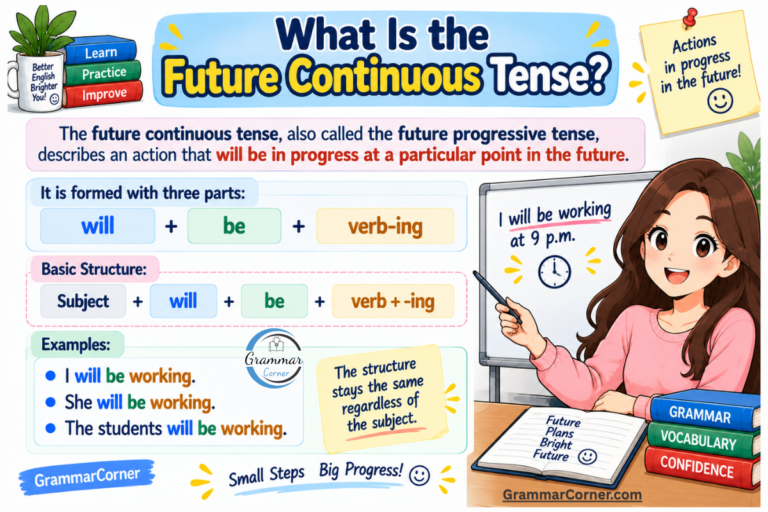
Future Continuous Tense Chart (Formula, Rules & Examples)
What Is the Future Continuous Tense? The future continuous tense is also called the future progressive tense. It describes an action that will be in progress at a point in the future. It is constituted from three parts that never change: will + be + the -ing form of the main verb. How the examples…
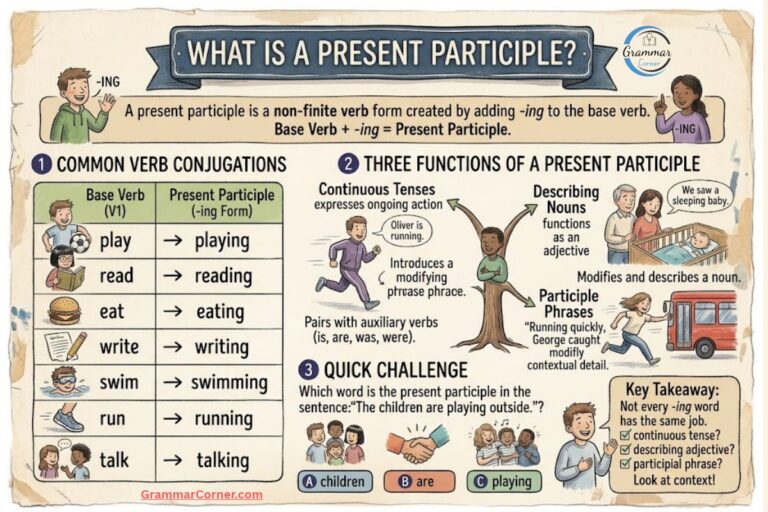
Present Participle (Functions, Formula & Examples)
What Is a Present Participle? A present participle is a non-finite verb form created by adding -ing to the base verb. Unlike irregular past participles, both regular and irregular verbs take the uniform -ing suffix when forming the present participle. Base Verb + -ing = Present Participle Common Verb Conjugations Base Verb (V1) Present Participle…
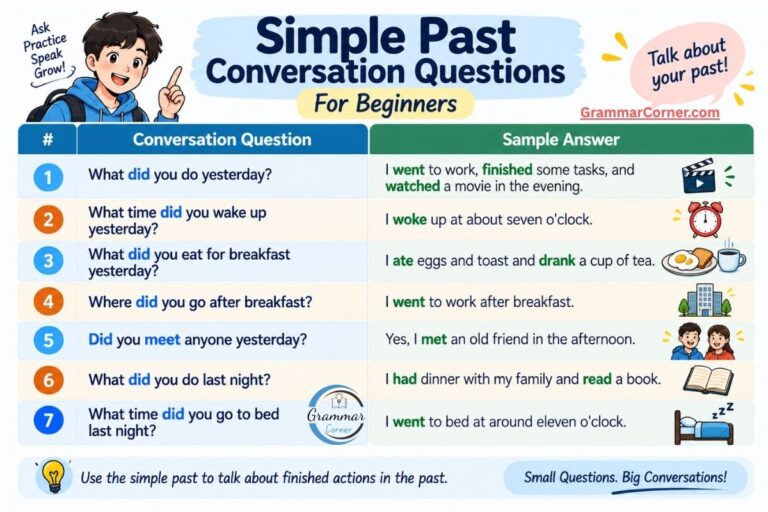
Simple Past Conversation Questions With Answers
Simple Past Conversation Questions with Answers Simple past conversation questions help English learners talk about completed actions, past experiences, childhood memories, school life, travel, food, work, and important events. They also give learners repeated practice with did, was, were, regular past verbs, and irregular past verbs in natural questions and answers. Simple Past Conversation Questions…
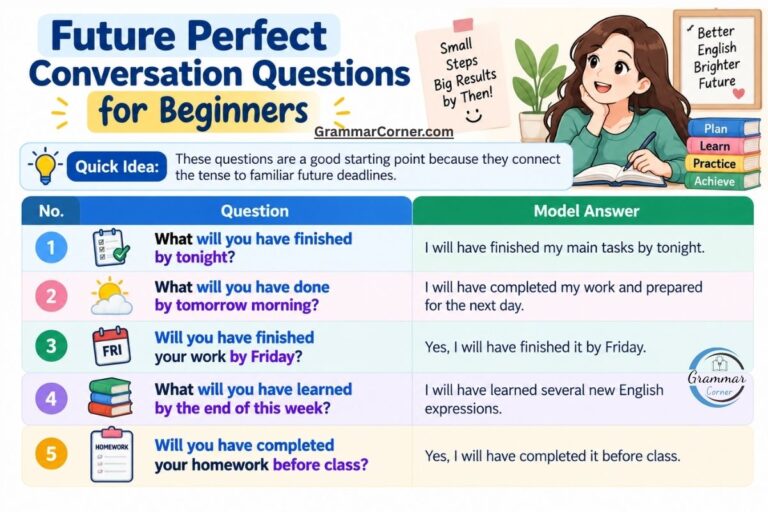
Future Perfect Conversation Questions with Answers
What Is the Future Perfect Tense? Future perfect conversation questions deal with the things that will be completed before a particular time or event in the future. The tense is especially advantageous when discussing goals, careers, achievements, deadlines, travel plans, education, and predictions. How the examples are marked will have past participle future reference point…
Past Perfect Conversation Questions with Answers
Past perfect conversation questions are useful when you are discussing about one past event that happened before another past event. The tense helps learner to understand the order in which things happened, especially when a conversation moves between two different moments in the past. How The Sentence is Marked had past participle the later past…
Present Simple Conversation Questions with Answers
The present simple tense is one of the most commonly used tenses in everyday English. Practicing conversation questions is one of the best ways to become comfortable using this tense in real-life situations. Habits I get up at six. Routines She works every day. Facts Water boils at 100°C. Permanent situations They live in Faisalabad….