Simple Past Tense Chart (Rules, Formula, Examples)
What Is the Simple Past Tense?
The simple past tense is used to talk about an action, event, or situation that happened and finished in the past.
For example:
- Elly visited her grandmother yesterday.
- We watched a documentary last night.
- Daniel lost his keys.
- They were tired after the journey.
The verb usually changes to show that the action happened in the past. Regular verbs generally take -ed, while irregular verbs have their own past forms.
Present vs. Simple Past Verb Forms
| Present | Simple Past |
|---|---|
| walk | walked |
| visit | visited |
| play | played |
| go | went |
| see | saw |
| take | took |
Compare these sentences:
The first sentence describes a present habit. The second tells us about a completed action in the past.
Quick Practice
Change each verb into the simple past tense.
- clean →
Answer
cleaned - visit →
Answer
visited - go →
Answer
went - buy →
Answer
bought
All answers
When Do We Use the Simple Past Tense?
The simple past has several common uses. The key idea is that the action or situation belongs to a finished period in the past.
Completed Actions in the Past
Use the simple past for an action that started and ended in the past.
- Maria finished her assignment.
- We visited the museum on Saturday.
- Tom closed the window.
- The meeting ended at noon.
Compare:
The first action is complete. The second is happening now.
A Series of Completed Actions
The simple past is also useful when several completed actions happen one after another.
- James opened the door, walked inside, and sat down.
- We packed our bags, locked the house, and left for the airport.
- She woke up, made breakfast, and went to work.
Past States and Situations
The simple past is not limited to physical actions. It can describe a condition, feeling, belief, possession, or situation that was true in the past.
- I was nervous before the interview.
- They lived in Lahore in 2018.
- She knew the answer.
- We had a small house near the river.
- He liked classical music when he was younger.
Actions at a Specific Past Time
The simple past commonly appears with a time expression that tells us when something happened.
Common expressions include:
| Time expression | Example |
|---|---|
| yesterday | I called him yesterday. |
| last night | We watched a film last night. |
| last week | She started the course last week. |
| two days ago | They arrived two days ago. |
| in 2020 | He moved abroad in 2020. |
| on Monday | I met her on Monday. |
| when I was a child | I played outside when I was a child. |
A time expression is helpful, but it is not always necessary.
- Who broke the glass?
- I forgot his name.
- She left early.
Quick Practice
Choose the sentence that correctly uses the simple past.
- I visited / visit my uncle last Sunday.
Answer
I visited my uncle last Sunday. - She buys / bought a new phone yesterday.
Answer
She bought a new phone yesterday. - We watched / watch the match two hours ago.
Answer
We watched the match two hours ago.
All answers
How to Form the Simple Past Tense
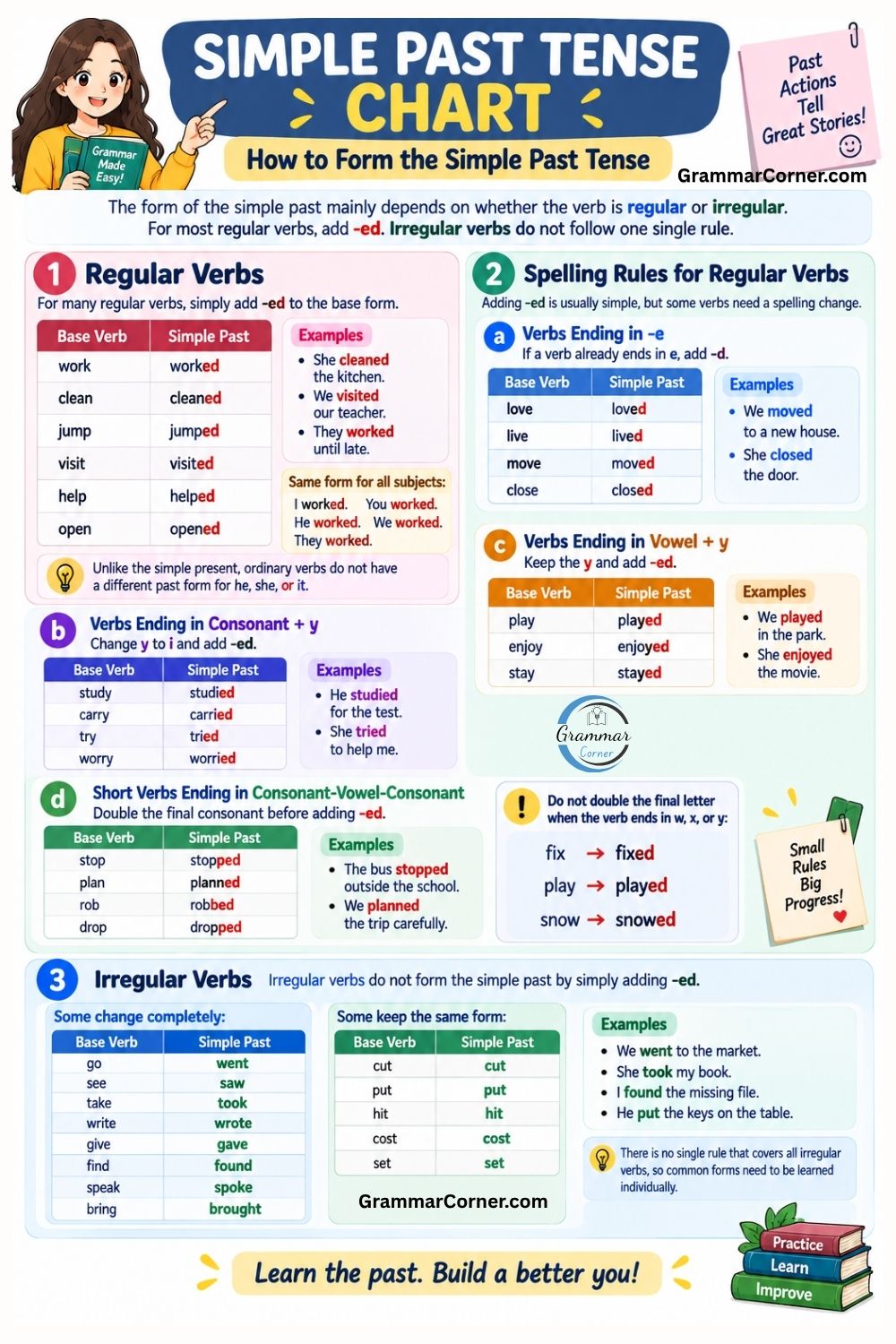
The form of the simple past depends mainly on whether the verb is regular or irregular.
For most regular verbs, add -ed. Irregular verbs do not follow one single rule.
Regular Verbs
For many regular verbs, simply add -ed to the base form.
| Base verb | Simple past |
|---|---|
| work | worked |
| clean | cleaned |
| jump | jumped |
| visit | visited |
| help | helped |
| open | opened |
Examples:
- She cleaned the kitchen.
- We visited our teacher.
- They worked until late.
The same past form is normally used with different subjects:
Spelling Rules for Regular Verbs
Adding -ed is simple, but some verbs require a spelling change.
Verbs Ending in -e
If a verb already ends in e, add -d.
| Base verb | Simple past |
|---|---|
| love | loved |
| live | lived |
| move | moved |
| close | closed |
- We moved to a new house.
- She closed the door.
Verbs Ending in Consonant + y
Change y to i and add -ed.
| Base verb | Simple past |
|---|---|
| study | studied |
| carry | carried |
| try | tried |
| worry | worried |
- He studied for the test.
- She tried to help me.
But when a verb ends in a vowel + y, keep the y and add -ed.
| Base verb | Simple past |
|---|---|
| play | played |
| enjoy | enjoyed |
| stay | stayed |
Short Verbs Ending in Consonant-Vowel-Consonant
Some short verbs double their final consonant before adding -ed.
| Base verb | Simple past |
|---|---|
| stop | stopped |
| plan | planned |
| rob | robbed |
| drop | dropped |
- The bus stopped outside the school.
- We planned the trip carefully.
Do not double the final letter when the verb ends in w, x, or y:
Irregular Verbs
Irregular verbs do not form the simple past by simply adding -ed.
Some change completely:
| Base verb | Simple past |
|---|---|
| go | went |
| see | saw |
| take | took |
| write | wrote |
| give | gave |
| find | found |
| speak | spoke |
| bring | brought |
Some irregular verbs keep the same form:
| Base verb | Simple past |
|---|---|
| cut | cut |
| put | put |
| hit | hit |
| cost | cost |
| set | set |
Examples:
- We went to the market.
- She took my book.
- I found the missing file.
- He put the keys on the table.
The Past Forms of Be
The verb be is different from most verbs in the simple past.
It has two forms: was and were.
| Subject | Past form of be |
|---|---|
| I | was |
| You | were |
| He | was |
| She | was |
| It | was |
| We | were |
| You | were |
| They | were |
Examples:
- I was tired.
- She was at home.
- You were late.
- They were happy.
Quick Practice
Choose the correct past form.
- She the door. (close)
Answer
She closed the door. - We the problem. (solve)
Answer
We solved the problem. - He to the office. (go)
Answer
He went to the office. - They very tired. (be)
Answer
They were very tired. - I the book on the desk. (put)
Answer
I put the book on the desk.
All answers
Simple Past Tense Sentence Structure
The structure changes when you move from an affirmative sentence to a negative sentence or question.
Affirmative Sentences
For ordinary verbs:
| Subject | Past Verb | Rest of Sentence |
|---|---|---|
| I | watched | the movie. |
| She | bought | a dress. |
| They | visited | the park. |
Examples:
- I watched the movie.
- She bought a dress.
- They visited the park.
Negative Sentences
For most verbs, use:
or
Examples:
- I did not watch the movie.
- She didn’t buy a dress.
- They didn’t visit the park.
Notice an important point: after did or didn’t, use the base form, not the past form.
She didn’t went to school.
She didn’t go to school.
The reason is that did already carries the past tense.
Negative Sentences with Be
With was and were, do not use did. Use:
Examples:
- I wasn’t angry.
- He was not available.
- They weren’t ready.
- We were not late.
Yes/No Questions
For ordinary verbs, use:
Examples:
- Did you call Ali?
- Did she finish the work?
- Did they arrive on time?
Did she finished the work?
Did she finish the work?
Questions with Be
With was and were, do not use did. Use:
Examples:
- Was he at home?
- Was she angry?
- Were they ready?
- Were you busy yesterday?
Wh-Questions
A question beginning with what, where, when, why, who, or how usually follows this pattern:
| Question | Example |
|---|---|
| What | What did you buy? |
| Where | Where did she go? |
| When | When did they arrive? |
| Why | Why did he leave? |
| How | How did you solve it? |
For example:
- Where did you park the car?
- Why did she leave early?
- When did they finish the project?
There is one useful exception with who. When who is the subject performing the action, did is not needed:
- Who called you?
- Who opened the window?
- Who broke the glass?
Quick Practice
Correct the mistakes.
- Did you went there?
- She didn’t saw him.
- Were you at home?
- Did they finished the work?
Show Answers
- Did you go there?
- She didn’t see him.
- Were you at home? — Correct.
- Did they finish the work?
Simple Past Tense with Time Expressions
Time expressions make the past time clear and are often used with the simple past.
Common expressions include:
Examples:
- We arrived yesterday.
- She called me two hours ago.
- They moved here in 2019.
- I met him last year.
- He left on Tuesday.
A time expression can appear at the beginning or end of a sentence:
Quick Practice
Add a suitable time expression to each sentence.
- I visited my cousin .
- She moved to Canada .
- We finished the meeting .
Possible answers
Simple Past vs. Present Perfect
The simple past and present perfect can both describe past events, but they do not normally communicate the same relationship with the present.
| Simple Past | Present Perfect |
|---|---|
| I visited Paris in 2022. | I have visited Paris before. |
| She finished the report yesterday. | She has finished the report. |
| We saw that movie last week. | We have seen that movie. |
Compare:
The first sentence gives a finished past time. The second focuses on the present result: I do not have my keys now.
A simple way to remember the difference is:
Simple past → finished past time
Present perfect → past connected to the present
Quick Practice
Choose the better tense.
- I him last Monday. (met / have met)
Answer
I met him last Monday. - She her homework already. (finished / has finished)
Answer
She has finished her homework already. - We that museum in 2023. (visited / have visited)
Answer
We visited that museum in 2023.
All answers
Common Mistakes with the Simple Past Tense
Using the Past Form After Did
Using the Past Form After Didn’t
Using Did with Was/Were
Forgetting to Change an Irregular Verb
Using the Simple Past for an Ongoing Past Action
Quick Practice
Find and correct the mistake in each sentence.
- 1.Did she went to the bank?
- 2.We didn’t saw the accident.
- 3.He was went to school.
- 4.They goed home early.
Answers
- 1.Did she go to the bank?
- 2.We didn’t see the accident.
- 3.He went to school.
- 4.They went home early.
Simple Past Tense Practice Exercises
Now test your understanding without looking back at the rules.
Complete the Sentences
Write the simple past form of the verb in brackets.
- 1.Emma ______ the window. (open)
- 2.We ______ dinner at eight. (eat)
- 3.David ______ his keys yesterday. (lose)
- 4.They ______ the project on time. (finish)
- 5.I ______ her at the station. (meet)
- 6.She ______ very tired after work. (be)
- 7.The children ______ football after school. (play)
- 8.He ______ the answer immediately. (know)
Make the Sentences Negative
Rewrite each sentence in the negative.
- 1.I watched the match.
- 2.She bought a new bag.
- 3.They visited the museum.
- 4.He called me.
Make Questions
Turn each statement into a simple past question.
- 1.You visited the library.
- 2.She finished the assignment.
- 3.They went to Islamabad.
- 4.He saw the message.
Correct the Mistakes
- 1.Did you saw my brother?
- 2.She didn’t went to work.
- 3.We was late.
- 4.He studyed all night.
- 5.They buyed a new car.
Answers
Exercise 1
- 1.opened
- 2.ate
- 3.lost
- 4.finished
- 5.met
- 6.was
- 7.played
- 8.knew
Exercise 2
- 1.I didn’t watch the match.
- 2.She didn’t buy a new bag.
- 3.They didn’t visit the museum.
- 4.He didn’t call me.
Exercise 3
- 1.Did you visit the library?
- 2.Did she finish the assignment?
- 3.Did they go to Islamabad?
- 4.Did he see the message?
Exercise 4
- 1.Did you see my brother?
- 2.She didn’t go to work.
- 3.We were late.
- 4.He studied all night.
- 5.They bought a new car.
Frequently Asked Questions About the Simple Past Tense
What is the simple past tense?
The simple past tense is used for actions, events, or situations that happened and were completed in the past. For example, “She visited her aunt yesterday.”
What is the formula for the simple past tense?
For an affirmative sentence with an ordinary verb, the basic structure is subject + past form of the verb + rest of the sentence. For example, “They played football.”
What is the negative form of the simple past tense?
Use subject + did not/didn’t + base form of the verb. For example, “I didn’t see him.” With be, use was not/wasn’t or were not/weren’t.
How do you form a simple past question?
For most verbs, use did + subject + base form of the verb. For example, “Did you finish the work?” With be, use was/were + subject, as in “Were they ready?”
What is the difference between simple past and present perfect?
The simple past normally refers to a completed action in a finished past time, while the present perfect connects a past event to the present or refers to an unspecified past time. Compare “I visited London in 2022” with “I have visited London.”
What is the simple past form of go?
The simple past form of go is went. For example: “We went to the market yesterday.”
What is the simple past form of be?
The simple past forms of be are was and were. Use was with I, he, she, and it, and were with you, we, and they.
Frequently Asked Questions About the Simple Past Tense
What is the simple past tense?
The simple past tense is used for actions, events, or situations that happened and were completed in the past. For example, “She visited her aunt yesterday.”
What is the formula for the simple past tense?
For an affirmative sentence with an ordinary verb, the basic structure is subject + past form of the verb + rest of the sentence. For example, “They played football.”
What is the negative form of the simple past tense?
Use subject + did not/didn’t + base form of the verb. For example, “I didn’t see him.” With be, use was not/wasn’t or were not/weren’t.
How do you form a simple past question?
For most verbs, use did + subject + base form of the verb. For example, “Did you finish the work?” With be, use was/were + subject, as in “Were they ready?”
What is the difference between simple past and present perfect?
The simple past normally refers to a completed action in a finished past time, while the present perfect connects a past event to the present or refers to an unspecified past time. Compare “I visited London in 2022” with “I have visited London.”
What is the simple past form of go?
The simple past form of go is went. For example: “We went to the market yesterday.”
What is the simple past form of be?
The simple past forms of be are was and were. Use was with I, he, she, and it, and were with you, we, and they.
All 12 tenses, in one place
English builds every tense from the same two ingredients — when (present, past, future) and aspect (simple, continuous, perfect, perfect continuous). Each tense below links to its chart and a set of practice conversation questions.
| Present Tense | Past Tense | Future Tense |
|---|---|---|