Present Continuous Tense (Formula, Chart, Examples)
What is Present Continuous Tense?
The present continuous tense (also called the present progressive) shows an unfinished action in progress. It describes an action that is happening now, around now, or arranged for the near future. It is formed with the helping verb am, is, or are plus the -ing form of the main verb.
Present Continuous formula
Present continuous formula is as follows: subject + am/is/are + verb-ing, as in She is cooking dinner.
In present continuous structure, two pieces are always present:
-
A form of the verb be
am, is, or are. This part changes with the subject.
changes -
The present participle
The main verb plus -ing. This part never changes, no matter who the subject is.
never changes
| Subject | Form of be | Example |
|---|---|---|
| I | am | I am waiting outside. |
| He / She / It, one person or thing | is | She is cooking dinner. |
| You / We / They, plural nouns | are | They are cooking dinner. |
Watch which half moves
Tap any subject. Only the middle word reacts — cooking stays exactly as it is.
Pick a subject above to build the sentence.
Present Continuous vs Present Progressive (Are They Different?)
Short answer
They are two names for exactly the same thing. No difference in grammar, meaning, or use.
| Name | Where you’ll meet it |
|---|---|
| Present continuous | The older classroom term. More common in British course books and in ESL teaching worldwide. |
| Present progressive | Preferred in American academic grammar and in modern linguistics, because progressive is the technical name for this aspect of a verb. |
Why linguists prefer the other name
Descriptive grammarians often point out that English has only two true tenses marked on the verb itself, present and past, and that am working is really the present tense combined with progressive aspect. That is why you will see the label present progressive in reference grammars while textbooks and exam papers still say present continuous.
Exam tip
If a test asks for the “present continuous,” write the same answer you would write for the “present progressive.”
When To Use Present Continuous?
We use it when an action is unfinished. The full list is covered later in this guide, but here is the overview:
| Use | Example |
|---|---|
| Action happening right now | She is answering the phone. |
| Temporary situation | I am living with my aunt this month. |
| Action around the present time | He is training for a marathon. |
| Changing or developing situation | The days are getting shorter. |
| New trend | More people are working from home. |
| Repeated action with always | You are always interrupting me. |
| Fixed future arrangement | We are flying to Dubai on Friday. |
| Current project | I am writing a cookbook. |
| Live commentary | Ali is passing the ball to Hassan. |
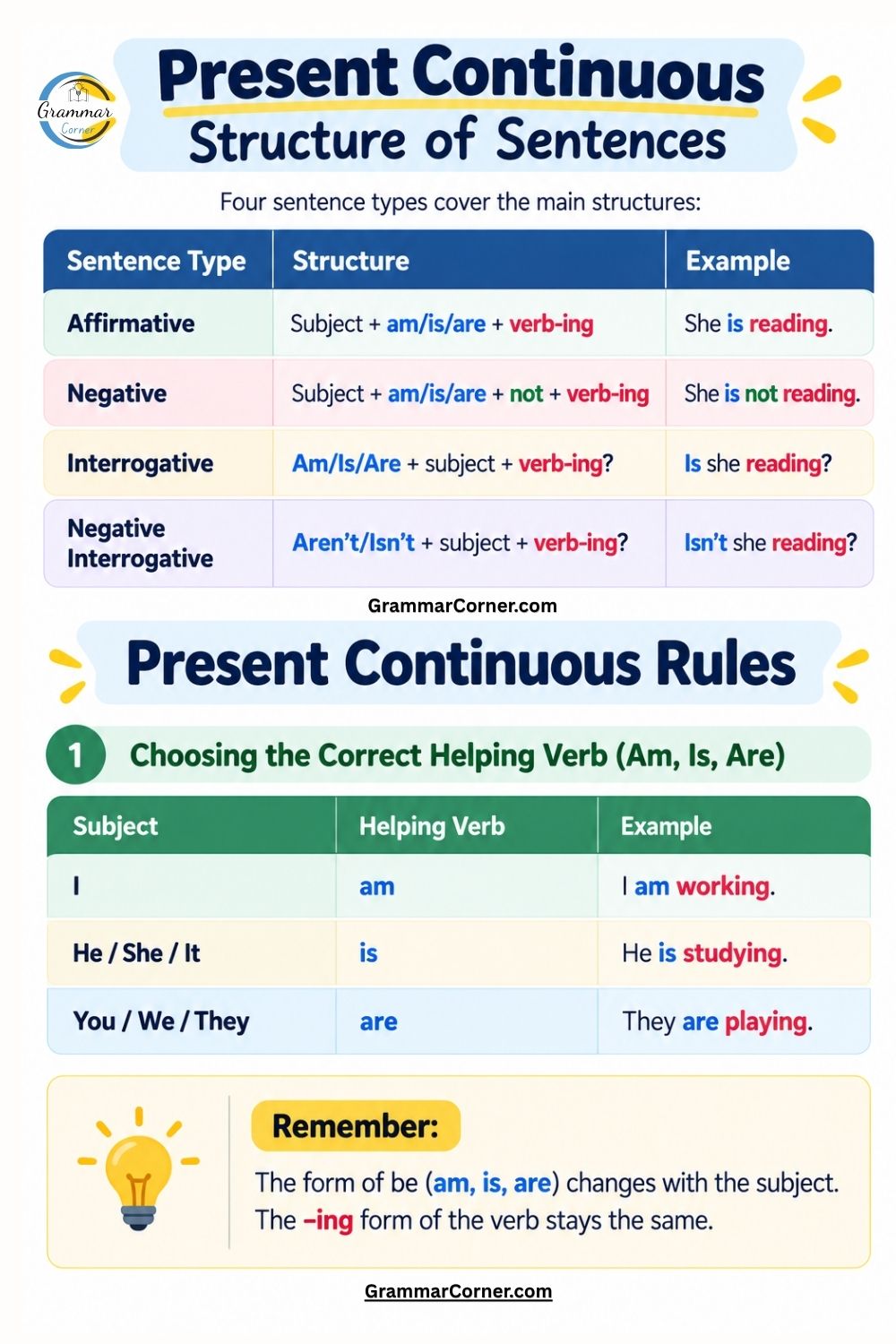
Present Continuous Structure of Sentences
Four sentence types cover everything you can build with this tense.
| Sentence Type | Structure | Example |
|---|---|---|
| Affirmative | Subject + am/is/are + verb-ing | She is reading. |
| Negative | Subject + am/is/are + not + verb-ing | She is not reading. |
| Interrogative | Am/Is/Are + subject + verb-ing? | Is she reading? |
| Negative Interrogative | Aren’t/Isn’t + subject + verb-ing? | Isn’t she reading? |
Present Continuous Rules
Choosing the Correct Helping Verb (Am, Is, Are)
| Subject | Helping Verb | Example |
|---|---|---|
| I | am | I am working. |
| He/She/It | is | He is studying. |
| You/We/They | are | They are playing. |
A few extra pointers that exam questions like to test:
Grammar notes
- Singular nouns take is. The engine is making a strange noise.
- Plural nouns take are. The engines are making a strange noise.
- Two subjects joined by and take are. Sara and Bilal are waiting outside.
- Uncountable nouns take is. The rice is boiling.
- Words between the subject and the verb do not change anything. The box of files is sitting on my desk. The subject is box, not files.
- Everybody, somebody, nobody, each, and every take is. Everybody is watching the screen.
How to Add “-ing” to Verbs
Most verbs simply take -ing with nothing else changing. The exceptions follow clear patterns.
| Base Verb | Rule | Example |
|---|---|---|
| work | add -ing | working |
| make | drop final e | making |
| run | double consonant | running |
| lie | ie → ying | lying |
| travel | British vs American spelling | travelling / traveling |
Here are the same rules with more detail, because this is where most spelling errors happen:
Rule 1 — Most verbs
Just add -ing.
Rule 2 — Verbs ending in a silent -e
Drop the e, then add -ing.
Rule 3 — Verbs ending in -ee, -ye, or -oe
Keep the e.
The verb be is irregular here too: being.
Rule 4 — One-syllable verbs ending in consonant + vowel + consonant
Double the last consonant.
This rule does not apply when the verb ends in w, x, or y: show → showing, fix → fixing, play → playing.
Rule 5 — Two-syllable verbs
Double the final consonant only if the stress falls on the second syllable.
Rule 6 — Verbs ending in -ie
Change ie to y, then add -ing.
Compare with verbs ending in a single -y, which never change: study → studying, carry → carrying, enjoy → enjoying.
Rule 7 — Verbs ending in -c
Add k before -ing.
Without the k, the c would be pronounced like an s.
Rule 8 — Verbs ending in -l
British and American spelling differ. British English doubles the l whatever the stress; American English doubles it only when the stress is on the final syllable.
Pick one variety and stay with it across your whole document.
Present Continuous Tense Chart
Present Continuous Examples
What you’ll see below
The use of Present Continuous examples can also be observed in daily routine of the children as well as for some future planning.
Read them by shape
Every sentence below is the same tense wearing a different shape. Tap a button to see only that kind.
Showing all 105 examples.
Daily Life 15 examples
- I am making breakfast for the family.
- My mother is watering the plants.
- The washing machine is running.
- He is charging his phone in the kitchen.
- We are cleaning the storeroom today.
- She is folding the laundry.
- The neighbours are moving out this weekend.
- I am waiting for the milkman.
- My father is reading the newspaper on the balcony.
- The rice is boiling over.
- They are painting their front gate.
- I am not using the car today.
- Is your brother sleeping?
- The lights are flickering again.
- We are having guests for dinner.
No examples of this shape in this group.
School 15 examples
- The students are copying notes from the board.
- Our teacher is explaining fractions.
- I am preparing for my chemistry test.
- She is borrowing a book from the library.
- The bell is ringing.
- They are practising for the annual function.
- He is not paying attention.
- Are you taking the science stream this year?
- The principal is addressing the assembly.
- We are working on a group project about water.
- Sana is presenting her report right now.
- The exam results are being announced today.
- I am struggling with algebra these days.
- The children are lining up for the bus.
- He is repeating the lesson for the slower learners.
No examples of this shape in this group.
Office 15 examples
- I am replying to a client email.
- The manager is interviewing candidates.
- We are hiring two designers this quarter.
- She is presenting the sales figures.
- The server is being updated.
- He is not attending the Monday meeting.
- Are you handling the Karachi account?
- Our team is testing a new dashboard.
- The accountant is checking last month’s invoices.
- They are shifting to a bigger office.
- I am covering for Rahim while he is on leave.
- The printer is jamming again.
- She is training the new intern.
- We are running behind schedule.
- The company is expanding into three new cities.
No examples of this shape in this group.
Travel 15 examples
- We are flying to Doha on Thursday.
- The train is arriving at platform four.
- She is packing her suitcase.
- I am waiting at the departure gate.
- They are staying at a guesthouse near the lake.
- The taxi is honking outside.
- He is renewing his passport this week.
- Are you travelling alone?
- The tourists are taking photos of the fort.
- Our flight is boarding now.
- I am learning basic Turkish before the trip.
- The bus is stopping for a tea break.
- They are not visiting the northern areas this year.
- My luggage is being scanned.
- We are checking out at eleven.
No examples of this shape in this group.
Sports 15 examples
- The players are warming up on the field.
- He is bowling the last over.
- The crowd is cheering loudly.
- She is leading the race.
- They are losing by two goals.
- The referee is signalling a foul.
- I am training for a half marathon.
- Our team is playing better than last season.
- He is not batting today because of an injury.
- The swimmer is touching the wall first.
- The coach is shouting instructions.
- Are they winning?
- The score is changing every minute.
- She is stretching before the match.
- The match is being broadcast live.
No examples of this shape in this group.
Children 15 examples
- The baby is crawling towards the sofa.
- My son is building a tower with blocks.
- She is colouring a picture of a rainbow.
- The kids are laughing at a cartoon.
- He is learning to tie his shoelaces.
- They are fighting over the remote again.
- The toddler is throwing food on the floor.
- Is she brushing her teeth?
- My daughter is counting to twenty.
- The boys are riding their bicycles outside.
- He is growing so fast.
- The children are not listening to me.
- She is pretending to be a doctor.
- They are feeding the ducks at the park.
- The baby is smiling in her sleep.
No examples of this shape in this group.
Future Plans 15 examples
- I am meeting my cousin at seven.
- We are celebrating Eid at my grandmother’s house.
- She is starting her internship on the first of next month.
- They are getting married in November.
- He is joining the gym from Monday.
- Our class is visiting the museum on Friday.
- I am seeing the doctor tomorrow morning.
- We are shifting to a new flat next week.
- The company is launching the app in December.
- She is flying back on the fifteenth.
- Are you coming to the wedding?
- They are not attending the conference this year.
- I am giving a presentation at nine sharp.
- My parents are arriving on the night train.
- We are opening the shop early tomorrow.
No examples of this shape in this group.
Teacher tip
Look at the last group again. Nothing in it is happening as you read — every sentence names a plan that is already fixed, with the time attached: at seven, on Friday, in November. That time phrase is what tells your reader you mean later, not now.
Did you notice?
Four sentences above use an extra word: The server is being updated. My luggage is being scanned. Nobody is named as the doer, because the focus is on the thing it happens to. Tap the Passive filter to see all four together.
Mini challenge: now or arranged for later?
Same tense in every sentence. Only the time phrase moves it.
- The rice is boiling over.
- They are getting married in November.
- The bell is ringing.
- Our class is visiting the museum on Friday.
Key takeaways
- Every sentence above follows the same shape: a form of be plus a verb ending in -ing.
- Negatives slot not between the two pieces; questions move am/is/are in front of the subject.
- The tense itself doesn’t say now or later — the time phrase does.
When to Use the Present Continuous Tense
Actions Happening Right Now
This is the core use. The action started a moment ago and has not finished.
- The kettle is boiling.
- I am typing an email to my manager.
- Look, it is snowing outside.
Temporary Situations
The action is true these days but not permanent. The speaker expects it to end.
- I am staying at a hotel until my flat is ready.
- She is covering for her colleague while he is on leave.
- We are using the back entrance because the lift is broken.
Actions Happening Around the Present Time
The action does not have to be in progress at the exact second you speak. It is in progress over a wider stretch of time.
- I am reading a book about the Mughal empire. (You are not reading it at this moment.)
- She is learning to drive.
- They are renovating their kitchen.
Changing or Developing Situations
Use this tense with verbs of change:
- get
- become
- grow
- rise
- fall
- increase
- decrease
- improve
- change
- turn
- The weather is getting colder.
- Prices are rising every month.
- My grandfather’s health is improving.
New Trends
When something is spreading or shifting across society, the continuous form shows the movement.
- More students are choosing online courses.
- Fewer people are reading printed newspapers.
- Small businesses are shifting to digital payments.
Repeated Actions with “Always”
With always, constantly, or forever, the present continuous carries a feeling: irritation, surprise, or friendly exaggeration. It is not neutral like the simple present.
- He is always losing his keys.
- You are constantly checking your phone.
- She is forever helping people who never thank her.
- My laptop is always crashing during meetings.
Where the adverb sits
The adverb sits between the helping verb and the main verb:
- is always losing
- always is losing
Fixed Future Arrangements
If a plan is settled — a ticket booked, a time agreed, a person expecting you — the present continuous works as a future tense.
- We are flying to Istanbul on Tuesday morning.
- I am meeting the client at four.
- She is starting her new job on Monday.
- They are getting married in December.
One condition
The arrangement must be definite. For a wish or a rough intention, use going to or will instead.
Describing Current Projects
Writers, students, and professionals use this tense to report ongoing work.
- Our team is developing a mobile app for farmers.
- I am writing my thesis on renewable energy.
- The council is building a new bridge across the canal.
- She is training three new employees this quarter.
Narrating Live Events
Sports commentary, live blogs, and demonstrations run almost entirely on this tense, because everything is unfolding as the audience watches.
- Khan is running towards the goal.
- The chef is folding the batter gently.
- The judges are counting the votes now.
- Rain is falling heavily over the stadium.
Mini challenge: which use is this?
Same tense every time. Only the job it’s doing changes.
- More families are choosing electric cars.
- He is always interrupting me.
- I am staying with my aunt until Sunday.
- We are meeting the landlord at six.
When NOT to Use the Present Continuous
Stative Verbs
Some verbs describe a state rather than an action: something that simply is, with no beginning, middle, or end you can watch. These are called stative verbs, and they normally stay in the simple present.
Common stative verbs and what they describe:
- know — knowledge in your mind, not an activity
- love — an emotion you hold, not something you perform
- hate — the same, an ongoing feeling
- believe — an opinion you carry
- own — a legal state, not an action
- prefer — a settled choice
- understand — a mental condition, not a task
Others in the same family:
- want
- need
- like
- seem
- belong
- contain
- cost
- mean
- remember
- forget
- recognise
- deserve
- matter
- agree
- doubt
- hope
- wish
- suppose
| Incorrect | Correct |
|---|---|
| I am knowing him. | I know him. |
| She is loving chocolate. | She loves chocolate. |
| They are believing the story. | They believe the story. |
| He is owning three shops. | He owns three shops. |
| We are preferring tea. | We prefer tea. |
| I am understanding the lesson. | I understand the lesson. |
| This is costing 500 dollars. | This costs 500 dollars. |
| I am wanting a glass of water. | I want a glass of water. |
Verbs That Can Be Both Stative and Dynamic
Several verbs have two personalities. As a state, they take the simple present. As a deliberate action, they take the continuous.
| Verb | Stative Meaning (simple present) | Dynamic Meaning (continuous) |
|---|---|---|
| think | have an opinion I think you are right. | use your mind I am thinking about your offer. |
| have | possess She has two brothers. | experience or do She is having lunch. |
| see | perceive with eyes I see the mountain from here. | meet or date I am seeing the doctor at five. |
| feel | an opinion I feel this plan is risky. | a physical or emotional state in progress I am feeling better today. |
| taste | describe a quality The soup tastes salty. | the act of tasting The chef is tasting the soup. |
| look | appear You look tired. | direct your eyes He is looking at the map. |
| smell | describe a quality The flowers smell sweet. | the act of smelling She is smelling the flowers. |
| weigh | have a weight The bag weighs five kilos. | measure something He is weighing the bag. |
| appear | seem He appears confident. | perform She is appearing on stage tonight. |
| be | a fixed quality He is polite. | temporary behaviour He is being rude today. |
Mini challenge: which side is the verb on?
Read the meaning, then pick the form that fits.
- I … this soup is too salty.
- The chef … the sauce.
- She … two cars.
- He … rude today.
- I … the doctor at five.
Signal Words Used with the Present Continuous
Signal words are clues. When you see them in a question, the present continuous is usually the answer.
| Signal Word | Example |
|---|---|
| now | She is studying now. |
| right now | I am cooking right now, can I call you back? |
| currently | He is currently working on a new design. |
| at the moment | We are not accepting orders at the moment. |
| today | The team is playing well today. |
| these days | Fuel prices are falling these days. |
| this week | I am covering the morning shift this week. |
| nowadays | More children are learning to code nowadays. |
| still | She is still waiting for a reply. |
| tonight | We are watching a film tonight. |
Teacher tip
Notice where the clue lands. Most of these sit at the end of the sentence, but currently and still slip in between am/is/are and the -ing word — the same seat that always takes.
Key takeaways
- Nine jobs, one shape: now, temporary, around now, changing, trends, always with feeling, fixed plans, projects, live commentary.
- Stative verbs describe what simply is, so they stay in the simple present.
- Ten verbs switch sides — the meaning decides the form, not the verb itself.
- Signal words are hints, not rules. Read the meaning before you trust them.
Present Continuous Passive Voice
Quick answer
Use the passive when the action matters more than the person doing it, or when you do not know who did it.
Formula
| Active | Passive |
|---|---|
| They are building a bridge. | A bridge is being built. |
| The mechanic is repairing my car. | My car is being repaired. |
| Someone is watching us. | We are being watched. |
| The committee is reviewing the applications. | The applications are being reviewed. |
| They are painting the school walls. | The school walls are being painted. |
| The chef is preparing your order. | Your order is being prepared. |
| Workers are cleaning the drains. | The drains are being cleaned. |
Three points worth remembering:
-
Only verbs that take an object can become passive
You cannot make a passive from He is sleeping, because there is nothing to receive the action.
-
The helping verb agrees with the new subject
A bridge is being built but Bridges are being built.
-
If you want to name the doer, add by
The applications are being reviewed by the committee.
Flip it around
Tap an active sentence and watch the object move to the front.
Pick a sentence above to see its passive twin.
Contractions in the Present Continuous
| Full Form | Contraction |
|---|---|
| I am | I’m |
| He is | He’s |
| She is | She’s |
| It is | It’s |
| We are | We’re |
| You are | You’re |
| They are | They’re |
| is not | isn’t |
| are not | aren’t |
| am not | I’m not (no contraction of am not) |
A spelling warning that costs marks
It’s with an apostrophe means it is or it has. Its without an apostrophe shows possession.
✅ It’s raining is correct. ❌ Its raining is not.
One more double meaning
Also note that he’s can mean he is or he has. Context sorts it out: He’s cooking is present continuous, while He’s cooked is present perfect.
Mini challenge: apostrophe check
Three sentences, three quick decisions.
- … raining, so take an umbrella.
- The dog is wagging … tail.
- He’s cooking dinner. Which tense is this?
Present Continuous vs Other English Tenses
Present Continuous vs Simple Present
| Point | Present Continuous | Simple Present |
|---|---|---|
| Meaning | action in progress | habit, routine, or fact |
| Time frame | now, around now, temporary | always, generally, permanent |
| Form | am/is/are + verb-ing | base verb (+ s for he/she/it) |
| Example | She is working late tonight. | She works at a bank. |
| Example | It is raining in Karachi. | It rains a lot in July. |
| Example | I am living with friends this term. | I live in Multan. |
| Stative verbs | avoided | used |
| Signal words | now, at the moment, currently | always, usually, every day |
Ask whether the sentence describes a routine or a moment. He drinks tea is a routine. He is drinking tea is a moment.
Present Continuous vs Present Perfect Continuous
| Point | Present Continuous | Present Perfect Continuous |
|---|---|---|
| Form | am/is/are + verb-ing | have/has + been + verb-ing |
| Focus | the action right now | how long the action has lasted |
| Starting point | not mentioned | mentioned or implied |
| Example | I am waiting for the bus. | I have been waiting for the bus for an hour. |
| Example | She is studying French. | She has been studying French since January. |
| Common partners | now, at the moment | for, since, all day, how long |
If the sentence answers how long?, you need the present perfect continuous. If it answers what is happening?, the present continuous is enough.
Present Continuous vs Going To
| Point | Present Continuous (future) | Going To |
|---|---|---|
| Meaning | a fixed arrangement | an intention or a prediction based on evidence |
| How settled | time, place, or people already agreed | decided in the mind, details may be open |
| Example | I am meeting Ahmed at six. | I am going to meet Ahmed sometime this week. |
| Example | We are moving house on Sunday. | We are going to move house eventually. |
| Prediction | not used | Look at those clouds, it is going to rain. |
Both are correct in many sentences, and the difference is often small. If you have made a diary entry or told another person, use the present continuous. If it is still only your plan, use going to.
Present Continuous vs Will
| Point | Present Continuous (future) | Will |
|---|---|---|
| Meaning | arranged before the moment of speaking | decided at the moment of speaking |
| Typical use | appointments, bookings, schedules | offers, promises, instant decisions, predictions |
| Example | I am seeing the dentist tomorrow. | The phone is ringing. I will answer it. |
| Example | She is giving a talk on Friday. | She will probably enjoy the talk. |
| Example | They are arriving at nine. | Don’t worry, I will help you. |
If the plan existed before the conversation started, use the present continuous. If the decision was born inside the conversation, use will.
Mini challenge: pick the right form
One question from each comparison above.
- She … at a bank. (It’s her job.)
- I … for the bus for an hour.
- Look at those clouds — it … rain.
- The phone is ringing. I … answer it.
- I … the dentist tomorrow. (The appointment is booked.)
Key takeaways
- Passive: am/is/are + being + past participle, and only verbs with an object can make one.
- It’s means it is; its means belonging to it. There is no contraction for am not.
- Routine or moment decides between the simple present and the continuous.
- For the future, the continuous carries arrangements; going to carries intentions, and will carries decisions made on the spot.
Time Expressions Used with the Present Continuous
Signal words vs time expressions
Signal words are single clues. Time expressions are the longer phrases that set the frame of the sentence.
| Time Expression | Points To | Example |
|---|---|---|
| at the moment | this second | She is not answering at the moment. |
| right now | this second | I am printing the file right now. |
| currently | an ongoing period | He is currently studying in Ankara. |
| at present | an ongoing period | We are at present testing the software. |
| this morning / this afternoon | today, unfinished | I am working from home this afternoon. |
| this week / this month | a temporary stretch | She is managing the branch this week. |
| these days | modern times | People are paying with cards these days. |
| nowadays | modern times | Fewer families are cooking daily nowadays. |
| for the time being | a temporary arrangement | I am using my old phone for the time being. |
| until Friday | a fixed end | The road is staying closed until Friday. |
| tonight / tomorrow | a future arrangement | We are eating out tonight. |
| next week / on Monday | a future arrangement | He is joining the team next week. |
| Look! / Listen! | this second | Listen! Someone is calling your name. |
Teacher tip
Read the tags down the middle column and you’ll see the tense stretching. The same am/is/are + -ing covers a single second (Listen!), a whole term (currently), a decade of change (nowadays), and next Monday. The verb never changes — only the phrase beside it.
Common Mistakes with the Present Continuous
Twelve mistakes, five families
Most errors repeat the same few causes. Tap a family to see only those.
Showing all 12 mistakes.
-
Stative verb
I am understand.
I understand.
Understand is a stative verb, and it also has no -ing here at all. Two errors in three words.
-
Stative verb
She is knowing.
She knows.
Knowledge is a state, not an activity in progress.
-
Missing piece
They are play football.
They are playing football.
The helping verb is there, but the main verb lost its -ing.
-
Missing piece
He playing cricket.
He is playing cricket.
The opposite error: the -ing is there, but the helping verb went missing. Both halves are compulsory.
-
Agreement
The children is dancing.
The children are dancing.
Children is plural, so it takes are.
-
Stative verb
I am not agree with you.
I do not agree with you.
Agree is stative. The negative is built with do not, not am not.
-
Spelling
She is runing in the park.
She is running in the park.
Run ends in consonant + vowel + consonant, so the final letter doubles.
-
Spelling
He is writeing a letter.
He is writing a letter.
Drop the silent e before adding -ing.
-
Question form
Is she cook dinner?
Is she cooking dinner?
In questions the helping verb moves forward, but the main verb keeps its -ing.
-
Word order
What you are doing?
What are you doing?
After a question word, the helping verb comes before the subject.
-
Short answer
Yes, I’m.
Yes, I am.
Positive short answers are never contracted.
-
Stative meaning
I am having a new laptop.
I have a new laptop.
Have meaning possession stays in the simple present. I am having lunch is fine, because that have is an action.
| Common Error | Correction | Reason |
|---|---|---|
| I am understand. | I understand. | stative verb, no -ing |
| She is knowing. | She knows. | stative verb |
| They are play football. | They are playing football. | missing -ing |
| He playing cricket. | He is playing cricket. | missing helping verb |
| The children is dancing. | The children are dancing. | plural subject needs are |
| I am not agree. | I do not agree. | stative verb |
| She is runing. | She is running. | double the final consonant |
| He is writeing. | He is writing. | drop the silent e |
| Is she cook dinner? | Is she cooking dinner? | main verb keeps -ing |
| What you are doing? | What are you doing? | word order in questions |
| Yes, I’m. | Yes, I am. | no contraction in positive short answers |
| I am having a car. | I have a car. | have = possession |
Mini challenge: spot the correct one
Fresh sentences, the same four traps.
- Which is correct?
- Which is correct?
- Are you listening? Which reply is correct?
- Which is correct?
Key takeaways
- The time phrase sets the frame — the same tense covers this second, this term, and next Monday.
- Both halves are compulsory: drop the helping verb or the -ing and the sentence breaks.
- Stative verbs cause four of the twelve mistakes. When in doubt, ask whether you can watch it happening.
- Questions move am/is/are forward, never the -ing.
Present Continuous Exercises
Fill in the Blanks
Write the correct present continuous form of the verb in brackets.
-
Listen! The baby (cry) in the next room.
Show answer
is crying Listen! points at this exact second.
-
I (not / watch) television at the moment.
Show answer
am not watching The not slots between the two halves.
-
My cousins (stay) with us this week.
Show answer
are staying A temporary stretch, and cousins is plural.
-
Look, the sun (come) out.
Show answer
is coming
-
She (write) her third novel these days.
Show answer
is writing Drop the silent e before -ing.
-
We (have) dinner at seven tonight, so please be on time.
Show answer
are having Here have means eat, so the continuous is fine.
-
Why you (stand) in the rain?
Show answer
are … standing After the question word, the helping verb comes first.
-
The price of vegetables (rise) again.
Show answer
is rising A changing situation. The subject is price, not vegetables.
-
He (always / borrow) my charger.
Show answer
is always borrowing Always sits between the two halves and adds a hint of irritation.
-
They (not / travel) this summer.
Show answer
are not traveling (American) / are not travelling (British) British English doubles the final l.
Correct the Mistakes
Rewrite each sentence correctly.
-
She is knowing the answer.
Show answer
She knows the answer. Know is stative.
-
They are play cricket in the park.
Show answer
They are playing cricket in the park.
-
Is she cook dinner now?
Show answer
Is she cooking dinner now?
-
We are wanting a bigger house.
Show answer
We want a bigger house.
-
The children is playing outside.
Show answer
The children are playing outside.
-
I am go to the market.
Show answer
I am going to the market.
-
He is beginer at chess and is loosing every match.
Show answer
He is a beginner at chess and is losing every match. Three fixes: the article a, the spelling of beginner, and losing with one o.
-
What you are doing here?
Show answer
What are you doing here?
Multiple Choice Questions
Choose the correct option.
Correct so far: 0 of 8
- Ali his homework right now.
- they waiting outside?
- I the answer to that question.
- She to music at the moment.
- We to Lahore next Friday. The tickets are booked.
- Look! The cat up the tree.
- He his old bicycle these days.
- The road at present.
Sentence Transformation
Rewrite each sentence as instructed.
-
She is watering the plants. (Make it negative.)
Show answer
She is not watering the plants.
-
They are painting the wall. (Make it a yes/no question.)
Show answer
Are they painting the wall?
-
He is going to the market. (Ask a WH question about the place.)
Show answer
Where is he going?
-
The workers are digging the road. (Change to passive voice.)
Show answer
The road is being dug by the workers.
-
I am not feeling well. (Add a question tag.)
Show answer
I am not feeling well, am I? A negative sentence takes a positive tag.
-
Are you reading this book? (Give a negative short answer.)
Show answer
No, I’m not.
Teacher tip on question tags
Question 5 works because the sentence is already negative, so the tag turns positive: am I? Flip it around and English does something odd — the tag for I am feeling well is aren’t I?, never amn’t I?
Picture Description Activity
Find any busy photograph: a market, a classroom, a railway station, a family kitchen. Write eight sentences describing what is happening, using the present continuous.
Model answer for a market photo
- A vendor is weighing tomatoes.
- Two women are choosing vegetables.
- A boy is pushing a cart through the crowd.
- The shopkeeper on the left is counting money.
- Someone is carrying a basket on his head.
- A dog is sleeping beside the stall.
- The sun is shining on the fruit crates.
- An old man is waiting for his change.
How to score it
Give yourself one point for every sentence that contains both a helping verb and an -ing verb.
Conversation Practice
Practise this dialogue with a partner, then replace the underlined ideas with your own.
- AHi Zoya, what are you doing?
- BI am packing for my trip. I am flying to Islamabad on Sunday.
- AAre you going alone?
- BNo, I’m not. My sister is coming with me. She is finishing her exams on Friday.
- AWhere are you staying?
- BWe are staying with our uncle. He is renovating his house, so we are sleeping in the guest room.
- ASounds fun. It is raining there these days, so carry a jacket.
Your turn
Now build your own six-line conversation. Rule: every reply must contain at least one present continuous verb.
Answer Key
Fill in the Blanks
- is crying
- am not watching
- are staying
- is coming
- is writing
- are having
- are … standing
- is rising
- is always borrowing
- are not traveling (American) / are not travelling (British)
Correct the Mistakes
- She knows the answer.
- They are playing cricket in the park.
- Is she cooking dinner now?
- We want a bigger house.
- The children are playing outside.
- I am going to the market.
- He is a beginner at chess and is losing every match.
- What are you doing here?
Multiple Choice
- b
- c
- b
- b
- a
- c
- a
- b
Sentence Transformation
- She is not watering the plants.
- Are they painting the wall?
- Where is he going?
- The road is being dug by the workers.
- I am not feeling well, am I?
- No, I’m not.
Picture Description and Conversation Practice
Answers will vary. Check that every sentence has am/is/are plus a verb ending in -ing.
Present Continuous Quiz with Answers
Ten questions. One mark each.
Correct so far: 0 of 10
- Which sentence is correct?
- Complete: The workers the pipeline this week.
- What is the passive form of They are cleaning the windows?
- Which spelling is correct?
- Choose the correct tag: You are coming with us, ?
- Which sentence describes a fixed future arrangement?
- Complete: She complaining about the food.
- Which is the correct short answer to Are you listening?
- Choose the correct sentence.
- Which verb is being used as a state, not an action?
Quiz Answers
1. b 2. b 3. b 4. b 5. b 6. b 7. a 8. b 9. a 10. c
| Score | What to do next |
|---|---|
| 9–10 | Excellent. |
| 7–8 | Good. |
| 5–6 | Revise the stative-verb and question sections. |
| Below 5 | Work through the formula chart again. |
Frequently Asked Questions
What is the present continuous tense?
The present continuous tense describes an action that is unfinished: happening now, happening around this period, or arranged for the near future. It is built with am, is, or are plus the main verb ending in -ing, as in They are waiting outside.
Can we use the present continuous for future events?
Yes, when the plan is already arranged. We are leaving at six means the departure is settled, not just intended. This use normally needs a future time expression such as tonight, tomorrow, or on Monday, otherwise the listener will assume you mean right now.
Can stative verbs be used in the present continuous?
Normally no. Verbs like know, own, belong, prefer, and understand describe states and stay in the simple present. A few verbs cross over when their meaning changes: think, have, see, feel, taste, look, and be take the continuous when they describe a deliberate action or a temporary condition.
Why do we use “am,” “is,” and “are”?
They are the present-tense forms of the verb be, and English matches them to the subject.
| Form | Goes with |
|---|---|
| am | I |
| is | singular subjects including he, she, and it |
| are | you, we, they, and all plural nouns |
Without one of these three words the sentence is incomplete.
Can the present continuous be used in passive voice?
Yes. The passive formula is am/is/are + being + past participle: The hall is being decorated. Only verbs that take an object can be turned into the passive, so a sentence such as He is sleeping has no passive form.
How do you ask questions in the present continuous?
- Move the helping verb in front of the subject: Are you listening?
- For WH questions, put the question word first: Where are you going?
- The main verb keeps its -ing ending in every question.
- When the question word is itself the subject, the order does not change: Who is calling?
What are common signal words?
- now
- right now
- at the moment
- currently
- today
- these days
- this week
- nowadays
- still
- tonight
The commands Look! and Listen! also point strongly to this tense, because both draw attention to something happening as you speak.
Which verbs change spelling before adding “-ing”?
Four groups change.
| Verb ending | Change | Example |
|---|---|---|
| silent e | drop the e | make → making |
| consonant-vowel-consonant | double the last letter | run → running |
| -ie | switch to y | lie → lying |
| -c | add a k | panic → panicking |
British English also doubles a final l, as in travelling.
What is the difference between “I’m going” and “I go”?
I go describes a routine: I go to the gym on Tuesdays. I’m going describes either an action in progress, as in I’m going to the gym right now, or a fixed plan, as in I’m going to the gym after work. The first is what you always do, the second is what is happening or arranged.
Can “always” be used with the present continuous?
Yes, and it changes the tone. He always forgets his keys is a neutral fact, while He is always forgetting his keys adds irritation or humour. The adverb sits between the helping verb and the main verb. Constantly and forever work the same way.
All 12 tenses, in one place
English builds every tense from the same two ingredients — when (present, past, future) and aspect (simple, continuous, perfect, perfect continuous). Each tense below links to its chart and a set of practice conversation questions.
| Present Tense | Past Tense | Future Tense |
|---|---|---|