Sentence Structure (4 Types Explained With Examples)
What Is A Sentence?
A sentence is more than a random group of words placed next to one another. Words must follow a meaningful order so every part works together to express a complete idea.
That specific arrangement is called sentence structure. Without proper structure, even the simplest words lose their intended meaning or convey something completely unexpected.
Here, the child performs the action (kicking), and the ball receives it. The meaning is clear and logical.
The exact same words are used, but swapping their positions changes who performs the action—resulting in a completely different meaning.
Observe Word Order in Action
Both sentences above use the exact same vocabulary, but word placement changes the entire story:
The human child is the actor; the ball is being kicked.
What Is Sentence Structure?
Sentence structure is the way words, phrases, and clauses are arranged and connected to form a meaningful sentence.
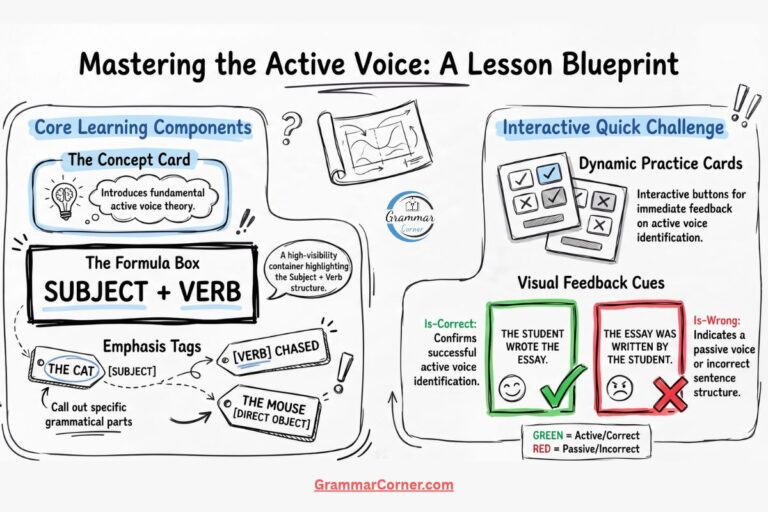
In English, the usual word order is Subject + Verb + Object (SVO):
Here, “Anna” is the subject, “reads” is the verb, and “books” is the object.
However, English sentences can take many other forms. A sentence may contain a complement, an adverbial element, an indirect object, or one or more dependent clauses.
| Sentence | Structure Pattern |
|---|---|
| Birds fly. | Subject + Verb |
| Birds eat seeds. | Subject + Verb + Object |
| The sky is blue. | Subject + Verb + Complement |
| We met at the station. | Subject + Verb + Adverbial |
| Sara gave me a gift. | Subject + Verb + Indirect Object + Direct Object |
The structure changes according to what the verb requires and what the writer wants to communicate.
Sentence Structure vs. Sentence Type
Do not confuse sentence structure with sentence type by purpose. These are two completely different systems of classification:
By Structure
- Simple sentences
- Compound sentences
- Complex sentences
- Compound-complex sentences
By Purpose / Function
- Declarative sentences
- Interrogative sentences
- Imperative sentences
- Exclamatory sentences
A sentence belongs to both categories at the same time.
Combined Example
Consider the sentence: “Why did you leave because you were tired?”
It is an interrogative sentence because it asks a question, and it is complex because it contains an independent clause and a dependent clause.
Why Is Sentence Structure Important?
Understanding sentence structure is useful for much more than passing a grammar test. Mastering it transforms how clearly and effectively you express your thoughts.
It Helps You Write Clearly
Correct word order makes your meaning easier to understand instantly.
The teacher explained the lesson clearly.
The lesson clearly the teacher explained.
It Helps You Connect Ideas
Understanding clauses allows you to join separate ideas effectively.
The road was flooded. We stayed home.
The road was flooded, so we stayed home.
It Improves Punctuation
Proper comma and semicolon usage depends entirely on knowing whether a clause is independent or dependent.
It Prevents Repetitive Writing
Varying your sentence structures creates rhythm and keeps readers engaged.
I woke up. I ate breakfast. I left home. I reached school.
After eating breakfast, I left home and reached school before the first class began.
It Improves Reading Comprehension
Long or dense sentences become easier to parse when you can instantly spot their main clause and supporting elements. This skill is critical when reading academic articles, legal documents, and formal texts.
What Are the Basic Parts of a Sentence?
Every complete sentence can be divided into two fundamental components: the Subject and the Predicate.
Explore Subject & Predicate Breakdown
Select an example to see how the sentence splits into its core subject and complete predicate:
1. The Subject
The subject is the person, place, thing, or idea that the sentence is about, or the entity performing the action.
| Complete Sentence | Complete Subject | Main (Simple) Subject |
|---|---|---|
| The baby is sleeping. | The baby | baby |
| My brother plays cricket. | My brother | brother |
| The old house looks beautiful. | The old house | house |
| Honesty matters. | Honesty | Honesty |
| The students in the front row answered the question. | The students in the front row | students |
2. The Predicate
The predicate contains the verb and all accompanying details that describe what the subject does or is. A predicate can range from a single verb to an extensive phrase.
| Sentence | Subject | Predicate |
|---|---|---|
| The students completed their homework. | The students | completed their homework. |
| Birds fly. | Birds | fly. |
| The birds in our garden have been singing since early morning. | The birds in our garden | have been singing since early morning. |
What Are the Main Components of a Sentence?
Sentence structure becomes easy to understand and construct once you learn the specific role each major component performs.
| Component | What it does | Example |
|---|---|---|
| Subject | Identifies who or what the sentence is about | The child smiled. |
| Verb | Expresses an action, event, or state | The child smiled. |
| Direct Object | Receives the action of the verb | She opened the door. |
| Indirect Object | Identifies the recipient or beneficiary of the action | He gave me a book. |
| Complement | Completes or describes the meaning of another element | She is happy. |
| Adverbial | Adds information such as time, place, manner, or reason | We met after school. |
These components do not necessarily appear in every sentence. Structure can vary from minimal requirements to highly detailed arrangements:
Needs only two components to form a complete sentence.
Combines five distinct structural elements seamlessly.
1. The Verb
The verb is the primary anchor of a clause. It expresses an action, occurrence, or state of being. A sentence cannot normally be understood without its main verb.
Verb Examples in Action
• Birds fly. (Action)
• She laughed. (Action)
• They are waiting. (Action in progress)
• He seems tired. (State of being)
• We have finished the work. (Completed action)
2. The Object
An object is commonly the person or thing affected by the action expressed by a transitive verb.
Basic Transitive Pattern
Saim opened the door.
Saim = Subject | opened = Verb | the door = Object
Direct Object vs. Indirect Object
Objects are categorized based on whether they receive the action directly or serve as the beneficiary/recipient of the action.
Interactive Object Test
Select a scenario to analyze how direct and indirect objects work together:
Result: “A laptop” directly receives the action of buying, making it the Direct Object.
Quick Test for Objects
• To find the Direct Object: Ask “What?” or “Whom?” after the verb.
• To find the Indirect Object: Ask “To whom?”, “For whom?”, or “For what?” after the verb.
What Is a Complement?
A complement is an element that completes the meaning of a verb or gives essential information about another part of the sentence.
Without additional information, the linking verb “is” feels unfinished.
The phrase “a doctor” completes the meaning of the linking verb by identifying the subject.
Defines or describes the subject. Usually follows linking verbs like be, seem, become, feel, look, smell, taste, or appear.
- My father is a teacher.
- The soup smells delicious.
- Sara became angry.
- The children are excited.
Gives additional information about or renames the direct object resulting from the action.
- The news made everyone nervous.
- They elected Maria president.
(identifies what Maria became as a result of the vote)
What Is an Adverbial?
An adverbial adds extra circumstances to a sentence, providing details about an action, event, or situation. It answers key details such as:
• When: We arrived early. | They left after lunch.
• Where: She works at the hospital.
• How: He spoke very quietly.
• Why / Extent / Frequency: Adds reason, degree, or repetition to the action.
Adverbials can often occur in different positions within a sentence without changing the core meaning:
• Front: Yesterday, we visited the museum.
• End: We visited the museum yesterday.
Note: Word order still matters, as not every adverbial moves with equal freedom (e.g., “We yesterday visited the museum” sounds unnatural in standard English).
What Is a Clause?
A clause is a group of words built around a subject and a verb. Understanding clauses is critical because sentence structure patterns are based on how clauses combine.
Interactive Clause Analyzer
Select a clause type to compare how it functions in a sentence:
Expresses a complete thought and can stand alone as a full sentence.
Independent vs. Dependent Clauses
| Feature | Independent Clause | Dependent Clause |
|---|---|---|
| Has a Subject? | Yes | Yes |
| Has a Verb? | Yes | Yes |
| Expresses Complete Thought? | Yes | No |
| Can Stand Alone? | Yes | No |
| Alternative Name | Main clause | Subordinate clause |
| Example | We stayed home. | …because it was raining. |
How Do Clauses Determine Sentence Structure?
The number and relationship of independent and dependent clauses determine the four main structural types. This clause-based classification is shared by major grammar references worldwide.
| Sentence Structure | Independent Clauses | Dependent Clauses |
|---|---|---|
| Simple | 1 | 0 |
| Compound | 2 or more | 0 |
| Complex | 1 | 1 or more |
| Compound-Complex | 2 or more | 1 or more |
What Are the Four Types of Sentence Structure?
The difference between the four structural types is not simply the length of the sentence—it is determined entirely by the number and type of clauses they contain.
1. Simple Sentence
A simple sentence contains exactly one independent clause and no dependent clauses.
Basic Simple Examples
• The baby slept.
• Maria plays tennis.
• The old man smiled.
• My brother and I watched a movie.
A simple sentence can contain compound elements (multiple subjects or multiple verbs) while still remaining a simple sentence, as long as it forms only one complete thought/clause:
Compound Elements in a Simple Sentence
Sara and Ahmar studied and prepared for the exam.
• Compound Subject: Sara and Ahmar
• Compound Verb: studied and prepared
• Result: Contains only 1 independent clause = Simple Sentence.
Simple Sentence Patterns
| Sentence | Basic Structural Pattern |
|---|---|
| Birds fly. | Subject + Verb (S + V) |
| The boy kicked the ball. | Subject + Verb + Object (S + V + O) |
| My father is a doctor. | Subject + Verb + Complement (S + V + C) |
| We met at noon. | Subject + Verb + Adverbial (S + V + A) |
| Sarah and Tom laughed. | Compound Subject + Verb |
When Should You Use Simple Sentences?
- To state an important fact clearly
- To give a direct instruction
- To create emphasis and impact
- To keep an explanation easy to follow
- To make a complicated passage easier to read
2. Compound Sentence
A compound sentence contains at least two independent clauses joined together to show a logical relationship between equal ideas.
Compound Formulas
• Independent Clause + Coordinating Conjunction (FANBOYS) + Independent Clause
• Independent Clause + Semicolon + Independent Clause
Example Breakdown
The rain stopped, and the children went outside.
Clause 1: The rain stopped. (Independent)
Clause 2: The children went outside. (Independent)
Connecting element: and (Coordinating Conjunction)
Coordinating Conjunctions (FANBOYS)
The seven common coordinating conjunctions can be remembered using the acronym FANBOYS:
Explore FANBOYS Relationships
Click any letter to see its conjunction, primary relationship, and example:
| Letter | Conjunction | Common Relationship |
|---|---|---|
| F | For | Reason |
| A | And | Addition |
| N | Nor | Negative Alternative |
| B | But | Contrast |
| O | Or | Choice |
| Y | Yet | Contrast |
| S | So | Result |
Semicolon Connection Example
The shop was closed; we went home.
Important: Avoid Comma Splices!
Do not join two independent clauses with only a comma. This creates an error called a comma splice.
How to Correctly Join the Clauses:
3. Complex Sentence
A complex sentence contains one independent clause and at least one dependent clause.
Example Breakdown
We stayed indoors because it was raining.
• Independent Clause: We stayed indoors.
• Dependent Clause: because it was raining. (explains the reason for staying indoors)
Complex Sentence Formula & Word Order
Both clause arrangements are possible in complex sentences:
Arrangement Formulas
• Independent clause + Dependent clause
• Dependent clause + Independent clause
Punctuation Rule for Complex Sentences
Notice the comma placement depending on which clause comes first:
• Introductory Dependent Clause (Comma Required):
Because it was raining, we stayed indoors.
• Dependent Clause Following Main Clause (No Comma Needed):
We stayed indoors because it was raining.
Note: A comma is usually unnecessary when the dependent clause follows the main clause and is closely connected to it.
Common Subordinating Conjunctions
Subordinating conjunctions connect dependent clauses to independent clauses by establishing specific relationships:
Subordinating Conjunction Explorer
Click a relationship category to examine common conjunctions and usage examples:
| Relationship | Common Words |
|---|---|
| Time | when, while, before, after, until, since |
| Reason | because, since, as |
| Condition | if, unless, provided that |
| Contrast | although, though, even though, whereas |
| Purpose | so that, in order that |
| Place | where, wherever |
More Subordinating Examples
• When the bell rang, the students entered the classroom.
• We canceled the trip because the weather was bad.
• Although he was tired, he continued working.
• I will call you if I arrive early.
Complex Sentences With Relative Clauses
A dependent clause can also act as a relative clause to describe or modify a noun:
I met the woman who lives next door.
The dependent clause “who lives next door” describes the noun woman.
Common Relative Words:
4. Compound-Complex Sentence
A compound-complex sentence contains at least two independent clauses and at least one dependent clause. It combines the structural features of both compound and complex sentences.
Example Breakdown
Because the road was flooded, we stayed home, and our friends visited us later.
• Dependent Clause: Because the road was flooded
• Independent Clause 1: We stayed home
• Independent Clause 2: Our friends visited us later
• Result: Compound-Complex Sentence
Compound-Complex Sentence Formulas
Arrangement Patterns
• Dependent clause + Independent clause + Coordinating Conjunction + Independent clause
• Independent clause + Dependent clause + Coordinating Conjunction + Independent clause
Second Arrangement Example
I finished my work after everyone left, and I went home.
1. I finished my work = Independent clause
2. after everyone left = Dependent clause
3. I went home = Independent clause
Why Use Compound-Complex Sentences?
They are useful when several closely related ideas need to appear together in a single cohesive flow.
Writing Tip: Length alone does not make a sentence better. If a compound-complex sentence becomes difficult to follow, divide it into two or more clearer sentences.
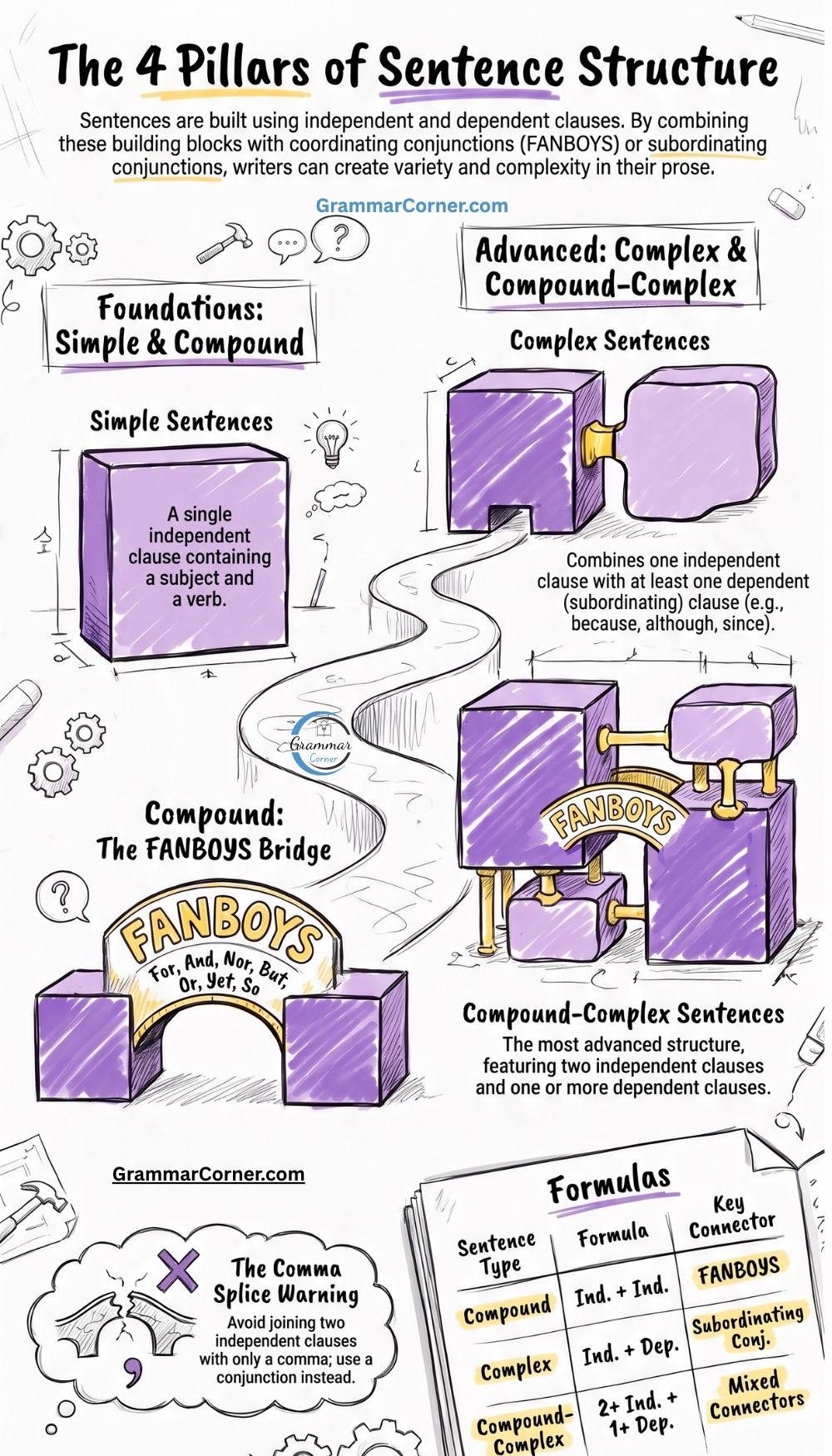
Simple, Compound, Complex, and Compound-Complex: Comparison
A useful way to identify the structure of any sentence is to count the clauses rather than count the words.
| Type | Clause Pattern | Example |
|---|---|---|
| Simple | 1 independent | The children laughed. |
| Compound | 2+ independent | The children laughed, and the teacher smiled. |
| Complex | 1 independent + 1+ dependent | The children laughed because the teacher smiled. |
| Compound-Complex | 2+ independent + 1+ dependent | Because the teacher smiled, the children laughed, and the class became lively. |
What Are the Basic Sentence Patterns?
While the four structural types above classify whole clauses, another useful way to study sentence structure is to examine the arrangement of the main sentence components. These patterns show what can come after the verb, making them essential for learners mastering English sentence structure.
Common Sentence Pattern Symbols
Interactive Pattern Explorer
Click any pattern code below to view its component breakdown and list of examples:
One of the simplest sentence patterns.
More Examples:
- The baby cried.
- The dog barked.
- Leaves fall.
Full Sentence Patterns Breakdown
1. S + V: Subject + Verb
This is one of the simplest sentence patterns.
Birds fly.
Birds = S | fly = V
Other examples:
• The baby cried.
• The dog barked.
• Leaves fall.
2. S + V + O: Subject + Verb + Object
Some verbs require an object to complete their transitive meaning.
Emma opened the door.
Emma = S | opened = V | the door = O
More examples:
• We watched a movie.
• She bought a dress.
• The students completed the assignment.
3. S + V + C: Subject + Verb + Complement
A linking verb connects the subject to a subject complement that describes or renames it.
My brother is a doctor.
My brother = S | is = V | a doctor = C
More examples:
• The soup tastes delicious.
• Sara became angry.
• The sky looks beautiful.
4. S + V + A: Subject + Verb + Adverbial
The final element gives essential extra information such as place, time, or manner.
The children played outside.
The children = S | played = V | outside = A
More examples:
• We arrived early.
• She lives in Karachi.
• They worked all night.
5. S + V + O + C: Subject + Verb + Object + Complement
The complement illustrates, describes, or renames the direct object resulting from the action.
The news made him angry.
The news = S | made = V | him = O | angry = C
More examples:
• They painted the wall blue.
• We found the lesson useful.
• The committee elected Sara chairperson.
6. S + V + O + A: Subject + Verb + Object + Adverbial
An adverbial adds circumstantial information to a sentence that already contains a direct object.
She placed the books on the table.
She = S | placed = V | the books = O | on the table = A
More examples:
• He put the keys in the drawer.
• We left the bags outside.
• She kept the documents in her office.
7. S + V + IO + DO: Subject + Verb + Indirect Object + Direct Object
This pattern contains two objects: an indirect recipient (IO) and a direct object (DO).
The teacher gave the students homework.
The teacher = S | gave = V | the students = IO | homework = DO
More examples:
• My father bought me a watch.
• Anna sent her friend a message.
• The company offered him a job.
How Sentence Patterns and Sentence Structures Work Together
This distinction is important because every sentence can be analyzed through two distinct lenses: its overall clause-based structure and its internal component pattern.
Single Clause Analysis
Sara reads books.
• Basic component pattern: S + V + O
• Clause-based structure: Simple sentence
Multi-Clause Analysis
Sara reads books, and her brother watches television.
• Clause-based structure: Compound sentence
• Internal patterns:
1. Sara reads books = SVO
2. her brother watches television = SVO
This means a sentence can be described from more than one grammatical perspective simultaneously. While clause types determine overall complexity, component patterns govern the arrangement inside each clause.
Sentence Structure and Word Order
English generally follows a relatively fixed word order. The most common baseline pattern in declarative statements is:
Subject → Verb → Object
Because word order dictates grammatical relationships in English, changing the sequence directly alters the meaning or shifts focus:
The boy kicked the ball. (The boy performs the action)
The ball kicked the boy. (Changing the order completely changes the meaning!)
Compare These Sentences
| Sentence | Meaning & Focus |
|---|---|
| The dog chased the cat. | The dog performed the action. |
| The cat chased the dog. | The cat performed the action. |
| Yesterday, the dog chased the cat. | The time element has moved to the beginning for emphasis. |
| The dog chased the cat yesterday. | The time element appears naturally at the end. |
Notice that the last two sentences share the same core meaning, but shifting the position of the adverbial (A) alters the stylistic emphasis.
Sentence Structure and Punctuation
Sentence structure and punctuation are closely connected. Correct punctuation depends directly on understanding clause types and positions.
1. Comma Between Two Independent Clauses
When two independent clauses are joined with a coordinating conjunction (FANBOYS), a comma normally comes right before the conjunction.
2. Semicolon Between Closely Related Independent Clauses
A semicolon can connect two closely related independent clauses when no coordinating conjunction is used.
3. Comma After an Introductory Dependent Clause
When a dependent clause comes first, a comma commonly separates it from the main clause. However, when the main clause comes first, a comma is usually unnecessary.
Introductory clause (Comma needed):
Although it was late, we continued working.
Main clause first (No comma needed):
We continued working although it was late.
Because exact punctuation depends on the type and role of each clause, you should always evaluate sentence structure before applying punctuation marks.
Common Sentence Structure Errors
Understanding sentence structure is particularly helpful because many common writing errors stem directly from mismanaged clauses and word placements. Master these five common mistakes to immediately polish your grammar and writing clarity.
1. Sentence Fragment
A sentence fragment is an incomplete group of words presented as a full sentence. It often occurs when a dependent clause is left standing alone without an independent main clause.
The reader expects to know what happened because you were tired.
✅ Correct: Because I was tired, I went to bed.
✅ Or: I went to bed because I was tired.
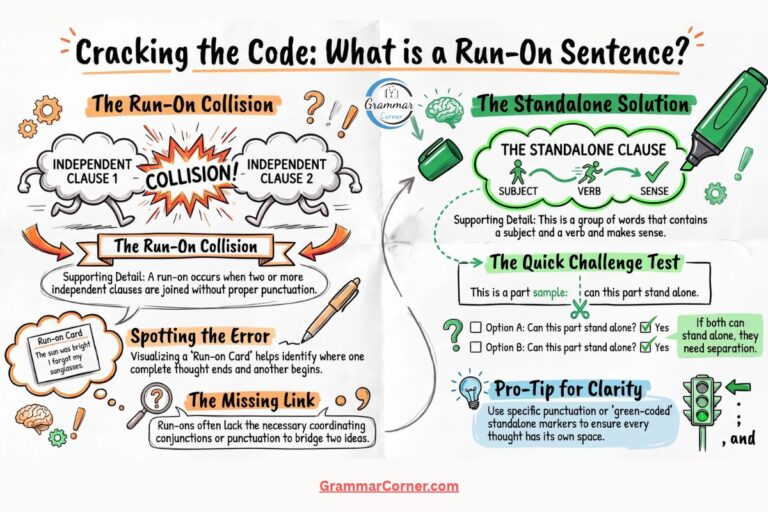
2. Run-On Sentence
A run-on sentence occurs when two or more independent clauses are incorrectly joined without appropriate punctuation or connecting words.
✅ Correct: I finished my work, and I went home.
✅ Or: I finished my work; I went home.
✅ Or: I finished my work. I went home.
3. Comma Splice
A comma splice occurs when a comma alone is used to join two independent clauses. A comma isn’t strong enough on its own to link independent thoughts.
✅ Correct: The test was difficult, so everyone complained.
✅ Correct: The test was difficult; everyone complained.
✅ Correct: The test was difficult. Everyone complained.
4. Unclear Modifier Placement
A modifier should be positioned so that readers can easily tell what word or phrase it describes. Poor placement creates confusion or unintended humor.
Clear Placement
Walking to school, I saw a broken bicycle.
The sentence clearly indicates that I was walking.
Misplaced Modifier
Walking to school, the broken bicycle caught my attention.
Grammatically suggests that the bicycle was walking to school!
✅ Better Version: While I was walking to school, I noticed a broken bicycle.
5. Subject-Verb Agreement Problems
The subject and verb in a sentence must always agree in number (singular subjects take singular verbs; plural subjects take plural verbs).
✅ Correct: The students are ready.
A long subject phrase or interrupting words can sometimes make subject-verb agreement errors harder to spot:
✅ Correct: The list of required books is on the desk.
The main subject is list (singular), not books. The verb must agree with list, making “is” the correct choice.
How to Identify Sentence Structure Step by Step
When you are unsure whether a sentence is simple, compound, complex, or compound-complex, follow this systematic 5-step method:
Look for all main verbs and verb phrases in the sentence.
Identify who or what performs each action or is associated with each state of being.
Mark each distinct group containing a subject-verb pair.
Ask yourself: Can this clause stand alone as a complete sentence?
- If yes: It is an independent clause.
- If no: It is a dependent clause.
Count your independent and dependent clauses, then match them to the guide below:
Clause Formula Quick Guide
Examples: Identify the Sentence Structure
• There is 1 independent clause.
Answer: Simple
• There are 2 independent clauses.
Answer: Compound
• There is 1 independent clause and 1 dependent clause.
Answer: Complex
• There are 2 independent clauses and 1 dependent clause.
Answer: Compound-Complex
A More Detailed Sentence Structure Table
Compare how different clause counts change the overall structure type:
| Sentence | Independent Clause(s) | Dependent Clause(s) | Type |
|---|---|---|---|
| The baby is sleeping. | 1 | 0 | Simple |
| The baby is sleeping, and the mother is reading. | 2 | 0 | Compound |
| The baby is sleeping because she is tired. | 1 | 1 | Complex |
| Because she is tired, the baby is sleeping, and the mother is resting. | 2 | 1 | Compound-complex |
| We bought a new car. | 1 | 0 | Simple |
| We bought a new car, but we sold the old one. | 2 | 0 | Compound |
| We bought a new car because our old one was unreliable. | 1 | 1 | Complex |
| Because our old car was unreliable, we bought a new one, and my brother sold the old one. | 2 | 1 | Compound-complex |
Sentence Structure Practice
Test your knowledge of sentence structures (Simple, Compound, Complex, and Compound-Complex). Try identifying the structure of each sentence before expanding the answer or checking the summary table.
Practice Questions
Click to reveal answer
Structure: Simple
Reason: Contains one independent clause.
Click to reveal answer
Structure: Compound
Reason: Two independent clauses joined by but.
Click to reveal answer
Structure: Complex
Reason: One independent clause + one dependent clause.
Click to reveal answer
Structure: Complex
Reason: Introductory dependent clause + independent clause.
Click to reveal answer
Structure: Compound
Reason: Two independent clauses joined by and.
Click to reveal answer
Structure: Complex
Reason: Main clause + dependent time clause.
Click to reveal answer
Structure: Compound-complex
Reason: Two independent clauses + one dependent clause.
Click to reveal answer
Structure: Simple
Reason: One independent clause.
Click to reveal answer
Structure: Complex
Reason: Dependent clause + independent clause.
Click to reveal answer
Structure: Compound
Reason: Two independent clauses joined by so.
Answers Summary Table
| No. | Sentence Type | Reason |
|---|---|---|
| 1 | Simple | One independent clause |
| 2 | Compound | Two independent clauses joined by but |
| 3 | Complex | One independent clause + one dependent clause |
| 4 | Complex | Introductory dependent clause + independent clause |
| 5 | Compound | Two independent clauses joined by and |
| 6 | Complex | Main clause + dependent time clause |
| 7 | Compound-complex | Two independent clauses + one dependent clause |
| 8 | Simple | One independent clause |
| 9 | Complex | Dependent clause + independent clause |
| 10 | Compound | Two independent clauses joined by so |
Practice: Identify the Sentence Pattern
Identify the basic component pattern (S, V, O, C, A, IO, DO) in each sentence below.
| No. | Sentence | Pattern | Component Breakdown |
|---|---|---|---|
| 1 | The birds sing. | SV | The birds (S) + sing (V) |
| 2 | She opened the window. | SVO | She (S) + opened (V) + the window (O) |
| 3 | My father is a doctor. | SVC | My father (S) + is (V) + a doctor (C) |
| 4 | We arrived early. | SVA | We (S) + arrived (V) + early (A) |
| 5 | They painted the door red. | SVOC | They (S) + painted (V) + the door (O) + red (C) |
| 6 | She put the books on the desk. | SVOA | She (S) + put (V) + the books (O) + on the desk (A) |
| 7 | He gave me a gift. | SVIODO | He (S) + gave (V) + me (IO) + a gift (DO) |
| 8 | Yesterday, we watched a movie. | ASVO | Yesterday (A) + we (S) + watched (V) + a movie (O) |
How to Improve Your Writing With Sentence Structure
Learning sentence structure is not about making every sentence complicated. Good writers choose a structure that purposefully suits their idea.
Short sentences make important information stand out clearly and forcefully.
Use when two related ideas hold similar weight and importance in the thought.
Perfect when one idea modifies, explains, or gives cause to the main idea.
Allows several interconnected pieces of background and action to sit together seamlessly.
How to Vary Sentence Structure
Sentence variety makes writing sound rhythmically natural rather than repetitive. Consider this monotonous paragraph:
Issue: Every sentence follows a repetitive, mechanical Simple (SV / SVO) pattern.
Result: Combines dependent introductory phrases with compound predicates for better flow.
The goal is not to eliminate simple sentences. The goal is to use different structures where they make the writing clearer, more rhythmic, and more interesting.
A Useful Balance
Good writing typically contains a intentional mixture of:
- Short simple sentences
- Longer simple sentences
- Compound sentences
- Complex sentences
- Compound-complex sentences
Remember: Sentence variety should always serve meaning, not become a competition to write the longest possible sentence.
Simple vs. Compound vs. Complex vs. Compound-Complex
| Feature | Simple | Compound | Complex | Compound-Complex |
|---|---|---|---|---|
| Independent Clause(s) | 1 | 2+ | 1 | 2+ |
| Dependent Clause(s) | None | None | 1+ | 1+ |
| Main Joining Method | None needed | Coordinating conjunction / semicolon | Subordination | Combination |
| Main Purpose | Direct idea | Connect equal ideas | Show relationships | Connect several relationships |
| Example | She smiled. | She smiled, and I laughed. | She smiled because I laughed. | Because I laughed, she smiled, and I apologized. |
Sentence Structure vs. Syntax
The terms sentence structure and syntax are closely related, but they are not always used in exactly the same way:
- Syntax: Broadly concerns how words and phrases are arranged to form grammatical expressions.
- Sentence Structure: Focuses more specifically on how the constituent parts and clauses of a sentence are organized.
“The child carefully opened the box.”
The position of the adverb carefully affects how the sentence is organized and interpreted. A slight change in word order can alter emphasis or tone. Understanding syntax directly supports a deeper mastery of sentence structure.
Frequently Asked Questions About Sentence Structure
What is sentence structure?
Sentence structure is the way words, phrases, and clauses are arranged and connected to create a grammatically meaningful sentence. It encompasses both word order and the relationships between the different grammatical components of a sentence.
What are the four main types of sentence structure?
The four main types are simple, compound, complex, and compound-complex. They are distinguished by the number and combination of independent and dependent clauses they contain.
What is the difference between a simple and compound sentence?
A simple sentence contains one independent clause, while a compound sentence contains two or more independent clauses joined appropriately (e.g., with a comma and coordinating conjunction like and, but, or so).
- She studied. — Simple
- She studied, and she passed. — Compound
What is the difference between a compound and complex sentence?
A compound sentence joins two or more independent clauses of equal weight. A complex sentence contains one main independent clause paired with at least one dependent clause that relies on the main clause for complete meaning.
- I was tired, but I continued working. — Compound
- I continued working although I was tired. — Complex
What is a compound-complex sentence?
A compound-complex sentence contains at least two independent clauses combined with at least one dependent clause.
“Although it was raining, we went outside, and we played football.”
What is the basic word order in English?
The most common baseline word order in English statements is Subject + Verb + Object (SVO).
Example: “The student (S) answered (V) the question (O).”
However, English uses several other foundational patterns depending on the verb type and information structure.
What are SV, SVO, and SVC?
These are shorthand labels describing common clause constituent patterns:
- SV = Subject + Verb (“Birds fly.”)
- SVO = Subject + Verb + Object (“She reads books.”)
- SVC = Subject + Verb + Complement (“He is tired.”)