Run-On Sentences (How to Identify, Structure & Example)
What Is a Run-On Sentence?
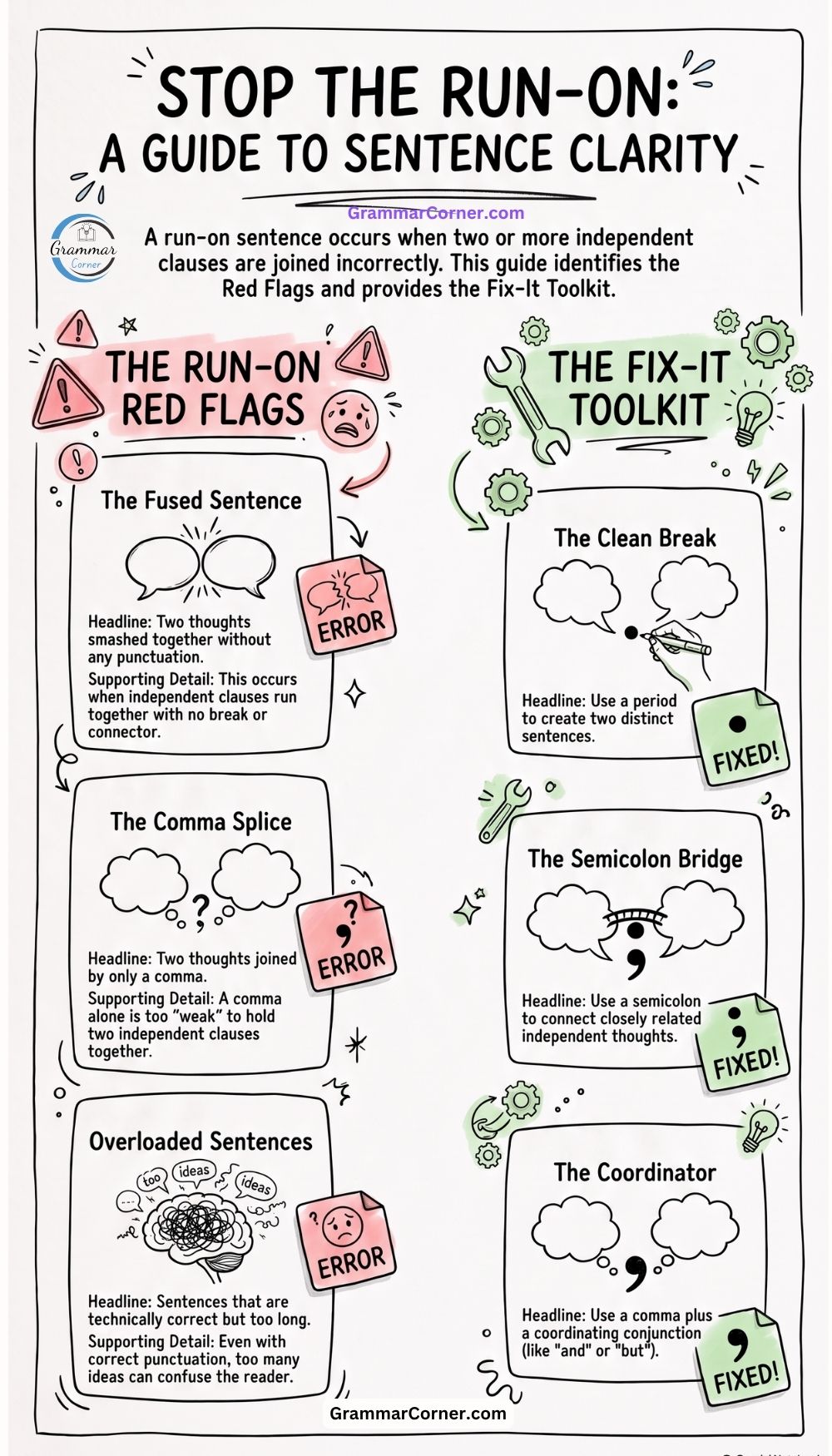
A run-on sentence occurs when two or more independent clauses are joined incorrectly. An independent clause contains both a subject and a verb and expresses a complete, standalone thought.
Understanding the Breakdown
Consider this example:
You can understand what the writer intends to say, but critical structural elements are missing. The sentence actually contains two distinct complete thoughts:
- Thought 1: The rain stopped.
- Thought 2: The children went outside.
These two independent clauses have been pushed together without the punctuation or connecting words required to separate them properly. This structural collision creates a run-on sentence.
Why Do Run-On Sentences Happen?
Run-on sentences are very common in student and drafted writing. Writers often focus so intensely on getting their ideas onto the page that they forget to signal to readers where one complete thought ends and the next begins.
Another Example of a Run-On Sentence
First, look at a proper, standalone independent clause:
Now, examine this uncorrected example:
Here, two independent clauses collide without proper punctuation or conjunctions:
- Clause 1: The sun was setting.
- Clause 2: The birds were returning to their nests.
Because they have been joined without an appropriate connection, the result is a run-on sentence.
✨ Quick Challenge
Which of the following examples is a run-on sentence (two independent clauses joined without proper punctuation or conjunctions)? Tap your answer.
See the full answer
Answer: “The alarm rang everyone evacuated the building immediately.”
Structural breakdown of the run-on error:
- Clause 1: The alarm rang. (Independent clause)
- Clause 2: Everyone evacuated the building immediately. (Independent clause)
- The Error: Fusing two complete thoughts together without a period, semicolon, or coordinating conjunction creates a fused run-on sentence.
Is a Run-On Sentence Always Very Long?
No. This is one of the most important grammatical misunderstandings to clear up. The term run-on does not refer to word count or physical length—it refers strictly to improper clause connections. A six-word sentence can be a run-on, while a forty-word sentence can be completely correct.
Compare these two examples to see why word length doesn’t dictate correctness:
“I called her she didn’t answer.”
Contains two independent clauses jammed together without punctuation.
“Although the weather had been unusually cold for several days, the farmers continued working in the fields because they knew that the crops needed attention before the next storm arrived.”
Lengthy, but every clause is joined correctly with proper conjunctions.
Length vs. Grammar Comparison
| Sentence | Is It Long? | Is It a Run-On? |
|---|---|---|
| I called her she didn’t answer. | No | Yes |
| The sun came out, and the children returned to the playground. | No | No |
| Although the road was narrow and difficult to follow, the driver continued carefully until he reached the village. | Yes | No |
| We missed the bus we walked home. | No | Yes |
What Is an Independent Clause?
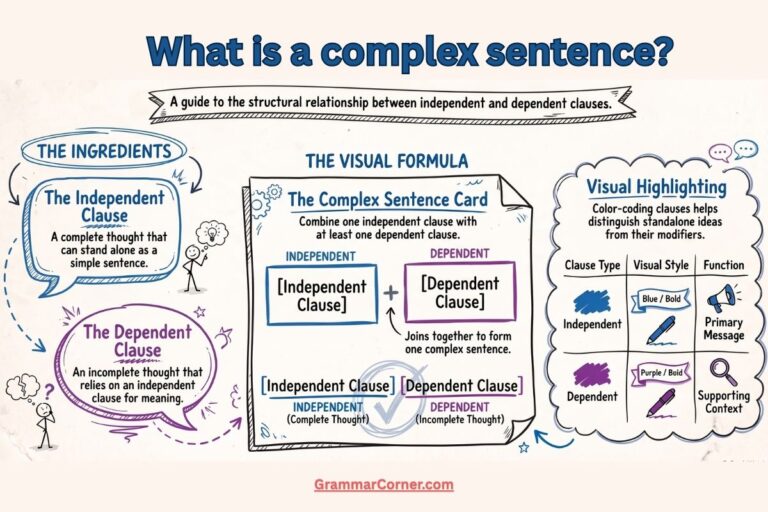
Understanding independent clauses is the ultimate key to identifying and fixing run-on sentences. An independent clause contains a subject and a predicate (verb) and expresses a complete, standalone thought.
- The baby is sleeping.
- Maria opened the window.
- We finished the project.
- The train arrived late.
The Independent Clause Test
When analyzing a sentence, ask yourself this simple question:
“Can this specific group of words stand alone and make complete sense by itself?”
| Group of Words | Independent Clause? | Reason |
|---|---|---|
| The dog barked. | Yes | Complete thought. |
| Sarah finished her homework. | Yes | Complete thought. |
| Because Sarah finished her homework | No | Begins with a subordinating word; leaves thought hanging. |
| When the train arrived | No | Incomplete thought. |
| They went home. | Yes | Complete thought. |
Whenever two independent clauses sit side-by-side in your writing, always double-check how they are connected!
What Is a Dependent Clause?
A dependent clause (also called a subordinate clause) contains a subject and a verb, but it cannot stand alone as a complete sentence because it begins with a subordinating conjunction or relative pronoun.
- because the road was closed
- although she was tired
- when the teacher arrived
- if the weather improves
Dependent clauses must attach to an independent clause to complete their meaning:
How Do You Identify a Run-On Sentence?
You can identify almost any run-on sentence by working through a simple 4-step diagnostic process:
Example: “The students finished the test they left the room.”
Identified Clauses: (1) “The students finished the test” / (2) “They left the room”
Result: Both clauses can stand alone as complete thoughts. You have two independent clauses sitting next to each other.
• Is there a period between them?
• Is there a semicolon?
• Is there a comma followed by a coordinating conjunction (FANBOYS)?
• Is one clause properly subordinated with a connecting word?
If none of these connections exist, you are dealing with a run-on sentence.
• Separate: The students finished the test. They left the room.
• Coordinate: The students finished the test, and they left the room.
• Subordinate: After the students finished the test, they left the room.
What Are the Types of Run-On Sentences?
In English grammar, run-on errors are classified into three primary categories:
- Fused Sentences
- Comma Splices
- Improperly Connected Multiple Clauses
1. Fused Sentences
A fused sentence occurs when two or more independent clauses are slammed together without any punctuation or connecting conjunction between them.
Two complete thoughts (The store was closed / We went home) are fused with zero punctuation.
More Fused Sentence Examples & Corrections
| ❌ Fused Sentence (Incorrect) | ✅ Corrected Version |
|---|---|
| The movie ended everyone left the theater. | The movie ended, and everyone left the theater. |
| I forgot my keys I couldn’t open the door. | I forgot my keys, so I couldn’t open the door. |
| The phone rang nobody answered it. | The phone rang, but nobody answered it. |
| She studied hard she passed the examination. | She studied hard, so she passed the examination. |
2. Comma Splice
A comma splice occurs when two independent clauses are joined with only a comma between them.
A comma alone is not grammatically strong enough to join two complete, standalone thoughts.
More Comma Splice Examples
| ❌ Comma Splice Example | Structural Problem |
|---|---|
| The weather was beautiful, we went for a walk. | Two independent clauses separated only by a comma. |
| He wanted to buy the car, he couldn’t afford it. | Two independent clauses separated only by a comma. |
| The bell rang, the students left the classroom. | Two independent clauses separated only by a comma. |
How to Correct a Comma Splice
You have four primary ways to fix a comma splice, depending on how you want to connect your ideas:
Separates the thoughts into two distinct sentences.
Connects two closely related independent clauses.
Add a comma + FANBOYS (for, and, nor, but, or, yet, so).
Turn one clause into a dependent clause.
3. Too Many Connected Independent Clauses
A sentence can also become problematic when too many independent clauses are strung together using repeated conjunctions (polysyndeton without stylistic intent).
While this sentence may pass loose grammatical definitions, it is clearly overloaded. The reader is forced to push through one complete thought after another without stylistic variation or breathing room.
Better Restructured Options
Run-On Sentence vs. Comma Splice
While these terms are closely related in everyday writing discussions, they represent distinct structural issues:
| Problem / Structure | What Happens | Example |
|---|---|---|
| Fused Sentence | Independent clauses have zero punctuation between them | I was tired I went home. |
| Comma Splice | Independent clauses are joined using only a comma | I was tired, I went home. |
| Correct Compound | Comma + coordinating conjunction (FANBOYS) | I was tired, so I went home. |
| Correct Semicolon | Semicolon joins closely related clauses | I was tired; I went home. |
How Do You Fix a Run-On Sentence?
There is no single one-size-fits-all correction for every run-on error. Depending on the relationship between your thoughts, you can repair a run-on sentence using five primary strategies:
- Fix 1: Separating the clauses into distinct sentences
- Fix 2: Joining closely related clauses with a semicolon
- Fix 3: Connecting clauses using a comma and a coordinating conjunction (FANBOYS)
- Fix 4: Making one clause dependent with a subordinating conjunction
- Fix 5: Completely restructuring and rewriting the sentence
The simplest solution is often to break the independent clauses into two standalone sentences using a period.
When Should You Use Two Sentences?
- Both ideas are equally important.
- The precise relationship between the thoughts does not need special emphasis.
- The original sentence feels crowded or cumbersome.
- You want to establish a quicker, punchier reading rhythm.
A semicolon (;) effectively connects two closely related independent clauses without adding connecting words.
The semicolon signals to the reader that two thoughts are intimately linked while keeping them grammatically separate.
When Is a Semicolon Appropriate?
A semicolon works best when the second clause directly expands upon, contrasts, or explains the first:
Do not force a semicolon simply to join two unrelated ideas. The logical connection must be immediate and clear.
You can combine two independent clauses using a comma followed by a coordinating conjunction.
| Conjunction | Common Relationship | Example Sentence |
|---|---|---|
| and | Addition | The shop was crowded, and we decided to return later. |
| but / yet | Contrast | I wanted to stay, but my friends were ready to leave. |
| so | Result | The road was flooded, so we turned around. |
| or / nor | Choice / Negative alternative | You can call me, or you can send a message. |
| for | Reason | He stayed alert, for the night was dark. |
Why Is the Comma Important?
When joining two independent clauses with a FANBOYS conjunction, the comma goes immediately before the conjunction:
The comma alerts the reader that the first complete thought has concluded.
When two thoughts are not equal in importance, convert one independent clause into a dependent clause using a subordinating conjunction.
| Relationship | Common Subordinating Conjunctions |
|---|---|
| Reason | because, since |
| Time | when, while, after, before |
| Condition | if, unless |
| Contrast | although, though, even though |
| Purpose / Result | so that, whereas, while |
Transformation Examples
Subordination does more than fix punctuation—it explicitly defines the logical relationship between both thoughts.
Sometimes, simple punctuation additions aren’t enough. Completely restructuring the phrasing creates a cleaner, more fluid result.
When Should You Rewrite?
- The sentence repeats words unnecessarily.
- Too many clauses are crammed together.
- The ideas are unequal in importance or logic.
- Adding punctuation alone leaves the sentence feeling awkward or wordy.
What Is a Run-On Sentence?
A run-on sentence occurs when two or more independent clauses are joined incorrectly. An independent clause contains both a subject and a verb and expresses a complete, standalone thought.
Understanding the Breakdown
Consider this example:
You can understand what the writer intends to say, but critical structural elements are missing. The sentence actually contains two distinct complete thoughts:
- Thought 1: The rain stopped.
- Thought 2: The children went outside.
These two independent clauses have been pushed together without the punctuation or connecting words required to separate them properly. This structural collision creates a run-on sentence.
Why Do Run-On Sentences Happen?
Run-on sentences are very common in student and drafted writing. Writers often focus so intensely on getting their ideas onto the page that they forget to signal to readers where one complete thought ends and the next begins.
Another Example of a Run-On Sentence
First, look at a proper, standalone independent clause:
Now, examine this uncorrected example:
Here, two independent clauses collide without proper punctuation or conjunctions:
- Clause 1: The sun was setting.
- Clause 2: The birds were returning to their nests.
Because they have been joined without an appropriate connection, the result is a run-on sentence.
✨ Quick Challenge
Which of the following examples is a run-on sentence (two independent clauses joined without proper punctuation or conjunctions)? Tap your answer.
See the full answer
Answer: “The alarm rang everyone evacuated the building immediately.”
Structural breakdown of the run-on error:
- Clause 1: The alarm rang. (Independent clause)
- Clause 2: Everyone evacuated the building immediately. (Independent clause)
- The Error: Fusing two complete thoughts together without a period, semicolon, or coordinating conjunction creates a fused run-on sentence.
Can a Colon Fix a Run-On Sentence?
Yes, but only under specific circumstances. A colon (:) can connect two independent clauses when the second clause directly explains, illustrates, or expands upon the first.
The second clause explicitly defines what “one goal” means.
Caution: Do not use a colon as a general substitute for a period, semicolon, or conjunction. A colon requires a clear explanatory relationship between the two clauses.
Special Run-On Contexts: Questions, Exclamations, and Dialogue
1. Run-On Sentences With Questions
Run-ons occur frequently when a question and a declarative statement are jammed together without terminal punctuation:
2. Run-On Sentences With Exclamations
The same error occurs when exclamatory expressions sit directly beside another clause without punctuation:
3. Run-On Sentences in Dialogue
In informal speech, people often run thoughts together without pausing. However, written dialogue still requires proper sentence boundaries to remain readable:
Common Causes of Run-On Sentences
Why do writers create run-ons in the first place? Understanding the root cause helps prevent the error:
Simply omitting a period between two complete thoughts during drafting.
Treating a comma as a full sentence separator, resulting in a comma splice.
When thoughts flow faster than structural formatting, multiple clauses collide.
Stringing endless clauses together with repeated and, but, or so connectors.
If you cannot identify where a complete thought ends, properly connecting clauses becomes difficult.
Common Mistakes When Fixing Run-On Sentences
✅ Correct: The class ended, and the students went home.
✅ Standard Compound Form: The class ended, and the students went home.
Semicolons are reserved for joining two independent clauses, not a dependent clause.
✅ Correct: Because the class ended, the students went home.
✅ Correct: The test was difficult. Everyone complained.
Not every run-on should be broken into four tiny, choppy sentences.
How to Avoid Run-On Sentences While Writing
You don’t need to wait until the final proofread to catch run-on sentences. Incorporate these proactive habits into your writing process:
Pause at each period. Does the sentence contain more than one complete thought?
If you see two subjects and two verbs, verify they are connected correctly.
Don’t just add “and”—choose a connector (like because, although, or so) that defines the relationship.
If you naturally pause between two ideas, your punctuation should reflect that break.
A Quick Run-On Sentence Checklist
When proofreading, ask these questions:
Run-On Sentence Examples: Incorrect vs. Correct
| Incorrect (Run-On) | Corrected Version |
|---|---|
| The sun was setting we continued walking. | The sun was setting, but we continued walking. |
| I finished my work I went home. | I finished my work. I went home. |
| The car was old, it still worked well. | The car was old, but it still worked well. |
| She missed the train she arrived late. | Because she missed the train, she arrived late. |
| The store was crowded we left quickly. | The store was crowded; we left quickly. |
| He forgot his wallet he couldn’t pay. | He forgot his wallet, so he couldn’t pay. |
| The children were tired they kept playing. | Although the children were tired, they kept playing. |
| The alarm rang I woke up immediately. | When the alarm rang, I woke up immediately. |
Practice Exercises
Exercise 1: Identify the Run-On Sentences
- The dog barked the baby woke up. (Run-on)
- The dog barked, and the baby woke up. (Correct)
- Although the dog barked, the baby remained asleep. (Correct)
- The dog barked; the baby woke up. (Correct)
- The baby woke up, the dog barked. (Run-on — comma splice)
- We stayed inside because it was raining. (Correct)
- The rain stopped we went outside. (Run-on)
- The rain stopped, so we went outside. (Correct)
- The teacher entered the room the students became quiet. (Run-on)
- When the teacher entered the room, the students became quiet. (Correct)
Exercise 2: Fix the Run-On Sentences
- The shop was closed we returned home. → The shop was closed, so we returned home.
- I wanted to call her I didn’t have her number. → I wanted to call her, but I didn’t have her number.
- The weather was cold, we stayed indoors. → The weather was cold, so we stayed indoors.
- The bell rang the students left the classroom. → When the bell rang, the students left the classroom.
- He was tired he continued working. → Although he was tired, he continued working.
- The road was flooded we took another route. → The road was flooded; we took another route.
- She practiced every day she improved quickly. → She practiced every day, so she improved quickly.
- The movie was long it was enjoyable. → The movie was long, but it was enjoyable.
Practice Exercises
Exercise 3: Choose the Best Correction
- Run-on: The computer stopped working I called a technician.
A. The computer stopped working, I called a technician.
B. The computer stopped working; I called a technician.
C. The computer stopped working I called a technician.
D. The computer stopped working, called a technician.
Answer: B (Semicolon correctly joins related independent clauses) - Run-on: It was raining we canceled the game.
A. It was raining, so we canceled the game.
B. It was raining, we canceled the game.
C. It was raining we canceled the game.
D. It was raining; because we canceled the game.
Answer: A (Comma + coordinating conjunction creates a clear cause/effect) - Run-on: She was nervous she gave an excellent presentation.
A. She was nervous, she gave an excellent presentation.
B. Although she was nervous, she gave an excellent presentation.
C. She was nervous she gave an excellent presentation.
D. She was nervous; although she gave an excellent presentation.
Answer: B (Subordination clearly establishes the contrast between nervousness and success)
Exercise 4: Find the Two Independent Clauses
Identify the two independent clauses in each run-on:
- The phone rang nobody answered it.
Clause 1: The phone rang / Clause 2: Nobody answered it - The team practiced hard they won the match.
Clause 1: The team practiced hard / Clause 2: They won the match - The store closed early we returned the next day.
Clause 1: The store closed early / Clause 2: We returned the next day
Quick Reference: Ways to Fix a Run-On
| Method | Pattern | Example |
|---|---|---|
| Period | Clause. Clause. | The bell rang. We left. |
| Semicolon | Clause; clause. | The bell rang; we left. |
| Coord. Conjunction | Clause, + FANBOYS + clause. | The bell rang, so we left. |
| Subord. Conjunction | Dependent clause + independent clause | When the bell rang, we left. |
| Rewrite | Restructure the ideas | After the bell rang, everyone left. |
Frequently Asked Questions About Run-On Sentences