Dependent Adverb Clause (Structure, Types & Examples)
What Is a Dependent Adverb Clause?
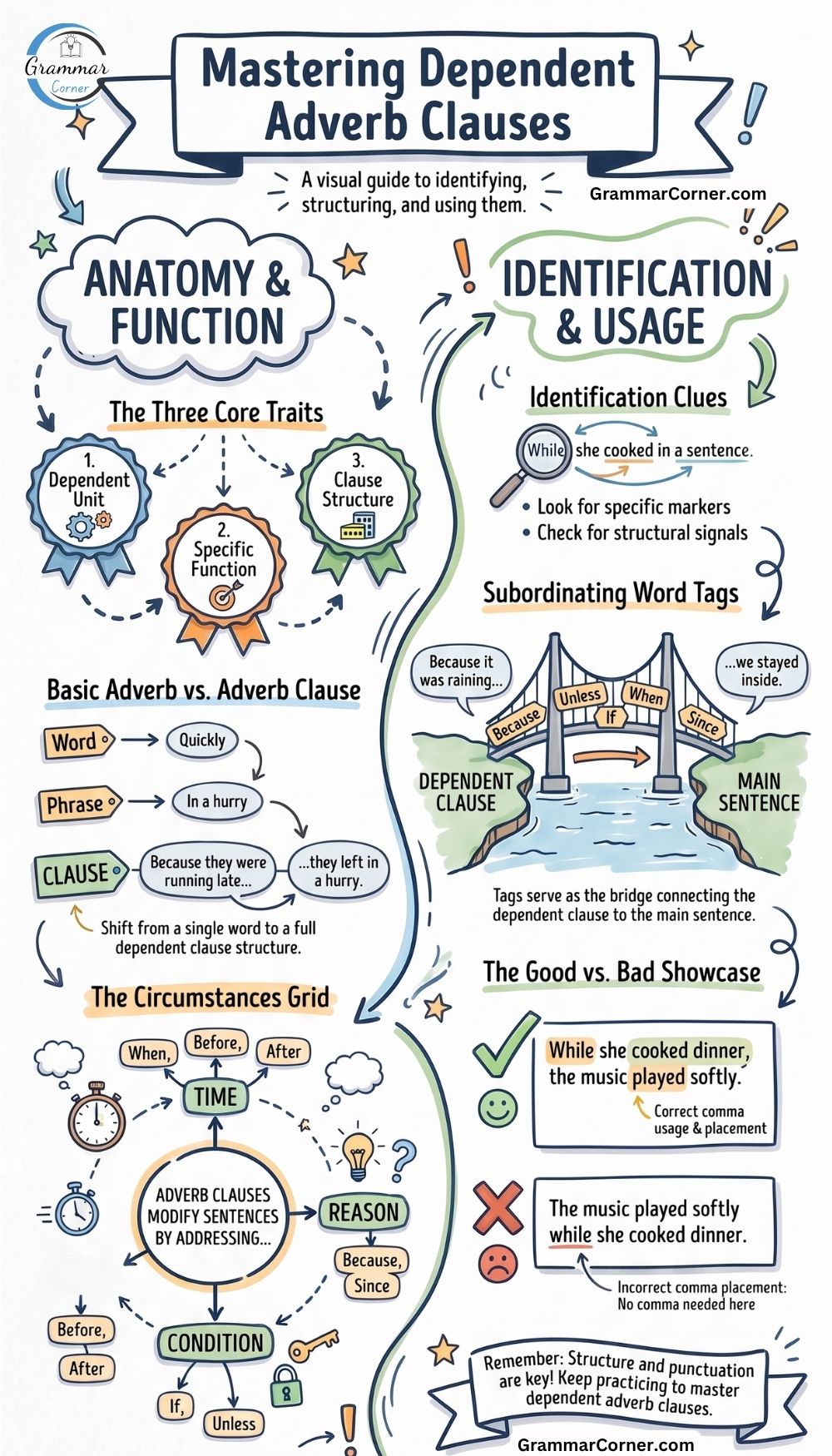
A dependent adverb clause is a group of words that contains a subject and a verb. It cannot normally stand alone as a complete sentence, and functions like an adverb by adding descriptive and situational information about another clause.
Basic Action vs. Adding a Dependent Adverb Clause
Compare how adding a dependent adverb clause enhances a simple statement with vital contextual detail:
Why Dependent Adverb Clauses Are Useful
Dependent adverb clauses connect an action directly with essential circumstantial details. They clarify logical relationships between ideas and help writers avoid a series of disconnected, choppy short sentences by expressing:
Anatomy of a Dependent Adverb Clause
Examine the internal structure of this dependent adverb clause:
Why Is It Called a Dependent Adverb Clause?
The name contains three useful clues that explain its exact grammatical role:
It contains a subject and a verb.
• Verb: was blocked
It performs a function similar to an adverb by adding information such as time, reason, place, condition, or manner.
It cannot normally express a complete thought by itself.
Dependent Adverb Clause at a Glance
| Feature | Description |
|---|---|
| Structure | Contains a subject and a verb |
| Grammar role | Functions adverbially |
| Sentence status | Dependent |
| Usually begins with | A subordinating conjunction or subordinating expression |
| Main purpose | Adds circumstances or relationships to a main clause |
| Can stand alone? | Normally no |
| Common meanings | Time, place, reason, condition, contrast, purpose, manner, result, comparison |
How Does a Dependent Adverb Clause Work?
A dependent adverb clause normally works alongside an independent clause. Consider:
The sentence contains two clauses:
| Clause | Type | Function |
|---|---|---|
| When the lights came on | Dependent adverb clause | Tells when |
| everyone returned to their seats | Independent clause | Gives the main idea |
The two clauses are connected by when.
- Without the dependent clause: “Everyone returned to their seats.” ➔ The sentence is complete.
- Without the independent clause: “When the lights came on.” ➔ The reader naturally expects more information.
That dependence is what makes the first clause a dependent clause.
Internal Structure of a Dependent Adverb Clause
Look closely at this sentence:
“Although the road was narrow, the driver continued carefully.”
The dependent adverb clause contains three important parts:
| Part | Example | Function |
|---|---|---|
| Subordinating conjunction | Although | Shows the relationship |
| Subject | the road | Performs or receives the action |
| Verb | was | Forms the predicate |
Together: Although + the road + was narrow
The complete clause expresses a contrast with the main clause.
Another Example
Dependent Adverb Clause vs. Adverb
A single adverb can provide information about an action:
The children played outside.
A dependent adverb clause can provide more detailed information:
The children played where their parents could see them.
Compare them:
| Form | Example | Information |
|---|---|---|
| Adverb | She arrived early. | When |
| Adverbial phrase | She arrived before noon. | When |
| Dependent adverb clause | She arrived before the meeting began. | When |
The biggest structural difference is that the dependent adverb clause contains its own subject and verb.
Types of Dependent Adverb Clauses
Dependent adverb clauses can express several relationships between ideas. The most common types are:
- Time
- Place
- Reason
- Condition
- Contrast
- Purpose
- Result
- Manner
- Comparison
- Degree
Types of Dependent Adverb Clauses: Quick Chart
| Type | Question It Answers | Example |
|---|---|---|
| Time | When? | When the class ended, we left. |
| Place | Where? | Sit where you can see the board. |
| Reason | Why? | We stayed home because it was raining. |
| Condition | Under what condition? | If you hurry, you can catch the bus. |
| Contrast | Despite what? | Although she was tired, she continued. |
| Purpose | For what purpose? | He whispered so that nobody would hear. |
| Result | With what consequence? | It was so cold that we stayed inside. |
| Manner | How? | He acted as though he knew the answer. |
| Comparison | Compared with what? | She runs faster than I do. |
| Degree | To what extent? | He was so nervous that he forgot his lines. |
Dependent Adverb Clauses of Time
A time clause tells us when one event occurs in relation to another.
Common subordinating expressions include:
- When the meeting ended, everyone packed their bags.
- We waited until the rain stopped.
- She called me after she reached home.
- As soon as the results arrive, we will inform you.
Time Expressions and Their Meanings
| Expression | Main Idea | Example |
|---|---|---|
| when | At the time of an event | Call me when you arrive. |
| while | During an ongoing period | I listened while she explained the problem. |
| before | Earlier event | Finish this before you leave. |
| after | Later event | We ate after the guests arrived. |
| until | Up to a particular point | Stay here until I return. |
| once | After a condition is fulfilled | We can begin once everyone is ready. |
| whenever | Every time | He smiles whenever he sees his dog. |
Future Meaning in Time Clauses
English usually does not use will in a time clause when the clause refers to a future event.
Dependent Adverb Clauses of Place
A place clause tells us where an action occurs or where a situation applies.
Common words include:
- Sit where you feel comfortable.
- We followed the path wherever it led.
- They built the shelter where the ground was higher.
Where and Wherever
Where generally points to a particular location:
We stopped where the road became narrow.
Wherever has a broader meaning such as any place or every place that fits the situation:
You can work wherever you find a suitable workspace.
Dependent Adverb Clauses of Reason
A reason clause explains why something happens.
Common subordinators include:
- We postponed the match because the field was wet.
- Since everyone was ready, we started the presentation.
- As the shop was closing, we decided to leave.
Because, Since, and As
Although all three can introduce reasons, they can carry slightly different emphasis.
- Because usually presents a direct reason:
She stayed home because she was ill. - Since often introduces a reason that is already known or accepted:
Since you have finished, you can leave. - As can introduce a reason, particularly in formal or written contexts:
As the road was blocked, we chose another route.
Dependent Adverb Clauses of Condition
A conditional clause tells us what must happen, or what situation must exist, for another event to occur.
Common expressions include:
- If you study regularly, you will make progress.
- We will go hiking if the weather improves.
- You cannot enter unless you have permission.
If vs. Unless
If introduces a condition: If you hurry, you can catch the train.
Unless expresses a negative condition: Unless you hurry, you will miss the train.
unless = if ... notDependent Adverb Clauses of Contrast
A contrast clause shows that one fact does not prevent another fact from being true.
Common subordinators include:
- Although the task was difficult, she completed it.
- He went to work even though he was tired.
- Whereas his brother enjoys football, he prefers cricket.
Although vs. Even Though
Both introduce contrast, but even though often gives stronger emphasis.
- Although the journey was long, we enjoyed it.
- Even though the journey was extremely long, we enjoyed it.
Although vs. Even If
These expressions should not be treated as interchangeable.
- Although normally introduces a fact:
Although he was tired, he continued working. - Even if introduces a possibility or condition:
Even if he is tired, he will continue working.
Dependent Adverb Clauses of Purpose
A purpose clause explains the intended goal of an action.
Common expressions include:
- She spoke quietly so that the baby would not wake up.
- He saved money so that he could buy a new laptop.
- The teacher repeated the instructions so that every student could understand them.
Reason vs. Purpose
These two relationships are easy to confuse.
- We stayed inside because it was raining. ➔ This gives the reason.
- We stayed inside so that we could finish our work. ➔ This gives the purpose.
Dependent Adverb Clauses of Result
A result clause tells us what happened as a consequence of something else.
Common patterns include:
- The road was so slippery that we drove slowly.
- It was such a difficult question that nobody answered immediately.
- He spoke so softly that I could barely hear him.
So and Such
| Structure | Example |
|---|---|
so + adjective + that |
It was so cold that we stayed inside. |
so + adverb + that |
She spoke so quickly that I missed some words. |
such + adjective + noun + that |
It was such a difficult exam that many students complained. |
such + noun + that |
It was such a surprise that everyone became silent. |
Dependent Adverb Clauses of Manner
A manner clause tells us how something happens or describes the way an action appears.
Common expressions include:
- Do the exercise as the teacher explained it.
- He behaved as though he knew everyone there.
- She looked at me as if she had heard something surprising.
As If and As Though
These expressions often describe an appearance, impression, or imagined situation:
He talks as though he knows everything.
This does not necessarily mean that he really knows everything. It describes how he talks.
Dependent Adverb Clauses of Comparison
Comparison clauses show a relationship between two things, actions, qualities, or situations.
Common patterns include:
- She works harder than I do.
- He is as careful as his sister is.
- The new machine works more efficiently than the old one did.
Some comparison clauses are shortened in ordinary English because part of the meaning is obvious:
She is taller than I am.
Dependent Adverb Clauses of Degree
A degree clause shows the extent to which something is true.
- The bag was so heavy that I could not lift it.
- He was more nervous than I expected.
- She was as confident as her coach had predicted.
Degree and result structures sometimes overlap. The important point is to identify what the clause contributes to the sentence.
How to Identify a Dependent Adverb Clause
Finding one becomes much easier if you use a simple process.
• the students = subject
• finished = verb
So the group is a clause.
“After the students finished the test.”
This does not express a complete thought. Therefore, it is dependent.
It tells us when they left.
Because it gives information about the action in the main clause, it functions adverbially.
Therefore: After the students finished the test = dependent adverb clause of time.
A Simple Three-Step Test
When you are unsure whether a group of words is a dependent adverb clause, ask:
| Question | What to Look For |
|---|---|
| 1. Does it contain a subject and verb? | If yes, it may be a clause. |
| 2. Can it stand alone? | If no, it is dependent. |
| 3. Does it tell when, where, why, how, or under what condition? | If yes, it is functioning adverbially. |
This method is more reliable than simply looking for words such as because, when, or if.
Dependent Adverb Clause vs. Adverbial Phrase
Both can provide information about an action, but their structures differ. Compare:
- We left after lunch. ➔ After lunch is an adverbial phrase.
- We left after the guests arrived. ➔ After the guests arrived is a dependent adverb clause.
Comparison Table
| Adverbial Phrase | Dependent Adverb Clause |
|---|---|
| after lunch | after the guests arrived |
| before sunset | before the sun disappeared |
| because of the rain | because the rain was heavy |
| with great care | as carefully as she could |
| during the meeting | while the meeting was taking place |
The Easy Test
If the group has its own subject and verb, it can be a clause:
Dependent Adverb Clause vs. Dependent Adjective Clause
Both are dependent clauses, but their jobs are different:
- An adjective clause describes a noun or pronoun:
The house where my grandparents lived was very old. - An adverb clause provides information about an action:
My grandparents lived where the river bends.
The word where appears in both examples, but the clauses perform different functions.
Quick Comparison
| Dependent Adjective Clause | Dependent Adverb Clause |
|---|---|
| Modifies a noun/pronoun | Modifies an action or circumstance |
| Describes or identifies something | Gives information such as time, place, reason, or condition |
| The book that you gave me | I read it because you recommended it |
| The place where she works | She works where the road ends |
Dependent Adverb Clause vs. Dependent Noun Clause
A noun clause performs a noun-like role:
I know where he lives.
Here, where he lives functions as the object of know.
Now compare:
He lives where the mountains begin.
Here, where the mountains begin tells us where he lives. It functions adverbially.
Comparison
| Noun Clause | Adverb Clause |
|---|---|
| Functions as a noun | Functions as an adverb |
| I know what she wants. | She left because she was tired. |
| Tell me where he went. | We stopped where the road ended. |
| Whoever arrives first will start. | We will begin when everyone arrives. |
The word that introduces a clause is not enough to determine its type. Function matters.
How Dependent Adverb Clauses Connect to Main Clauses
A dependent adverb clause usually connects to an independent clause through a subordinating conjunction or subordinating expression. For example:
Here, because signals a cause-and-effect relationship.
Other common subordinating expressions include:
This list is useful for learning, but classification should always depend on the meaning of the complete clause.
Where Can a Dependent Adverb Clause Appear?
A dependent adverb clause can appear before the main clause, after it, or sometimes inside it.
A comma normally separates the introductory dependent clause from the main clause.
When the clause follows the main clause and is closely connected to it, a comma is usually unnecessary.
When a dependent adverb clause is inserted as an interrupting element, commas can mark it off.
The punctuation should reflect the clause’s relationship with the rest of the sentence rather than being applied mechanically.
Comma Rules for Dependent Adverb Clauses
Comma placement is one of the areas that causes the most confusion. A useful starting point is:
Introductory dependent adverb clause → usually followed by a comma.
When the lesson ended, the students packed their books.
When the dependent adverb clause comes after the main clause, a comma is usually unnecessary:
The students packed their books when the lesson ended.
Comma Guide
| Position | Usual Pattern | Example |
|---|---|---|
| Beginning | Comma usually follows the clause | When the bell rang, the students left. |
| End | No comma in most closely connected constructions | The students left when the bell rang. |
| Middle/interruption | Usually set off with commas | The students, when the bell rang, rushed outside. |
Can a Comma Ever Appear Before a Final Adverb Clause?
Yes. Although the no-comma pattern is a useful default, punctuation can change when a writer wants to create a deliberate pause, clarify meaning, or separate an added comment from the main statement.
This can be ambiguous. Does it mean:
- I stayed because I was angry? Or
- I left, but anger was not the reason?
Punctuation and sentence restructuring may be needed to make the intended meaning unmistakable. A clearer rewrite is often better than trying to solve every ambiguity with a comma:
• “I stayed because I was angry.”
Clarity should come first.
Common Mistakes With Dependent Adverb Clauses
This creates a different grammatical problem because the implied subject of arriving does not logically match the train.
The clause describes house (adjective clause).
The clause tells us where the action occurred (adverb clause).
How to Use Dependent Adverb Clauses in Better Writing
Dependent adverb clauses are not just grammar exercises. They are useful tools for connecting ideas.
How to Choose the Right Dependent Adverb Clause
Before choosing a subordinating conjunction, decide what relationship you want to show:
This approach helps you select a conjunction because of its meaning, not simply because it appears on a memorized grammar list.
Dependent Adverb Clauses in Complex Sentences
A sentence containing an independent clause and a dependent clause is a complex sentence.
A sentence can contain more than one dependent adverb clause:
Dependent Adverb Clause Examples
Here are examples of different types in context:
Practice Exercises
Practice: Identify the Dependent Adverb Clause
Find the dependent adverb clause in each sentence and identify its type:
- When the movie ended, everyone stood up.
- We stayed home because the roads were flooded.
- If you need more time, let me know.
- Although the instructions were clear, several students made mistakes.
- She whispered so that the baby would remain asleep.
- We waited until the doctor returned.
- Sit wherever you can hear the speaker.
- He behaved as though nothing had happened.
- The test was so difficult that many students ran out of time.
- She works harder than I do.
| No. | Dependent Adverb Clause | Type |
|---|---|---|
| 1 | When the movie ended | Time |
| 2 | because the roads were flooded | Reason |
| 3 | If you need more time | Condition |
| 4 | Although the instructions were clear | Contrast |
| 5 | so that the baby would remain asleep | Purpose |
| 6 | until the doctor returned | Time |
| 7 | wherever you can hear the speaker | Place |
| 8 | as though nothing had happened | Manner |
| 9 | that many students ran out of time | Result |
| 10 | than I do | Comparison |
Practice: Clause or Phrase?
Decide whether the bold group is a dependent adverb clause or an adverbial phrase:
- We left after the meeting.
- We left after the meeting ended.
- She stayed home because of the rain.
- She stayed home because the rain continued.
- They waited until sunset.
- They waited until the sun disappeared.
| Expression | Answer | Why? |
|---|---|---|
| after the meeting | Adverbial phrase | No subject + verb |
| after the meeting ended | Dependent adverb clause | Contains subject + verb |
| because of the rain | Adverbial phrase | No subject + verb |
| because the rain continued | Dependent adverb clause | Contains subject + verb |
| until sunset | Adverbial phrase | No subject + verb |
| until the sun disappeared | Dependent adverb clause | Contains subject + verb |
Practice: Complete the Sentences
Choose a suitable subordinating expression:
- ______ you finish your work, you can leave.
- We stayed inside ______ the storm passed.
- She continued studying ______ she was exhausted.
- I will call you ______ I reach the office.
- He spoke quietly ______ the children could sleep.
- You can sit ______ you like.
Several answers may be grammatically possible in some exercises, but the meaning of the sentence must remain logical.
Practice: Correct the Errors
Review the errors and their corrections below:
Dependent Adverb Clauses Chart
| If You Want to Express… | Useful Introducers | Example |
|---|---|---|
| Time | when, before, after, while, until | After she arrived, we began. |
| Place | where, wherever | Sit where you can see clearly. |
| Reason | because, since, as | We left because it was late. |
| Condition | if, unless, provided that | If you agree, we can proceed. |
| Contrast | although, though, even though | Although it was difficult, we tried. |
| Purpose | so that, in order that | He wrote slowly so that everyone could follow. |
| Result | so…that, such…that | It was so cold that we stayed inside. |
| Manner | as, as if, as though | He acted as though he knew the answer. |
| Comparison | than, as…as | She runs faster than I do. |
| Degree | than, as…as, so…that | He was so tired that he fell asleep. |
Frequently Asked Questions
The sentence contains two dependent adverb clauses with different functions:
A dependent adverb clause is specifically a dependent clause that performs an adverbial function.
Here, the clause tells us when the show had started, so it functions adverbially.
Once you can separate structure from function, these clauses become much easier to understand. Instead of memorizing dozens of conjunctions, first ask what relationship you want to express. Then choose the subordinating expression that communicates that relationship clearly.