Complex Sentence (Formula, Punctuation Rules and Examples)
Understanding Complex Sentences
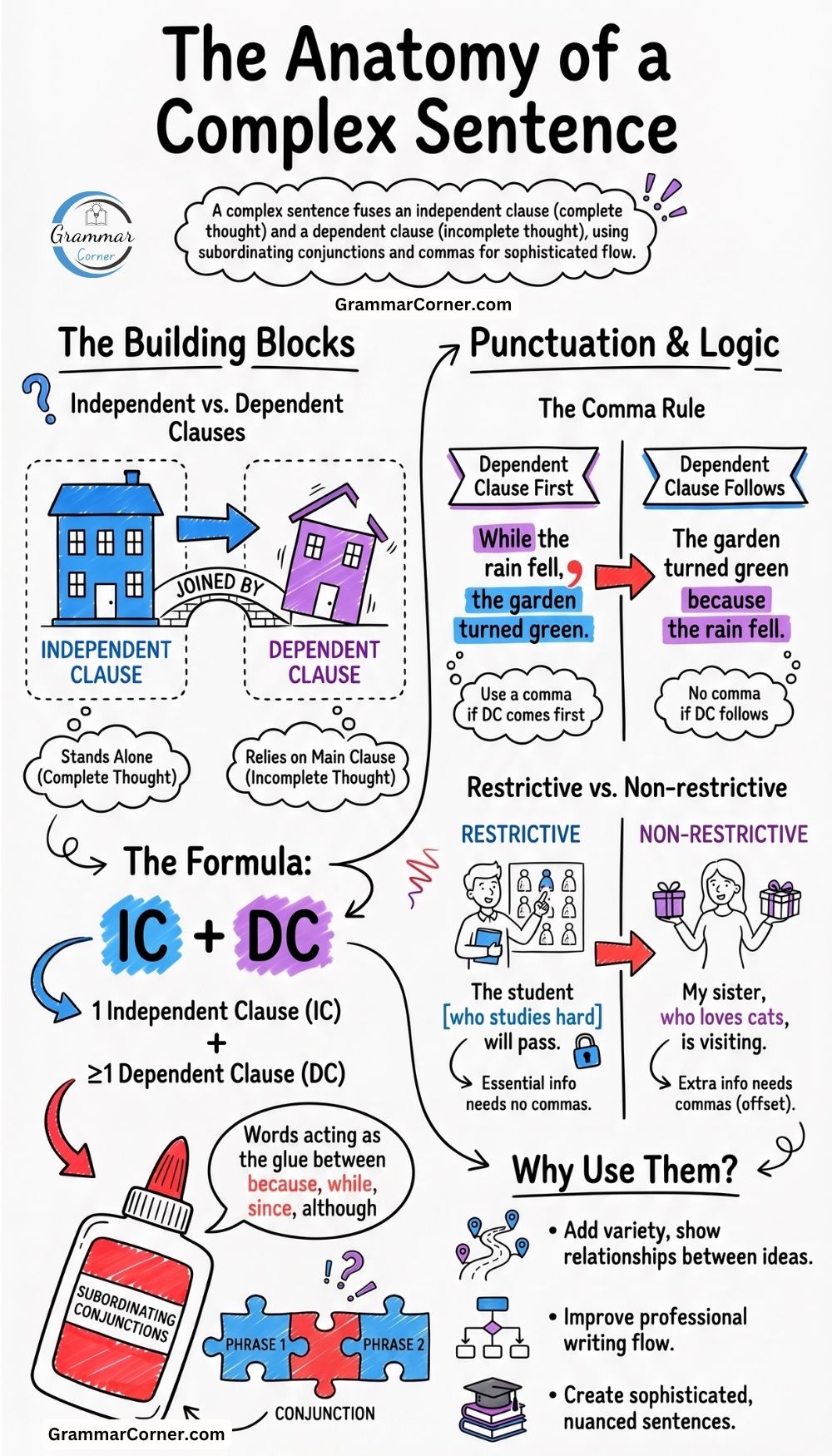
A complex sentence allows you to connect a main idea with another idea that depends on it. Instead of presenting every thought as a separate, choppy sentence, you can use them to show logical relationships—such as time, reason, condition, contrast, purpose, or place—within a single structure.
To master these, you must first distinguish between an independent clause (a complete thought) and a dependent clause (an incomplete thought that adds extra information).
What Is a Complex Sentence?
A complex sentence consists of one independent clause and at least one dependent clause. The dependent clause relies on the main clause to make full sense.
Analysis: The first part is an independent clause (it stands alone). The second part is a dependent clause (it relies on the first to complete the logic of the reason).
The Complex Sentence Formula
Complex sentences are flexible; you can place the dependent clause at the beginning or the end of the sentence depending on your desired emphasis.
Example:
- I called the office after I received the message.
- After I received the message, I called the office.
Both sentences convey the exact same meaning. The only difference is the order of the clauses and the addition of a comma when the dependent clause comes first.
What Makes a Sentence Complex?
The defining feature of a complex sentence is its clause structure, not its length. A very short sentence can be complex, and a very long one can be simple.
To be grammatically complex, a sentence must satisfy three conditions:
- ✓ Exactly one independent clause.
- ✓ At least one dependent clause.
- ✓ A grammatical connection (conjunction or relative pronoun) linking them.
How Dependent Clauses Start
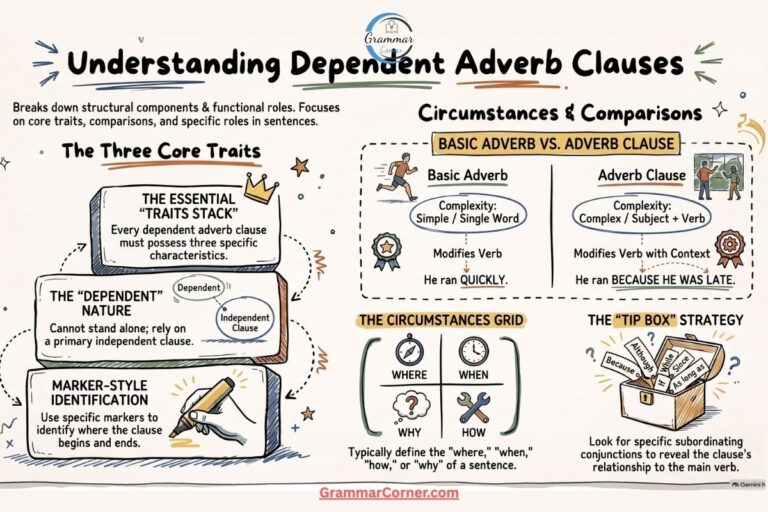
Dependent clauses are “marked” by specific words that prevent them from standing alone. Look for these signals:
Variations in Complexity
1. The “1 + 1” Structure
The most common complex sentence pairs one complete thought with one piece of dependent information.
2. Multiple Dependent Clauses
You can add as many dependent clauses as you like to clarify time, reason, or condition—as long as you have only one independent clause.
Key Takeaway: Don’t count the words; count the clauses. If there is only one “main” part that can stand alone, the sentence is complex.
Independent vs. Dependent Clauses
To build complex sentences, you must first master the two building blocks of English clause structure.
What Is an Independent Clause?
An independent clause contains a subject and a predicate, and it expresses a complete thought.
It can stand alone as a sentence, making it independent.
What Is a Dependent Clause?
A dependent clause also contains a subject and a verb, but it cannot stand alone. It feels incomplete and leaves the listener waiting for more information.
This relies on a main clause to complete the idea: “We ended the game because the children were tired.”
Quick Reference: Clause Comparison
| Feature | Independent Clause | Dependent Clause |
|---|---|---|
| Complete thought? | Yes | No |
| Can stand alone? | Yes | No |
| Has subject/verb? | Yes | Yes |
| Role in sentence | Main Idea | Supporting Idea |
Tip: If you aren’t sure if a clause is independent, try placing it by itself. If it sounds like a complete sentence, it’s independent!
What Is a Subordinating Conjunction?
A subordinating conjunction is the “bridge” that connects a dependent clause to an independent one. It defines the logical relationship between them.
The conjunction determines how the ideas connect:
- Reason: “We waited inside because it was raining.”
- Time: “We waited inside until the rain stopped.”
- Condition: “We will go outside if the rain stops.”
The conjunction is more than just a connector; it acts as a signal to the reader about the timing, cause, or context of the main action.
Types of Relationships in Complex Sentences
The beauty of complex sentences is their ability to define precise logical connections between ideas. Dependent clauses can express several distinct relationships depending on the subordinating conjunction you choose.
| Relationship | Common Words | Example |
|---|---|---|
| Time | when, before, after, while, until |
We left after the meeting ended. |
| Reason | because, since, as |
I stayed home because I felt tired. |
| Condition | if, unless, provided that |
We will travel if the weather improves. |
| Contrast | although, though, even though, whereas |
Although he was nervous, he spoke clearly. |
| Purpose | so that, in order that |
She spoke slowly so that everyone could follow her. |
| Place | where, wherever |
Sit wherever you feel comfortable. |
| Manner | as if, as though |
He behaved as though nothing had happened. |
Notice how identical clause structures perform vastly different functions simply by changing the connector word.
How to Form a Complex Sentence
Building a complex sentence starts with combining two related ideas into a single, cohesive thought.
Idea B: It was raining heavily.
By introducing because, you instantly establish a cause-and-effect relationship.
Choosing Your Clause Arrangement
Both clause orders are grammatically correct. The arrangement you choose simply changes which piece of information receives initial emphasis.
[Independent Clause] + [Dependent Clause]
“We stayed at home because the roads were flooded.”
[Dependent Clause] + , + [Independent Clause]
“Because the roads were flooded, we stayed at home.”
Note: Notice the comma placement in Pattern 2! Putting the dependent clause first requires a comma before the main clause.
✨ Quick Challenge
Which of the following correctly punctuates a complex sentence starting with a dependent clause of contrast? Tap your answer.
See the full answer
Answer: “Although the deadline was tight, the team delivered the project on schedule.”
Breakdown of Pattern 2 rules:
- Dependent Clause (Contrast): Although the deadline was tight (introduced by Although).
- Comma Rule: When the dependent clause comes first, insert a comma to signal the boundary before the independent clause.
- Independent Clause: the team delivered the project on schedule.
- Avoid Redundant Connectors: Never use Although and but together to join two clauses.
Punctuation Rules for Complex Sentences
Punctuation in complex sentences depends largely on the position of the dependent clause relative to the independent clause.
When a dependent clause introduces the sentence, follow it with a comma to signal where the main clause begins.
Dependent: Although the task looked difficult | Independent: the students completed it on time
More Examples:
- When the guests arrived, we served dinner.
- If you need help, call me.
- Before the shop closes, we need to buy the groceries.
When the dependent clause follows the main clause, a comma is normally unnecessary because the logic flows directly into the essential detail.
More Examples:
- Call me if you need help.
- We need to buy the groceries before the shop closes.
Comparing the Two Arrangements:
- When the guests arrived, we served dinner. (Dependent first → needs comma)
- We served dinner when the guests arrived. (Dependent last → no comma)
The clause arrangement changes, but both variations remain fully complex sentences.
Complex Sentences With Relative Clauses
Subordinating conjunctions aren’t the only way to make a sentence complex—a relative clause can also serve as the dependent clause.
Relative clauses begin with relative pronouns or adverbs:
Main Clause: The woman is a doctor.
Relative Clause (Dependent): who lives next door (adds essential identifying info).
Relative Clause (Dependent): where my grandfather grew up (provides detail about the noun “village”).
Restrictive vs. Nonrestrictive Relative Clauses
Understanding whether a relative clause is essential determines how you punctuate it:
The clause who submitted their forms is essential because it specifies which students received certificates. Do not set it off with commas.
The clause who lives in Lahore simply adds nonessential background info about my brother. Set it off with commas.
Complex Sentence Punctuation Rules
Proper punctuation depends directly on the position and specific function of the dependent clause within the sentence structure.
Dependent Clause Position
At the Beginning (Comma Required):
At the End (No Comma Needed):
Relative Clause Punctuation
Punctuation directly changes the meaning and essential nature of relative clauses:
Nonrestrictive (Extra details → Enclosed in commas):
Restrictive (Essential details → No commas):
Complex Sentence Examples by Relationship
A dependent clause does far more than add words to a sentence—it establishes precise context by explaining why, when, under what condition, where, how, or despite what circumstance an action takes place.
| Example Sentence | Relationship |
|---|---|
| We stayed inside because the storm was getting stronger. | Reason |
| When the bell rang, the students left the classroom. | Time |
| Although the road was narrow, the driver continued carefully. | Contrast |
| You can borrow my laptop if you handle it carefully. | Condition |
| She whispered so that the baby would not wake up. | Purpose |
| We sat wherever there was enough space. | Place |
| He looked at me as though he already knew the answer. | Manner |
Clause Analysis: Breaking Down Complex Sentences
Deconstructing sentences into individual clauses is one of the clearest ways to analyze and master their internal grammar structure.
“Because the train was delayed, we arrived late.”
- Dependent Clause Because the train was delayed
- Independent Clause we arrived late
- Subordinating Conjunction because
“I will call you when I reach the station.”
- Independent Clause I will call you
- Dependent Clause when I reach the station
- Subordinating Conjunction when
“The book that you recommended was very helpful.”
- Main Clause The book was very helpful
- Relative Clause that you recommended
Complex Sentences vs. Other Sentence Structures
Understanding complex sentences becomes much easier when you compare them directly to the other three major English sentence structures.
| Sentence Type | Independent Clauses | Dependent Clauses |
|---|---|---|
| Simple | 1 | 0 |
| Compound | 2 or more | 0 |
| Complex | 1 | 1 or more |
| Compound-Complex | 2 or more | 1 or more |
Direct Structure Comparisons
1. Complex vs. Simple Sentence
A simple sentence contains only one independent clause, while a complex sentence attaches a dependent clause to add extra logical context.
The complex sentence adds a time relationship (before the teacher arrived) that the simple sentence lacks.
2. Complex vs. Compound Sentence
A compound sentence joins two equal, independent clauses using a coordinating conjunction (like and, but, or so). A complex sentence combines one main clause with a supporting dependent clause.
Don’t just count clauses—test whether each clause can stand alone as a full sentence.
3. Complex vs. Compound-Complex Sentence
A compound-complex sentence contains at least two independent clauses plus at least one dependent clause.
Breakdown: 1 dependent clause (After the students...) + 2 independent clauses (they left... / the teacher locked...).
Why Do We Use Complex Sentences?
Complex sentences are essential tools in writing when two ideas are closely linked, allowing you to explicitly show the relationship between them rather than leaving the reader to guess.
“The plants died because nobody watered them.”
Explains the exact reason behind the result.
“We started dinner after everyone arrived.”
Establishes precise chronological order.
“Although the apartment was small, it was comfortable.”
Connects two opposing or surprising ideas.
“We will go hiking if the weather improves.”
States the condition required for the main action.
“When the company opened its first branch, only five employees worked there.”
Gives helpful situational context before the main statement.
✨ Quick Challenge
Which of the following examples functions as a complex sentence (exactly one independent clause + at least one dependent clause)? Tap your answer.
See the full answer
Answer: “When the lightning struck the transformer, the power went out across the neighborhood.”
Structural breakdown according to clause count:
- Dependent Clause: When the lightning struck the transformer (cannot stand alone).
- Independent Clause: the power went out across the neighborhood (complete standalone thought).
- Formula:
1 Dependent Clause + 1 Independent Clause = Complex Sentence.
How to Use Complex Sentences Effectively
A complex sentence should clarify the relationship between ideas, not make your writing harder to digest.
Selecting the correct conjunction ensures your logic is crystal clear:
- Use
becausefor reason - Use
althoughfor contrast - Use
iffor conditions
To create better rhythm in your paragraphs, alternate between putting dependent clauses at the beginning and the end:
• “Because the weather changed, we canceled the trip.”
• “We canceled the trip because the weather changed.”
Complex sentences aren’t automatically better than simple ones. Stacking too many in a row can overwhelm the reader. Good writing balances simple, compound, and complex structures.
Common Errors in Complex Sentences
Incorrectly joining two independent clauses with only a comma.
Leaving a dependent clause standing alone without a main clause.
Omitting the comma after an introductory dependent clause.
A phrase lacks a subject-verb pair, whereas a dependent clause contains both.
Phrase: “After lunch, we returned to work.” (No verb in underlined phrase)
Dependent Clause: “After we finished lunch, we returned to work.” (Contains subject “we” and verb “finished”)
5-Step Process: How to Identify a Complex Sentence
-
1Find the Verbs
Locate all main verbs and verb phrases in the sentence.
-
2Identify the Clauses
Group words that share their own distinct subject-verb relationships.
-
3Test Each Clause
Ask whether each clause can stand alone as a complete sentence.
-
4Look for a Dependent Marker
Check for subordinating conjunctions (like if, because, when) or relative pronouns.
-
5Count the Clause Types
If you find 1 Independent Clause + at least 1 Dependent Clause, it is a complex sentence.
“If the weather improves, we will play outside.”
If the weather improves= Dependent clause (introduced by marker If)we will play outside= Independent clause- Result: Complex Sentence
Complex Sentence Practice
Test your skills! Read each sentence below and try to identify the independent clause and the dependent clause before checking the answer table.
- Because the road was flooded, we took another route.
- I will wait here until the doctor arrives.
- Although the task was difficult, Maya completed it.
- We will start the meeting when everyone arrives.
- The house that stands near the river has been empty for years.
- If you finish your work early, you can leave.
- He spoke quietly so that the baby would remain asleep.
- I visited the restaurant where my parents first met.
Answers & Breakdown
| # | Independent Clause | Dependent Clause |
|---|---|---|
| 1 | We took another route. | Because the road was flooded. |
| 2 | I will wait here. | Until the doctor arrives. |
| 3 | Maya completed it. | Although the task was difficult. |
| 4 | We will start the meeting. | When everyone arrives. |
| 5 | The house has been empty for years. | That stands near the river. |
| 6 | You can leave. | If you finish your work early. |
| 7 | He spoke quietly. | So that the baby would remain asleep. |
| 8 | I visited the restaurant. | Where my parents first met. |
Frequently Asked Questions About Complex Sentences
What is a complex sentence?
A complex sentence contains one independent clause and at least one dependent clause. The dependent clause adds context such as reason, time, condition, contrast, purpose, or place.
What is the basic formula of a complex sentence?
There are two basic arrangements:
Example: “We stayed home because it was raining.”
Example: “Because it was raining, we stayed home.”
What words are commonly used in complex sentences?
Common subordinating conjunctions include because, although, if, unless, when, while, before, after, since, and until. Relative words such as who, which, that, where, and whose can also introduce dependent clauses.
Does a complex sentence need a comma?
Not always. An introductory dependent clause placed at the start is generally followed by a comma. However, a closely connected dependent clause placed after the independent clause usually does not require one.
Can a complex sentence have more than one dependent clause?
Yes. A sentence can contain one independent clause and multiple dependent clauses and still be classified as a complex sentence.
Can a complex sentence have two independent clauses?
No. If a sentence has two or more independent clauses along with at least one dependent clause, it is classified as a compound-complex sentence.
Is a long sentence always complex?
No. Length does not determine sentence structure. A long sentence can be simple, compound, complex, or compound-complex depending on its underlying clause relationships.
What is the difference between a complex sentence and a compound sentence?
A complex sentence has one independent clause and at least one dependent clause. A compound sentence has two or more independent clauses joined by coordinating conjunctions, with no dependent clauses.