Simple Sentence Structure Explained With Examples | Complete Guide
What Is a Simple Sentence?
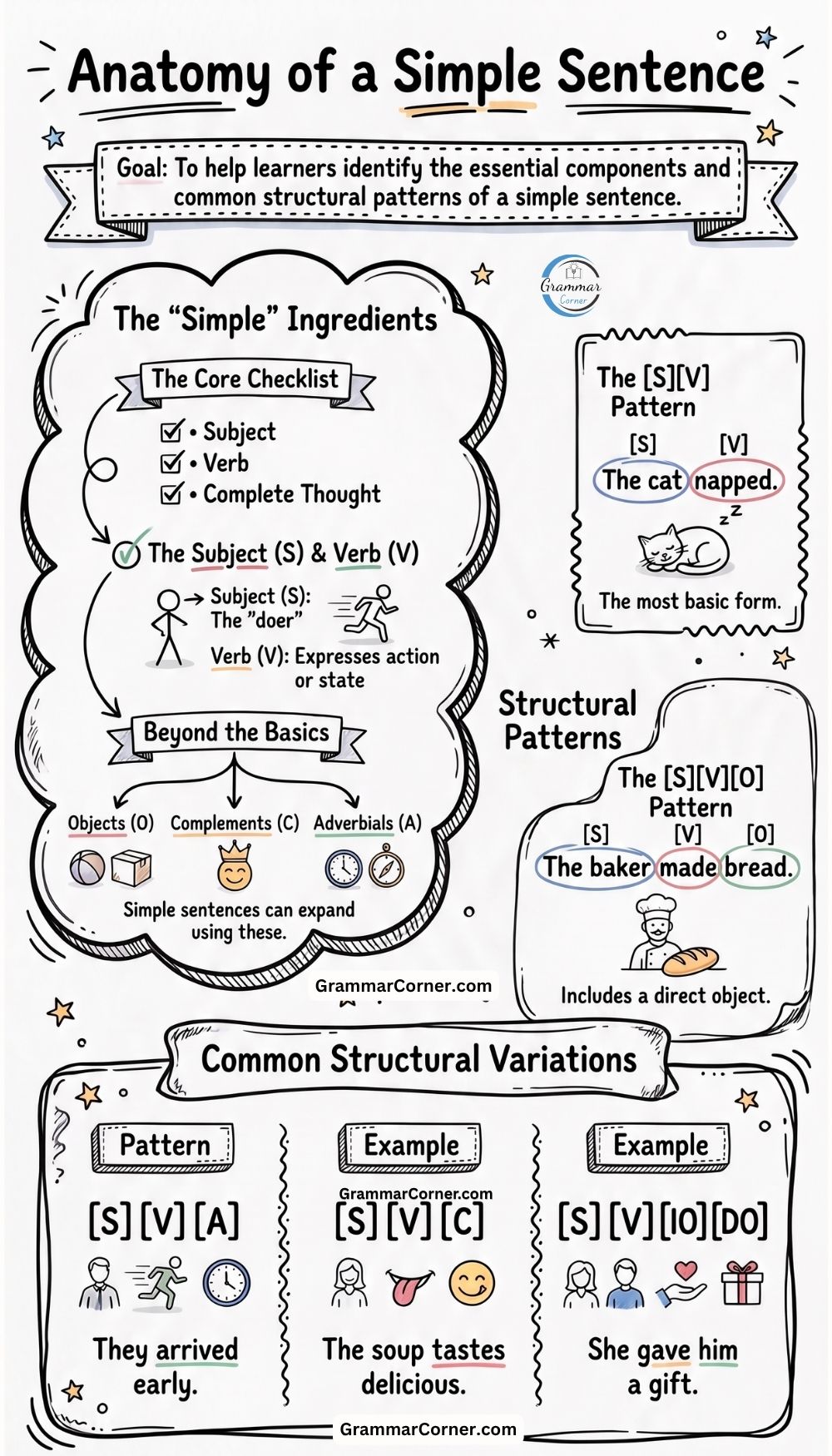
A simple sentence contains one independent clause and expresses a complete thought. It normally has a subject and a verb, although it may also contain an object, complement, adverbial, or other modifiers.
Anatomy of a Simple Sentence
Consider the following example:
This sentence consists of exactly one independent clause broken down as follows:
Because there is no dependent clause attached to it, the sentence is classified as simple.
What Makes a Sentence Simple?
The easiest way to recognize a simple sentence is to look directly at its clauses.
Essentials of a Simple Sentence
A sentence is classified as simple when it satisfies these criteria:
- One independent clause
- At least one subject
- At least one verb
- Expresses a complete thought
- Zero dependent clauses
Comparing Simple vs. Complex Structures
Notice how adding a dependent clause transforms the underlying structure:
Contains one subject (the old bus) and one main verb (stopped). The phrase near the school adds detail about location, but it does not form a new clause.
The first part remains an independent clause, but because the driver heard a strange noise introduces a dependent clause. Therefore, this sentence is complex rather than simple.
Simple Sentence at a Glance
| Feature | Simple Sentence |
|---|---|
| Independent clauses | One |
| Dependent clauses | None |
| Complete thought | Yes |
| Basic requirement | Subject + verb |
| Can contain objects? | Yes |
| Can contain modifiers? | Yes |
| Can have a compound subject? | Yes |
| Can have a compound predicate? | Yes |
Simple Sentence Structure
The basic structure of a simple sentence can be represented in several ways. The exact pattern depends on the verb and on the information the writer wants to include.
Common Structural Patterns
| Pattern | Structure | Example |
|---|---|---|
| SV | Subject + Verb | Birds fly. |
| SVO | Subject + Verb + Object | Sara opened the window. |
| SVC | Subject + Verb + Complement | My uncle is a doctor. |
| SVA | Subject + Verb + Adverbial | We arrived early. |
| SVIODO | Subject + Verb + Indirect Object + Direct Object | He gave me a pen. |
| SVOC | Subject + Verb + Object + Complement | They painted the door blue. |
| SVOA | Subject + Verb + Object + Adverbial | She placed the bag on the chair. |
Detailed Pattern Breakdown
1. Subject + Verb (SV)
The SV pattern is one of the simplest ways to form a complete sentence.
The verb in these sentences does not require an object to complete its basic meaning.
More Examples:
- The birds sing.
- Leaves fall.
- The dog barked.
- My sister laughed.
2. Subject + Verb + Object (SVO)
Some verbs are transitive and require an object to receive or complete the action.
The object tells us what or whom the action affects.
More Examples:
- We watched a movie.
- Maria bought a notebook.
- The mechanic repaired the car.
3. Subject + Verb + Complement (SVC)
A complement completes the meaning of a linking verb by describing or renaming the subject.
Here, delicious describes the subject (the soup).
The phrase a teacher is a complement identifying what Mr. Ahmed became.
Common linking verbs include: be, become, seem, appear, feel, look, smell, and taste.
4. Subject + Verb + Adverbial (SVA)
An adverbial gives additional details about the action, such as where, when, or how it occurs.
The word outside informs us where they played. The presence of an adverbial does not alter the fact that it remains a simple sentence.
More Examples:
- We arrived early.
- She lives in Multan.
- They worked all night.
5. Subject + Verb + Indirect Object + Direct Object (SVIODO)
Certain ditransitive verbs can take two separate objects.
The indirect object identifies the recipient, while the direct object identifies what was given.
6. Subject + Verb + Object + Complement (SVOC)
An object complement provides essential context or state descriptions specifically about the object.
Here, everyone is the object and nervous describes their resulting state.
Another Example:
- They painted the wall green. (The wall = object; green = object complement describing the result).
7. Subject + Verb + Object + Adverbial (SVOA)
This structure contains a direct object followed immediately by an adverbial phrase.
The phrase on the table clarifies the spatial location of where the keys were placed.
More Examples:
- He left his shoes outside.
- We placed the boxes in the storeroom.
✨ Quick Challenge
Identify the structural pattern of the following simple sentence: “The committee appointed Marcus chairperson yesterday.” Tap your answer.
See the full answer
Answer: SVOC + Adverbial (Subject + Verb + Object + Object Complement + Adverbial)
Component-by-component breakdown:
- Subject (S): The committee (the entity performing the action)
- Verb (V): appointed (transitive verb of appointing/naming)
- Object (O): Marcus (the entity receiving the appointment)
- Object Complement (C): chairperson (renames/defines the role of Marcus)
- Adverbial (A): yesterday (time adverbial indicating when the action occurred)
Parts of a Simple Sentence
A simple sentence can contain several grammatical elements. The most important ones are the subject, verb, object, complement, and adverbial.
Not every simple sentence needs all of them to be grammatically complete:
Contains only the essentials: a subject (Birds) and a verb (fly).
Core Grammatical Elements
The subject tells us who or what the sentence is about.
- The children laughed.
- My brother plays cricket.
- The old building needs repairs.
Note: The subject can be a single word or a longer noun phrase.
The verb expresses an action, event, or state of being. A simple sentence must have a verb or verb phrase.
- The children laughed.
- Maria opened the door.
- My father is a doctor.
An object receives the action of a transitive verb. An object is not required in every sentence; intransitive verbs can form complete sentences without one.
- The boy kicked the ball.
- Sarah opened the window.
- We finished our homework.
A complement completes the meaning of a linking verb or provides necessary descriptive information about the subject or object.
- The flowers are beautiful.
- His brother became a pilot.
- They found the task difficult.
An adverbial provides additional information about an action or situation, such as time, place, or manner.
- We arrived early.
- She lives near the airport.
- They worked until midnight.
Note: An adverbial may be a single word, prepositional phrase, or other grammatical unit.
Common Questions About Simple Sentences
A simple sentence can contain two or more subjects that share the same verb. It remains simple as long as there is only one independent clause.
There are two subjects (Ali and Hamza), but only one independent clause. The sentence is therefore simple.
The subject is compound (The teacher + the students), but the sentence still contains only one independent clause.
Common Misconception: Students often assume that two subjects automatically create a compound sentence. They do not!
A simple sentence can have one subject performing two or more actions (verbs).
The single subject Sara performs two actions: opened and switched on. Because there is still only one independent clause, it is a simple sentence.
Now there are two distinct subjects and two independent clauses joined by a conjunction (Sara opened… + she switched…).
Length does not determine whether a sentence is simple. A sentence may contain several phrases, modifiers, objects, or compound elements and still consist of only one independent clause.
Despite its length, its underlying pattern is still Subject + Verb + Object + Adverbial (SVOA):
The prepositional phrases from our neighborhood and after lunch enrich the sentence with extra details, but they do not add secondary clauses.
Simple Sentence Examples
Here are examples of simple sentences illustrating each structural pattern:
| Simple Sentence | Pattern |
|---|---|
| The baby slept. | SV |
| My sister reads novels. | SVO |
| The sky looks beautiful. | SVC |
| We arrived late. | SVA |
| He gave me a gift. | SVIODO |
| They painted the room white. | SVOC |
| She placed the books on the shelf. | SVOA |
Notice that these sentences do not all look alike. Some are brief, while others contain additional information. Their shared, defining characteristic is that each consists of exactly one independent clause.
Simple Sentences vs. Other Sentence Structures
A simple sentence is only one of four main sentence structures in English grammar. The remaining three are compound, complex, and compound-complex sentences.
The easiest way to distinguish them is by counting and analyzing their clauses:
| Sentence Type | Independent Clauses | Dependent Clauses |
|---|---|---|
| Simple | 1 | 0 |
| Compound | 2 or more | 0 |
| Complex | 1 | 1 or more |
| Compound-complex | 2 or more | 1 or more |
1. Simple vs. Compound Sentences
A simple sentence has one independent clause, whereas a compound sentence contains two or more independent clauses joined by a coordinating conjunction.
Contains only 1 independent clause.
Contains 2 independent clauses joined by the coordinating conjunction and.
2. Simple vs. Complex Sentences
A complex sentence contains one independent clause combined with at least one dependent (subordinate) clause.
Expresses a complete thought with no subordinate clauses.
The clause because it was raining cannot stand alone as a complete sentence; it relies on the main clause.
3. Simple vs. Compound-Complex Sentences
A compound-complex sentence contains at least two independent clauses and at least one dependent clause.
Clause Breakdown:
- Because the road was flooded — Dependent clause
- we stayed home — Independent clause 1
- our friends visited us later — Independent clause 2
When and Why Do We Use Simple Sentences?
Simple sentences are valuable tools in writing because they communicate ideas with directness and clarity.
When the reader needs critical information quickly, direct simple sentences eliminate confusion.
Short, unadorned simple sentences deliver dramatic punch and structural weight.
Ideal when introducing complex topics to beginners by establishing one clear idea at a time.
Mixing crisp simple sentences with longer compound or complex sentences keeps prose engaging.
Simple Sentences and Punctuation
Because a simple sentence consists of only one independent clause, it does not normally require a comma to separate verb phrases sharing a single subject.
Compare the Rule:
“Jack opened the door and walked inside.”
No comma before and because Jack is the subject performing both actions.
“Jack opened the door, and he walked inside.”
Requires a comma because he creates a second independent clause, forming a compound sentence.
Side-by-Side Comparison
| Sentence | Type | Why? |
|---|---|---|
| Jack opened the door and walked inside. | Simple | One subject performs two actions (compound predicate). |
| Jack opened the door, and he walked inside. | Compound | Two complete independent clauses are joined by and. |
Mastering this comma rule is one of the quickest ways to eliminate unnecessary punctuation errors in your writing.
Common Mistakes With Simple Sentences
Sentence length never determines sentence structure. A very brief sentence can easily contain multiple clauses.
Multiple actions performed by a single subject do not alter the simple structure.
Placing a comma before a conjunction that merely connects two verbs sharing one subject is a frequent error.
No comma is needed because the second verb does not start a new independent clause.
Having more than one subject noun does not mean you have a compound sentence structure.
How to Identify a Simple Sentence
Not sure if a sentence is simple? Use this 5-step checklist to analyze its structure quickly and accurately.
There is only one subject (The children) and one verb (played). The phrase “after school” is a prepositional phrase, not a clause. Therefore, the sentence is simple.
Simple Sentence Practice
Test your knowledge by identifying whether the following sentences are simple. Then, check your answers against the provided explanations.
| No. | Sentence | Is it Simple? | Explanation |
|---|---|---|---|
| 1 | The students completed their project. | Simple | One independent clause. |
| 2 | Ahmed and Bilal played cricket. | Simple | Compound subject, but one clause. |
| 3 | She opened the window and turned on the fan. | Simple | One subject with a compound predicate. |
| 4 | We stayed home because it was raining. | Not Simple | Contains a dependent clause (because…). |
| 5 | The old house looked beautiful. | Simple | One independent clause. |
| 6 | When the teacher arrived, the students became quiet. | Not Simple | Contains a dependent clause (When…). |
| 7 | My brother washed the car and cleaned the garage. | Simple | One subject performs two actions. |
| 8 | The manager gave the employees new instructions. | Simple | One independent clause with indirect/direct objects. |
Frequently Asked Questions About Simple Sentences
- Simple: 1 independent clause.
- Compound: 2+ independent clauses (e.g., “She opened the window, and she turned on the fan.”).
- Complex: 1 independent clause + at least 1 dependent clause.
SV, SVO, SVC, SVA, SVIODO, SVOC, and SVOA. The pattern depends on the verb and the elements required to complete its meaning.