Passive Sentences (Structure & Examples) | Active Voice Vs. Passive Voice
What Is a Passive Sentence?
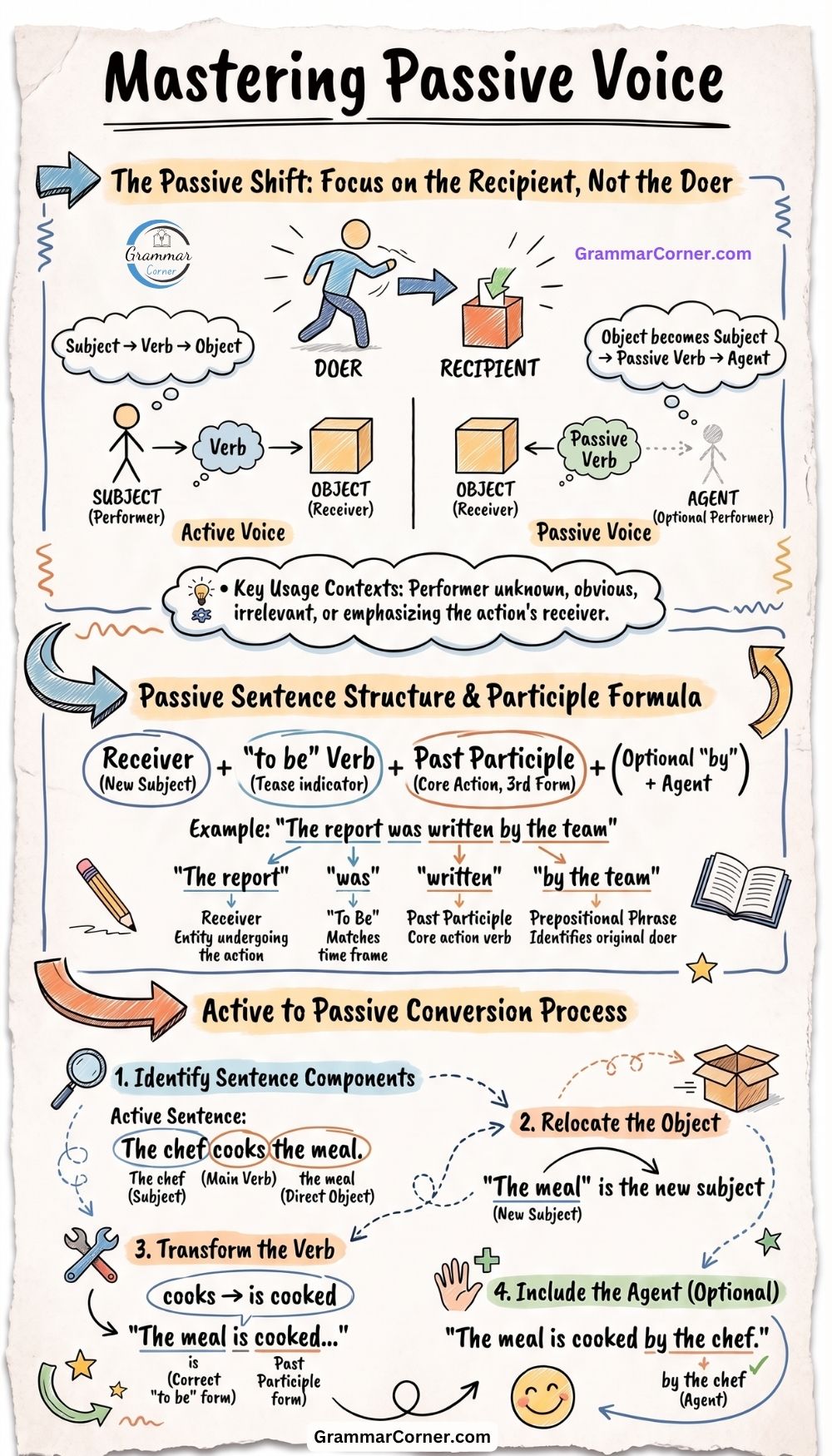
A passive sentence is a sentence in which the grammatical subject receives the action rather than performing it. This sentence structure informs who performed an action or focuses directly on the person or thing affected by that action.
Active vs. Passive Focus
Compare how the grammatical focus shifts between these two sentences describing the exact same event:
Both sentences describe the same event, but their focus is completely different. The active sentence puts the technician first, while the passive sentence places the computer first. This change in focus is the core concept behind passive constructions.
Where Are Passive Sentences Used?
Passive constructions are widely used across various types of written and spoken English:
They are especially useful when the person who performed an action is unknown, obvious, unimportant, or less important than the result of the action itself.
Structural Breakdown of a Passive Sentence
Look closely at the structure below:
- The window → Grammatical subject (receives the action).
- was broken → Passive verb phrase.
- by the boy → Agent (the person who performed the action).
✨ Quick Challenge
Which of the following sentences is in the passive voice (where the subject receives the action rather than performing it)? Tap your answer.
See the full answer
Answer: “A new compound was discovered by the scientist in the laboratory.”
Structural breakdown of the passive sentence:
- Subject (Receiver): A new compound (does not perform the action).
- Passive Verb: was discovered (be + past participle).
- Agent: by the scientist (the entity that performed the discovery).
What Is Passive Voice?
Passive voice is a grammatical construction in which the subject of a sentence receives the action expressed by the verb. The term voice describes the relationship between the subject and the action itself.
English relies on two grammatical voices:
| Voice | Relationship of Subject to Action | Example |
|---|---|---|
| Active voice | Subject performs the action | The manager approved the request. |
| Passive voice | Subject receives the action | The request was approved by the manager. |
Notice how the tense shifts across these passive sentences while the passive voice remains constant:
- The letters are delivered every morning. (Present)
- The letters were delivered yesterday. (Past)
- The letters will be delivered tomorrow. (Future)
- The letters have been delivered already. (Present Perfect)
What Is the Basic Structure of a Passive Sentence?
The standard structural pattern for building a passive sentence is:
Three essential elements form this pattern:
- The receiver of the action shifts into the subject position.
- A appropriate form of the auxiliary verb be is selected.
- The main verb converts to its past participle form.
The agent (person or thing performing the action) can be added using a “by” phrase, though this element is completely optional.
Passive Sentence Formula Breakdown
| Element | Grammatical Function | Example Component |
|---|---|---|
| Subject | Receives the action | The bridge |
| Form of be | Shows tense & structure | was |
| Past participle | Main action | repaired |
| Agent phrase | Identifies the doer | by the engineers |
| Complete Sentence | The bridge was repaired by the engineers. | |
What Is a Past Participle?
The past participle is the specific verb form used in passive constructions and various compound tenses. For regular verbs, it is formed by adding -ed to the base verb.
Regular Verbs (-ed)
| Base Verb | Past Participle |
|---|---|
| clean | cleaned |
| open | opened |
| repair | repaired |
| wash | washed |
Irregular Verbs (Vary)
| Base Verb | Past Participle |
|---|---|
| write | written |
| break | broken |
| choose | chosen |
| build | built |
| take | taken |
| make | made |
Every passive sentence requires the correct past participle form of the main verb:
Active Sentence vs. Passive Sentence
The clearest way to understand the passive voice is by placing it directly alongside the active voice:
Active and Passive Compared
| Active Sentence | Passive Sentence |
|---|---|
| The company launched the product. | The product was launched by the company. |
| The police arrested the suspect. | The suspect was arrested by the police. |
| The students completed the project. | The project was completed by the students. |
| Someone cleaned the room. | The room was cleaned. |
| The storm damaged several houses. | Several houses were damaged by the storm. |
How to Change an Active Sentence Into a Passive Sentence
Converting an active sentence into a passive sentence follows a logical, step-by-step grammatical process.
Consider the active sentence: “The gardener watered the plants.”
Final Passive Result: “The plants were watered by the gardener.”
Active-to-Passive Pattern Breakdown
| Active Component | Example Element | Passive Component | Converted Element |
|---|---|---|---|
| Subject | The gardener | New Subject | The plants |
| Verb | watered | Be + Participle | were watered |
| Object | the plants | Agent Phrase | by the gardener |
Passive Sentences in Different Tenses
The passive voice can be formed across many English tenses. When changing tenses, the auxiliary form of be changes according to time and aspect, while the main verb always remains in its past participle form.
- English is spoken in many countries.
- The rooms are cleaned every morning.
- The report is checked before publication.
- The road is being repaired.
- New houses are being built.
- The documents are being examined.
Note: The word being is essential in present continuous passive constructions.
- The work has been completed.
- Several changes have been made.
- The documents have been signed.
- The car was repaired yesterday.
- The invitations were sent last week.
- The building was damaged by the storm.
- The bridge was being repaired.
- The students were being tested.
- The equipment was being inspected.
- The room had been cleaned before the guests arrived.
- The decision had been announced earlier.
- The documents had been prepared in advance.
- The results will be announced tomorrow.
- The building will be opened next month.
- The package will be delivered soon.
- The project will have been completed by June.
- The repairs will have been finished by Friday.
Passive Voice Tense Chart
Use this reference chart for a quick structural comparison of passive forms across all major tenses:
| Tense | Passive Structure | Example |
|---|---|---|
| Simple Present | am/is/are + past participle | The room is cleaned. |
| Present Continuous | am/is/are being + past participle | The room is being cleaned. |
| Present Perfect | has/have been + past participle | The room has been cleaned. |
| Simple Past | was/were + past participle | The room was cleaned. |
| Past Continuous | was/were being + past participle | The room was being cleaned. |
| Past Perfect | had been + past participle | The room had been cleaned. |
| Simple Future | will be + past participle | The room will be cleaned. |
| Future Perfect | will have been + past participle | The room will have been cleaned. |
Passive Sentences With Modal Verbs
Modal verbs—such as can, could, may, might, must, should, and will—integrate smoothly into passive constructions.
Here are several examples of passive sentences formed with common modal verbs:
- The problem can be solved.
- The form must be completed.
- The rules should be followed.
- The package may be delivered today.
- The equipment could be repaired.
Modal Passive Transformations
| Active Voice | Passive Voice |
|---|---|
| You must follow the instructions. | The instructions must be followed. |
| We can solve the problem. | The problem can be solved. |
| They should complete the form. | The form should be completed. |
| Someone may change the schedule. | The schedule may be changed. |
When Should You Use a Passive Sentence?
The passive voice is a valuable writing tool, not a construction you should automatically avoid. It serves several clear grammatical and stylistic purposes:
Used when we know what happened but do not know who performed the action.
Used when the completed action matters far more than the person doing it.
Used when everyone already understands who performs the action.
Places the most important piece of information right at the beginning.
Keeps the focus entirely on objective processes and results rather than researchers.
Ideal for outlining official procedures, guidelines, or regulations objectively.
When Is the Active Voice Better?
While the passive voice has important uses, the active voice is generally preferred when you want your sentence to be:
Compare these pairs to see how active voice creates stronger, more immediate statements:
Note: Neither sentence in these pairs is grammatically incorrect. The ideal choice depends entirely on what you want the reader to focus on!
Passive Voice Does Not Mean Bad Writing
One common misconception is that passive voice always equates to poor writing. That is simply not true. A passive sentence only becomes problematic when used unnecessarily, repeatedly, or when it obscures meaning.
Consider this natural passive sentence:
Here, the focus is rightfully on the patient and what happened to them. Changing this sentence to active voice—“The ambulance drivers took the patient to the hospital”—is only useful if the drivers themselves are important to your story. Otherwise, the passive version is clearly the better choice. Good writers use both voices intentionally according to purpose.
When Should You Avoid the Passive Voice?
Avoid unnecessary passive constructions when they hide critical responsibility or make a sentence needlessly complicated.
What Is an Agent in a Passive Sentence?
The agent is the person, group, or thing that actually performs the action in a passive sentence. In passive constructions, the agent is introduced using the preposition by.
For example, in “The painting was created by the artist,” the phrase the artist is the agent.
Examples of Agents in Passive Sentences
| Passive Sentence | Agent (The Doer) |
|---|---|
| The letter was written by Maria. | Maria |
| The bridge was designed by engineers. | engineers |
| The window was broken by the ball. | the ball |
| The decision was announced by the manager. | the manager |
When Should You Omit the Agent?
An agent does not have to appear for a passive sentence to be complete. For instance, “The window was broken” is a perfectly valid sentence.
You can omit the agent when:
- You do not know who performed the action.
- The identity of the doer is obvious.
- The identity of the doer is not important.
- Mentioning the agent would distract from the main point.
- You deliberately want to focus on the result rather than the doer.
Compare how removing an unnecessary agent improves clarity:
✨ Quick Challenge
In which of the following scenarios is it best to omit the agent from a passive sentence? Tap your answer.
See the full answer
Answer: Reporting a criminal arrest: “The suspect was arrested late last night.”
The agent (by the police) is completely obvious from the context of an arrest. Omitting redundant agents keeps passive sentences concise, direct, and focused on the outcome.
Passive Sentences With Two Objects
Some active sentences contain both a direct object and an indirect object. When transforming these into passive sentences, you can create two distinct passive constructions.
The first version (focusing on the person/recipient) usually sounds more natural in spoken and written English.
Examples of Two-Object Passive Conversions
| Active Sentence | Passive Version 1 | Passive Version 2 |
|---|---|---|
| The manager gave Sara a promotion. | Sara was given a promotion. | A promotion was given to Sara. |
| They sent us an invitation. | We were sent an invitation. | An invitation was sent to us. |
| The company offered him a job. | He was offered a job. | A job was offered to him. |
Passive Sentences With Questions
Passive voice can be used to construct both Yes/No and WH-questions, as well as questions inquiring about the agent:
- Was the report completed?
- Were the documents signed?
- Has the package been delivered?
- When was the building constructed?
- Why was the meeting canceled?
- Where was the painting discovered?
Questions About the Agent
When asking who performed the action, English allows two forms depending on register:
The formal version is grammatically precise but often feels stiff in casual conversation.
Negative Passive Sentences
In negative passive constructions, the word not is placed directly after the auxiliary verb.
For example: The application + was + not + approved.
- The door was not locked.
- The report was not completed.
- The documents have not been signed.
- The package will not be delivered today.
- The road is not being repaired.
Passive Sentences With Infinitives
Passive structures frequently occur with infinitives following the structure to be + past participle.
- The work needs to be completed.
- The machine needs to be repaired.
- The forms are ready to be submitted.
- The problem is difficult to be solved.
Some infinitive-passive constructions sound more natural than others. If a simpler active or descriptive alternative is available, English speakers generally prefer it.
Passive Sentences With Reporting Verbs
In formal and journalistic writing, passive constructions are paired with reporting verbs such as say, believe, expect, report, consider, and know to present information objectively without naming specific sources in the primary clause.
- The company is expected to announce the results soon.
- The building is believed to be more than a century old.
- The scientist is reported to have discovered a new method.
- The plan is considered to be practical.
Can an Intransitive Verb Be Made Passive?
Usually, no. A standard passive construction requires a direct object in the active sentence, because that object must “become” the new subject of the passive sentence.
However, intransitive verbs (verbs that do not take a direct object) cannot be converted:
Transitive vs. Intransitive Verbs
| Verb Type | Has Direct Object? | Normal Passive Possible? |
|---|---|---|
| Transitive | Yes | Yes |
| Intransitive | No | No |
• Transitive examples: build, write, repair, clean, open, invite.
• Intransitive examples: arrive, sleep, laugh, disappear, occur.
Passive Sentence vs. Adjective
Not every structure using be + past participle is a passive verb; sometimes, it describes a state rather than an action.
Common Mistakes With Passive Sentences
✅ The car was repaired yesterday.
✅ The letter was written by Sara.
✅ The road is being repaired now.
✅ The thief was arrested.
✅ The accident occurred yesterday.
✅ The product will be launched by the company. (Keep tense consistent)
✅ The documents were signed.
Passive Voice Quick Reference Chart
| Active Pattern | Passive Pattern |
|---|---|
| Subject + verb + object | Object + be + past participle |
| Subject + is/are + verb-ing + object | Object + is/are + being + past participle |
| Subject + has/have + past participle + object | Object + has/have + been + past participle |
| Subject + was/were + verb-ing + object | Object + was/were + being + past participle |
| Subject + had + past participle + object | Object + had + been + past participle |
| Subject + will + verb + object | Object + will + be + past participle |
| Subject + modal + verb + object | Object + modal + be + past participle |
Passive Sentence Examples in Everyday English
The passive voice is highly functional when you need to highlight the action itself rather than the person performing it. Here is how it appears across different settings:
- The dishes were washed after dinner.
- The windows are cleaned every month.
- The door was left open.
- The homework was collected by the teacher.
- The test papers were distributed.
- The results will be announced tomorrow.
- The report has been completed.
- The meeting was postponed.
- The documents must be signed.
- Several roads were closed after the storm.
- The samples were stored at a low temperature.
- The results were compared with previous data.
Active or Passive? A Quick Decision Guide
When choosing between voices, ask these four questions to ensure your writing remains clear and effective:
If the doer matters: The engineer designed the bridge.
If the result matters: The bridge was designed in 2025.
If not, the passive is the natural choice: “My documents were stolen.”
If yes: Use active (The security team discovered the problem).
If no: Use passive (The problem was discovered during inspection).
Passive Sentence Practice
Exercise 1: Change Active Sentences to Passive
- The chef prepared the dinner.
- The workers repaired the road.
- The company will publish the report.
- The students have completed the assignment.
- The storm damaged several buildings.
- The manager approved the request.
- The police arrested the suspect.
- The technician is repairing the printer.
- The committee had rejected the proposal.
- The school will announce the results tomorrow.
Exercise 2: Identify the Voice
| Sentence | Answer |
|---|---|
| The dog chased the cat. | Active |
| The cat was chased by the dog. | Passive |
| The letter was delivered this morning. | Passive |
| Maria opened the window. | Active |
| The windows are cleaned every week. | Passive |
| The students completed the project. | Active |
| The project has been completed. | Passive |
| Someone damaged the fence. | Active |
| The fence was damaged during the night. | Passive |
| The company will release the product next month. | Active |
Exercise 3: Correct the Mistakes
- The house was build last year. → The house was built last year.
- The documents is being checked. → The documents are being checked.
- The letter was wrote by Ali. → The letter was written by Ali.
- The road is repair at the moment. → The road is being repaired at the moment.
- The results will announced tomorrow. → The results will be announced tomorrow.
- The package has delivered. → The package has been delivered.
- The accident was occurred yesterday. → The accident occurred yesterday.
- The books was placed on the table. → The books were placed on the table.
Frequently Asked Questions About Passive Sentences
However, if the specific identity of the cleaners is unimportant, the cleaner and more natural phrasing is simply: “The room was cleaned.”