Compound-Complex Sentences
What Is a Compound-Complex Sentence?
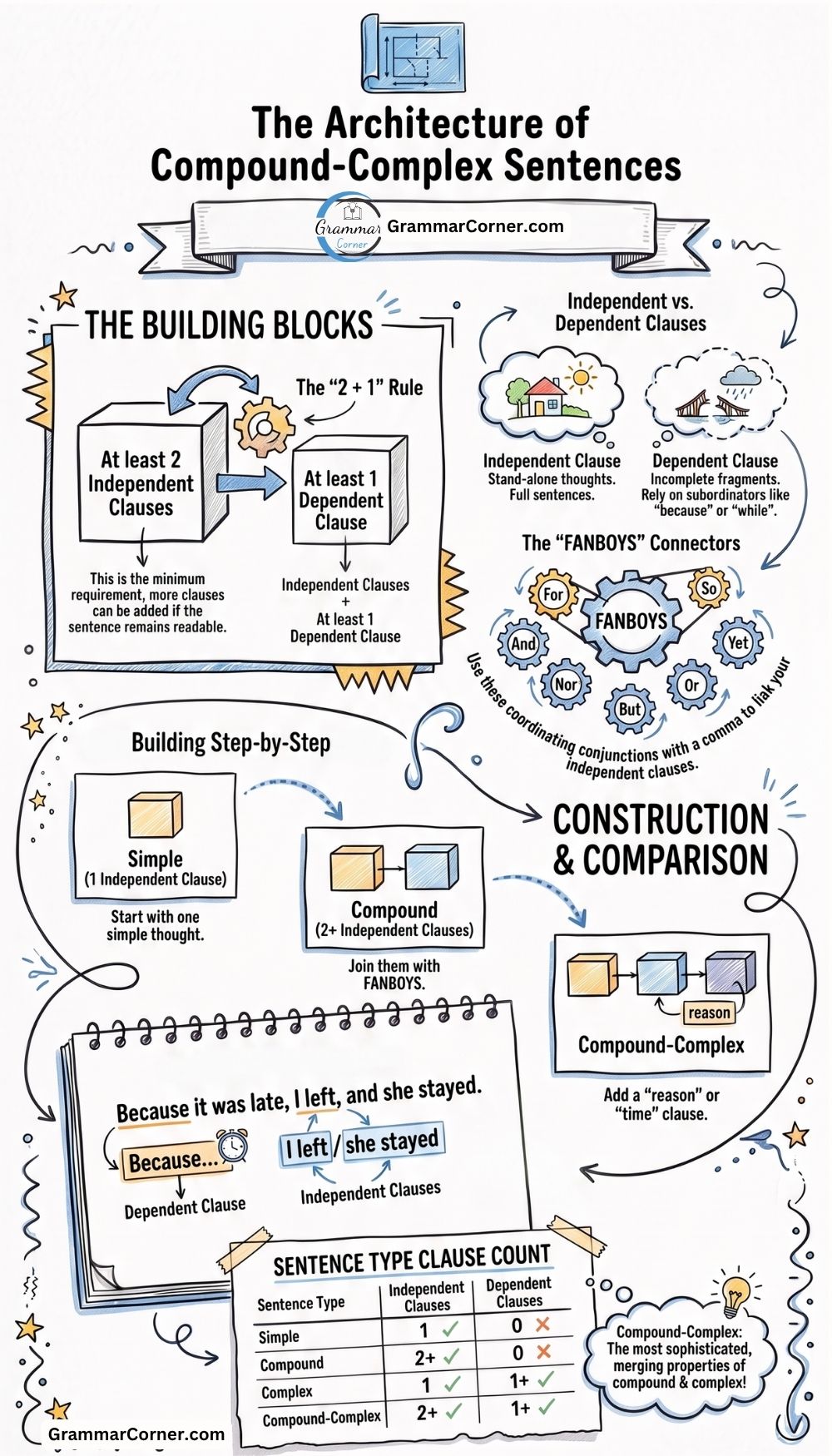
A compound-complex sentence merges two fundamental sentence structures into one: compound and complex.
A compound-complex sentence contains at least two independent clauses and at least one dependent clause.
While this may sound confusing at first, the name itself gives you a direct clue about how it is built:
Tells you the sentence contains multiple independent clauses.
Tells you the sentence also contains at least one dependent clause.
Example Analysis
Consider the following sentence:
“Although the weather was cold, we went for a walk, and we stayed outside until sunset.”
If we break this sentence down into its individual components, we can see exactly how it works:
| Clause | Clause Type |
|---|---|
| Although the weather was cold | Dependent clause |
| we went for a walk | Independent clause |
| and we stayed outside until sunset | Independent clause |
✨ Quick Challenge
Which of the following examples meets the definition of a compound-complex sentence (at least two independent clauses + at least one dependent clause)? Tap your answer.
See the full answer
Answer: “Because the deadline was approaching, Maria completed the proposal, and she sent it to the director.”
Clause breakdown of the compound-complex sentence:
- Dependent Clause: Because the deadline was approaching (introduced by the subordinator Because).
- Independent Clause 1: Maria completed the proposal.
- Independent Clause 2: she sent it to the director (joined with coordinating conjunction and).
How Is a Compound-Complex Sentence Formed?
The easiest way to understand this structure is to watch it build step-by-step from simpler sentence types.
• “The students finished their work.”
• “They left the classroom.”
“The students finished their work, and they left the classroom.”
“After the teacher checked their work, the students finished their work, and they left the classroom.”
This complete sentence now contains 1 Dependent Clause + 2 Independent Clauses, making it compound-complex.
Compound-Complex Sentence Patterns & Formulas
There is no single rigid formula that every compound-complex sentence must follow. The clauses can be arranged in several flexible orders depending on what you want to emphasize.
| Pattern | Structure | Example |
|---|---|---|
| 1 | DC + IC + Conjunction + IC |
Because it was late, we went home, and the children went to bed. |
| 2 | IC + Conjunction + IC + DC |
We went home, and the children went to bed because it was late. |
| 3 | IC + DC + Conjunction + IC |
We went home because it was late, and the children went to bed. |
| 4 | IC + Conjunction + DC + IC |
We went home, and because it was late, the children went to bed. |
| 5 | IC + Semicolon + IC (containing DC) |
We went home; the children went to bed because it was late. |
Note: These structural patterns are not restrictive rules. They simply demonstrate how versatile compound-complex sentences can be while keeping all three required building blocks intact.
The Three Essential Parts of a Compound-Complex Sentence
Before analyzing a compound-complex sentence, you need to recognize its three basic building blocks.
1. Independent Clause
An independent clause expresses a complete thought and can stand alone as a full sentence.
This is a complete thought, making it an independent clause.
2. Dependent Clause
A dependent clause contains a subject and verb but does not express a complete thought by itself—it leaves the reader expecting more information.
Connected: “Although the students were tired, they returned to class.”
Now the dependent clause is properly attached to an independent clause.
3. Coordinating Connection
The independent clauses in a compound-complex sentence must be connected appropriately, commonly using a coordinating conjunction (and, but, or, so, yet, nor, for) or punctuation.
“The students were tired, but they continued working because the deadline was near.”
• Independent they continued working
• Dependent because the deadline was near
Compound-Complex Sentence vs. the Four Sentence Structures
The clearest way to understand a compound-complex sentence is to compare it against all four major sentence structures. Keep in mind: classification is based on the number and type of clauses, not on sentence length.
| Sentence Type | Independent Clauses | Dependent Clauses |
|---|---|---|
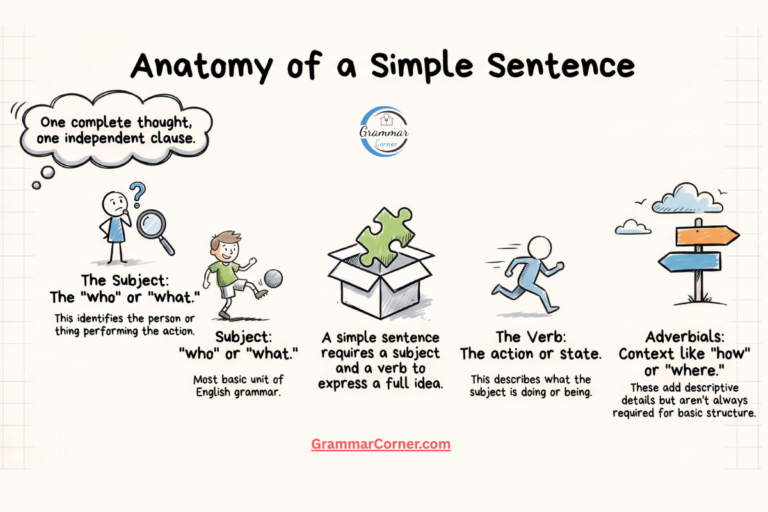
| Simple | 1 | 0 |
| Compound | 2 or more | 0 |
| Complex | 1 | 1 or more |
| Compound-Complex | 2 or more | 1 or more |
Structural Breakdown in Action
“The children played outside.”
Contains only 1 independent clause.
“The children played outside, and their parents watched them.”
Contains 2 independent clauses joined by a conjunction. Both parts can stand alone.
“The children played outside because the weather was pleasant.”
Contains 1 independent clause + 1 dependent clause (“because the weather was pleasant” cannot stand alone).
“Because the weather was pleasant, the children played outside, and their parents watched them.”
• Independent the children played outside
• Independent their parents watched them
Combining at least two independent clauses with at least one dependent clause is the defining feature of this structure.
How to Identify a Compound-Complex Sentence
Do not try to identify a compound-complex sentence simply by counting verbs or checking sentence length. Instead, systematic clause analysis will give you the exact structure every time.
Locate all main verbs and verb phrases throughout the sentence.
Determine which subjects are connected directly to those verbs.
Divide the sentence into distinct units that contain their own subject + verb relationship.
Ask if each clause can stand alone. If yes = Independent. If no = Dependent.
Verify that you have at least two independent clauses.
Confirm that you have at least one dependent clause.
If your sentence breakdown yields 2+ Independent Clauses + 1+ Dependent Clause, it is officially a compound-complex sentence.
Compound-Complex Sentence Examples With Clause Analysis
Seeing the individual clauses separated in a breakdown table makes analyzing this structure straightforward.
| Clause Part | Clause Type |
|---|---|
| When the bell rang | Dependent |
| the students packed their bags | Independent |
| and the teacher closed the book | Independent |
Analysis: Contains two independent clauses and one dependent clause introduced by the subordinating conjunction when.
| Clause Part | Clause Type |
|---|---|
| I wanted to visit the museum | Independent |
| but I stayed home | Independent |
| because I was feeling tired | Dependent |
Analysis: The coordinating conjunction but joins the two independent clauses, while because introduces the dependent clause at the end.
| Clause Part | Clause Type |
|---|---|
| Although the road was crowded | Dependent |
| we reached the airport on time | Independent |
| and our friends were already waiting | Independent |
Analysis: Begins with a dependent clause, followed by two independent clauses joined by and.
Types of Dependent Clauses in Compound-Complex Sentences
A compound-complex sentence can feature different categories of dependent clauses. Understanding these types gives you immense control over sentence variety and depth.
1. Adverbial Clauses
An adverbial clause modifies a verb, adjective, or adverb by describing circumstances like time, reason, condition, contrast, purpose, or place.
The dependent clause “Because the shop was closing” answers why the action happened.
Common Subordinating Words:
2. Relative (Adjective) Clauses
A relative clause modifies a noun or pronoun, offering crucial context or added detail about a person, place, or thing.
The clause “who joined our school last year” directly describes the teacher.
Note: Relative clauses can be restrictive or nonrestrictive, which determines whether commas are required around them.
3. Noun Clauses
A noun clause acts as a noun within a larger clause—often serving as the subject, direct object, or indirect object.
Here, “what the company needed” acts directly as the object of the verb explained.
Compound-Complex Sentences With Coordinating Conjunctions
The independent clauses in a compound-complex sentence are frequently linked using a coordinating conjunction. You can easily remember the seven options using the acronym FANBOYS:
Examples in Action:
- “The rain had stopped, so we went outside after the clouds cleared.”
- “Although he was nervous, he gave the presentation, and the audience listened carefully.”
- “I wanted to stay longer, but I had to leave because my train was due.”
Compound-Complex Sentences With Semicolons
You can also join two closely related independent clauses using a semicolon instead of a comma and coordinating conjunction. A dependent clause can attach to either side of the semicolon.
“The weather was getting worse; we decided to leave because the road might become dangerous.”
• Independent Clause we decided to leave
• Dependent Clause because the road might become dangerous
Punctuation Warning: Do not use a semicolon simply because a sentence is long or contains multiple clauses. The segments on both sides of the semicolon must be fully capable of standing alone as complete independent thoughts.
Punctuation in Compound-Complex Sentences
Punctuation can feel tricky when multiple clauses are working together. The secret is knowing exactly what each punctuation mark is connecting.
1. Comma With a Coordinating Conjunction
When connecting two independent clauses with a coordinating conjunction (and, but, so, etc.), place a comma directly before the conjunction.
The comma separates the first independent clause from the second independent clause (which carries the dependent clause at the end).
2. Comma Positioning for Dependent Clauses
A. Introductory Dependent Clause (Comma Required):
A comma separates the leading dependent clause from the main independent clause.
B. Dependent Clause at the End (No Comma Needed):
When a dependent clause closely follows its main clause at the end, a comma is usually unnecessary.
3. Relative Clauses: Nonrestrictive vs. Restrictive
Punctuation depends on whether the relative clause provides extra information or necessary identity detail.
Nonrestrictive (Extra info → Use Commas):
“The new teacher, who has taught for many years, explained the lesson, and the students took notes.”Restrictive (Essential identification → No Commas):
“The teacher who joined the school this year explained the lesson, and the students took notes.”How to Build a Compound-Complex Sentence Step by Step
You do not need to compose a intricate sentence in one go. Constructing one from smaller building blocks ensures perfect grammatical accuracy.
Method 1: Compound → Compound-Complex
Method 2: Complex → Compound-Complex
Can a Compound-Complex Sentence Be Short?
The label compound-complex describes structural grammar, not word count or sentence length. A sentence can be brief and still meet all criteria.
“I left because it was late, and she stayed.”
• Dependent because it was late
• Independent she stayed
A longer sentence isn’t automatically advanced, and a short sentence isn’t always simple.
Compound-Complex Sentence Examples for Different Relationships
One of the greatest strengths of a compound-complex sentence is its ability to express multiple logical connections at once. The dependent clause can establish various relationships with the rest of the sentence:
| Relationship | Example Sentence |
|---|---|
| Time | When the class ended, the students left, and the teacher locked the door. |
| Reason | We stayed inside because it was raining, and we watched a movie. |
| Condition | If the weather improves, we will travel tomorrow, and our friends will join us. |
| Contrast | Although the task was difficult, she completed it, and her partner checked the answers. |
| Purpose | She spoke quietly so that the baby would sleep, and everyone remained silent. |
| Relative Info | The book that you recommended was useful, and I finished it in one evening. |
Direct Comparisons With Other Sentence Types
To master this structure, contrast compound-complex sentences directly against simpler grammatical forms.
Compound-Complex vs. Complex Sentence
The key difference is the number of independent clauses.
“Although it was raining, we went outside.”
• 1 Independent Clause• 1 Dependent Clause
“Although it was raining, we went outside, and our neighbors joined us.”
• 2 Independent Clauses• 1 Dependent Clause
Compound-Complex vs. Compound Sentence
The difference here hinges entirely on whether a dependent clause exists.
“The rain stopped, and the children went outside.”
• 2 Independent Clauses• 0 Dependent Clauses
“After the rain stopped, the children went outside, and their parents followed them.”
• 2 Independent Clauses• 1 Dependent Clause
Compound-Complex vs. Simple Sentence
A simple sentence has a single independent thought, while a compound-complex sentence requires at least three total clause units.
“The children played outside.”
• 1 Independent Clause“Because the weather was pleasant, the children played outside, and their parents watched them.”
• 2 Independent Clauses• 1 Dependent Clause
Compound-Complex Sentence vs. Compound Predicate
This subtle distinction often confuses writers. A sentence can contain multiple verbs without actually having multiple independent clauses.
“Sara opened the door and switched on the light.”
Structure: Simple sentence with a compound predicate. One subject (Sara) carries out two actions. There is only one clause.
“Sara opened the door, and her brother switched on the light because the room was dark.”
• Independent her brother switched on the light
• Dependent because the room was dark
Structure: Fully compound-complex because two distinct subjects perform actions across independent clauses, alongside a dependent clause.
✨ Quick Challenge
Which of the following examples functions as a compound-complex sentence establishing a reason / cause-and-effect relationship? Tap your answer.
See the full answer
Answer: “Because the server was overheating, the technician replaced the faulty drive, and the system resumed normal operations.”
Structural breakdown:
- Dependent Clause (Reason): Because the server was overheating
- Independent Clause 1: the technician replaced the faulty drive
- Independent Clause 2: and the system resumed normal operations
- Distinction: Unlike sentences with compound predicates (a single subject doing multiple actions), this sentence features multiple distinct subject-verb pairs across two independent clauses plus a dependent clause.
Common Mistakes With Compound-Complex Sentences
Because compound-complex sentences combine multiple clause types, it is easy for small structural errors or pacing issues to slip in. Here are five common pitfalls and how to avoid them.
Mistake 1: Forgetting the Dependent Clause
Two independent clauses joined together form a compound sentence, not a compound-complex sentence.
Mistake 2: Creating a Comma Splice
Joining two independent clauses with only a comma creates a run-on error known as a comma splice.
Mistake 3: Using a Dependent Clause as a Complete Sentence
A dependent clause cannot stand alone as a sentence. Leaving it isolated creates a sentence fragment.
Mistake 4: Adding Clauses Just to Make the Sentence Complex
More clauses do not automatically make writing better. If three separate sentences convey your ideas more clearly, keep them separate. Use compound-complex sentences when ideas are genuinely interconnected—not just to sound sophisticated.
Mistake 5: Losing Track of the Main Idea
Packing too much information into a single sentence forces readers to reread to figure out who did what. If the core message gets buried, split the thought into two sentences.
How to Use Compound-Complex Sentences Effectively
When applied deliberately, compound-complex sentences help structure related ideas logically and add dynamic rhythm to your writing.
1. To Show Several Relationships at Once
“Although the road was crowded, we reached the station on time, and our friends were waiting for us.”
Combines contrast (although) and addition (and) in a single unified thought.2. To Connect a Cause With Multiple Results
“Because the electricity failed, the computers shut down, and the staff stopped working.”
Establishes one single cause leading directly to two distinct outcomes.3. To Create Sentence Variety
A paragraph filled only with short, simple sentences can sound choppy and repetitive. Incorporating a well-placed compound-complex sentence provides natural prose flow. Aim for a balanced mix of simple, compound, complex, and compound-complex structures.
How to Know When a Sentence Is Too Complicated
A compound-complex sentence becomes problematic when its structure obscures meaning rather than clarifying it. Watch out for these red flags:
Good writing is not about using the most complex sentence structure possible. It is about choosing the exact structure that communicates your idea with absolute clarity. Instead of forcing six ideas into one overloaded sentence, break them into two or three clean sentences.
Sentence Practice
Test your knowledge by identifying the independent clauses (which can stand alone) and the dependent clauses (which need more context) in the sentences below.
- Because the shop was closing, we bought the groceries, and we returned home.
- I wanted to attend the meeting, but I stayed at work because my manager needed help.
- When the movie ended, we left the theater, and our friends went to a restaurant.
- The student who won the competition received a prize, and her teacher congratulated her.
- Although the road was difficult, the driver continued carefully, and we reached the village safely.
- We stayed inside because the storm was approaching, and the children played board games.
Answer Key
| No. | Independent Clauses | Dependent Clause |
|---|---|---|
| 1 | We bought the groceries; we returned home | Because the shop was closing |
| 2 | I wanted to attend the meeting; I stayed at work | Because my manager needed help |
| 3 | We left the theater; our friends went to a restaurant | When the movie ended |
| 4 | The student received a prize; her teacher congratulated her | Who won the competition |
| 5 | The driver continued carefully; we reached the village safely | Although the road was difficult |
| 6 | We stayed inside; the children played board games | Because the storm was approaching |
Frequently Asked Questions
What is a compound-complex sentence?
A compound-complex sentence contains at least two independent clauses and at least one dependent clause. It effectively bridges the features of both compound and complex structures.
What is the formula?
There is no single fixed formula, as clauses can be reordered for emphasis. A common pattern is: [Dependent Clause] + [Independent Clause] + [Coordinating Conjunction] + [Independent Clause].
How many clauses must it have?
It must have at least three: two independent and one dependent. You may include additional clauses, provided the sentence remains grammatically sound and readable.
Which conjunctions should I use?
Use coordinating conjunctions (for, and, nor, but, or, yet, so) to join independent clauses, and subordinating conjunctions (because, although, when, if, while, after) to introduce dependent clauses.
Does it require a semicolon?
No. You can use a comma with a coordinating conjunction to link independent clauses. A semicolon is simply an alternative punctuation choice when appropriate for your style.
How do I distinguish it from other types?
| Type | Independent Clauses | Dependent Clause |
|---|---|---|
| Compound | 2 or more | 0 |
| Complex | 1 | 1 or more |
| Compound-Complex | 2 or more | 1 or more |