Imperative Sentences (Structure, Types and Examples)
What Is an Imperative Sentence?
An imperative sentence tells someone to perform an action or refrain from performing an action. It can give a direct command, make a polite request, offer advice, provide an instruction, issue a warning, or extend an invitation, based on the context and the speaker’s tone.
- Close the door.
- Please take your seat.
- Do not touch the switch.
What do these sentences have in common? Each one tells someone to do something or not to do something. They are imperative sentences. They are common in everyday conversations as well as in signs, recipes, manuals, classrooms, workplaces, and written instructions.
The Implied Subject “You”
Consider the following example:
The person being addressed is understood to be you. The sentence implicitly means: “You open the window.” However, English normally leaves the subject you unstated in an imperative sentence.
More Examples of Imperative Sentences
- Bring your notebook.
- Please wait here.
- Turn left at the next street.
- Don’t touch the wet paint.
- Remember to lock the door.
✨ Quick Challenge
Which of the following sentences functions as an imperative sentence with an understood subject [You]? Tap your answer.
See the full answer
Answer: “Review the contract before signing.”
Imperative sentences have two key identifying features:
- They begin directly with the base form of the verb (Review).
- The subject [You] is omitted because it is understood to be the listener/reader.
What Is the Purpose of an Imperative Sentence?
Imperative sentences are used whenever a speaker or writer wants another person to take, avoid, or consider an action.
A command tells someone directly what to do. Commands can sound firm because the sentence goes directly to the required action.
- Leave the room.
- Put your phone away.
- Stand behind the line.
Instructions explain what someone should do to complete a task. They are common in recipes, manuals, classroom activities, and directions.
- Add two cups of flour and mix the ingredients thoroughly.
- Press the green button to start the machine.
- Turn left after the traffic lights.
An imperative can also be used when asking someone to do something. The word please can make a direct imperative sound more courteous.
- Please pass me the water.
- Please send me the document.
- Give me a moment, please.
Imperatives are also useful when recommending a course of action.
- Take a short break.
- Read the instructions carefully.
- Don’t spend more than you can afford.
A warning tells someone to avoid danger or an undesirable result.
- Watch your step.
- Don’t go near the edge.
- Be careful with that knife.
An imperative can invite someone to join an activity.
- Come and have dinner with us.
- Join us for lunch.
- Come in and make yourself comfortable.
Imperative Sentence Structure
The basic structure of an imperative sentence is simple:
For example:
- Open the door.
- Read the instructions.
- Wait here.
The verbs open, read, and wait appear in their base forms.
Basic Structure Examples
| Structure Pattern | Example |
|---|---|
| Verb | Sit. |
| Verb + object | Read the book. |
| Verb + adverb | Walk slowly. |
| Verb + prepositional phrase | Wait outside the office. |
| Verb + object + adverbial | Put the books on the table. |
| Please + verb | Please take a seat. |
| Don’t + verb | Don’t touch the wire. |
Imperatives can become longer when additional information is added:
Read the instructions carefully before you begin the exercise.
The basic command is still read. Everything else provides additional information.
What Verb Form Is Used in an Imperative Sentence?
Imperatives normally use the base form of the verb, also called the bare infinitive.
Compare the different verb forms:
| Verb Form | Example |
|---|---|
| infinitive | to open |
| base form | open |
| third-person singular | opens |
| past form | opened |
| -ing form | opening |
The imperative correctly uses open:
✔ Open the window.
Incorrect options:
- ❌ Opens the window.
- ❌ Opened the window.
- ❌ To open the window.
The same pattern applies to irregular verbs:
- Be careful.
- Go home.
- Take your seat.
- Write your name here.
- Be quiet.
- Be patient.
- Be honest.
Types of Imperative Sentences
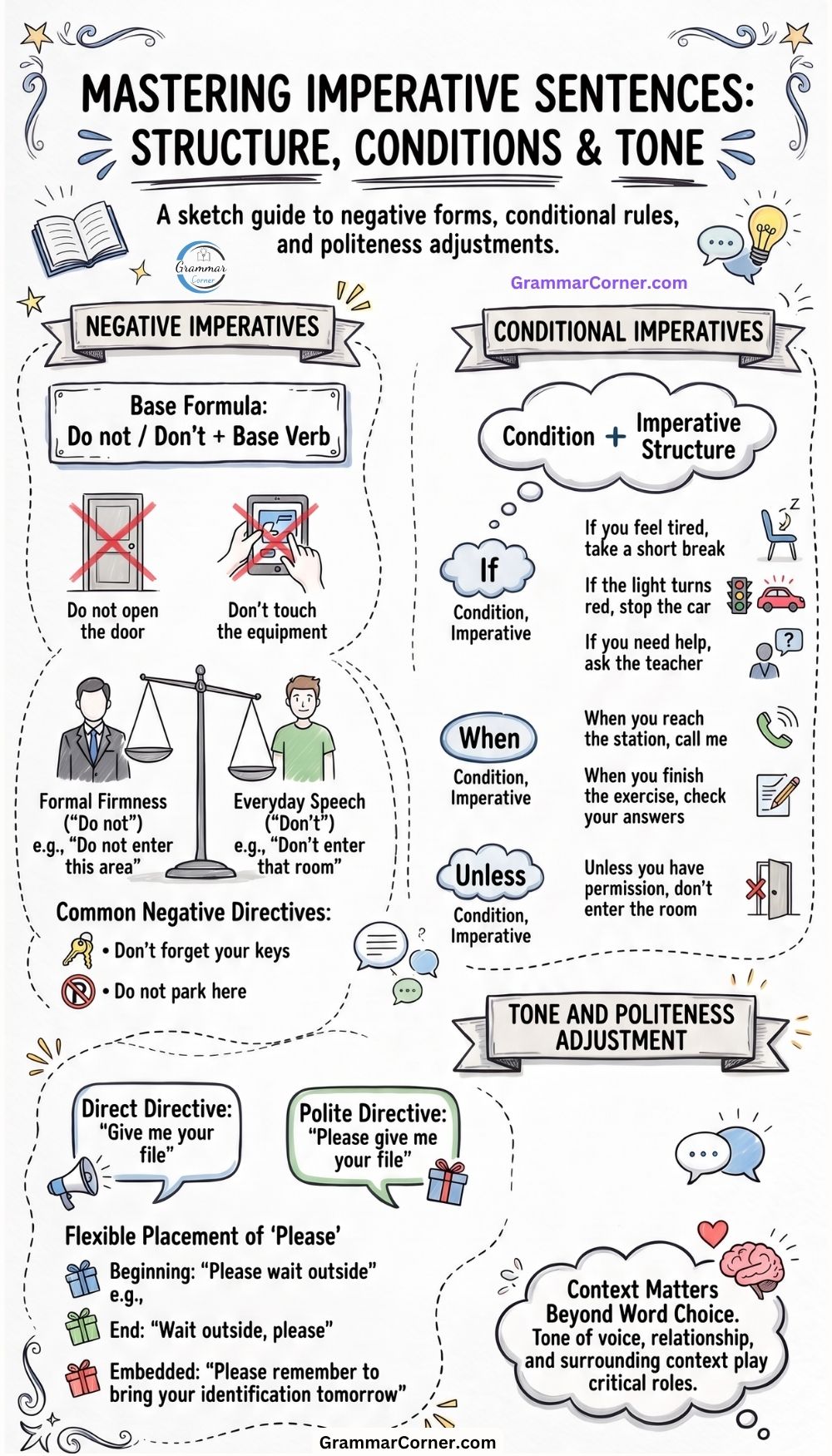
Imperative sentences can be grouped according to what they tell the listener to do. A useful classification includes affirmative, negative, conditional, and polite imperatives.
An affirmative imperative tells someone to do something. The verb normally appears directly at the beginning of the sentence.
- Open the book.
- Call me tomorrow.
- Take the medicine with water.
- Write your answer in the space provided.
- Bring your identification card.
- Follow the instructions.
- Keep your receipt.
- Wait for your turn.
- Check your answer before submitting it.
A negative imperative tells someone not to do something. The negative form is particularly common for warnings, rules, prohibitions, and advice.
- Do not open the door.
- Don’t touch the equipment.
- Don’t forget your keys.
- Do not park here.
“Do Not” vs. “Don’t”
Both forms are grammatically correct. The choice depends on the context and the desired tone:
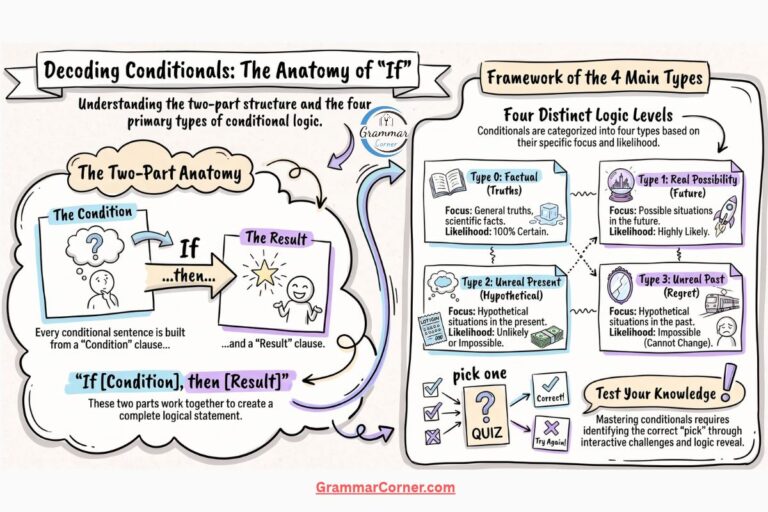
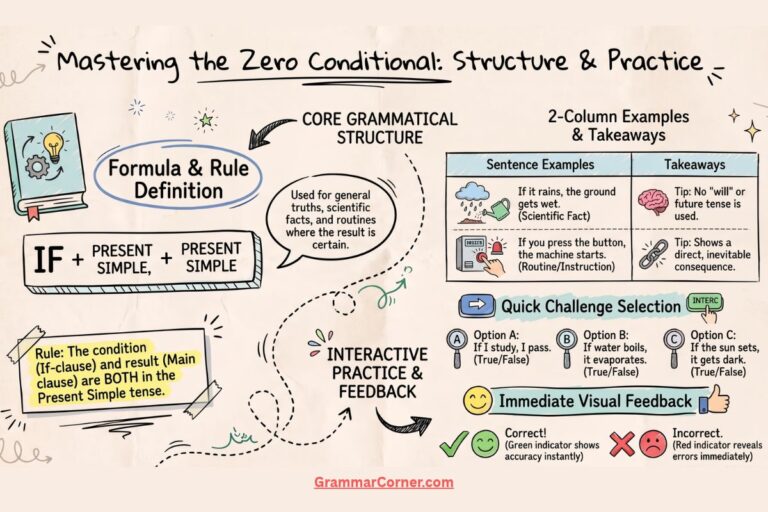
A conditional imperative contains a condition followed by a command, request, or instruction. The conditional clause tells us when or under what circumstances the instruction applies. Conditional imperatives are particularly useful for instructions and safety guidance.
- If + condition, imperative: If you feel tired, take a short break.
- If + condition, imperative: If the light turns red, stop the car.
- If + condition, imperative: If you need help, ask the teacher.
- When + condition, imperative: When you reach the station, call me.
- When + condition, imperative: When you finish the exercise, check your answers.
- Unless + condition, imperative: Unless you have permission, don’t enter the room.
Adding please is one of the simplest ways to make an imperative more polite and less abrupt.
The word please can appear at the beginning or end of a sentence, or within a longer request:
- Please wait outside.
- Wait outside, please.
- Please remember to bring your identification tomorrow.
Note: However, please does not automatically make every command polite. Tone, context, relationship, and wording also matter.
Are Imperative Sentences Rude?
Not necessarily. An imperative sentence can sound polite, neutral, firm, friendly, or rude, depending on the circumstances.
Compare how different variations direct the listener toward the same general action with contrasting tones:
| Sentence | Possible Tone |
|---|---|
| Please have a seat. | Polite |
| Have a seat. | Neutral / Friendly |
| Sit down. | Direct |
| Sit down right now! | Forceful |
How to Make an Imperative Sentence Polite
There are several effective ways to soften a direct instruction or request without compromising clarity:
A simple addition that immediately softens the command.
Words like kindly frame requests with formal courtesy.
Frame the instruction as a warm invitation.
Turning the Request Into a Question
Sometimes a question sounds less direct and more polite:
These are interrogative sentences, not imperative sentences, but they perform a similar communicative function. The important distinction is that making a request politely does not always require avoiding the imperative form—a simple please can be enough in many situations.
Imperative Sentences and Punctuation
Imperative sentences commonly end with either a period (.) or an exclamation mark (!).
Suitable for routine instructions, requests, and advice.
- Please close the window.
- Take your time.
- Read the question carefully.
Used to show urgency, force, or strong emphasis.
- Stop!
- Watch out!
- Don’t touch that!
Distinguishing Imperatives from Exclamatory Sentences
An exclamation mark does not automatically make a sentence imperative, as it is also used with exclamatory sentences. Context and meaning help distinguish them:
Can an Imperative Sentence End With a Question Mark?
Yes, in certain polite or tentative constructions (such as tag questions added to requests):
The punctuation reflects the way the request is framed. However, a straightforward imperative normally ends with a period or exclamation mark.
Can an Imperative Sentence Be One Word?
Yes. A single verb can form a complete imperative sentence when the intended action is clear.
The implied subject is still you. For example, shouting “Stop!” means “(You) stop!” These short forms are especially common in warnings, emergencies, sports, and everyday conversation.
Imperative Sentences With Objects
An imperative does not always stop after the verb. Like declarative sentences, imperative verbs are often followed by objects—including direct and indirect objects—to clarify the action.
- Read the instructions.
- Bring your passport.
- Tell me the truth.
- Show us your work.
Even with objects, the implied subject remains you.
• me = Indirect Object
• your work = Direct Object
Imperative Sentences With “Let’s”
“Let’s” (a contraction of let us) is used to suggest that the speaker and the listener perform an action together. It effectively includes the speaker in the imperative directive.
“Go outside.”
Directs you (the listener) only.
“Let’s go outside.”
Includes us (speaker + listener).
- Let’s start the meeting.
- Let’s take a break.
- Let’s discuss the problem.
Imperative Sentences With “Let”
The verb “Let” can also express permission or a request for something to be allowed to happen. These follow a different structure than standard verb + object imperatives but still function as a directive.
- Let me explain.
- Let him speak.
- Let them decide.
Imperative vs. Declarative Sentences
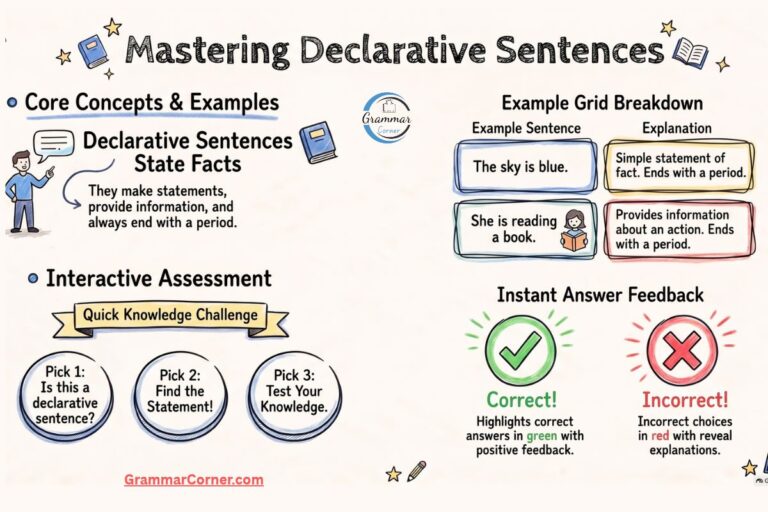
While both can influence behavior, the grammatical structure differs significantly. An imperative directs action, whereas a declarative sentence states information or advice.
| Feature | Declarative | Imperative |
|---|---|---|
| Primary Function | Makes a statement | Gives a directive |
| Subject | Usually expressed | Usually implied (“you”) |
| Verb Form | Changes based on subject | Always base form |
| Example | You should leave now. | Leave now. |
• “You should read the instructions.” (Declarative sentence providing advice)
• “Read the instructions.” (Imperative sentence issuing a command)
Imperative vs. Interrogative Sentences
While an imperative sentence gives a command directly, an interrogative sentence asks a question. Both may achieve the same goal, but their grammatical forms differ significantly.
| Imperative (Direct) | Interrogative (Polite/Indirect) |
|---|---|
| Close the door. | Could you close the door? |
| Pass the salt. | Could you pass the salt? |
| Wait here. | Would you wait here? |
| Help me with this. | Can you help me with this? |
Using an interrogative structure is a common strategy in polite conversation to make a request sound less demanding.
Imperative vs. Exclamatory Sentences
Both sentence types can end with an exclamation mark, which often leads to confusion. Remember: Sentence purpose is more important than punctuation.
| Imperative (Action) | Exclamatory (Emotion) |
|---|---|
| Look at the sky! (Command) | What a beautiful sky! (Admiration) |
| Stop! (Instruction) | That’s incredible! (Surprise) |
| Come here! (Directive) | We won! (Joy) |
Imperative Sentences in Everyday English
Imperatives are the most efficient way to communicate actions in daily life. They are foundational to how we interact with our environment, technology, and each other:
- Turn off the lights.
- Put your shoes away.
- Don’t leave the door open.
- Open your books.
- Listen to the recording.
- Write your answer below.
- Turn left here.
- Slow down.
- Stop at the red light.
- Send me the revised document.
- Check these figures again.
- Please join the meeting at ten.
- Chop the onions finely.
- Add the eggs and mix well.
- Bake for twenty minutes.
- Keep off the grass.
- Do not enter.
- Keep the door closed.
Imperative Sentences in Instructions and Directions
Imperatives are essential when explaining a process. They allow the reader to follow a sequence of steps clearly without unnecessary filler words.
Sequential Steps:
“Open the application. Enter your username. Select ‘Submit.’ Wait for the confirmation message.”
Combined Instructions:
“Open the file, check the information, correct any errors, and save the document.”
Imperative Sentences in Recipes, Rules, and Signs
Recipes rely heavily on imperative verbs so the reader knows exactly what action to perform. Omitting “you” keeps directions concise and easy to follow.
- Heat the oil in a large pan.
- Add the onions and cook until soft.
- Pour in the sauce and stir well.
- Serve immediately.
Signs frequently use negative imperatives to communicate prohibitions and regulations quickly and noticeably.
- Do not enter.
- Do not park here.
- Do not feed the animals.
- Keep the area clean.
Common Mistakes With Imperative Sentences
✅ Better: Open the door.
The subject you is normally understood. An expressed “you” is reserved for specific emphasis or contrast.
✅ Correct: Close the door.
Imperatives always use the base form of the verb without to.
✅ Correct: Close the window.
The verb does not take the third-person -s ending in an ordinary imperative sentence.
✅ Correct: Don’t touch the glass. / Do not touch the glass.
Always use the pattern Don't / Do not + base verb for negative imperatives.
This is an imperative, but it functions as a polite request. Tone depends on wording, context, and speaker relationships.
✅ Use: Stop!
One exclamation mark is enough. Multiple exclamation points look exaggerated and unpolished.
Imperative Sentences: Quick Comparison Table
| Feature | Imperative Sentence Rule / Example |
|---|---|
| Main Purpose | Gives a command, request, instruction, warning, advice, or invitation |
| Usual Subject | Implied you |
| Verb Form | Base form ( bare infinitive ) |
| Positive Form | Open the door. |
| Negative Form | Don’t open the door. |
| Polite Form | Please open the door. |
| Conditional Form | If it rains, take an umbrella. |
| Usual Punctuation | Period (.) or Exclamation mark (!) |
| Example of One-Word Imperative | Stop! |
✨ Quick Challenge
Which of the following sentences correctly forms a negative imperative without grammatical errors? Tap your answer.
See the full answer
Answer: “Do not touch the electrical equipment.”
Key rules for forming correct negative imperatives:
- Standard Formula:
Do not / Don't + base verb (bare infinitive). - Common Pitfalls to Avoid: Omitting the auxiliary do (“Not touch…”), adding an infinitive to (“Do not to touch…”), or adding third-person -s (“Don’t touches…”).
Practice: Identify the Imperative Sentences
Test your understanding! Identify whether each sentence below is functioning as an imperative or not.
- Open the window.
- The window is open.
- Did you open the window?
- Please wait here.
- Don’t touch that button.
- What a beautiful window!
- Read the instructions carefully.
- You should read the instructions.
Answer Key & Explanations
| Sentence | Answer | Why? |
|---|---|---|
| Open the window. | Imperative | It directly tells someone what to do. |
| The window is open. | Not imperative | It makes a statement (Declarative). |
| Did you open the window? | Not imperative | It asks a question (Interrogative). |
| Please wait here. | Imperative | It makes a polite request. |
| Don’t touch that button. | Imperative | It tells someone what not to do. |
| What a beautiful window! | Not imperative | It expresses emotion (Exclamatory). |
| Read the instructions carefully. | Imperative | It gives a direct instruction. |
| You should read the instructions. | Not imperative | It is a statement giving advice rather than a direct imperative. |
Practice: Complete the Imperative Sentences
Choose the appropriate verb from the word bank to complete each imperative sentence correctly:
- ______ the door quietly.
- ______ your name at the top of the page.
- ______ the instructions before beginning.
- ______ your passport with you.
- ______ here until I return.
- ______ left at the next intersection.
- ______ late for the appointment.
- ______ careful with the glass.
Answer Key
| No. | Completed Sentence |
|---|---|
| 1 | Close the door quietly. |
| 2 | Write your name at the top of the page. |
| 3 | Read the instructions before beginning. |
| 4 | Bring your passport with you. |
| 5 | Wait here until I return. |
| 6 | Turn left at the next intersection. |
| 7 | Don’t be late for the appointment. |
| 8 | Be careful with the glass. |
Frequently Asked Questions About Imperative Sentences
Base-form verb + rest of sentence.
• Please wait here for a moment.
• Please send me the details when you have time.