(A, An, The) Articles Chart (Usage Rules & Examples)
What Are Articles in English Grammar?
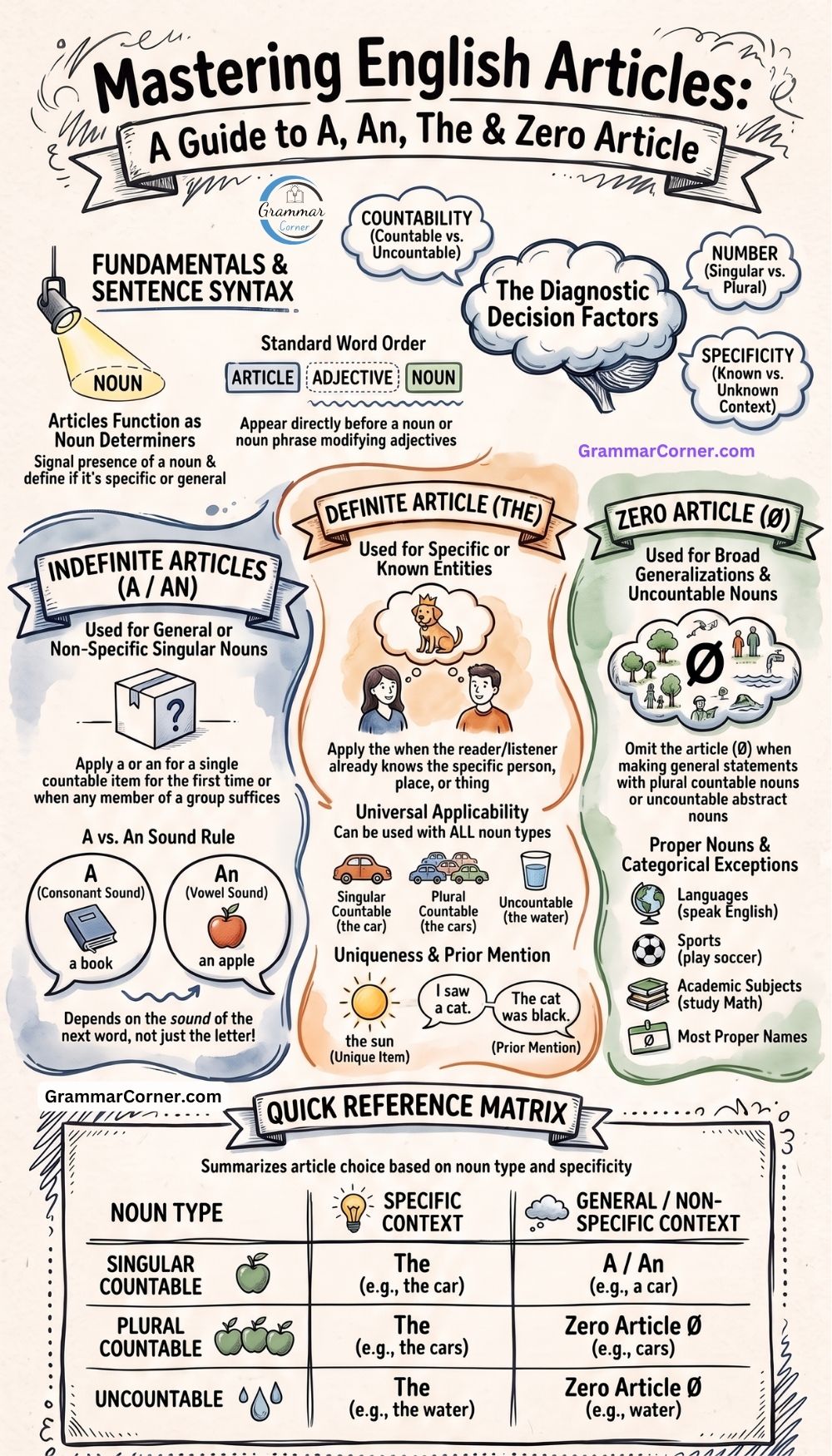
An article is a word placed before a noun to indicate whether the noun refers to something specific or nonspecific.
Although a, an, and the are small words, they alter the meaning of a sentence by signaling whether the noun refers to one item in general, a particular known item, or a whole category:
English uses three primary article categories:
- Indefinite Articles (a, an): Refer to non-specific singular countable items.
- Definite Article (the): Refers to specific, uniquely identifiable items.
- Zero Article (Ø): The omission of an article when referring to plurals or uncountable nouns in general.
Articles Overview Table
| Example Sentence | Article Used | Meaning & Reference |
|---|---|---|
| I bought a book. | a | One book in general (not a specific title) |
| I bought an umbrella. | an | One umbrella in general (vowel sound opener) |
| I bought the book. | the | A specific, previously identified book |
| Books are useful. | Zero Article (—) | Books in general as a whole class |
Article Placement and Modifiers
Articles typically appear directly before nouns. However, when premodifying adjectives or adverbs are added, the article moves to the front of the entire noun phrase:
- a beautiful garden
- an interesting story
- the old house
Key Factors Governing Article Choice
Selecting the correct article depends on four core grammatical criteria:
Articles determine the scope of a noun: a/an introduces general singular items, the points to specific shared knowledge, and the zero article generalizes across plural and uncountable concepts.
Quick Challenge
Three of these four sentences use articles correctly. One has an error. Tap the sentence that doesn’t belong.
See the full answer
Answer: “The books are useful in general.”
When referring to plural countable nouns in a general sense (as an entire category or class), English uses the zero article (Ø) rather than the. The correct sentence is simply “Books are useful in general.”
The Three Articles in English
A and an refer to one nonspecific member of a category. They are used exclusively with singular countable nouns:
- She adopted a cat.
- He bought an umbrella.
- I need a pen.
- We saw an eagle.
The identifies a particular, specified entity already known to the speaker and listener. It can be paired with singular, plural, countable, or uncountable nouns:
- Please close the door. (Singular countable)
- Where is the book I gave you? (Specific item)
- The students are waiting outside. (Plural countable)
- The water in this bottle is cold. (Uncountable)
The zero article is the deliberate omission of an article when discussing plurals, uncountable substances, academic subjects, or meals in a generalized sense:
- Water is essential for life. (General substance)
- Children need love and attention. (General class)
- She studies English. (Academic subject)
- We had breakfast at seven. (Routine meal)
How to Choose Between “A” and “An”
The choice between a and an is determined entirely by the initial sound of the following word, not its spelling letter.
Both words start with the vowel letter u, but their spoken initial sounds differ completely:
• a university ➔ Begins with the consonant glide /j/ (as in you).
• an umbrella ➔ Begins with the short vowel sound /ʌ/.
Words Beginning with Vowel Letters That Take “A”
| Correct Phrase | Phonetic Reason |
|---|---|
| a university | Begins with a consonant /j/ sound |
| a European country | Begins with a consonant /j/ sound |
| a useful tool | Begins with a consonant /j/ sound |
| a uniform | Begins with a consonant /j/ sound |
| a one-time event | Begins with a consonant /w/ sound (won) |
Words Beginning with Consonant Letters That Take “An”
| Correct Phrase | Phonetic Reason |
|---|---|
| an hour | Silent initial h (begins with /aʊ/) |
| an honest person | Silent initial h (begins with /ɒ/) |
| an heir | Silent initial h (begins with /eə/) |
| an honor | Silent initial h (begins with /ɒ/) |
Articles with Abbreviations and Initialisms
Determine the article by the pronunciation of the first spoken letter:
• an MRI ➔ Pronounced /em-ɑː-aɪ/ (starts with vowel sound /e/)
• an HTML document ➔ Pronounced /eɪtʃ-ti-em-el/ (starts with vowel sound /eɪ/)
• a USB drive ➔ Pronounced /juː-es-biː/ (starts with consonant sound /j/)
• a CEO ➔ Pronounced /siː-iː-əʊ/ (starts with consonant sound /s/)
When to Use “A” or “An”
1. One Member of a Class or Category
Use a or an to introduce an unspecified individual representing a larger group:
- She is a doctor.
- He is an engineer.
- I need a chair.
- We saw an elephant.
2. The First-Mention to Second-Mention Progression
Introduce a new entity with a/an, then shift to the once the entity has become shared knowledge:
• Second sentence: the bird refers back to that specific, established entity.
3. Professions and Occupations
Singular professions in English strictly require an indefinite article:
• Ahmed is an architect. (Not: “Ahmed is architect” ❌)
• She became a teacher.
• His father is an electrician.
Always choose between a and an based on spoken phonetics rather than written spelling, pair singular occupations with an indefinite article, and transition from a/an to the once an entity has been established in discourse.
Quick Challenge
Three of these four article pairings are correct. One is incorrect based on spoken phonetics. Tap the pairing that contains an error.
See the full answer
Answer: “a MBA degree”
The choice between a and an depends on the initial spoken sound rather than the letter written. When pronouncing the initialism MBA, the first letter is spoken as /em/, which starts with a vowel sound. Therefore, the correct phrase is an MBA degree.
Indefinite Articles to Mean “Per” or “Each”
In expressions of rate, price, frequency, and speed, a and an function as equivalents to per or each:
When to Use the Definite Article (“The”)
Use the when the entity being discussed is specific, identifiable, unique, or clearly established in context.
Use the when the immediate physical or conversational environment makes it obvious which specific item is meant:
- Please close the door.
- Where is the bathroom?
- Can you open the window?
When a noun is introduced for the first time, use a/an. Subsequent mentions take the because the referent has been established:
Use the for objects, celestial bodies, or environmental features that are singular and unique:
- The sun rises in the east.
- We watched the moon through a telescope.
A general plural or uncountable noun becomes specific when followed by a restrictive phrase or relative clause:
- The students in Class 8 are preparing for an exam.
- The car parked outside belongs to my neighbor.
- I enjoyed the movie we watched last night.
Superlative adjectives and ordinal numbers identify unique positions in a series, requiring the:
- She won the first prize.
- This is the best answer.
- He lives on the third floor.
Geographical Usage Patterns
Geographical proper nouns follow distinct conventional patterns:
| Use “The” (the) | Use Zero Article (Ø) |
|---|---|
| Rivers: the Nile, the Indus | Individual Countries: Pakistan, India, France |
| Seas & Oceans: the Mediterranean Sea, the Atlantic Ocean | Cities & Towns: Lahore, London, Paris |
| Mountain Ranges: the Himalayas, the Alps | Continents: Asia, Europe, Africa |
| Deserts: the Sahara, the Gobi | Individual Mountains: Mount Everest, K2 |
| Island Groups: the Philippines, the Maldives | Individual Lakes: Lake Victoria, Lake Superior |
| Plural/Descriptive Countries: the United States, the Netherlands | Most Streets & Roads: Mall Road, Oxford Street |
| Regions: the Middle East | — |
Special Categories Taking “The”
1. Groups of People (The + Adjective)
When an adjective follows the to represent an entire collective class of people, it functions as a plural nominal group:
- The government should help the elderly.
- Special programs were created for the unemployed.
2. Musical Instruments & Cultural Institutions
In general statements of ability or cultural activity, English commonly uses the:
The definite article the anchors reference to specific shared knowledge, unique entities, superlatives, and distinct geographical and cultural patterns.
When No Article Is Used (The Zero Article)
Knowing when to omit an article is just as important as knowing which one to choose. English regularly uses the zero article (Ø) in generalized, non-restrictive contexts.
Plural countable nouns take no article when referring to an entire class, category, or group in general:
- Dogs make good pets. (Dogs in general)
- Teachers have an important job.
- Books can change the way we think.
- Cars are expensive to maintain.
Mass nouns and abstract concepts take no article when discussed generally:
- Water is necessary for life.
- Information is easy to find online.
- Knowledge comes with experience.
- Music can affect our emotions.
Standard names of languages, school subjects, and games do not use articles:
- She speaks English.
- I am studying biology.
- He enjoys football.
- They play tennis.
Exception: When the noun is restricted or postmodified, the is required (e.g., “The English spoken in this region is different,” “The history of Pakistan is fascinating”).
Everyday institutional and habitual activities drop the article:
Standard proper nouns for countries, cities, continents, individual mountains, and single lakes take no article:
Compare with established plural/political names requiring the: the United Kingdom, the United States, the United Arab Emirates, the Netherlands, the Himalayas, the Pacific Ocean.Articles with Countable and Uncountable Nouns
The countability and grammatical number of the noun determine which articles are structurally valid:
| Noun Type | A / An (a/an) | The (the) | Zero Article (Ø) |
|---|---|---|---|
| Singular countable | Yes (a chair) | Yes (the chair) | Usually No |
| Plural countable | No | Yes (the chairs) | Yes (chairs) |
| Uncountable | No | Yes (the water) | Yes (water) |
Partitives: Measuring Uncountable Nouns
Because uncountable nouns cannot take a/an directly, use a partitive counter or container to express a discrete single quantity:
• ❌ Error: “I need an advice.”
Articles with Intervening Adjectives
When an adjective is placed between the article and the noun, the selection of a vs. an is determined exclusively by the sound of the adjective immediately following it:
• a car ➔ a red car ➔ an old car ➔ an expensive car
• a useful book (starts with /j/ sound) ➔ an interesting book (starts with /ɪ/ sound)
• an unusual umbrella (adjective begins with /ʌ/)
Use the zero article for general plurals, general mass nouns, routine meals, and standard proper names. When introducing single units of uncountable nouns, rely on partitives (a piece of…), and always match a/an to the phonetic opening of the immediately following word.
Articles with Possessives and Other Determiners
English syntax does not stack central determiners. Articles (a, an, the), possessive determiners (my, your, his, her, their), demonstratives (this, that, these, those), and quantifiers (some, each, every) fulfill the same structural slot:
• ❌ a your car ➔ ✅ a car or ✅ your car
• ❌ the this house ➔ ✅ the house or ✅ this house
A, An, The, or No Article? A 5-Step Decision Guide
Use this step-by-step diagnostic sequence to determine the required article form:
Articles in Everyday Sentences
a laptop introduces new information; the laptop specifies the known item.
Books generalizes all books; the books points to a defined, specific list.
Coffee refers to the beverage in general; the coffee isolates a specific portion.
• “She is a university student.” (Consonant sound /j/ takes a)
• “He waited for an hour.” (Silent h with opening vowel sound takes an)
Common Errors with A, An, and The
A, An, and The: Quick Comparison Chart
This master reference chart outlines the exact article required across common grammatical and contextual situations:
| Grammatical Situation | Correct Choice | Example |
|---|---|---|
| One nonspecific singular countable noun | a / an | I saw a bird. |
| One nonspecific noun before a vowel sound | an | She ate an orange. |
| One nonspecific noun before a consonant sound | a | He bought a car. |
| Known or identified noun | the | The car is outside. |
| Noun mentioned earlier (second mention) | the | I saw a dog. The dog was black. |
| Specific plural noun | the | The students are ready. |
| General plural noun | No article (—) | Students need practice. |
| General uncountable noun | No article (—) | Water is essential. |
| Specific uncountable noun | the | The water is dirty. |
| Job or profession (singular) | a / an | She is a doctor. |
| Silent h opening sound | an | an hour |
| Vowel letter with initial /j/ consonant sound | a | a university |
| Languages | No article (—) | He speaks English. |
| Academic subjects | No article (—) | She studies chemistry. |
| Sports & games | No article (—) | They play tennis. |
| Rivers | the | the Indus |
| Mountain ranges | the | the Himalayas |
| Individual mountains | Usually no article (—) | Mount Everest |
Practice Exercises: Choose the Correct Article
Complete each sentence with a, an, the, or — (zero article):
- I saw ___ interesting film last night.
- She wants to become ___ doctor.
- Please close ___ door.
- ___ honesty is important in every relationship.
- He bought ___ new phone yesterday.
- We visited ___ museum near our hotel.
- She studies ___ English at school.
- I need ___ umbrella because it is raining.
- ___ students in this classroom are taking an exam.
- My father drinks ___ coffee every morning.
- We saw ___ elephant at the zoo.
- He climbed ___ Mount Everest.
- They crossed ___ river before sunset.
- She waited for ___ hour.
- ___ books can teach us many things.
| No. | Answer | Grammatical Explanation |
|---|---|---|
| 1 | an | interesting begins with an open vowel sound /ɪ/. |
| 2 | a | doctor is a singular countable profession starting with a consonant sound. |
| 3 | the | The listener can identify the specific, situational door. |
| 4 | — | honesty is an abstract uncountable noun used in a general sense. |
| 5 | a | Introduces one nonspecific, newly mentioned phone. |
| 6 | the | The postmodifier near our hotel restricts and specifies the museum. |
| 7 | — | Standard names of academic languages take no article. |
| 8 | an | umbrella begins with a short vowel sound /ʌ/. |
| 9 | the | Identifies a specific group of students restricted by in this classroom. |
| 10 | — | coffee refers to the drink in a general, habitual uncountable sense. |
| 11 | an | elephant begins with an opening vowel sound /e/. |
| 12 | — | Individual mountain peaks preceded by Mount take no article. |
| 13 | the | Refers to a specific, contextually identified river. |
| 14 | an | The initial h in hour is silent (begins with vowel diphthong /aʊ/). |
| 15 | — | books is a plural noun referring to literature/books in general. |
Frequently Asked Questions About Articles
• an apple / an hour (silent h)
• Water is important. (General mass noun)
• English is widely spoken. (Language name)
2. Specific / Identifiable: the
3. General plural / Uncountable: No article (—)
4. Consonant sound: a | Vowel sound: an
Final Summary Checklist
Mastering English articles requires asking what you intend to communicate:
- Number: Is the noun singular, plural, or uncountable?
- Countability: Can the noun be counted as discrete units?
- Specificity: Is it a generalized category or a specific, identifiable referent?
- Phonetics: Does the immediately following word open with a vowel or consonant sound?
Start by differentiating general vs. specific reference, ensure singular countable nouns always carry a determiner, match a/an strictly to pronunciation, and apply the zero article naturally to generalized plurals, mass nouns, and routine proper entities.

Similar Posts
Prepositions Chart (Types, Examples & Usage)
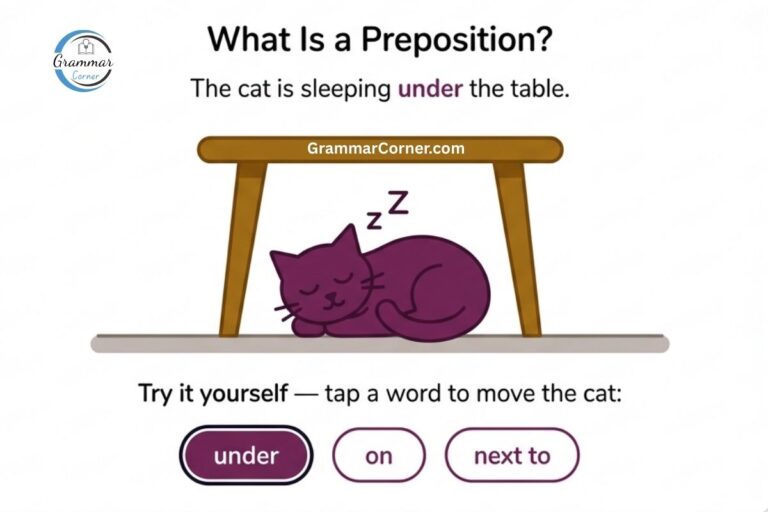
What Is a Preposition? “The cat is sleeping under the table.” Now take away the word under, and something breaks. You still have a cat and a table — but no idea how they relate to each other. Is the cat on the table? Next to it? Nowhere near it? That one small word is…
Conjunctions Chart (Table, Functions, Examples)
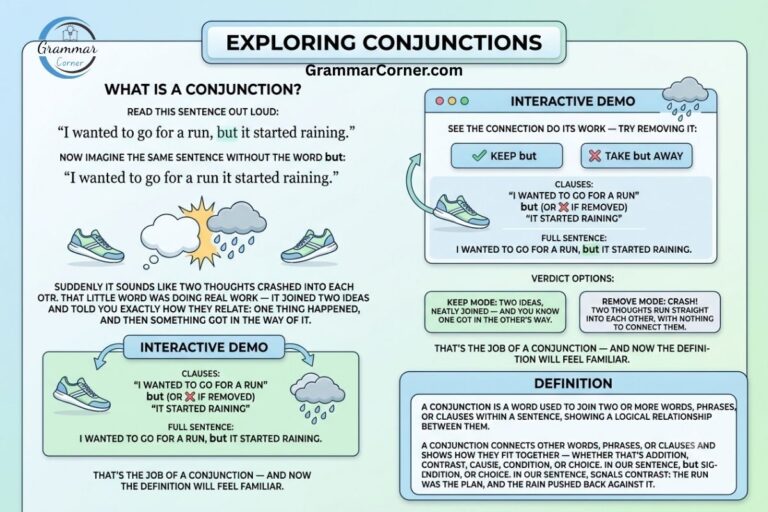
What Is a Conjunction? Read this sentence out loud: “I wanted to go for a run, but it started raining.” Now imagine the same sentence without the word but: “I wanted to go for a run it started raining.” Suddenly it sounds like two thoughts crashed into each other. That little word was doing real…
Interjection Chart (Types, Functions & Examples)
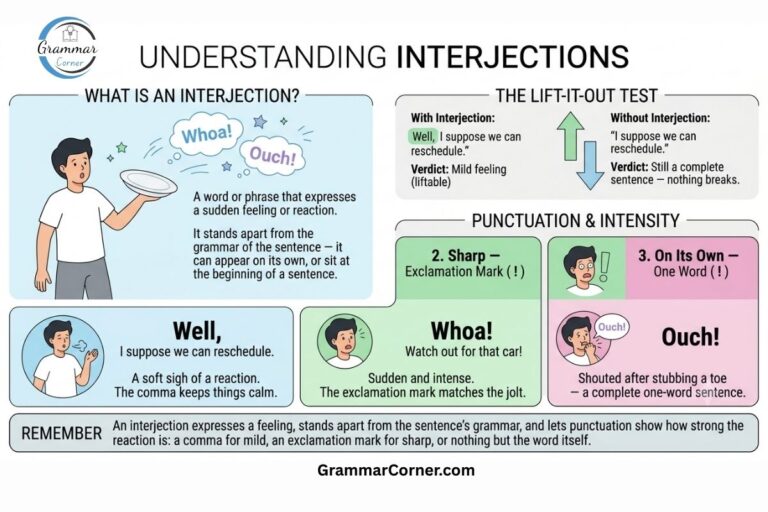
What Is an Interjection? Picture this: you’re carrying a stack of plates to the sink, one slips, and before you even think about it, a word jumps out of your mouth. Maybe it’s “Ouch!” or “Whoa!” or something less polite. That word wasn’t planned. It wasn’t part of a sentence you were building. It just…
Verbs Chart (Types, Examples and Rules) – Comprehensive Guide
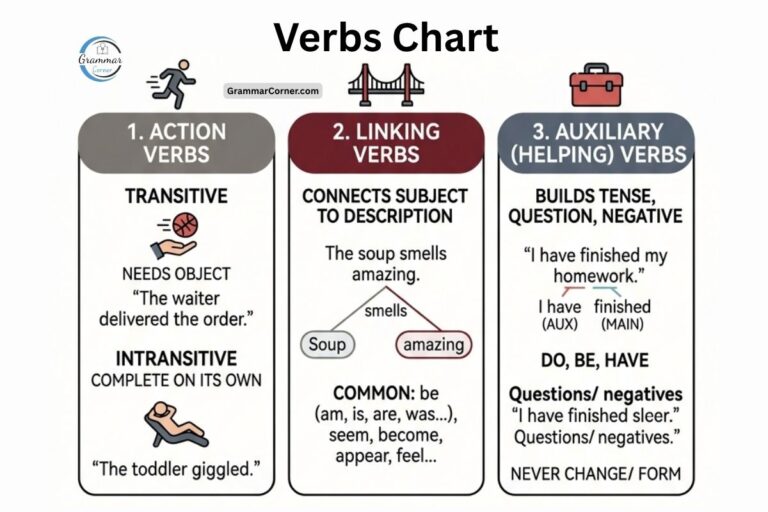
What Is a Verb? Think about the things happening around you every day. A child laughs, a dog barks, a phone rings, and a bird flies. Words like laughs, barks, rings, and flies all show an action or something happening. That’s the basic idea of a verb, before you even learn its formal definition. Tap…
Adverbs Chart (Types, Examples & Table) – Complete Guide
Adverb Article — Section Preview: What Is an Adverb? What Is an Adverb? Imagine someone telling you about their morning: “I woke up. I got ready. I left for work.” Now compare it with this version: “I woke up suddenly. I got ready quickly. I left for work late.” The second version presents a much…
Adjectives Chart (Types, Rules, Examples)
What Is an Adjective? Read these two sentences and notice which one actually tells you something. Just a fact “I got a dog.” True. Clear. And instantly forgettable. The full picture “I got a scruffyadjective, three-leggedadjective dognoun who howls every time the mail truck pulls up.” A picture, a sound, and almost a personality. The…