Conjunctions Chart (Table, Functions, Examples)
What Is a Conjunction?
Read this sentence out loud: “I wanted to go for a run, but it started raining.”
Now imagine the same sentence without the word but: “I wanted to go for a run it started raining.” Suddenly it sounds like two thoughts crashed into each other. That little word was doing real work — it joined two ideas and told you exactly how they relate: one thing happened, and then something got in the way of it.
See the connection do its work — try removing it:
I wanted to go for a run, but it started raining.
Two ideas, neatly joined — and you know one got in the other’s way.
That’s the job of a conjunction — and now the definition will feel familiar.
A conjunction is a word used to join two or more words, phrases, or clauses within a sentence, showing a logical relationship between them.
A conjunction connects other words, phrases, or clauses and shows how they fit together — whether that’s addition, contrast, cause, condition, or choice. In our sentence, but signals contrast: the run was the plan, and the rain pushed back against it.
Everyday Examples of Conjunctions
Every one of these sentences would fall apart into disconnected fragments without its conjunction. That’s really the whole point of this part of speech: conjunctions are the glue that lets us build longer, more precise sentences out of smaller ideas.
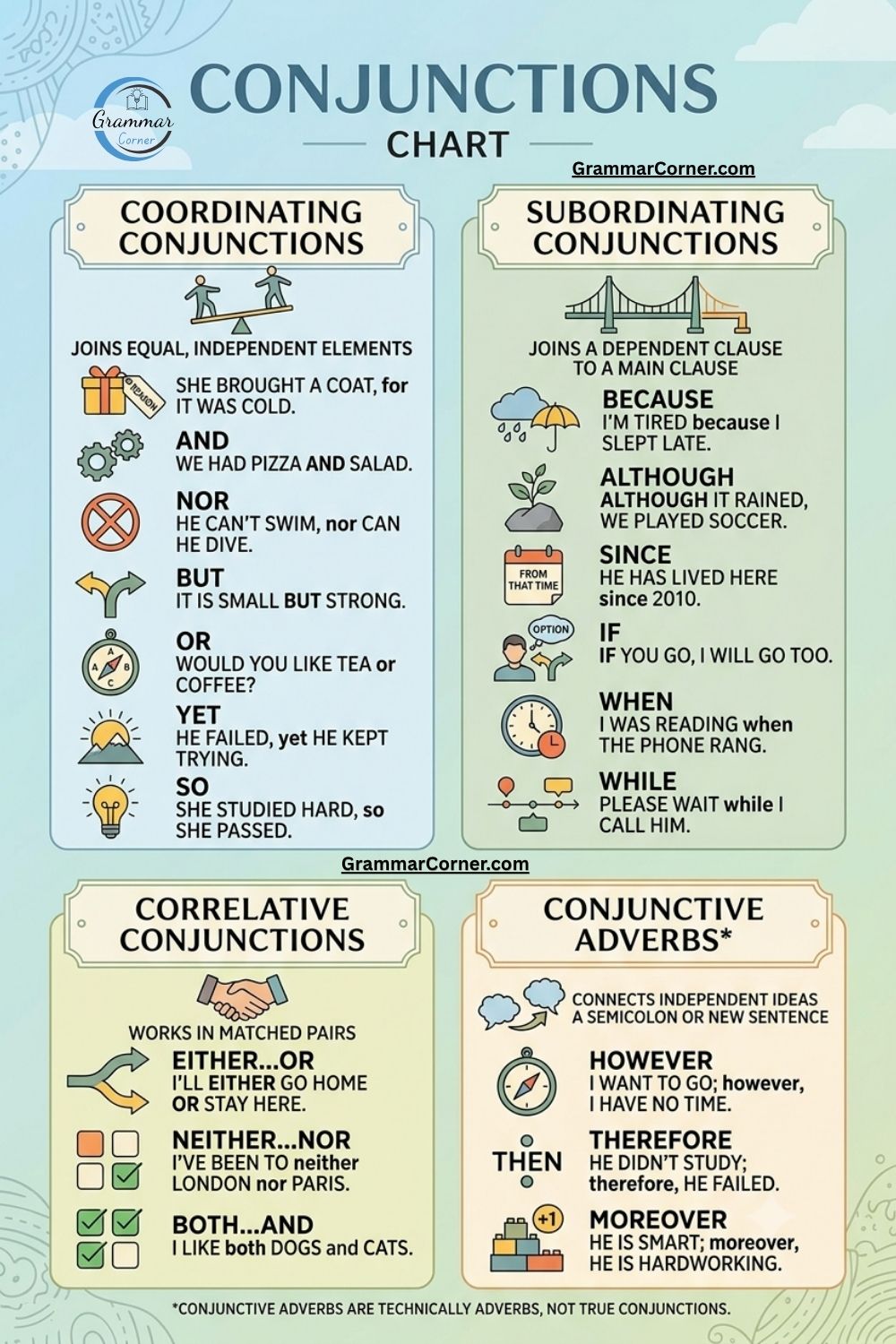
Conjunctions at a Glance (Quick Overview Table)
Here’s a snapshot before we go further into detail.
| Category | What It Does | Common Examples | Sample Sentence |
|---|---|---|---|
| Coordinating | Joins equal, independent elements | for, and, nor, but, or, yet, so | She studied hard, so she passed the exam. |
| Subordinating | Joins a dependent clause to a main clause | because, although, since, if, when, while | We stayed inside because it was storming. |
| Correlative | Works in matched pairs | either…or, neither…nor, both…and | Both the manager and the intern agreed. |
| Conjunctive Adverb* | Connects independent ideas across a semicolon or new sentence | however, therefore, moreover | The flight was delayed; however, we still made our connection. |
*Conjunctive adverbs are technically adverbs, not true conjunctions — we’ll clear up exactly why later in this article.
Types of Conjunctions
Coordinating Conjunctions
These join two elements of equal grammatical rank — two words, two phrases, or two independent clauses (a clause that could stand alone as its own sentence).
English has exactly seven of them, and there’s a popular memory trick for remembering all seven: FANBOYS.
-
I packed sunscreen, for the forecast promised a scorching afternoon.
reason -
The kids painted the fence and cleaned the garage.
addition -
She doesn’t eat meat, nor does she eat dairy.
negative addition -
The hotel was cheap but surprisingly comfortable.
contrast -
You can pay by card or by cash.
choice -
He trains every single day, yet he still gets nervous before races.
contrast -
The printer jammed, so we had to reschedule the meeting.
result
Quick tip: when a coordinating conjunction joins two independent clauses (each with its own subject and verb), put a comma before it. When it just joins two words or short phrases, skip the comma.
She cooked dinner, and he washed the dishes.
She cooked dinner and washed the dishes.
Subordinating Conjunctions
These introduce a dependent clause — a group of words with a subject and verb that can’t stand alone as a complete sentence — and connect it to an independent clause.
Common subordinating conjunctions include:
- because
- although
- since
- if
- when
- while
- unless
- until
- before
- after
- though
- even though
- whereas
- as soon as
- provided that
Although the movie was long, nobody left early.
We’ll leave as soon as the rain stops.
You won’t get the discount unless you sign up today.
She’s been working from home since the office reopened.
Notice something about word order here: the dependent clause can come before or after the main clause, and both orders mean exactly the same thing. The only difference is that when the dependent clause comes first, it’s followed by a comma.
Although the movie was long, nobody left early.
Nobody left early although the movie was long.
Correlative Conjunctions
These work in matched pairs, connecting two balanced parts of a sentence.
Common pairs:
- either…or
- neither…nor
- both…and
- not only…but also
- whether…or
You can have either the soup or the salad.
Neither the bus nor the train was running on time.
Both my sister and my cousin are training for the marathon.
Not only did she finish the report early, but she also caught two major errors.
Practical tip: whatever grammatical structure follows the first half of the pair should also follow the second half. Keeping the structure parallel — verb after “not only,” verb after “but also” — is what makes correlative conjunctions sound natural.
Not only did she finish early but also she caught errors.
This sounds off-balance because the two halves don’t match grammatically. Compare it with the parallel version above: a verb follows “not only,” and a verb follows “but also.”
A Quick Note on American and British English
Most conjunctions work identically in both varieties, but a few small habits differ:
| Situation | American English | British English |
|---|---|---|
| “While” vs “whilst” | while (whilst sounds old-fashioned) | while or whilst (whilst is still common, especially in formal writing) |
| Comma before the final “and” in a list | Often included (the Oxford or serial comma) | Often omitted, though usage varies |
| “Provided that” vs “providing that” | Both used, “provided that” slightly more common | Both used, “providing that” slightly more common |
None of these differences will get you marked wrong on either side of the Atlantic — they’re stylistic tendencies rather than firm rules.
Functions of Conjunctions in a Sentence
Conjunctions do one core job — connecting — but the type of relationship they express changes depending on which one you choose. Here’s how that plays out in real sentences.
-
Joining words
She likes tea and coffee.
and connects two nouns -
Joining phrases
He walked into the kitchen and out the back door.
and connects two prepositional phrases -
Joining independent clauses
The lights went out, but the generator kicked in immediately.
but connects two complete thoughts that could each stand alone -
Joining an independent clause to a dependent clause
I’ll text you when I arrive.
when attaches a dependent clause to the main sentence
Let’s break one sentence down completely:
Even though she was exhausted, she finished the project because the deadline couldn’t move.
-
Dependent clause
“Even though she was exhausted” is introduced by the subordinating conjunction even though, showing contrast.
-
Independent clause
“She finished the project” is the main point of the sentence.
-
Dependent clause
“Because the deadline couldn’t move” is introduced by because, showing cause.
One sentence, two subordinating conjunctions, three separate ideas woven into a single coherent thought. That’s the real power conjunctions bring to writing: without them, you’d be stuck writing everything in short, choppy statements.
How to Identify a Conjunction
Spotting a conjunction gets much easier once you know what to check. Run a word through these four checks and it has nowhere to hide.
If the word links two of the same kind of thing, it’s very likely a conjunction:
If it’s just introducing a single noun or noun phrase on its own, you’re probably looking at a preposition instead.
This is the clearest test for telling a subordinating conjunction apart from a preposition, because several words — since, before, after, until — can act as either. Finish this sentence both ways and watch the label change:
I haven’t seen her since she moved.
Conjunction A full clause follows — a subject (she) plus a verb (moved).
Try splitting the sentence at the suspected conjunction. If you end up with two separate sentences that used to be one connected idea, you’ve found your conjunction.
He studies hard and he still finds time to relax.
One connected idea, held together by and.
Some words connect ideas without being true conjunctions:
Grammatically, these behave like adverbs, not conjunctions. That distinction matters most for punctuation — which is exactly where the most common conjunction mistakes creep in.
Common Mistakes with Conjunctions
The store was closed, however we found another one nearby.
The store was closed; however, we found another one nearby.
Why: However is a conjunctive adverb, not a coordinating conjunction, so a comma alone can’t connect two independent clauses around it. You need a semicolon (or a period) before it, and a comma after it.
I finished my homework, I still had time to watch a show.
I finished my homework, so I still had time to watch a show.
Why: Two independent clauses can’t be joined with just a comma — that’s called a comma splice. You need a coordinating conjunction after the comma, a semicolon, or a period.
She not only enjoys hiking but also to cook elaborate meals.
She not only enjoys hiking but also cooking elaborate meals.
Why: Whatever grammatical form follows the first half of a correlative pair must match the form after the second half. Since enjoys hiking uses a gerund, but also needs one too.
This route is faster then the highway.
This route is faster than the highway.
Why: Than handles comparisons and is the word you want here. Then refers to time or sequence (First we’ll eat, then we’ll leave). They sound similar but do completely different jobs.
Plenty of people were taught this is forbidden, but it isn’t an actual grammar rule — it’s a style preference, often taught to stop young writers from producing sentence fragments. The one thing to check is that the sentence is actually complete:
The dependent clause is properly attached to an independent one.
There’s no main clause attached, so the thought is left hanging.
She didn’t want neither option.
She wanted neither option. or She didn’t want either option.
Why: Neither already carries a negative meaning, so pairing it with didn’t creates a double negative. Choose one negative word, not two.
Practice Exercises
Fill in each blank with the conjunction that fits best. Answers are listed at the end.
I wanted pizza, my friend wanted sushi, so we ordered both.
it was raining, the match continued.
You can choose the window seat or the aisle seat.
He was tired, he kept working until midnight.
the store nor the pharmacy was open on the holiday.
She’ll call you she lands at the airport.
Not only did the team win, they also broke a record.
I stayed home I was feeling sick.
Show answer key
- but
- Although (or Even though)
- either
- but (or yet)
- Neither
- when (or as soon as)
- but
- because (or since)
Conjunctions vs Related Grammar Terms
Conjunction vs Preposition
A conjunction typically connects clauses (groups of words with their own subject and verb). A preposition connects a noun or pronoun to the rest of the sentence.
I’ll wait until you get here.
until + subject + verbI’ll wait until noon.
until + nounAs mentioned earlier, several words can act as either one, so checking what comes right after the word is the fastest way to tell them apart.
Conjunction vs Conjunctive Adverb
A true conjunction (like and, but, or because) can join two independent clauses with just a comma or no punctuation mark at all, depending on the type. A conjunctive adverb (like however, therefore, or moreover) needs a semicolon or period before it when it’s connecting two independent clauses, plus a comma after it.
It was late, but we kept driving.
It was late; nevertheless, we kept driving.
Conjunction vs Relative Pronoun
Relative pronouns like who, which, and that also connect clauses, but unlike conjunctions, they also play a grammatical role inside the clause they introduce — usually as the subject or object of that clause.
She left because she was tired.
because has no grammatical role beyond connectingShe’s the one who called earlier.
who acts as the subject of “called”Comparison Table
| Feature | Conjunction | Conjunctive Adverb | Preposition |
|---|---|---|---|
| What it connects | Words, phrases, or clauses | Two independent clauses/sentences | A noun or pronoun to the sentence |
| Typical punctuation | Comma before (if joining two independent clauses) or none | Semicolon or period before, comma after | None — flows directly into its object |
| Example | She left, and he stayed. | She left; however, he stayed. | She left after the meeting. |
Frequently Asked Questions
Can you start a sentence with “and” or “but”?
Yes. Despite the old classroom rule, this is grammatically acceptable and used often in published, professional writing. It works especially well for emphasis. Just make sure what follows is a complete sentence, not a fragment.
What does FANBOYS stand for?
It’s a memory device for the seven coordinating conjunctions: for, and, nor, but, or, yet, so.
Is “so” always a conjunction?
No. “So” acts as a coordinating conjunction when it connects two independent clauses (“I was hungry, so I made lunch”), but it can also work as an adverb meaning “very” or “to that extent” (“The line was so long”).
What’s the difference between a comma splice and a proper comma-plus-conjunction sentence?
A comma splice happens when two independent clauses are joined with only a comma and no conjunction, which isn’t standard in formal English. Adding a coordinating conjunction after the comma — or swapping the comma for a semicolon — fixes it.
Do conjunctions ever appear without any punctuation at all?
Yes. When a coordinating conjunction joins two words or short phrases rather than two full clauses, no comma is needed: “I like tea and coffee” doesn’t need a comma before “and.”
How many conjunctions are there in English?
There’s no single fixed count, since correlative pairs and subordinating conjunctions add up quickly, but the seven coordinating conjunctions and a core set of around 30 to 40 common subordinating conjunctions cover the vast majority of everyday use.
Is “because” ever wrong to use at the start of a sentence?
Only if the sentence stops there without a main clause attached. “Because it was raining, we canceled the picnic” is complete and correct. “Because it was raining.” on its own is a fragment.
See also:
- Parts of Speech Complete Guide
- Punctuation Ultimate Guide
- Nouns Chart
- Pronouns Chart
- Verbs Chart
- Adverbs Chart
- Adjective chart
- Preposition Chart