Gerunds and Participles: Meaning, Rules, Examples, and Exercises
Gerunds vs. Participles: Understanding -ing Words
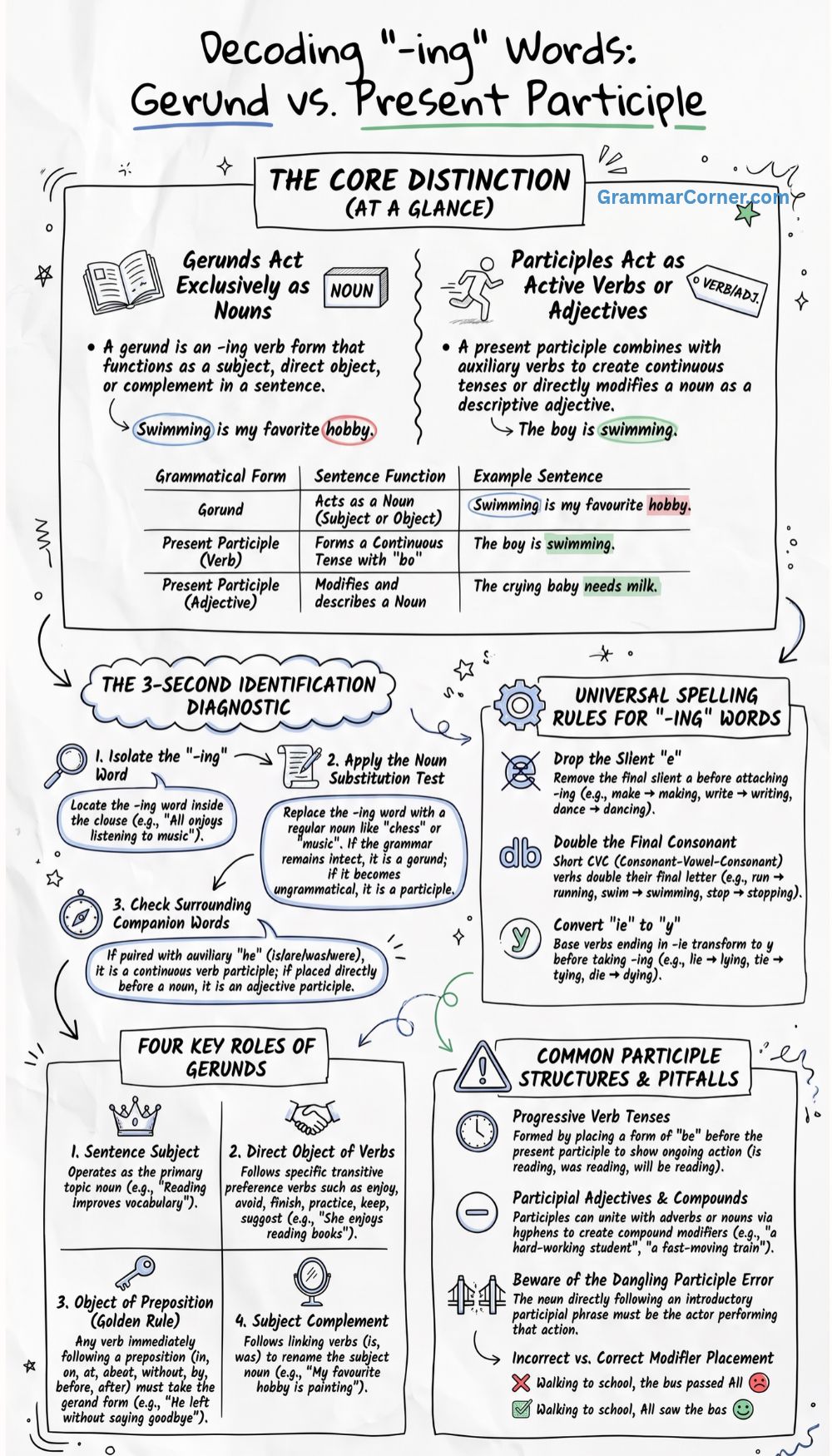
Both gerunds and present participles are verb forms that end in -ing, but they perform fundamentally different jobs in a sentence. While they look identical on the surface, their grammatical role determines whether they act as nouns, active verbs, or adjectives.
A gerund is an -ing verb form that functions as a noun (as a subject, object, or complement).
A participle is a verb form that works as a descriptive adjective or as part of a continuous verb phrase.
Same Word, Different Functions
Words like swimming and crying derive from verbs, but their role depends entirely on sentence context:
Quick Comparison Table
| Grammatical Form | Sentence Function | Example Sentence |
|---|---|---|
| Gerund | Acts as a Noun (Subject or Object) | Swimming is my favourite hobby. |
| Participle (Verb) | Forms a Continuous Tense with “be” | The boy is swimming. |
| Participle (Adjective) | Modifies and describes a Noun | The crying baby needs milk. |
Quick Challenge
In which of the following sentences does the word “swimming” function as a gerund? Tap your answer.
See the full explanation
Answer: “Swimming is my favourite hobby.”
Function breakdown:
- Gerund Role: In “Swimming is my favourite hobby,” swimming answers “What is my favourite hobby?” and serves as the subject noun.
- Participle Role: In “The boy is swimming,” swimming describes an action currently underway in a continuous tense.
- Key Test: If you can replace the -ing word with a regular noun (e.g., “Chess is my favourite hobby”) and the grammar remains intact, it is a gerund.
How Are Gerunds Formed?
A gerund is formed by attaching -ing to a base verb (read ➔ reading, play ➔ playing, cook ➔ cooking). Because gerunds share the exact same spelling rules as present participles, standard adjustments apply when adding the suffix.
Remove the final e before adding -ing:
- make ➔ making | write ➔ writing
- dance ➔ dancing | ride ➔ riding
Short C-V-C verbs double the final consonant:
- run ➔ running | sit ➔ sitting
- swim ➔ swimming | stop ➔ stopping
Verbs ending in -ie change to y before adding -ing:
How Are Gerunds Used in Sentences?
Because a gerund functions as a noun, it can take on any grammatical role that a standard noun performs:
Acts as the topic noun of the sentence.
Receives the action of verbs like enjoy, finish.
Always follow prepositions with -ing.
Follows linking verbs (is, was) to rename the subject.
Deep Dive: Gerunds as Subjects & Gerund Phrases
When placed at the beginning of a clause, a gerund replaces a noun subject entirely:
Gerunds can also take their own objects, creating a gerund phrase that acts as the complete subject:
- “Reading books helps children learn.”
- “Playing outside is good for health.”
- “Learning new words improves your English.”
- “Reading English books every day improves vocabulary.” (The entire phrase is the subject).
Gerunds as Direct Objects
Certain English verbs are followed exclusively or commonly by a gerund rather than an infinitive:
- She enjoys reading books.
- She finished cleaning her room.
- We practise speaking English every day.
- They avoid making noise in the library.
Gerunds After Prepositions: The Golden Rule
Whenever a verb comes immediately after a preposition (in, on, at, about, without, by, before, after, of, for), it must take the -ing gerund form.
- She is interested in learning English.
- We talked about going to the park.
- He improved his skills by reading books.
- Wash your hands before eating.
- He learned English by practising every day.
Quick Challenge
Which of the following sentences correctly applies a gerund after a preposition with proper spelling? Tap your answer.
See the full explanation
Answer: “He improved his English fluency by practising every day.”
Grammar breakdown:
- Preposition Rule: After prepositions like by, without, in, about, and before, verbs must take the -ing (gerund) form.
- Gerund Role: practising acts as the object of the preposition by.
- Spelling Checks: swim ➔ swimming (double consonant), make ➔ making (drop e), lie ➔ lying (ie ➔ y).
Understanding Gerund Phrases
A gerund phrase begins with a gerund (an -ing verb form) and includes its accompanying objects, modifiers, or prepositional phrases. The entire phrase functions collectively as a single noun.
- Playing football with my friends is enjoyable. (Subject phrase).
- I enjoy watching cartoons after school. (Object phrase).
- Learning new English words takes practice. (Subject phrase).
- Learning English every day improves your skills.
What Are Participles?
A participle is a verb form that functions as an adjective, creates continuous or perfect verb tenses, or introduces participial modifier clauses. English has two primary participle types:
- Continuous Tenses: “She is singing.” / “The boy is running.”
- Noun Modifiers: “The singing girl is my sister.”
- Introductory Phrases: “Running quickly, Ali caught the bus.”
- Perfect Tenses: “She has written a letter.”
- Passive Voice: “The window was broken.”
- Participial Adjectives: “He sat on a broken chair.”
Gerund vs. Present Participle
Because both gerunds and present participles end in -ing, the surface spelling never reveals the word’s grammatical identity. The distinction lies entirely in functional behavior:
• “I enjoy swimming.” (Direct Object)
• “Reading is my favorite hobby.” (Subject)
• “The swimming boy waved.” (Adjective)
• “Sara is reading a book.” (Verb Phrase)
- Is it acting like a noun (Subject/Object)? ➔ Gerund
- Is it pairing with “be” to show ongoing action? ➔ Present Participle
- Is it directly describing a noun? ➔ Present Participle (Adjective)
Side-by-Side Comparison Chart
| Gerund (Noun Function) | Present Participle (Verb / Adjective) |
|---|---|
| Swimming is fun. | Ali is swimming. |
| I enjoy reading. | The crying baby needs milk. |
| Playing is enjoyable. | The children are playing. |
| Learning English is useful. | The learning students worked hard. |
| Swimming is good exercise. | The children are swimming. |
3 Steps to Identify an -ing Word
Follow this systematic process whenever diagnosing ambiguous -ing words in reading and grammar exams:
Isolate the word ending in -ing within the clause (e.g., “Ali is playing football” or “Playing is fun”).
Ask: Is it the subject/object of the sentence (Gerund), forming a continuous verb with is/are/was/were (Participle), or describing a noun (Participle)?
Never identify an -ing word in isolation. Always review the full clause structure to verify its relationship with neighboring words.
Quick Challenge
In the sentence “I enjoy reading historical books in the library,” what is the grammatical classification of the word “reading”? Tap your answer.
See the full explanation
Answer: A. Gerund
Grammar breakdown:
- Noun Function: In “I enjoy reading historical books,” reading historical books is a gerund phrase serving as the direct object of the verb enjoy.
- Substitution Test: Replace reading with a standard noun (e.g., “I enjoy literature”)—the sentence structure remains identical.
- Contrast: In “Sara is reading historical books,” reading pairs with is to form a present continuous verb phrase (Present Participle).
Gerunds and Participles in the Same Sentence
A single sentence can easily feature both a present participle and a gerund. Because both share the -ing suffix, you must analyze the functional job of each individual word rather than assuming they perform identical roles.
Participial Phrases (Present vs. Past)
A participial phrase begins with a participle and adds descriptive background about a nearby noun or pronoun without requiring a separate sentence.
- “Running quickly, Ali caught the bus.” (Describes Ali).
- “Smiling happily, Sara opened the gift.” (Describes Sara).
- “Holding an umbrella, Tom walked home.” (Describes Tom).
- “Tired after the game, the players sat down.” (Describes the players’ state).
- “Exhausted from the climb, the hikers rested.”
- “Damaged by the wind, the roof was repaired.”
Avoiding Dangling Participles
The noun or pronoun placed immediately after the comma must be the actual person or object performing the participial action. If an unrelated subject is placed there, the modifier “dangles” and creates an unintentional, illogical meaning.
(Makes it sound as though the school bus was walking on foot).
(Places Ali immediately after the comma as the entity walking).
Quick Challenge
Which of the following sentences correctly avoids a dangling participle and accurately links the introductory phrase to the proper subject? Tap your answer.
See the full explanation
Answer: “Walking home from school, Sara got caught in the sudden rain.”
Grammar and modifier analysis:
- Modifier Subject Match: Walking home from school is an introductory participial phrase modifying Sara, who follows directly after the comma.
- Dual -ing Sentences: In sentences like “Running to school, Ali enjoys listening to music,” Running is a present participle modifying Ali, while listening is a gerund acting as the noun object of enjoys.
- Dangling Participle Prevention: Always confirm that the noun directly following your introductory comma is the true actor performing the participle’s action.
Present Participles and Continuous Tenses
Every continuous (progressive) tense in English requires a present participle (-ing form) paired with an appropriate auxiliary form of be.
Action happening right now.
Action underway at a past time.
Action in progress in the future.
Ongoing duration up to a point.
Gerunds vs. Infinitives After Verbs
When connecting two verbs together, certain main verbs require a gerund (-ing), while others demand an infinitive (to + base verb):
Common verb patterns taking -ing nouns:
Common verb patterns taking to + base form:
Quick Challenge
Which of the following sentences correctly applies a gerund after a verb of preference and correctly identifies a present participle in a past continuous tense? Tap your answer.
See the full explanation
Answer: “I enjoy reading novels while the children were playing football outside.”
Grammar breakdown:
- Gerund After “Enjoy”: enjoy is always followed by a gerund noun ➔ enjoy reading.
- Past Continuous Participle: In “were playing,” playing is the present participle functioning with were to show ongoing past action.
- Verb Pattern Reference:
- Gerund: enjoy, avoid, finish, practise ➔
+ verb-ing - Infinitive: want, need, hope, decide ➔
+ to-infinitive
- Gerund: enjoy, avoid, finish, practise ➔
Gerunds After Common Expressions
Many set idiomatic expressions in English naturally pair with a gerund (-ing form) rather than an infinitive. Learning these patterns as complete phrases guarantees accurate sentence construction.
- Sara is busy doing her homework.
- I had difficulty understanding the question.
- We had fun playing football.
- This book is worth reading.
- Alina spends a lot of time drawing.
- There is no point in arguing about it.
Participles in Compound Adjectives
A present participle can unite with an adverb, adjective, or noun to create a compound adjective that modifies a following noun:
- a hard-working student
- a good-looking building
- a fast-moving train
- a long-lasting battery
- an English-speaking country
When the compound adjective precedes the noun it modifies, use a hyphen to join the words into a single descriptive unit:
• “She works hard.” (Verb + Adverb)
Using Participles to Streamline Sentences
Participial phrases can replace longer coordinate or subordinate clauses, producing smoother, more concise writing:
| Full Compound / Subordinate Clause | Concise Participial Phrase |
|---|---|
| Ali was walking to school, and he saw his teacher. | Walking to school, Ali saw his teacher. |
| Sara was smiling as she opened the present. | Smiling, Sara opened the present. |
| Because he felt tired, Ahmed went to bed. | Feeling tired, Ahmed went to bed. |
| Because Sara felt happy, she smiled at her friends. | Feeling happy, Sara smiled at her friends. |
Quick Challenge
Which sentence correctly condenses “Because Sara felt happy, she smiled at her friends” into a concise participial phrase while maintaining clear subject alignment? Tap your answer.
See the full explanation
Answer: “Feeling happy, Sara smiled at her friends.”
Grammar breakdown:
- Reason Reduction: “Because Sara felt happy” streamlines cleanly into the present participle phrase “Feeling happy”.
- Subject Consistency: Placing Sara immediately after the comma preserves logical agency (Sara feels happy and performs the smile).
- Expression Reminder: Expressions like have fun, have difficulty, be busy, and be worth always require an -ing gerund (had fun playing, difficulty understanding).
Common Mistakes with Gerunds and Participles
Because gerunds and present participles share the exact same -ing ending, students frequently confuse their grammatical roles. Master these five essential corrections to write clean, natural English.
An -ing word is only a gerund when it acts as a noun. If it describes an ongoing action or modifies a noun, it is a participle.
Verbs that follow a preposition (without, by, in, about, before, after) must take the -ing (gerund) form:
✅ Correct: She left without saying goodbye.
Use -ing for the cause/stimulus and -ed for the person experiencing the emotion:
✅ Correct: I am excited about the trip.
The subject immediately following an introductory participial phrase must be the person or thing performing that action:
✅ Correct: Walking to school, I saw the bus. (Places the walker right after the comma).
Determine whether the entire phrase is functioning as a noun subject or as a descriptive modifier:
Quick Challenge
Which of the following sentences correctly applies a gerund after a preposition and avoids common grammatical errors? Tap your answer.
See the full explanation
Answer: “She left the office without saying goodbye to her colleagues.”
Core rules review:
- Preposition Rule: Always use the -ing (gerund) form immediately following any preposition (without saying, by reading, before eating).
- Adjective Distinctions: Use -ed for feelings (excited, bored) and -ing for the cause (exciting, boring).
- Modifier Placement: Ensure introductory participial phrases point directly to the subject placed right after the comma.
Practice Exercises on Gerunds and Participles
Solidify your mastery of gerunds (nouns) and present participles (verbs/adjectives) with these comprehensive exercises covering identification, syntactic function, phrase classification, and error correction.
- Swimming is good exercise. ➔ Gerund
- Ali is swimming in the pool. ➔ Present Participle
- I enjoy reading books. ➔ Gerund
- The crying baby needs milk. ➔ Present Participle
- Sara is writing a letter. ➔ Present Participle
- Writing helps me learn. ➔ Gerund
- The barking dog woke us up. ➔ Present Participle
- We love playing football. ➔ Gerund
- The children are playing outside. ➔ Present Participle
- Running every morning keeps me healthy. ➔ Gerund
- Swimming is fun. ➔ Noun
- Sara is swimming. ➔ Verb
- The swimming girl smiled. ➔ Adjective
- I enjoy reading. ➔ Noun
- The children are reading. ➔ Verb
- We saw a flying bird. ➔ Adjective
- I enjoy ______ books. ➔ A. reading
- She is ______ dinner. ➔ A. cooking
- ______ is good exercise. ➔ A. Swimming
- The ______ baby needs milk. ➔ A. crying
- He left without ______ goodbye. ➔ A. saying
- Reading books every day improves your English. ➔ Gerund Phrase
- Reading a book quietly, Sara sat near the window. ➔ Participial Phrase
- I enjoy playing football with my friends. ➔ Gerund Phrase
- Running quickly, Ali caught the bus. ➔ Participial Phrase
- Learning new words takes practice. ➔ Gerund Phrase
- Smiling happily, the girl opened the present. ➔ Participial Phrase
- I enjoy to read books. ➔ I enjoy reading books. (enjoy takes a gerund)
- She left without to say goodbye. ➔ She left without saying goodbye. (preposition + -ing)
- He enjoys to play football. ➔ He enjoys playing football.
- Walking to school, the bus passed Ali. ➔ Walking to school, Ali saw the bus. (avoids dangling participle)
- I am exciting about the trip. ➔ I am excited about the trip. (-ed for person’s feeling)
- Swimming is fun, and Ali is swimming every day. ➔ Swimming is fun, and Ali swims every day. (clearer routine aspect)
- Walking ➔ Present Participle: Introduces an adverbial participial phrase describing Ali’s simultaneous motion.
- listening ➔ Gerund: Functions as the direct object noun of the verb enjoys.
- talking ➔ Present Participle: Forms the main present continuous predicate alongside auxiliary are (are talking).
Quick Challenge
In the sentence “Reading a book quietly, Sara enjoys sipping hot tea,” what are the exact functions of “Reading” and “sipping”? Tap your answer.
See the full explanation
Answer: Reading = Present Participle; sipping = Gerund
Sentence structure breakdown:
- Reading a book quietly: Functions as a participial phrase modifying the subject Sara (Present Participle).
- sipping hot tea: Functions as a gerund phrase acting as the direct object of the verb enjoys (Gerund).
- Key takeaway: Surface spelling (-ing) never determines grammar—always identify whether the word is operating as a noun, verb component, or adjective modifier.
Frequently Asked Questions About Gerunds and Participles
Get direct answers to the most common questions regarding gerunds (noun functions), present and past participles, phrase structures, and modifier rules in English grammar.
- “The crying baby needs milk.” (Adjective modifying baby)
- “The baby is crying.” (Forms the present continuous verb phrase)
- “The boy is running.” ➔ Present Participle
- “Running is good exercise.” ➔ Gerund
- Gerund Test: Is the word acting as a noun (subject or object)? ➔ “Swimming is my hobby.”
- Participle Test: Does it help form a continuous tense or describe a noun? ➔ “She is reading.” / “The reading girl smiled.”
- Walking: Present participle introducing an adverbial phrase describing Ali.
- listening: Gerund acting as the noun object of the verb enjoys.
- As Subject: “Reading is useful.” | “Swimming is enjoyable.” | “Playing football is fun.”
- After Prepositions: before eating, after leaving, without speaking, by practising.
- Gerund Phrase (Noun): “Reading books every day improves your English.” (The entire phrase acts as the subject noun).
- Participial Phrase (Modifier): “Running quickly, Ali caught the bus.” (The phrase modifies and describes Ali).
✅ Corrected: Walking to school, I saw the bus.
- “Swimming is fun.” ➔ Gerund
- “Ali is swimming.” ➔ Present Participle
Quick Challenge
In the sentence “After finishing his homework, Ali enjoys reading historical novels,” how are “finishing” and “reading” categorized? Tap your answer.
See the full explanation
Answer: Both are Gerunds
Grammatical breakdown:
- Object of Preposition: In “After finishing his homework,” finishing is a gerund functioning as the object of the preposition After.
- Direct Object of Verb: In “enjoys reading historical novels,” reading is a gerund acting as the direct object of the verb enjoys.
- Rule Summary: An -ing word is a gerund whenever it fulfills any nominal (noun) role in a sentence.