Nouns Chart (Types, Rules, Examples) – Comprehensive Guide
What Is a Noun?
Take a look around you. The chair you’re sitting on, the phone in your hand, the book on your desk — they all have something in common. Each one has a word that names it. And that is exactly the job a noun does.
Try it Tap each object below to put a name on it.
Every object is waiting for its name.
Did you notice what those labels were doing? Each one simply named something. You didn’t describe the chair or say what the phone was doing — you just put a name on it. That naming job belongs to one part of speech.
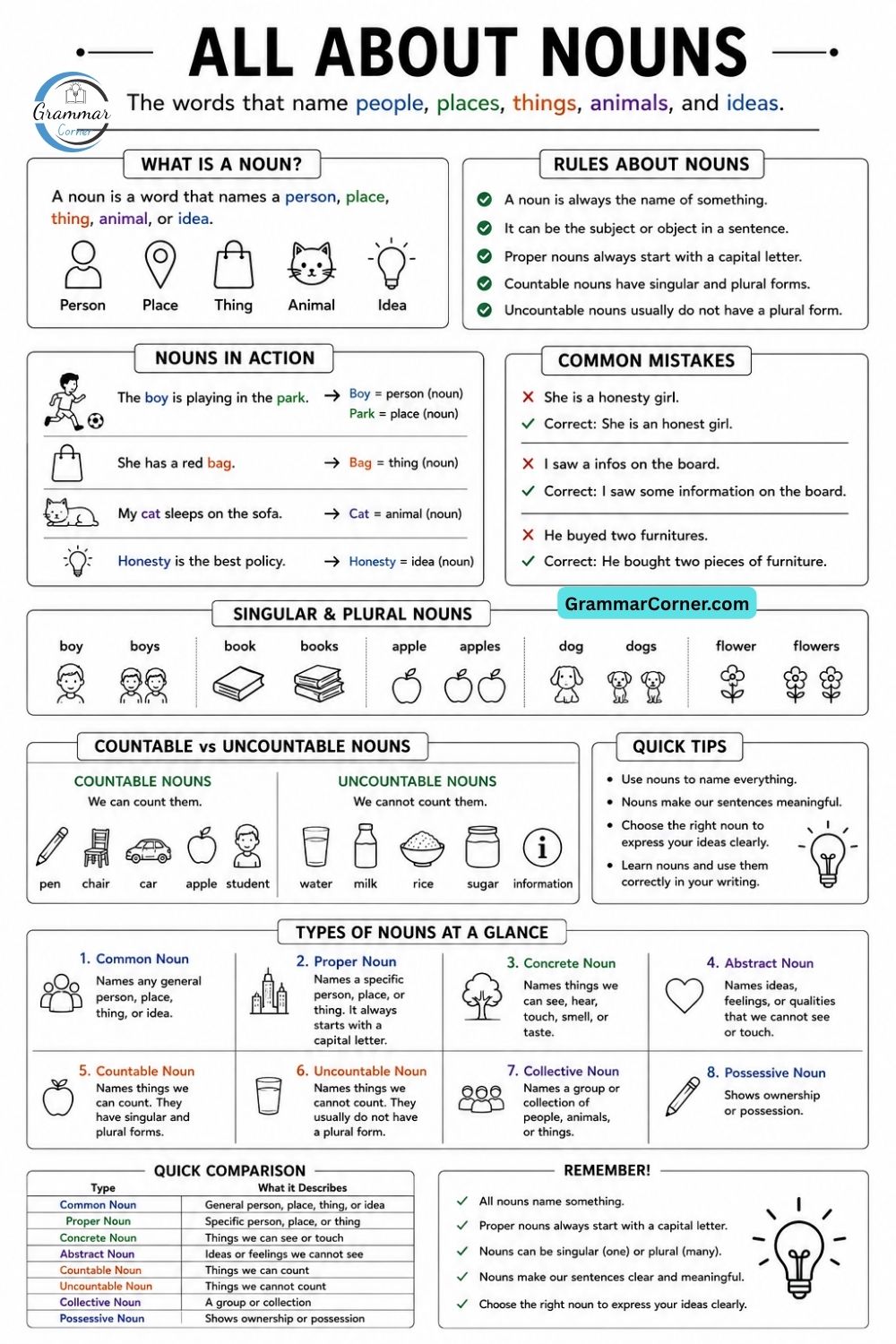
A noun is a word that names a person, place, thing, idea, or quality. That’s it — no hidden tricks.
Here are five nouns doing exactly that. Notice that they’re all nouns even though you can’t reach out and touch every one of them — some name things you can only feel or think about.
- teacher person Someone you can see and talk to.
- London place Somewhere you can visit.
- backpack thing An object you can pick up.
- freedom idea You can’t hold it, but you can name it.
- honesty quality Invisible — yet it still gets a name.
If a word puts a name on something — a person, a place, a thing, an idea, or a quality — it’s doing a noun’s job.
Simple Example
Here’s a simple sentence:
Try it Tap a noun below to remove it — then watch the sentence fall apart.
Latina bought a laptop from the store yesterday.
All three nouns are in place, and the sentence makes perfect sense.
Three nouns are doing quiet, essential work in that sentence: Latina (a person), laptop (a thing), and store (a place). Take them out, and you’re left with something like “Bought a laptop from yesterday.” Something is clearly missing — and that missing piece is almost always a noun.
Nouns are the naming words of English. Verbs tell you what’s happening, and adjectives describe things, but nouns tell you who or what the sentence is even about. Once you can spot them confidently, the rest of grammar gets a lot easier to untangle.
Quick Overview Table
-
Person
A human being (or named individual)
doctorAhmedsister -
Place
A location, real or imagined
kitchenParisNarnia -
Thing
An object you can usually see or touch
umbrellaphoneriver -
Idea / Concept
Something with no physical form
couragedemocracysilence -
Quality
A trait or characteristic
kindnessspeedhonesty
| Category | What It Names | Examples |
|---|---|---|
| Person | A human being (or named individual) | doctorAhmedsister |
| Place | A location, real or imagined | kitchenParisNarnia |
| Thing | An object you can usually see or touch | umbrellaphoneriver |
| Idea / Concept | Something with no physical form | couragedemocracysilence |
| Quality | A trait or characteristic | kindnessspeedhonesty |
If a word answers “who?” or “what?” in a sentence, there’s a very good chance it’s a noun.
Types of Nouns
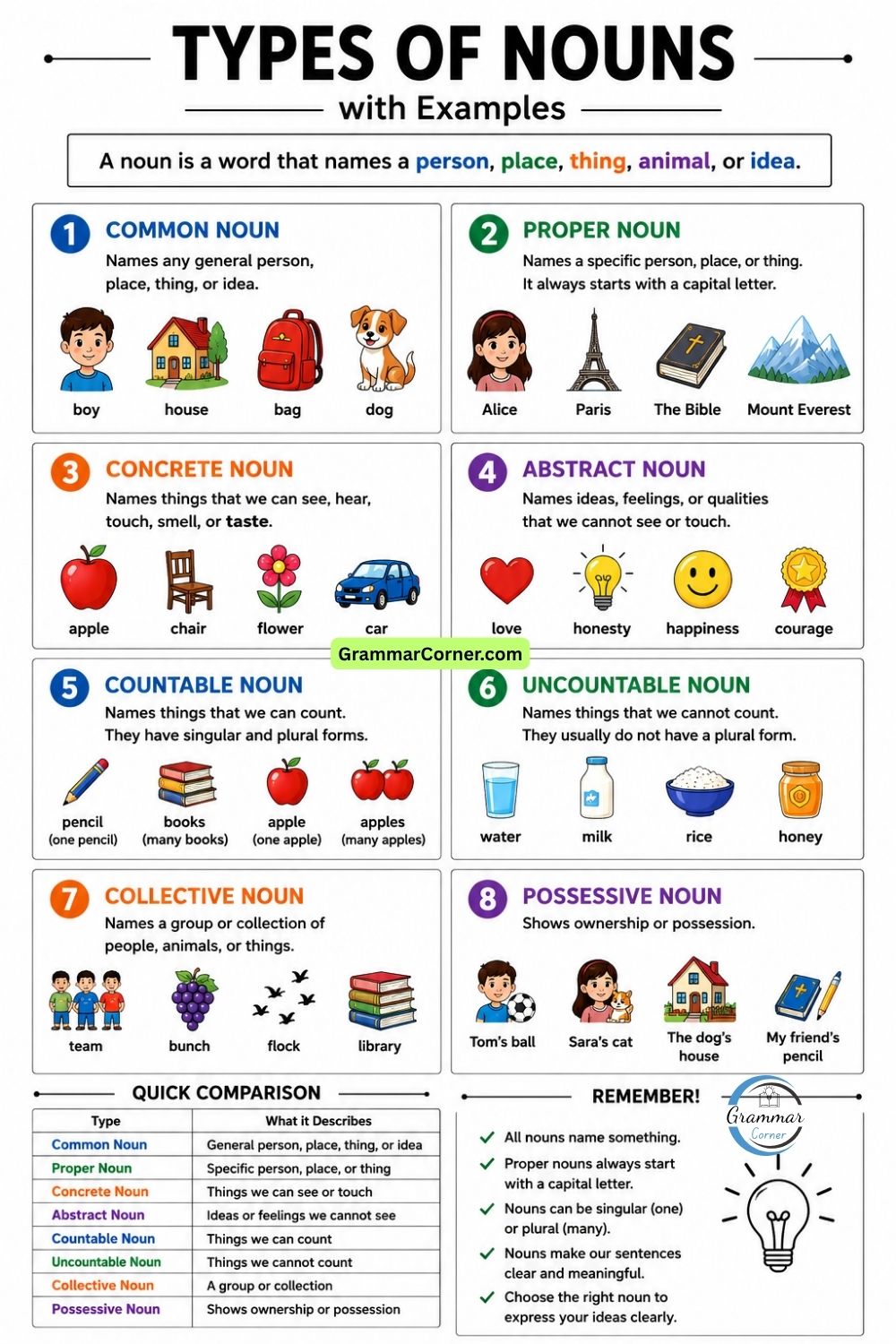
English doesn’t just have “nouns.” It has several overlapping categories, and most nouns actually belong to more than one at once. A word like dog is common, concrete, and countable — all at the same time.
Let’s break each category down.
1.Common Nouns and Proper Nouns
Names a general person, place, or thing — not one specific, named individual.
Names one particular person, place, or thing — and it always starts with a capital letter.
Notice the pattern: city could be any city on earth, but Lahore points to exactly one. That specificity is why proper nouns get capitalized — they work almost like a label or a name tag.
See it Switch between the common noun and the proper noun.
“city” could mean any one of these dots — that’s a common noun doing general work.
Incorrect: I visited lahore last winter.
Correct: I visited Lahore last winter.
Why: Lahore is a specific, named place, so it needs a capital letter — just as a person’s name would.
Incorrect: She studies History and Math at University.
Correct: She studies history and math at university.
Why: Here, “history,” “math,” and “university” are used generally — not as the name of one particular course or school — so they stay lowercase.
2.Concrete Nouns and Abstract Nouns
Names something you can experience with your five senses — you can see it, hear it, touch it, smell it, or taste it.
Names something you can only think about or feel — it has no physical form.
Here’s a quick way to test it: can you drop it on your foot? “Bicycle” — yes, painfully. “Bravery” — no. You can admire someone’s bravery, but you can’t hold it in your hand.
Try it Pick a noun and try to drop it on the foot.
The foot is safe — for now.
One small caveat before you rely on that trick everywhere: the foot test works for objects, but the real test is the senses. You can’t drop “thunder” or “perfume” on anything, yet both are concrete — you can hear one and smell the other.
3.Countable Nouns and Uncountable Nouns
Can be counted individually and has both a singular and plural form.
Also called a mass noun — refers to something treated as a whole, and it doesn’t normally take a plural form.
Try it Count up and down — then switch nouns and watch what happens to the plural.
one chair
One chair — singular, no “-s” needed yet.
This is where a lot of learners trip up — especially with words that feel like they should be countable but simply aren’t in English.
Incorrect: She gave me two advices about the interview.
Correct: She gave me two pieces of advice about the interview.
Why: “Advice” is uncountable in English, so it can’t take a plural “-s” or follow a number directly. You count it with a phrase like “a piece of” instead.
Incorrect: I bought a new furnitures for my room.
Correct: I bought a new piece of furniture for my room. / I bought new furniture for my room.
Why: “Furniture” behaves the same way as “advice” — it’s a mass noun, so it stays singular no matter how many individual items are involved.
American and British English mostly agree on which nouns are countable or uncountable, but there are a few well-known exceptions. In American English, “math” is uncountable and singular; in British English, the equivalent word is “maths” — also uncountable and singular. The spelling difference is just a shortening convention, not a grammar rule.
4.Collective Nouns
A collective noun names a group of people, animals, or things treated as one unit — for example:
The team is practicing every morning this week.
Here's where American and British English genuinely part ways. In American English, a collective noun almost always takes a singular verb, because the group is viewed as one single unit: "The team is winning." In British English, a collective noun can take either a singular or a plural verb, depending on whether the group is being thought of as one unit or as individual members acting separately.
See it Is the team one unit — or four individuals? Watch the verb follow your choice.
The team is winning.
One single unit — so the verb is singular. This is the normal choice in American English.
5.Compound Nouns
A compound noun is made of two or more words that work together to name one single thing. They can be written as one word, two separate words, or hyphenated — and there isn't always a strict rule for which format applies. It often just comes down to convention.
For most compound nouns, you pluralize the main word, not just whatever comes at the end. "Mother-in-law" becomes "mothers-in-law" — not "mother-in-laws" — because "mother" is the core noun being pluralized.
6.Possessive Nouns
A possessive noun shows ownership or a close relationship between two nouns. You form it by adding an apostrophe and "s" ('s) — or just an apostrophe for plural nouns that already end in "s."
Try it Change how many students wrote the essay — and watch the apostrophe move.
the student's essay
One student — the apostrophe comes before the "s": student's.
- The student's essay one student
- The students' essay more than one student
- James's car or James' car both are commonly accepted for names ending in "s"
Incorrect: The dogs bone was buried in the yard.
Correct: The dog's bone was buried in the yard.
Why: Without the apostrophe, "dogs" simply looks like a plural — more than one dog — instead of showing that the bone belongs to the dog.
Functions of Nouns in a Sentence
A noun's type tells you what kind of noun it is — a common noun, a proper noun, an abstract noun, and so on. A noun's function tells you the job it does in a sentence. The same noun can do different jobs in different sentences.
Subject
Who or what does the action?The subject is who or what is doing the action — or who or what the sentence is about.
The chef prepared dinner for twenty guests.
Chef is the subject — the one doing the preparing.
Direct Object
Verb + what? / whom?The direct object receives the action of the verb directly. It answers "what?" or "whom?" after the verb.
The chef prepared dinner for twenty guests.
Dinner is the direct object — it's the thing being prepared.
Indirect Object
To whom? / For whom?The indirect object tells you who or what receives the direct object. It usually answers "to whom?" or "for whom?"
The teacher gave the students a surprise quiz.
Students is the indirect object — they're the ones receiving "a surprise quiz," which is the direct object.
Subject Complement
Renames the subject after a linking verbA subject complement follows a linking verb (like "is," "become," or "seem") and renames or describes the subject.
My cousin became a pilot last year.
Pilot renames the subject, "cousin," after the linking verb "became."
Object Complement
Renames the direct objectAn object complement follows and describes or renames the direct object.
The committee elected her chairperson.
Chairperson renames "her," the direct object.
Object of a Preposition
Follows in, on, under, with, before…A noun that follows a preposition (like "in," "on," "under," "with," "before") is called the object of the preposition.
The keys are under the mat.
Mat is the object of the preposition "under."
Appositive
Sits beside a noun to rename itAn appositive is a noun placed right next to another noun to rename or explain it, often set off with commas.
My neighbor, a retired firefighter, waters my plants when I travel.
A retired firefighter renames "neighbor," giving extra information without starting a whole new sentence.
Try it One sentence, five noun jobs. Tap each highlighted noun to reveal its function.
subject gave her indirect object, appositive, a beautiful old direct object for their object of “for”.
Five nouns, five different jobs — all in one sentence.
How to Identify a Noun
If you're ever unsure whether a word is a noun, run it through a few quick tests.
The article test
Can you place "a," "an," or "the" in front of it? "The freedom," "a bicycle," "an idea" — all work naturally. You wouldn't say "the quickly" or "a beautifully," which is a strong sign those words aren't nouns.
The plural or possessive test
Can the word take an "-s" for plural, or an apostrophe-s for possession? "Book" becomes "books" or "book's." Verbs and adjectives generally can't do this in the same way.
The "who or what" test
Ask who or what the sentence is about, or who or what is receiving the action. Whatever answers that question is almost always a noun.
The position test
Nouns typically follow articles (a, an, the), possessives (my, her, their), or adjectives.
In "the bright red kite," you can predict that "kite" is the noun — it's the word all the description is building toward.
Try it Pick a word and run it through the tests.
Choose a word above to see the tests in action.
Some words look like other parts of speech but are secretly working as nouns. "Running" is usually a verb form — but in "Running is great exercise," it's acting as a noun. This special form is called a gerund, and we'll look at it more closely later in this article.
Common Mistakes with Nouns
Incorrect: The news are shocking today.
Correct: The news is shocking today.
Why: "News" ends in "s" but is uncountable and always singular in English, despite its appearance.
Incorrect: I have three childs from my first marriage.
Correct: I have three children from my first marriage.
Why: "Child" has an irregular plural — "children" — instead of the regular "-s" ending.
Incorrect: My favorite subject's are science and art.
Correct: My favorite subjects are science and art.
Why: This is a plural noun, not a possessive one, so it needs a simple "-s," not an apostrophe. Apostrophes show ownership, not plurals.
Incorrect: The Company announced new policies on monday.
Correct: The company announced new policies on Monday.
Why: "Company" is a common noun here and shouldn't be capitalized, while "Monday," a specific day name, is a proper noun and must be capitalized.
Incorrect: We need more informations before deciding.
Correct: We need more information before deciding.
Why: "Information" is uncountable, so it never takes a plural "-s."
This one isn't strictly about nouns, but it trips people up constantly when nouns are involved. "Its" (no apostrophe) is possessive. "It's" (with an apostrophe) means "it is." When in doubt, try replacing it with "it is" — if the sentence still makes sense, use "it's."
The company changed its logo.
Possessive "its" — the logo belongs to the company.
It's a great logo.
Contraction "it's" — short for "it is."
Tips for Using Nouns Correctly
-
Choose specific nouns over vague ones
Whenever you can, reach for the sharper word. "The dog ran across the yard" is fine, but "The terrier bolted across the yard" paints a sharper picture without adding a single extra sentence.
-
Use a number to test countability
When you're unsure if a noun is countable or uncountable, check whether it makes sense with a number in front of it. "Three chairs" works; "three furnitures" doesn't — that's your signal the noun is uncountable.
-
Read collective nouns in context
Before deciding on a verb, ask yourself: is this group acting as one unit, or are its members doing different things? That question will guide you toward the right verb — especially in British English.
-
Keep proper nouns consistent
If you introduce someone as "Dr. Amina Siddiqui," don't casually switch to "amina" later in formal writing — consistency reads as more professional and avoids confusing your reader.
-
Double-check apostrophes before you hit send
A stray apostrophe is one of the most common — and most noticeable — noun-related errors in emails, reports, and essays alike.
Practice Exercises
Exercise 1: Identify the nouns
Read each sentence first and guess the nouns yourself, then tap "Reveal nouns" to see them highlighted right where they live in the sentence.
1. The librarian organized the shelves before the visitors arrived.
2. Courage helped Fatima finish the marathon despite the heat.
3. Our neighbor's cat knocked a vase off the windowsill.
Exercise 2: Countable or uncountable?
Decide first, then tap each card to check your answer.
Exercise 3: Fix the mistake
Each sentence has one noun-related slip. Tap "Reveal fix" to see the correction in place.
8. The jury havehas reached its decision. (rewrite for American English)
9. She bought two breadsloaves of bread from the bakery.
10. My brothersbrother's car broke down on the highway.
Noun vs Related Grammar Terms
Noun vs Pronoun
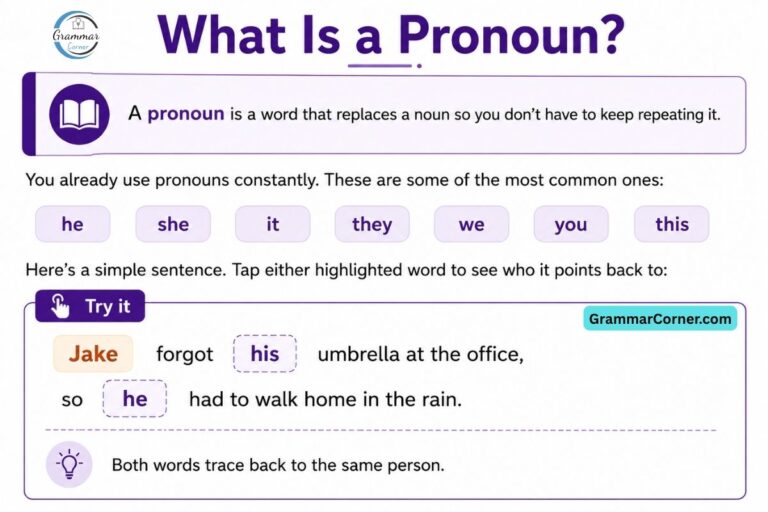
A noun names a person, place, thing, or idea directly. A pronoun replaces a noun so you don't have to repeat it constantly.
RepetitiveSarah forgot Sarah's umbrella at Sarah's office.
NaturalSarah forgot her umbrella at her office.
Noun vs Adjective
A noun names something; an adjective describes or modifies a noun. The tricky part is that the exact same word can sometimes switch roles.
That is a beautiful garden. — here "beautiful" is an adjective, describing "garden," the noun.
The garden is full of beauty. — here "beauty" is the noun itself.
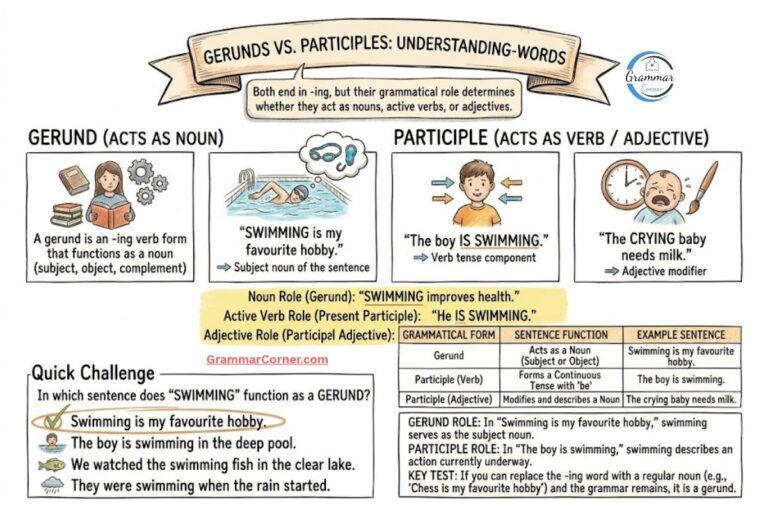
Noun vs Gerund
A gerund is a verb form ending in "-ing" that functions as a noun in a sentence. It looks like a verb but behaves grammatically like a noun.
Swimming is her favorite way to relax. "Swimming" isn't describing an action happening right now — it's the subject of the sentence, doing exactly what a noun does.
| Feature | Noun | Gerund |
|---|---|---|
| Form | Base word (dog, idea, city) | Verb + -ing (swimming, reading) |
| Function | Names a person, place, thing, idea | Acts as a noun, but comes from a verb |
| Example | The book is on the table. | Reading is relaxing. |
Frequently Asked Questions
Is "the" a noun?
No. "The" is an article, a type of determiner, not a noun. Its job is to introduce a noun, not to name anything by itself.
Can a noun be a verb too?
Many English words can function as either a noun or a verb depending on the sentence. Take "run": "She went for a run" uses it as a noun, while "She runs every morning" uses it as a verb. Context always decides the role.
How many types of nouns are there in English?
There isn't one single official count, since the categories overlap. The main ones are common, proper, concrete, abstract, countable, uncountable, collective, compound, and possessive nouns.
Do all nouns have a plural form?
No. Uncountable nouns like "information," "furniture," and "advice" don't have standard plural forms in English.
Why do some nouns need capital letters and others don't?
Capital letters mark proper nouns — nouns that name one specific, particular person, place, or thing, like "Egypt" or "Ramadan." Common nouns, like "country" or "holiday," stay lowercase because they refer to something general.
Is a name always a proper noun?
Yes. Names of specific people, places, brands, days, months, and titles are proper nouns and are always capitalized, regardless of how short or informal they are.
See also: