Punctuation Chart (Definition, Types, Symbols, Usage & Examples)
Punctuation Guides · Grammar Corner
A Complete Punctuation Guide
Punctuation refers to the symbols used in writing to organize sentences and clarify meaning. These marks give readers visual signals for how to pause, emphasize, and group words to grasp the intended message.
Punctuation acts like a traffic system for writing — separating ideas, signaling relationships, and improving flow and rhythm. This guide covers all 14 core marks, the rare typographical marks, and interactive practice to lock it all in.
A Brief History of Punctuation
Early writing had no spaces or punctuation at all — TEXTRANTOGETHERLIKETHIS, and readers had to untangle it aloud. Punctuation was invented, piece by piece, to make reading easier:
Aristophanes of Byzantium, librarian at Alexandria, introduces a system of dots to mark pauses of different lengths — the ancestor of the period, comma, and colon.
Irish and Anglo-Saxon scribes begin consistently putting spaces between words — a revolution that made silent reading practical.
The punctus interrogativus — the ancestor of the question mark — appears in medieval manuscripts.
Gutenberg’s printing press arrives. Printers need consistency, so punctuation begins to standardize rapidly.
Venetian printer Aldus Manutius prints the first semicolon — one of the few punctuation marks with a known inventor.
Quotation marks, parentheses, and the exclamation mark settle into recognizable modern forms.
Grammarians codify the rules, and punctuation reaches roughly the system English uses today.
Interactive Punctuation Explorer
Tap any symbol to see its name, its job, and live examples:
▼ Click a mark to explore it ▼
.Period
Ends a declarative or imperative sentence — a complete stop after a fully expressed thought.
- I went to the store earlier.
- Please pass the bread.
- She loves reading fantasy novels.
The 14 Punctuation Marks with Examples
Prefer to read straight through? Here is every mark, its purpose, and examples:
Period .
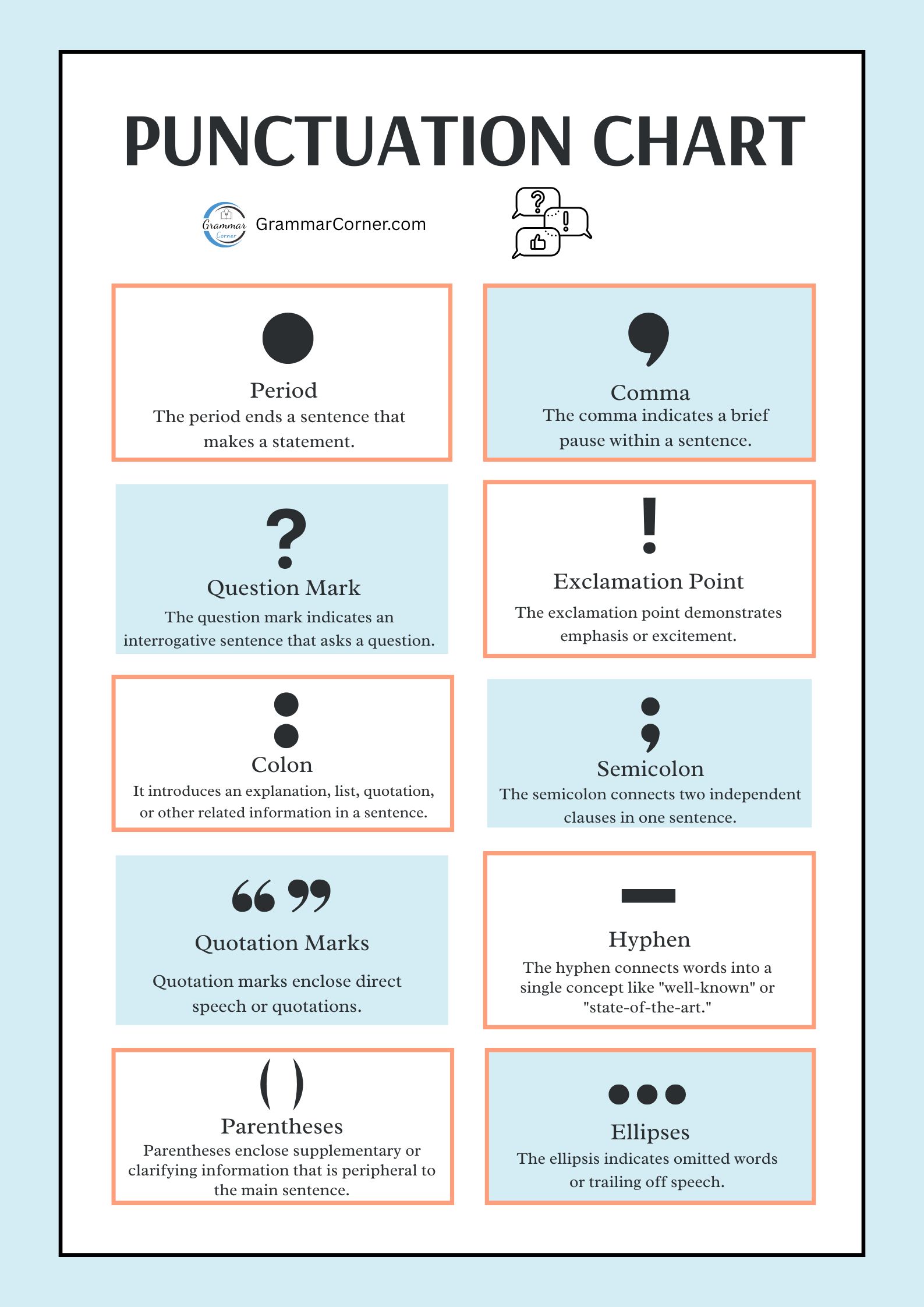
The period ends a sentence that makes a statement — a complete stop after a fully expressed thought. It closes declarative and imperative sentences.
- I went to the store earlier.
- Please pass the bread.
- She loves reading fantasy novels.
Comma ,
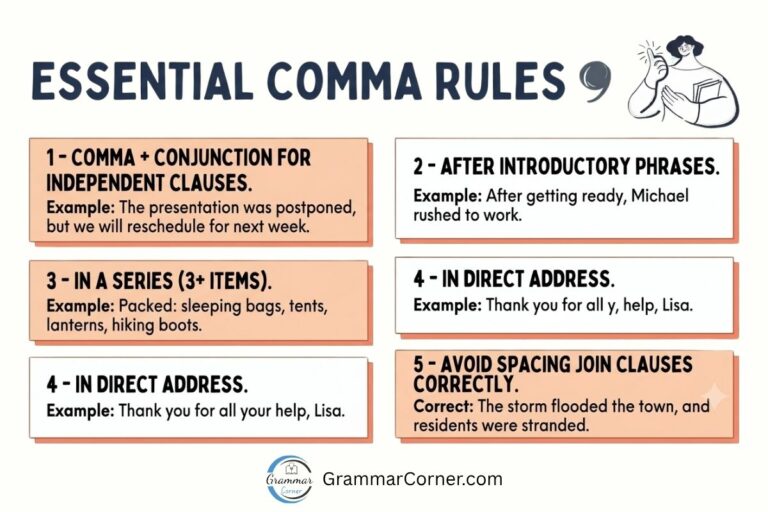
The comma marks a brief pause within a sentence. It separates clauses, phrases, and items in a list, and adds clarity.
- The cat, not surprisingly, jumped on the counter again.
- Sitting on the beach, sipping a cold drink, sounded relaxing.
- She ate an apple, an orange, and grapes for lunch.
Semicolon ;
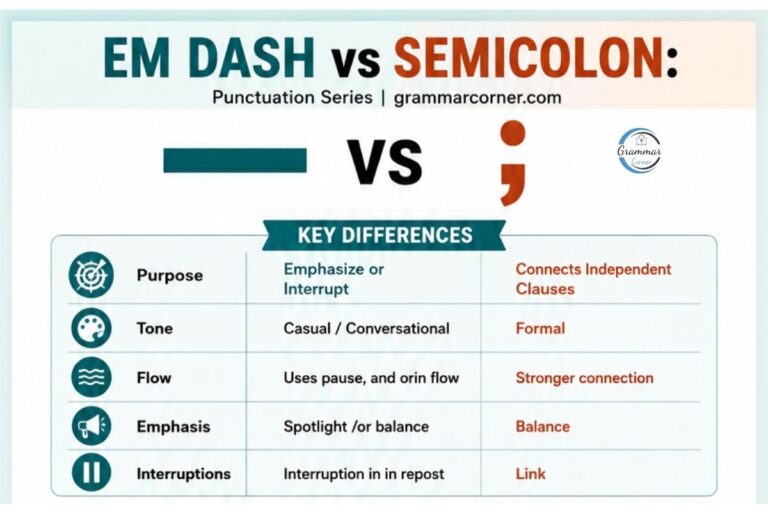
The semicolon connects two independent clauses in one sentence — a closer link than a period, a stronger separation than a comma.
- The thunder roared; the lightning flashed wildly.
- I wanted to go home; however, I stayed until the end.
- Don’t press the red button; it will set off the alarm.
Colon :
The colon introduces an explanation, list, or quotation. It signals that what follows is closely tied to the first part of the sentence.
- I have three goals this year: exercise daily, read 52 books, and learn to cook.
- Here’s the problem: we don’t have enough data to reach a conclusion.
- The coach’s motto was simple: never stop improving.
Apostrophe ‘
The apostrophe indicates possession (“Jenny’s book”) or marks omitted letters in contractions (“can’t” for “cannot”).
- The dragon’s wings were leathery.
- My sister’s art collection is impressive.
- Don’t = do not · can’t = cannot · it’s = it is.
Question Mark ?
The question mark ends an interrogative sentence — it replaces the period whenever the sentence asks for information.
- How was your day?
- Where should we meet later?
- What is the meaning of life?
Exclamation Point !
The exclamation point signals emphasis, excitement, or strong emotion at the end of a phrase or sentence.
- Watch out!
- I just won the lottery!
- This cake is delicious!
Quotation Marks “ ”
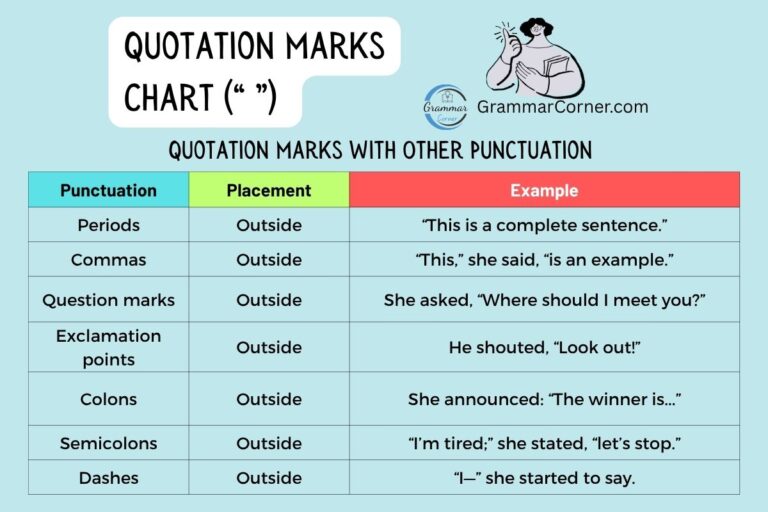
Quotation marks enclose direct speech and quotations, marking the exact beginning and end of a speaker’s verbatim words. They also set off some titles (articles, songs, short stories).
- The sign said, “Walk slowly.”
- “When will you be home?” she asked.
- The teacher remarked, “Excellent job on the test.”
Parentheses ( )
Parentheses enclose supplementary or clarifying information that is useful but not essential to the sentence’s meaning.
- The package should arrive tomorrow (unless there are delivery delays).
- My apartment (and my roommate’s) is quite small.
- We are going to the show (you should come too)!
Brackets [ ]
Brackets enclose editorial insertions or clarifications added inside a quotation — words that are helpful but were not part of the original.
- “She [the doctor] said I will be fine soon.”
- The book states, “He [King George] did not want to surrender power.”
- “Their [sic] going to win,” the post read.
Ellipsis …
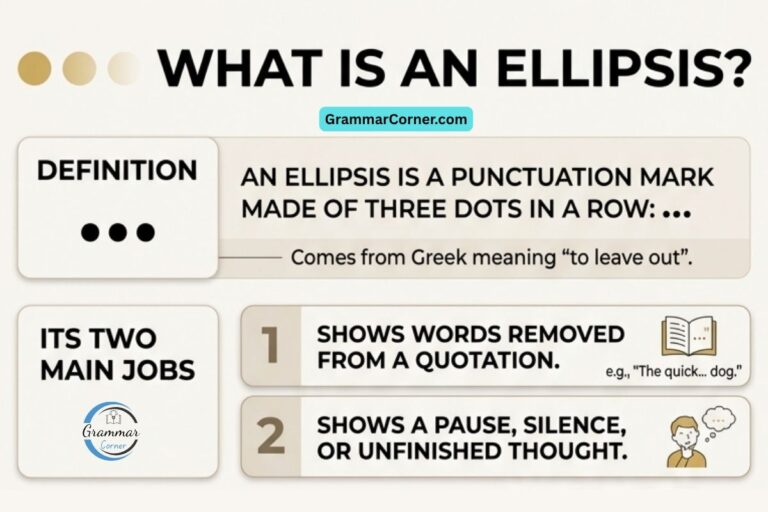
The ellipsis — three dots — indicates omitted words in a quotation or speech trailing off.
- “We the people…in order to form a more perfect union…”
- “I wanted to explain…but I didn’t get the chance.”
- “Well, I just thought maybe…” His voice faded.
Hyphen –
The hyphen joins words into a single concept, linking closely associated terms and compound modifiers.
- The proposal is a well-thought-out plan.
- The mother-in-law visited last weekend.
- He bought a state-of-the-art computer.
Em Dash —
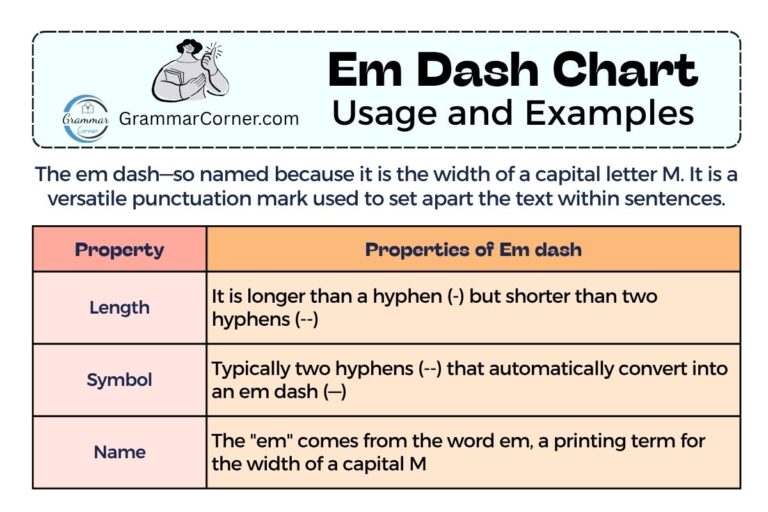
The em dash marks an abrupt change in thought or an emphatic break. It sets off parenthetical statements with more force than parentheses or commas.
- The cake—my favorite kind—was perfect.
- You should get some rest—you’ve been working all day!
- I have one goal this year—to be happier.
En Dash –
The en dash connects number ranges, dates, scores, and paired destinations — a quiet link rather than an abrupt break.
- The conference is March 12–14.
- Pages 45–67 cover that topic.
- It was a close game, ending 105–103.
Table of Punctuation Marks, Symbols and Examples
| Mark | Symbol | Example sentence |
|---|---|---|
| Period | . | I went to the store today. |
| Comma | , | The cat, not surprisingly, jumped on the counter again. |
| Semicolon | ; | I wanted to go home; however, I stayed until the end. |
| Colon | : | Here is the deal: we need to make a decision now. |
| Apostrophe | ‘ | My brother’s car is very old. |
| Question Mark | ? | Where should we meet later? |
| Exclamation Point | ! | Watch out! |
| Quotation Marks | “ ” | The sign said, “Walk slowly.” |
| Parentheses | ( ) | My apartment (and my roommate’s) is quite small. |
| Brackets | [ ] | The book states, “[King George] did not want to surrender power.” |
| Ellipsis | … | I wanted to explain…but I didn’t get the chance. |
| Hyphen | – | The proposal is a well-thought-out plan. |
| Em Dash | — | You should get some rest—you’ve been working all day! |
| En Dash | – | The conference is March 12–14. |
What Are Typographical Marks?
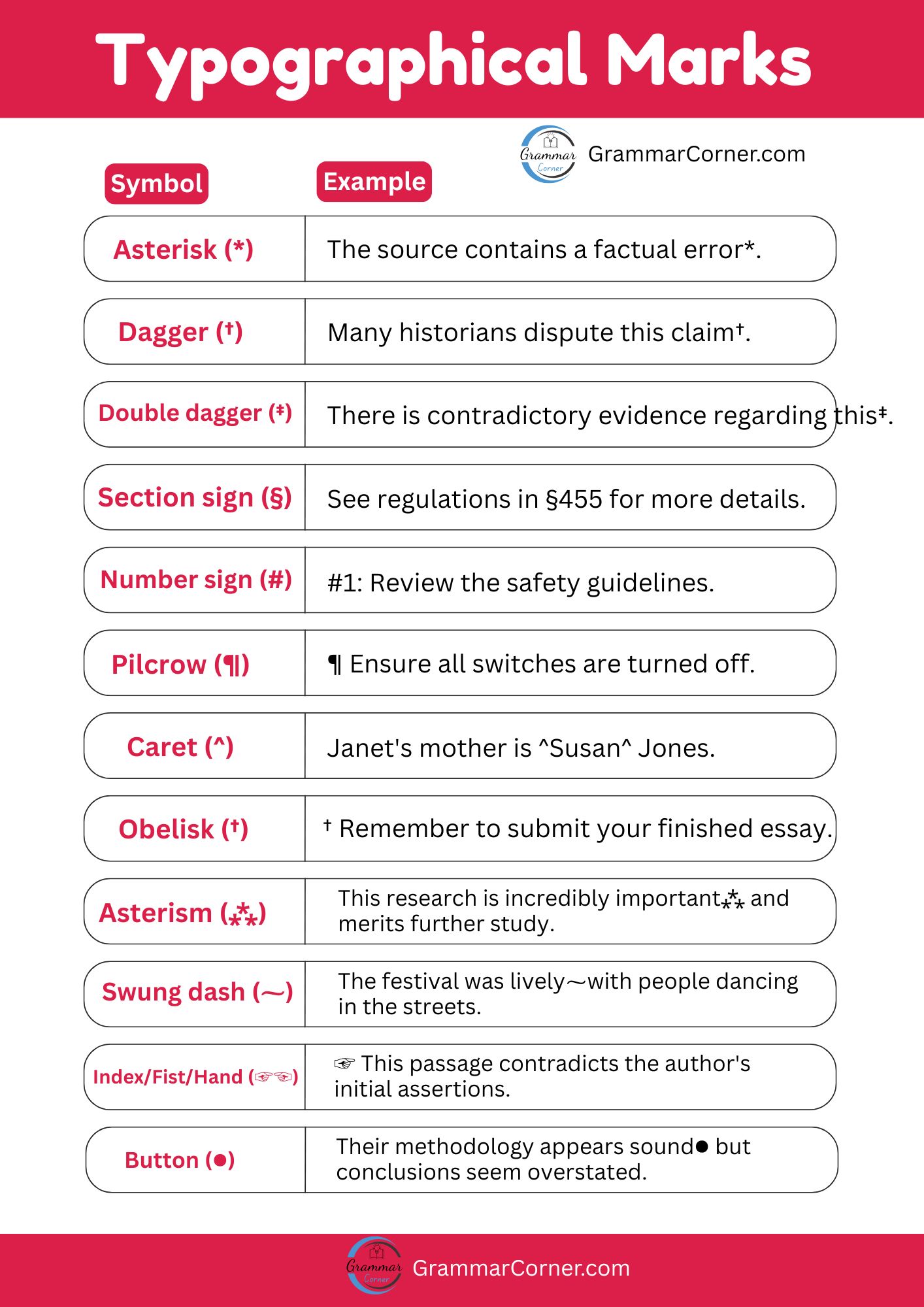
Beyond the everyday punctuation marks, English typography includes a set of specialist symbols used mainly in scholarly, legal, and printed texts. You won’t need most of them daily — but recognizing them makes you a sharper reader:
Asterisk *
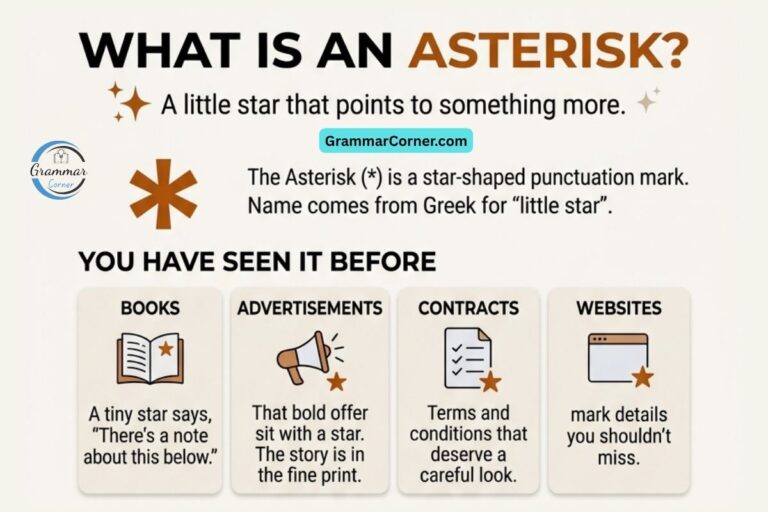
Marks a footnote or reference, and can stand in for omitted letters (often in censored words).
- The source contains a factual error.*
- Terms and conditions apply.*
- He muttered, “What the h*** was that?”
Dagger & Double Dagger † ‡
The dagger (†) — also called the obelisk, its older name — marks a second footnote when the asterisk is already used; the double dagger (‡) marks a third. The traditional footnote sequence runs * → † → ‡. In scholarly texts, a dagger after a person’s name can also indicate they are deceased.
- Many historians dispute this claim.†
- There is contradictory evidence regarding this.‡
Section Sign §
Denotes numbered sections, especially in legal documents and statutes.
- See the regulations in §455 for more details.
- The rules in §3.2 prohibit this action.
- §1981 deals with employment discrimination.
Number Sign #
Indicates a number (issue, step, or rank) — and in the digital era, hashtags on social media.
- Step #2: Mix all the ingredients together.
- Our team finished #1 in the region.
- The post trended under #GrammarMatters.
Pilcrow ¶
The paragraph mark. It flags new paragraphs in legal citations and proofreading, and appears in word processors when formatting marks are visible.
- The clause appears at ¶14 of the contract.
- Editor’s note: start a new paragraph here. ¶
Caret ^
A proofreader’s mark placed at the point where missing text should be inserted — one caret at the insertion point, with the new text written above or beside it.
- My favorite city is ^ Paris. (caret shows where “definitely” should be inserted)
- In programming and math, the caret also denotes exponents: 2^10 = 1024.
Asterism ⁂
Three asterisks in a triangle, marking a section break or a pause between passages of a book — a decorative ancestor of today’s centered “* * *” scene break.
- The chapter’s first scene ends, then:
⁂
Three years later, she returned to the village.
Swung Dash ⁓
A long, curved dash. Its main modern use is in dictionaries, where it stands in for the headword to avoid repetition; the ordinary tilde (~) also loosely means “approximately.”
- Dictionary entry for run: “⁓ a marathon; ⁓ a business.”
- The repair will cost ~$200. (informal: approximately)
Index / Manicule ☞
The pointing hand — also called a fist or manicule — used since medieval manuscripts to point at important text.
- ☞ Note the change in tone that occurs here.
- ☞ Pay careful attention to the subtext in this dialogue.
Bullet •
Marks the items of an unordered list — one of the most used typographical marks in modern documents and web writing.
- Bring the following: • a notebook • a pen • your ID badge
Interpunct ·
The middle dot. In classical Latin inscriptions it separated words (ROMA·AETERNA); today it survives in dictionaries to mark syllable breaks, and in some languages and math notation.
- Dictionary syllabification: punc·tu·a·tion.
- Latin inscription style: SENATVS·POPVLVSQVE·ROMANVS.
Underscore _
A holdover from typewriters (used to underline by overtyping). Today it mainly replaces spaces in file names, usernames, and code, and marks emphasis in plain-text writing.
- File name: quarterly_report_2026.pdf
- Username: @grammar_corner
- Plain-text emphasis: That was _exactly_ my point.
Braces { }
Also called curly brackets. They rarely appear in ordinary prose — their home is mathematics (sets), music (joining staves), and programming (code blocks).
- Math set notation: {2, 4, 6, 8}
- Code: if (x > 0) { return true; }
A Note on the Rare Marks
Several of these symbols — the manicule, asterism, and interpunct especially — are largely historical or decorative today. Use asterisks, daggers, and section signs when your document genuinely needs footnotes or legal references; enjoy the rest as typographic heritage rather than everyday tools.
Master Punctuation Chart
The whole system on one chart — the 14 marks grouped by what they do:
Punctuation FAQs
When should a comma versus a semicolon be used?
Do parentheses and brackets function the same way?
When should an em dash versus an en dash be used?
What is the proper way to use quotation marks?
Should punctuation go inside or outside parentheses?
Do bullet points need punctuation at the end?
How many spaces should come after a period?
Is punctuation needed in headings and titles?
Punctuation Practice Exercises
Time to apply everything. Fix each sentence in your head (or on paper), then click Show answer to check yourself:
1. Wheres the report I asked for she said
Apostrophe in the contraction, quotation marks around the speech, question mark inside the quote, period to end.
2. After a long day of work I enjoy relaxing with a good book
A comma follows the introductory phrase; a period ends the sentence.
3. The conference starts at 9 00 a.m and ends at 5 00 p.m
Colons in the clock times; periods in the abbreviations a.m. and p.m.
4. My brother who lives in New York is visiting us next week
Paired commas set off the non-essential clause about where he lives.
5. Please bring the following items to the meeting a notebook a pen and your ID badge
A colon introduces the list; commas separate its items.
1. Although it was raining, we decided to go for a hike however, we took our raincoats just in case.
“However” joining two independent clauses needs a semicolon before it and a comma after.
2. The company’s mission is to provide excellent service, innovative solutions and, a positive work environment.
The comma belongs before “and” (the serial comma) — never after it.
3. “I cant believe this is happening!” she exclaimed as she watched the scene unfold.
The contraction “can’t” needs its apostrophe.
4. He said “Im not sure if I can make it to the party tonight.”
A comma follows the dialogue tag “He said,” and “I’m” needs its apostrophe.
5. My favorite colors are blue, green and red.
The serial (Oxford) comma before “and” — optional in some styles, but consistent use prevents ambiguity.
Interactive Quiz: Test Your Punctuation Skills
Answer all 8 questions for instant feedback and a final score.
1. Which mark connects two independent clauses in one sentence?
A comma alone creates a comma splice; the semicolon is built for joining two complete, related sentences.
2. “The meeting runs March 12__14.” Which mark fills the blank?
Date and number ranges take the en dash: March 12–14.
3. Which sentence uses brackets correctly?
Brackets mark editorial insertions inside quotations. Your own aside in your own sentence takes parentheses.
4. Where does the period go: “He went to the store (to buy milk)__”?
The parenthetical is part of a larger sentence, so the period ends the whole sentence — outside. It goes inside only when the entire sentence is parenthetical.
5. What does an ellipsis (…) indicate?
The ellipsis marks omission or a fading trail-off. The abrupt cut-off is the em dash’s job.
6. Which contraction is punctuated correctly?
“It’s” = “it is” — the apostrophe marks the omitted letter. “Its” (no apostrophe) is the possessive; “its'” doesn’t exist.
7. How many spaces follow a period in modern writing?
One space is the modern standard; two spaces was a typewriter-era habit for monospaced fonts.
8. In American style, where do periods and commas go with quotation marks?
American convention: periods and commas tuck inside the closing quote. (British style places them by logic — one of the real US/UK differences.)
Key Points to Remember
- Punctuation is a traffic system: enders stop (. ? !), separators slow (, ; :), connectors merge (- – —), enclosers detour (“ ” ( ) [ ]), and indicators signal (‘ …).
- A comma alone cannot join two sentences — that’s the semicolon’s job.
- Enclosing marks always come in pairs — every opener needs a closer.
- Brackets are for edits inside quotes; parentheses are for your own asides.
- One space after a period; periods and commas inside closing quotation marks (US style).
See related posts
- Full Stop Chart
- Asterisk Rules
- Apostrophe Chart
- Comma Chart
- Colon Chart
- Semicolon Chart
- Ellipses
- Hyphen Chart
- Question Mark
- Quotation Mark
- Parentheses
- Punctuation Exercises