Prepositions Chart (Types, Examples & Usage)
What Is a Preposition?
“The cat is sleeping under the table.”
Now take away the word under, and something breaks. You still have a cat and a table — but no idea how they relate to each other. Is the cat on the table? Next to it? Nowhere near it? That one small word is doing all the work of connecting the cat to the table in a way that makes sense.
Try it yourself — tap a word and watch the cat move:
The cat is sleeping under the table.
One word, and the whole picture is clear.
Once you can see what that little word does, the definition almost writes itself.
A preposition is a word placed before a noun, pronoun, or noun phrase to show its relationship to another word in the sentence. Most often, that relationship is one of place, time, direction, or manner.
That is the whole job. In our sentence, under sits right before the noun phrase the table and quietly tells you exactly where the cat is. Small word, big responsibility.
Function of Preposition
A preposition is a word that shows the relationship between a noun (or pronoun) and some other word in the sentence. It usually tells you where something is, when it happens, or how it’s connected to something else. Let’s look at a few more everyday examples:
-
She left her umbrella at the coffee shop.
at shows location -
We’re meeting after lunch.
after shows time -
He walked through the crowded market.
through shows movement -
This gift is for my sister.
for shows purpose or recipient
In every one of these, the preposition links a noun (coffee shop, lunch, market, sister) to the rest of the sentence, and it tells you exactly how they’re connected. Without it, you’d just have a pile of unconnected words.
One more thing worth knowing early on: a preposition never travels alone. It always brings a noun or pronoun along with it, and together they form what’s called a prepositional phrase — something we’ll come back to a little later.
Preposition at a Glance
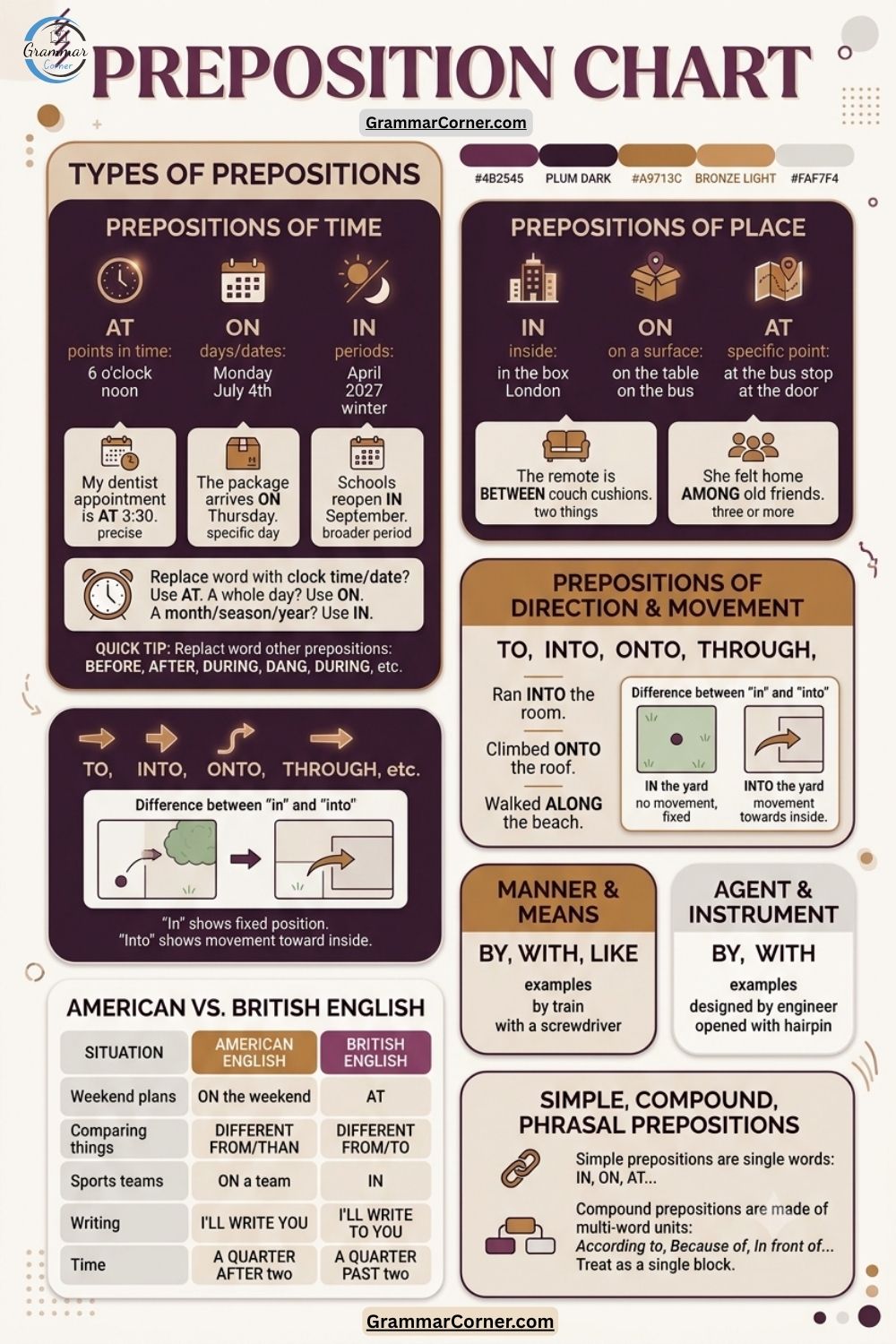
Quick overview tableBefore we go deeper, here’s a quick snapshot of the whole topic.
| Category | What it shows | Common examples | Sample sentence |
|---|---|---|---|
| Time | When something happens | in, on, at, before, after, during | The store closes at 9 p.m. |
| Place | Where something is | in, on, at, under, above, between | Your phone is on the counter. |
| Direction | Movement toward or through something | to, into, onto, through, across | They drove across the bridge. |
| Manner | How something is done | by, with, like | She solved it with patience. |
| Agent/Instrument | Who or what performs an action | by, with | The email was written by Sam. |
| Compound/Complex | Multi-word prepositions | because of, according to, in spite of | We stayed in because of the storm. |
Treat this table as a map. Every section below fills in the details behind one or more of these rows.
Types of Prepositions
Prepositions of Time
These tell you when something happens. Learners often mix up in, on, and at, so here’s a simple way to keep them straight:
- Use at for precise points in time: at 6 o’clock, at noon, at midnight.
- Use on for days and specific dates: on Monday, on July 4th, on my birthday.
- Use in for longer periods: in April, in 2027, in the morning, in winter.
Other time prepositions worth knowing: before, after, during, since, for, until, by.
- since pairs with a starting point: “I’ve lived here since 2019.”
- for pairs with a duration: “I’ve lived here for six years.”
If you can replace the word with a specific clock time or date, at is usually your best bet. Talking about a whole day? Reach for on. A stretch of time like a month, a season, or a year? Go with in.
Prepositions of Place
These describe location or position.
- in — inside something: in the box, in the car, in London.
- on — on a surface: on the table, on the wall, on the bus (for public transport, oddly enough, even though you’re technically inside it).
- at — a specific point: at the bus stop, at the door, at 221 Baker Street.
Other place prepositions: under, over, above, below, between, among, behind, in front of, next to, beside.
Prepositions of Direction and Movement
These show motion from one place to another: to, into, onto, through, across, along, towards, from, out of.
Notice the difference between in and into. “In” tells you where something already is (“The dog is in the yard”). “Into” tells you about movement toward the inside of something (“The dog ran into the yard”). Mixing these up is one of the most common slips for learners, and native speakers occasionally blur the line in casual speech too.
Prepositions of Manner and Means
These explain how something is done or by what method: by, with, like, in.
Prepositions of Agent and Instrument
Closely related to manner, these show who performed an action (agent) or what tool was used (instrument) — this shows up constantly in passive voice sentences.
Simple, Compound, and Phrasal (Complex) Prepositions
Simple prepositions are single words: in, on, at, by, for, with, to.
Compound prepositions are made of two or three words that function together as one unit: according to, because of, in spite of, on behalf of, in front of, instead of.
Treat these multi-word phrases as a single block — don’t try to analyze each word separately.
A Quick Note on American and British English
Most prepositions work the same on both sides of the Atlantic, but a few differences pop up regularly:
| Situation | American English | British English |
|---|---|---|
| Weekend plans | on the weekend | at the weekend |
| Comparing things | different from/than | different from/to |
| Sports teams | on a team | in a team |
| Writing to someone | I’ll write you. | I’ll write to you. |
| Time (quarter past) | a quarter after two | a quarter past two |
Neither version is “wrong” — they’re just regional habits. If you’re writing for a specific audience, matching their variety of English makes your writing feel natural to them.
How to Identify a Preposition
Spotting a preposition gets easy once you know what to look for.
-
Check what follows the word
A preposition is almost always followed by a noun, pronoun, or gerund (a verb ending in -ing used as a noun) — never by a verb in its regular form.
She is interested in cooking.
in is a preposition — cooking is acting as a noun -
Ask yourself if it answers where, when, or how
If the word helps answer one of those questions, there’s a good chance it’s a preposition.
-
See if it starts a phrase that could be removed
Try mentally deleting the phrase. If the sentence still makes basic sense without it, that’s a strong sign you’re looking at a prepositional phrase.
The keys (on the counter) are mine.
still makes sense with the phrase removed -
Watch out for words that can be more than one part of speech
This is where things get tricky. Words like before, after, since, and until can act as prepositions, conjunctions, or adverbs depending on what follows them.
PrepositionI’ll call you before dinner.
followed by a nounConjunctionI’ll call you before I leave.
followed by a subject + verbAdverbI’ve never been there before.
stands alone, no objectThe testIf the word is followed by a noun or noun phrase, it’s a preposition. If it’s followed by a subject and a verb, it’s introducing a clause and acting as a conjunction. If it has no object at all, it’s an adverb.
Don’t confuse prepositions with particles in phrasal verbs. In “She gave up smoking,” up isn’t showing location — it’s part of the phrasal verb “give up,” which means something entirely different from “give” alone. Compare that with “She climbed up the ladder,” where up is genuinely a preposition showing direction.
Common Mistakes with Prepositions
Mistake 1: Adding Unnecessary Prepositions
❌ Incorrect: “We discussed about the project.”
✅ Correct: “We discussed the project.”
Why: “Discuss” already means “talk about,” so adding “about” is redundant. The same goes for verbs like “mention,” “describe,” and “enter” (as in entering a room, not entering a contest).
Mistake 2: Using the Wrong Preposition After Certain Verbs or Adjectives
❌ Incorrect: “She’s married with a doctor.”
✅ Correct: “She’s married to a doctor.”
Why: Certain words simply pair with fixed prepositions, and there’s no shortcut except learning them: good at, interested in, afraid of, proud of, married to, capable of.
Mistake 3: Confusing “In,” “On,” and “At” for Time
❌ Incorrect: “The meeting is in Monday at 10 a.m.”
✅ Correct: “The meeting is on Monday at 10 a.m.”
Why: Specific days take “on,” not “in.” Remember the size rule from earlier: “at” for exact points, “on” for days, “in” for longer stretches.
Mistake 4: Mixing Up “In” and “Into”
❌ Incorrect: “The kids jumped in the pool from the diving board.”
✅ Correct: “The kids jumped into the pool from the diving board.”
Why: “Into” captures the movement from outside to inside. “In” describes a static position. Since jumping is an action of movement, “into” fits better here.
Mistake 5: Worrying About Ending a Sentence With a Preposition
Many people were taught that a sentence should never end with a preposition, but this “rule” isn’t actually a rule in modern English — it’s a leftover habit borrowed from Latin grammar, where sentence structure works differently.
In everyday writing and speech, ending with a preposition is fine. In very formal writing, you can restructure the sentence if you prefer a more traditional tone, but you’re not obligated to.
Mistake 6: Dropping a Needed Preposition
❌ Incorrect: “I’m waiting the bus.”
✅ Correct: “I’m waiting for the bus.”
Why: “Wait” needs “for” to connect to its object. Leaving it out is a common slip for English learners whose first language handles this differently.
Practice Exercises
Try filling in the blank with the correct preposition. Answers are listed at the end — try not to peek early.
The concert starts 7 p.m. sharp.
My grandmother was born 1952.
He hid the present the bed so no one would find it.
We’re driving the mountains this weekend.
This letter is addressed the manager.
She’s been studying French three years.
The cat jumped the fence and disappeared.
I left my jacket the restaurant last night.
He apologized being late.
They walked the park, enjoying the fresh air.
Show answer key
- at
- in
- under (or “beneath”)
- to
- to
- for
- over (or “off”)
- at
- for
- through (or “in”)
A few of these accept more than one correct answer depending on the exact meaning you intend — that’s normal with prepositions, since context shapes the choice.
Prepositions vs Related Grammar Terms
Preposition vs Conjunction
A preposition connects a noun or pronoun to the rest of the sentence. A conjunction connects two clauses (a clause has both a subject and a verb).
I stayed inside because of the rain.
because of + noun phraseI stayed inside because it was raining.
because + subject + verbSome words, like before, after, since, and until, can function as either, depending on what follows them, as we saw earlier.
Preposition vs Adverb
An adverb modifies a verb, adjective, or another adverb and doesn’t need an object. A preposition always needs an object (a noun or pronoun).
The bird flew over the fence.
over + fence = objectThe plane flew over.
no object — over stands aloneThis distinction matters most with phrasal verbs, where small words like up, down, off, and out often act as adverbs (technically called particles) rather than prepositions.
She looked up the word.
“look up” means “search for”She looked up at the sky.
up shows direction, followed by another prepositional phraseComparison Table
| Feature | Preposition | Conjunction | Adverb |
|---|---|---|---|
| Needs an object? | Yes, always a noun/pronoun | No — connects clauses instead | No |
| What it connects | A noun to the rest of the sentence | Two clauses | Modifies a verb, adjective, or adverb |
| Example | She sat beside him. | She sat down because she was tired. | She sat down quietly. |
Frequently Asked Questions
Can a sentence really end with a preposition?
Yes. This has been standard, accepted English for a long time, especially in speech and informal writing. The old “rule” against it was never based on how English actually works.
Is “to” always a preposition?
No. “To” is a preposition when it’s followed by a noun (“I’m going to the store”), but it’s part of the infinitive form of a verb when it’s followed by a base verb (“I want to go”). In that second case, “to go” together forms the infinitive, so “to” isn’t acting as a preposition at all.
What’s the most commonly used preposition in English?
Of is generally considered the most frequently used preposition in English, closely followed by “in,” “to,” “for,” and “on.”
Do all prepositions show location?
No. While many prepositions do show location (in, on, under), others show time (during, since), manner (by, with), or even abstract relationships (of, about, despite).
How many prepositions are there in English?
There’s no single fixed number, since English also uses compound prepositions (in front of, according to) alongside single-word ones. Most everyday communication relies on a core set of around 40 to 60 common prepositions.
Why is choosing the right preposition so hard for learners?
Because prepositions often don’t translate directly between languages, and their use with specific verbs and adjectives (like “afraid of” or “good at”) is largely a matter of convention rather than logic. The best way to build accuracy is through reading, listening, and noticing these fixed pairings over time.
Is “because of” one preposition or two words?
It’s a compound preposition — two words functioning together as a single unit, always followed by a noun or noun phrase, as in “because of the delay.”
See also:
- Parts of Speech Complete Guide
- Punctuation Ultimate Guide
- Nouns Chart
- Pronouns Chart
- Verbs Chart
- Adverbs Chart
- Adjective chart