Adverbs Chart (Types, Examples & Table) – Complete Guide
What Is an Adverb?
Imagine someone telling you about their morning: "I woke up. I got ready. I left for work." Now compare it with this version: "I woke up suddenly. I got ready quickly. I left for work late." The second version presents a much clearer picture, and the words doing that extra work — suddenly, quickly, and late — are all adverbs.
I woke up. I got ready. I left for work.
I woke up suddenly. I got ready quickly. I left for work late.
An adverb is a word that modifies a verb, an adjective, another adverb, or sometimes an entire sentence. Most of the time, an adverb is answering a question like how, when, where, how often, or to what extent something happens.
An adverb answers one of these questions about the word it's attached to:
- How?
- When?
- Where?
- How often?
- To what extent?
Here's a simple sentence: "The dog barked loudly at the delivery driver."
The dog barked loudly at the delivery driver.
With "loudly," you know exactly how the dog barked.
In the sentence above, the word "loudly" is an adverb. It's telling you how the dog barked. Take it out, and the sentence still technically works, but you lose that extra layer of detail about the way it happened. That's really the whole job of an adverb: adding shading and precision to whatever it's attached to.
Adverb at a Glance (Quick Overview Table)
| Category | What It Answers | Example |
|---|---|---|
| Manner | How? | She spoke softly during the interview. |
| Time | When? | We'll leave tomorrow. |
| Place | Where? | Put the boxes here. |
| Frequency | How often? | He rarely skips breakfast. |
| Degree | To what extent? | The soup was extremely spicy. |
| Sentence adverb | Comments on the whole sentence | Honestly, the movie was disappointing. |
If a word is answering how, when, where, how often, or how much about another word, there's a strong chance it's an adverb.
Why Adverbs Matter
Adverbs are what turn a flat, generic sentence into one with actual texture. "She finished the exam" tells you what happened, but "She finished the exam quickly" or "She finished the exam nervously" tells you something about how it happened, which often matters just as much as the event itself.
She finished the exam.
She finished the exam quickly.
She finished the exam nervously.
They also let you adjust intensity with real precision. "The coffee was hot" is one level of information; "The coffee was extremely hot" or "The coffee was slightly hot" both narrow that down considerably, using nothing but a single adverb of degree.
SlightlyThe coffee was slightly hot.
PlainThe coffee was hot.
ExtremelyThe coffee was extremely hot.
Beyond adding detail, adverbs affect how a sentence reads and even how it's interpreted. Moving an adverb from one spot to another can shift the entire meaning of a sentence, which is exactly why understanding adverb placement matters just as much as recognizing adverbs in the first place. We'll get into that shortly.
Types of Adverbs
Adverbs aren't just a single, uniform group of "-ly" words. They split into several categories based on what kind of information they're adding.
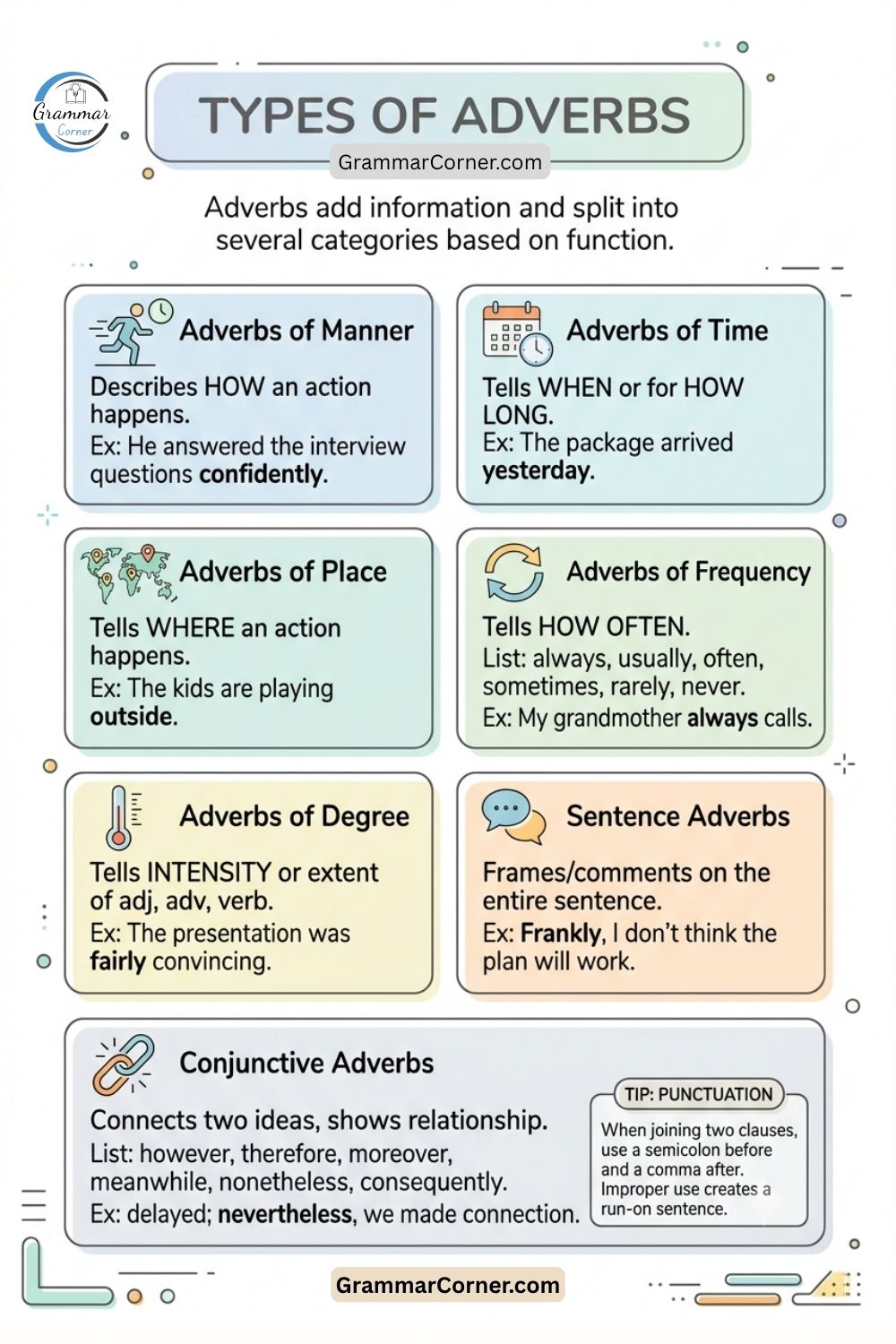
Adverbs of Manner
An adverb of manner describes how an action happens, and it's the type most people picture first when they think of adverbs.
He answered the interview questions confidently.
"Confidently" describes the manner in which he answered — not just that he answered, but the way he did it.
Many adverbs of manner are formed by adding "-ly" to an adjective (quiet → quietly, careful → carefully), but plenty of common ones don't follow that pattern at all, like "well," "fast," and "hard."
Adverbs of Time
An adverb of time tells you when something happens, or how long it lasts.
The package arrived yesterday, much earlier than expected.
"Yesterday" pins down exactly when the arrival happened.
Adverbs of Place
An adverb of place tells you where an action happens.
The kids are playing outside despite the cold weather.
"Outside" answers the question of where the playing is happening.
Adverbs of Frequency
An adverb of frequency tells you how often something happens.
- always
- usually
- often
- sometimes
- rarely
- never
My grandmother always calls on Sunday mornings.
"Always" tells you how frequently the calling happens, without needing to spell out an exact schedule.
Adverbs of Degree
An adverb of degree tells you the intensity or extent of an adjective, another adverb, or occasionally a verb.
The presentation was fairly convincing, though a bit too long.
"Fairly" softens "convincing," showing that the presentation was convincing to a moderate extent, not overwhelmingly so.
Sentence Adverbs
A sentence adverb doesn't modify one specific word — it comments on or frames the entire sentence, often expressing the speaker's attitude toward what follows.
Frankly, I don't think the plan will work.
"Frankly" isn't describing how the speaker will think — it's setting the tone for the whole statement, signaling honesty about what's coming next.
Conjunctive Adverbs
A conjunctive adverb connects two independent ideas while showing the relationship between them, such as contrast, cause, or sequence.
- however
- therefore
- moreover
- meanwhile
- nonetheless
- consequently
The flight was delayed by three hours; nevertheless, we still made our connection.
"Nevertheless" links the two ideas together and signals contrast between the delay and the fact that the connection was still made.
When a conjunctive adverb joins two independent clauses, it typically needs a semicolon before it and a comma after it, as shown above. Treating it like an ordinary conjunction and using only a comma before it creates a run-on sentence.
Functions of Adverbs in a Sentence
An adverb's category tells you what kind of information it adds. Its function tells you exactly which word or words it's attached to within a specific sentence.
Modifying a Verb
This is the most common job an adverb does — describing how, when, where, or how often an action happens.
She whispered nervously before her turn to present.
"Nervously" modifies the verb "whispered," describing the manner of the action.
Modifying an Adjective
An adverb can intensify or soften an adjective, sharpening the description.
The lecture hall was surprisingly crowded for a Friday afternoon.
"Surprisingly" modifies the adjective "crowded," adding a layer of unexpectedness to the description.
Modifying Another Adverb
An adverb can also modify a different adverb, usually adjusting its intensity.
He finished the marathon incredibly quickly, beating his previous record.
"Incredibly" modifies "quickly," which itself is modifying the verb "finished." Two adverbs are stacking here, each doing a slightly different job.
Modifying an Entire Sentence
As shown earlier with sentence adverbs, an adverb can frame or comment on everything that follows it rather than attaching to a single word.
Unfortunately, the concert was cancelled due to the storm.
Adverb Placement and Meaning
Where an adverb sits in a sentence can genuinely change what the sentence means, which makes placement one of the more important skills to develop.
Only she finished the assignment on time.
Nobody else finished it on time — only her.
Notice how the same three words — "she," "only," and "finished" — shift meaning depending purely on where "only" lands.
Fortunately, the technician arrived quickly and fixed the router almost immediately.
- Fortunately — sentence adverb, framing the whole sentence with a sense of relief
- quickly — adverb of manner, modifying "arrived"
- almost — adverb of degree, modifying "immediately"
- immediately — adverb of time, modifying "fixed"
How to Identify an Adverb
The "-ly" Test
The "-ly" test is a useful starting point, but it's far from foolproof. Plenty of adverbs end in "-ly" (quickly, carefully, honestly), but plenty of common adverbs don't. Meanwhile, some "-ly" words are actually adjectives, not adverbs at all — they describe nouns rather than modifying verbs.
- fast
- well
- hard
- late
- soon
- friendly
- lovely
- lonely
The Question Test
A more reliable approach is the question test. Ask whether the word is answering how, when, where, how often, or to what extent. If it is, and it's attached to a verb, adjective, adverb, or whole sentence rather than a noun, it's almost certainly an adverb.
The Movability Test
Many adverbs can shift position within a sentence without breaking the grammar, even if the emphasis changes slightly. All three versions below are grammatically valid:
Suddenly, the lights went out.
The lights suddenly went out.
The lights went out suddenly.
Adjectives, by contrast, are usually locked into position right next to the noun they describe.
Check What It's Modifying
If the word is describing a noun, it's an adjective, not an adverb, even if the sentence structure looks similar at first glance.
Common Mistakes with Adverbs
❌ IncorrectShe drove the car very careful through the narrow streets.
✅ CorrectShe drove the car very carefully through the narrow streets.
Why: The word is modifying the verb "drove," describing how she drove, so it needs the adverb form "carefully," not the adjective form "careful."
❌ IncorrectHe did good on his final exam.
✅ CorrectHe did well on his final exam.
Why: "Did" is a verb, so it needs an adverb to describe how the action was performed. "Good" is an adjective and should only describe a noun, as in "a good exam."
❌ IncorrectI can't hardly hear you over this music.
✅ CorrectI can hardly hear you over this music.
Why: "Hardly" already carries a negative meaning on its own, so pairing it with "can't" creates a double negative, which technically flips the meaning back to the opposite of what's intended.
❌ IncorrectThis recipe is more easier than the one we tried last week.
✅ CorrectThis recipe is easier than the one we tried last week.
Why: "Easier" is already the comparative form of "easy." Adding "more" in front creates a redundant double comparative, which isn't standard in modern English.
❌ IncorrectThe manager only spoke to two employees about the schedule change, everyone else found out later.
✅ CorrectThe manager spoke to only two employees about the schedule change; everyone else found out later.
Why: Placing "only" right before "spoke" can make it sound like speaking was the sole action taken, when the sentence actually means just two employees were told. Moving "only" closer to what it's actually limiting removes the ambiguity.
Signs and everyday speech often use short forms like "drive slow" or "think smart" instead of "drive slowly" or "think smartly." These are called flat adverbs, and while they're common and generally accepted in casual American English, formal writing usually still expects the full "-ly" form.
Tips for Using Adverbs Correctly
-
Place adverbs of frequency like always, usually, and never directly before the main verb — but after the verb “be.”
She always arrives early.She is always early.She early always arrives. -
Watch out for words that look identical as adjectives and adverbs, like fast, hard, and late. Context, not spelling, tells you which one you’re dealing with.
Adjective A fast car Adverb She drove fast -
Use well to describe how an action is performed, and good to describe a noun — unless you’re talking about health, where “well” can also mean “not sick.”
Health sense I feel well General sense I feel good -
Read a sentence aloud with the adverb in different positions if you’re unsure where it belongs. Adverb placement is genuinely more flexible in English than in many other languages, but the position you choose can still shift emphasis or clarity.
-
American English tends to be a little more relaxed about flat adverbs in everyday speech, while British English leans slightly more toward keeping the full “-ly” form even in casual contexts.
American: “Take it easy.” · “Drive safe.” — British: “Drive safely.” Neither approach is incorrect; it’s simply a difference in regional convention.
Practice Exercises
Exercise 1: Identify the Adverbs
-
The technician quickly repaired the printer before the meeting started.
Adverb: quickly -
Honestly, the new café downtown is surprisingly good.
Adverbs: Honestly, surprisingly -
We rarely eat out during the week, but we always do on Fridays.
Adverbs: rarely, always
Exercise 2: Classify Each Adverb by Type
-
everywhere
Type: place -
immediately
Type: time -
barely
Type: degree -
gracefully
Type: manner
Exercise 3: Fix the Mistake
-
The children behaved very good at the museum.
Corrected: The children behaved very well at the museum. -
This new phone charges more faster than my old one.
Corrected: This new phone charges faster than my old one. -
He can’t barely stay awake during afternoon meetings.
Corrected: He can barely stay awake during afternoon meetings.
Adverb vs Related Grammar Terms
Adverb vs Adjective
An adverb modifies a verb, an adjective, or another adverb, while an adjective modifies only a noun. The two are easy to mix up, since some words look almost identical in both forms.
She gave a quick answer during the quiz.
"Quick" describes the noun "answer."
She answered quickly during the quiz.
"Quickly" describes the verb "answered."
Adverb vs Preposition
Some short words, like "up," "down," "in," and "around," can function as either an adverb or a preposition, depending on whether they're followed by an object.
He looked up the address before leaving the house.
"Up" pairs with "the address" as part of a phrasal verb, closer to an adverb particle here.
He looked up at the tall building.
"Up" works together with "at the tall building," and the whole phrase functions prepositionally.
A simpler test: if the word is directly followed by a noun it's connecting to, it's likely working as a preposition. If it stands alone, describing the verb without an object attached, it's functioning as an adverb.
Adverb vs Conjunction
A conjunctive adverb, like "however" or "therefore," connects ideas but is grammatically still an adverb, while a true conjunction, like "but" or "so," follows different punctuation rules entirely.
| Feature | Conjunctive Adverb | Conjunction |
|---|---|---|
| Example | however, therefore | but, so |
| Punctuation before it | Semicolon | Comma |
| Can it move within the clause? | Yes | No, it must stay between the clauses |
| Example sentence | The traffic was terrible; however, we arrived on time. | The traffic was terrible, but we arrived on time. |
Frequently Asked Questions
-
Do all adverbs end in “-ly”?
No. Many common adverbs, like fast, well, hard, soon, and late, don’t end in “-ly” at all, while some “-ly” words, like friendly and lovely, are actually adjectives.
-
Can an adverb modify a noun?
No. Modifying a noun is the job of an adjective. If a word is describing a noun directly, it isn’t functioning as an adverb, even if it happens to be spelled the same as one.
-
Where should an adverb go in a sentence?
It depends on the type. Adverbs of manner, time, and place are fairly flexible and can often move between the beginning, middle, or end of a sentence. Adverbs of frequency usually sit right before the main verb, though they follow the verb “be.”
-
Is “very” an adverb?
Yes. “Very” is an adverb of degree, and its job is to intensify whatever word comes after it — usually an adjective or another adverb, as in very tired or very quickly.
-
What’s the difference between “good” and “well”?
“Good” is an adjective and describes a noun, as in a good meal. “Well” is usually an adverb and describes how an action is performed, as in she sings well, though “well” can also function as an adjective specifically when talking about health, as in I feel well.
-
Can a sentence have more than one adverb?
Yes, and it’s extremely common. Adverbs can stack to modify different parts of the same sentence, or even modify each other, as in “She spoke unusually softly during the announcement,” where “unusually” modifies “softly,” and together they describe how she spoke.
See also: