Irregular Plural Nouns (Definition, Types, Examples)
Understanding Irregular Plural Nouns
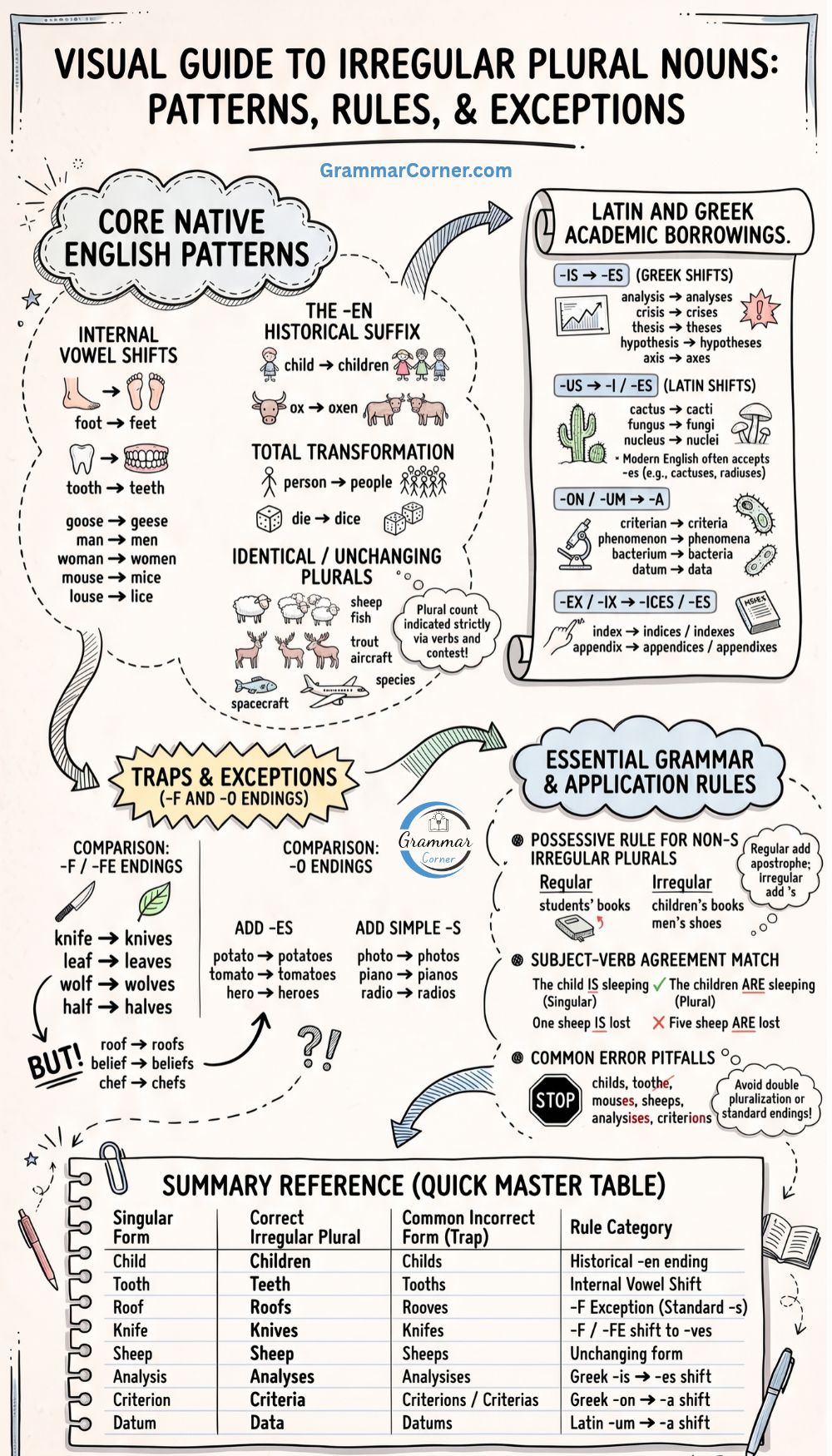
English nouns typically become plural in a predictable manner by appending -s or -es to a singular noun (e.g., book ➔ books, class ➔ classes). However, English also features many nouns that resist these simple patterns, shifting vowels, altering endings, adding distinct suffixes, or remaining completely unchanged.
These terms are known as irregular plural nouns. They appear frequently in daily conversation, formal correspondence, and academic prose. Mastering them is essential because applying regular plural endings where irregular forms are required creates ungrammatical sentences.
What Are Irregular Plural Nouns?
An irregular plural noun is a noun whose plural form is not formed by adding the standard -s or -es suffix.
| Singular | Plural |
|---|---|
| man | men |
| woman | women |
| child | children |
| tooth | teeth |
| foot | feet |
| mouse | mice |
| person | people |
Never write words like childs, tooths, or mouses. Always use their correct irregular counterparts (children, teeth, mice).
Quick Challenge #1
Choose the correct plural form for: One tooth ➔ several ______. Tap an option.
See the full explanation
Answer: B. teeth
Grammar breakdown:
- Vowel Shift: Words like tooth and foot form their plurals via internal vowel changes (teeth, feet) rather than adding -s.
- Additional Reference: Other examples from Quick Challenge #1 include children, mice, women, and feet.
How Are Irregular Plurals Different from Regular Plurals?
The most straightforward way to master irregular plurals is to contrast them directly with regular plural nouns. While regular nouns adhere to predictable spelling formulas, irregular nouns undergo distinct structural transformations.
Follow established suffix patterns (-s / -es):
- car ➔ cars
- teacher ➔ teachers
- box ➔ boxes
- dish ➔ dishes
- city ➔ cities
Alter vowels, endings, or remain identical:
- man ➔ men
- knife ➔ knives
- child ➔ children
- analysis ➔ analyses
- sheep ➔ sheep
The Trap of Letter Endings
A common mistake among learners is assuming that nouns ending with the same letters will always follow identical plural rules. For instance, while many words ending in -f shift to -ves, others simply take -s.
Spelling patterns serve as helpful general guides, but they are not absolute rules. Always verify irregular noun forms rather than guessing based on word endings.
Quick Challenge
Which noun forms its plural with a standard -s rather than shifting to -ves? Tap an option.
See the full explanation
Answer: B. roof
Grammar breakdown:
- Standard Suffix: Roof becomes roofs, demonstrating that similar letter endings do not guarantee identical plural rules.
- Irregular Shift: Words like leaf (leaves) and knife (knives) adopt the -ves plural pattern.
Types of Irregular Plural Nouns
Irregular plurals can be organized into several distinct categories. Recognizing these primary structural groups makes them much easier to master and retain.
1. Plurals That Change the Vowel
Some of the most familiar irregular nouns form their plurals by changing one or more internal vowels rather than adding suffixes like -s or -es.
| Singular | Plural |
|---|---|
| Louse | Lice |
| woman | women |
| foot | feet |
| tooth | teeth |
| goose | geese |
2. Plurals Ending in -en
A select group of common nouns form their plurals using an -en suffix or a related historical ending.
- child ➔ children
- ox ➔ oxen
Note: Children involves a complex historical root development rather than a simple child + en formula.
• Several oxen were pulling the cart.
3. Plurals That Change Completely
Some nouns transform into plural forms that bear little resemblance to their singular roots and must be memorized independently.
| Singular | Plural |
|---|---|
| person | people |
| mouse | mice |
| louse | lice |
| die | dice |
Example: One person was waiting outside. ➔ Several people were waiting outside.
4. Plurals That Do Not Change
Certain nouns maintain the exact same spelling in both singular and plural forms. Context and verb agreement clarify the count.
• Five deer are near the road.
The surrounding words and verbs provide the necessary plural clue.
Fish is normally used for both singular and plural (e.g., “I caught one fish” ➔ “We caught five fish”). In specialized contexts, particularly when discussing multiple distinct species, fishes may also appear.
Quick Challenge
Which noun remains completely unchanged in its plural form? Tap an option.
See the full explanation
Answer: B. sheep
Grammar breakdown:
- Unchanging Plurals: Words like sheep, deer, and fish have identical singular and plural spelling forms.
- Other Categories: Mouse changes to mice (internal vowel shift), and child changes to children (-en suffix).
Irregular Plurals of Words Ending in -f and -fe
Many nouns ending in -f or -fe form their plural counterparts by replacing the ending with -ves. However, because exceptions are common, this pattern should be treated as a useful tendency rather than an absolute rule.
- knife ➔ knives
- wife ➔ wives
- life ➔ lives
- leaf ➔ leaves
- calf ➔ calves
- loaf ➔ loaves
- wolf ➔ wolves
- half ➔ halves
Structural pattern: f/fe ➔ v + plural ending
Many nouns ending in -f simply take a standard -s:
- roof ➔ roofs (not rooves)
- belief ➔ beliefs
- chief ➔ chiefs
- chef ➔ chefs
- proof ➔ proofs
Irregular Plurals of Words Ending in -o
Nouns ending in -o present a similar split. While many take an -es ending, others simply append -s.
| Taking -es (-oes) | Taking -s (-os) |
|---|---|
| potato ➔ potatoes | photo ➔ photos |
| tomato ➔ tomatoes | piano ➔ pianos |
| hero ➔ heroes | radio ➔ radios |
| veto ➔ vetoes | video ➔ videos |
| volcano ➔ volcanoes | zoo ➔ zoos |
Certain words feature multiple accepted plural forms depending on context or regional preference (e.g., cello can appear as cellos or celli). When in doubt, consult a reliable dictionary.
Quick Challenge #2
Choose the correct plural form for: roof ➔ ______. Tap an option.
See the full explanation
Answer: B. roofs
Grammar breakdown:
- F-Ending Exception: Although words like knife change to knives, words like roof and belief defy the pattern by simply adding -s (roofs, beliefs).
- Additional Reference: Other correct plurals from Quick Challenge #2 include potatoes, photos, heroes, and knives.
Irregular Plurals Ending in -is
Many nouns ending in -is originate from Greek or Latin and form their plural counterparts by changing -is to -es.
| Singular | Plural |
|---|---|
| analysis | analyses |
| crisis | crises |
| thesis | theses |
| hypothesis | hypotheses |
| axis | axes |
A frequent mistake is adding regular suffixes onto these forms, producing incorrect words like analysises or criseses. Stick to the traditional -es shift.
Irregular Plurals of Words Ending in -us
Several nouns ending in -us, particularly terms derived from Latin, feature traditional plurals ending in -i.
- cactus ➔ cacti
- fungus ➔ fungi
- nucleus ➔ nuclei
- radius ➔ radii
- alumnus ➔ alumni
- focus ➔ foci
Contemporary English often accepts English-style plurals alongside traditional forms:
- focus ➔ focuses
- radius ➔ radiuses
- cactus ➔ cactuses
The preferred form can depend on context, field, and style (e.g., radii is especially familiar in mathematics).
Quick Challenge
Which is the correct traditional plural form for cactus? Tap an option.
See the full explanation
Answer: B. cacti
Grammar breakdown:
- Latin Origin: Words ending in -us like cactus and fungus traditionally shift their endings to -i (cacti, fungi).
- Modern Acceptability: While cactuses is also used in casual contexts, cacti remains the standard traditional choice.
Plurals Ending in -on
Several Greek-derived nouns form their plural counterparts by shifting the ending -on to -a. These terms are particularly frequent in academic, scientific, and professional prose.
| Singular (-on) | Plural (-a) |
|---|---|
| phenomenon | phenomena |
| criterion | criteria |
Using traditional forms like criteria and phenomena correctly is especially critical in academic and professional writing.
Plurals Ending in -um
Many Latin-derived nouns ending in -um form traditional plurals ending in -a.
| Singular (-um) | Plural (-a) |
|---|---|
| datum | data |
| bacterium | bacteria |
| memorandum | memoranda |
| curriculum | curricula |
| stratum | strata |
English usage varies. Certain words now accept standard English plural endings alongside traditional forms (e.g., curriculums is frequently used alongside traditional curricula).
Plurals of Words Ending in -ix or -ex
Some nouns ending in -ix or -ex retain traditional plurals ending in -ices, though modern alternatives are also widespread.
- index ➔ indices
- appendix ➔ appendices
- vortex ➔ vortices
Contemporary English also permits standard -es plurals:
- index ➔ indexes
- appendix ➔ appendixes
- vortex ➔ vortexes
Preference often depends on context (e.g., indexes for database books; indices in mathematical technical prose).
Quick Challenge #3
Complete the sentence with the correct plural form: The main ______ are accuracy and reliability. (criterion). Tap an option.
See the full explanation
Answer: B. criteria
Grammar breakdown:
- Greek Root Shift: Words ending in -on like criterion and phenomenon form their plurals by changing the ending to -a (criteria, phenomena).
- Additional Reference: Other correct plurals from Quick Challenge #3 include data, bacteria, curricula/curriculums, and phenomena.
Latin and Greek Plurals in Modern English
English has borrowed thousands of words from Latin and Greek. While some borrowed nouns retain their original plural patterns, others have gradually adapted to standard English plurals over time.
| Singular | Traditional Plural |
|---|---|
| bacterium | bacteria |
| criterion | criteria |
| phenomenon | phenomena |
| analysis | analyses |
| thesis | theses |
| nucleus | nuclei |
A word’s etymological origin explains its historical plural, but speakers do not always preserve original foreign patterns. English continually adapts borrowed words to its own grammatical norms.
Common Irregular Plural Nouns You Should Know
A master reference collection of high-frequency irregular plural nouns spanning different root categories:
| Singular | Plural |
|---|---|
| man | men |
| woman | women |
| child | children |
| person | people |
| tooth | teeth |
| foot | feet |
| mouse | mice |
| goose | geese |
| ox | oxen |
| louse | lice |
| sheep | sheep |
| deer | deer |
| fish | fish |
| species | species |
| aircraft | aircraft |
| knife | knives |
| wife | wives |
| life | lives |
| leaf | leaves |
| wolf | wolves |
| half | halves |
| analysis | analyses |
| crisis | crises |
| thesis | theses |
| hypothesis | hypotheses |
| phenomenon | phenomena |
| criterion | criteria |
| bacterium | bacteria |
| datum | data |
| nucleus | nuclei |
| cactus | cacti / cactuses |
| index | indices / indexes |
| appendix | appendices / appendixes |
While this list is not exhaustive, mastering these high-frequency irregular nouns provides a solid foundation for flawless academic, professional, and everyday writing.
Quick Challenge
Which irregular plural noun remains identical in both its singular and plural forms? Tap an option.
See the full explanation
Answer: B. species
Grammar breakdown:
- Unchanging Plurals: Words like species, sheep, deer, and aircraft do not alter their spelling in the plural.
- Other Categories: Analysis shifts to analyses (-is to -es), and mouse shifts to mice (vowel change).
Common Mistakes with Irregular Plural Nouns
Because regular plural rules are ubiquitous, learners frequently apply them automatically to irregular nouns. Reviewing frequent errors prevents common ungrammatical pitfalls.
| Incorrect Form | Correct Irregular Form |
|---|---|
| mans | men |
| womans | women |
| childs | children |
| foots | feet |
| tooths | teeth |
| mouses | mice |
| sheeps | sheep |
| deers | deer |
| knifes | knives |
| leafs | leaves |
| analysises | analyses |
| criterions* | criteria* |
| phenomenons* | phenomena* |
*Note: While occasional specialized or modern variations exist in loose speech, criteria and phenomena remain the standard traditional plurals.
Avoid treating plurals as an afterthought. Instead of memorizing isolated words like mouse, learn them paired together as mouse ➔ mice or criterion ➔ criteria to build stronger linguistic links.
Subject-Verb Agreement with Irregular Plural Nouns
Mastering plural forms is only half the task; you must also pair them with the appropriate verb agreement.
Singular nouns take singular verbs:
- The child is sleeping.
- The man is outside.
- The criterion is important.
- One sheep is missing.
Irregular plurals take plural verbs:
- The children are sleeping.
- The men are outside.
- The criteria are important.
- Five sheep are missing.
With unchanged nouns like sheep, context is crucial. The spelling remains identical, but the accompanying verb adapts based on whether the intended count is singular or plural.
Irregular Plurals and Possessive Forms
Irregular nouns also impact possessive constructions. While regular plural nouns ending in -s add only an apostrophe (e.g., the students’ books), irregular plurals that do not end in -s take ‘s.
Always use children’s for possession; avoid inventing ungrammatical forms like childrens or childrens’.
Quick Challenge
Which possessive form is grammatically correct for an irregular plural noun? Tap an option.
See the full explanation
Answer: C. children’s
Grammar breakdown:
- Possessive Rule: Because irregular plural nouns like children, men, and women do not end in an -s, they require ‘s to form the possessive case (children’s books, men’s shoes).
- Subject-Verb Agreement: Remember that plural irregular nouns also take plural verbs (e.g., The children are playing).
How to Learn Irregular Plural Nouns Easily
While irregular plurals can seem daunting because they cannot be reduced to a single rule, adopting a systematic, strategic approach makes mastering them much easier.
1. Learn Them in Groups
Avoid memorizing random vocabulary lists. Instead, cluster similar structural forms together to build natural recall patterns:
- man ➔ men
- woman ➔ women
- foot ➔ feet
- tooth ➔ teeth
- goose ➔ geese
- knife ➔ knives
- life ➔ lives
- wife ➔ wives
- leaf ➔ leaves
- wolf ➔ wolves
- sheep ➔ sheep
- deer ➔ deer
- fish ➔ fish
- species ➔ species
- analysis ➔ analyses
- criterion ➔ criteria
- phenomenon ➔ phenomena
- bacterium ➔ bacteria
2. Learn Them Through Sentences
Rather than studying isolated vocabulary words, embed each noun into complete sentence progressions:
3. Read and Listen Regularly
Irregular plurals become second nature when encountered repeatedly in authentic English. Reading books, articles, news reports, and academic papers exposes you to these forms naturally, while speaking reinforces the mental link between singular and plural forms.
4. Keep a Personal List
Maintain a dedicated vocabulary log. Whenever you encounter an unfamiliar irregular plural, record both forms together with a brief example sentence:
- hypothesis ➔ hypotheses (e.g., “Both hypotheses were tested.”)
- appendix ➔ appendices (e.g., “Check the appendices for data.”)
- goose ➔ geese (e.g., “A flock of geese flew overhead.”)
Reviewing a curated personal list regularly proves far more effective than trying to memorize every irregular noun at once.
Group related words, practice them in active sentences, and review your personal log consistently for long-term retention.
Quick Challenge
What is the most effective way to learn irregular plural nouns according to grammar experts? Tap an option.
See the full explanation
Answer: B. Learn them in structural groups and practice them in full sentences.
Grammar breakdown:
- Structured Learning: Grouping words by category (vowel changes, -ves endings, unchanged nouns) builds systematic recall paths.
- Contextual Reinforcement: Practicing nouns within sentences locks in both their spelling and subject-verb agreement rules.
A Simple Strategy for Remembering Difficult Plurals
When encountering a noun with an uncertain plural form, apply a reliable three-step verification method to prevent blindly applying rules that may not work.
- Step 1: Ask whether it is regular (can you naturally form the plural with -s or -es?).
- Step 2: Look for a familiar root pattern (does it resemble foot ➔ feet, knife ➔ knives, analysis ➔ analyses, or criterion ➔ criteria?).
Verify accepted forms:
If uncertainty remains, consult a reliable dictionary, particularly for words that feature multiple accepted plural variations.
Irregular Plurals in Formal and Academic Writing
Irregular plurals carry heightened importance in formal writing, where errors compromise both grammatical accuracy and professional credibility.
Pay rigorous attention to irregular plurals when preparing essays, reports, research papers, professional documents, and examinations.
Do All Irregular Plurals Have a Rule?
No. While some irregular plurals follow recognizable patterns, others cannot be predicted reliably. Learning them requires a balanced mix of pattern recognition and direct memorization.
| Example Word | Underlying Pattern Type |
|---|---|
| foot ➔ feet | Vowel-change pattern |
| knife ➔ knives | Ending-change pattern (-ves) |
| analysis ➔ analyses | Recognizable -is ➔ -es pattern |
| person ➔ people | Completely irregular (no simple modern rule) |
| sheep ➔ sheep | Unchanged plural form |
Frequently Asked Questions About Irregular Plural Nouns
- Person: people (though persons appears in official legal contexts).
- Sheep / Deer: Unchanged (one sheep ➔ ten sheep; one deer ➔ several deer).
- Analysis: analyses.
- Criterion: Traditional plural is criteria.
- Phenomenon: Traditional plural is phenomena.
- Fishes: Yes, but with specific usage. Fish is standard for general plurals, while fishes is used when discussing multiple distinct species or varieties.
- F-Endings: No. While some words become -ves (leaf ➔ leaves, knife ➔ knives), others simply add -s (roof ➔ roofs, belief ➔ beliefs).
Final Quick Challenge
Choose the correct plural form for: There are five ______ in the laboratory. (bacteriums / bacteria). Tap an option.
See the full explanation
Answer: B. bacteria
Grammar breakdown:
- Latin Root Shift: Nouns ending in -um like bacterium and datum form traditional plurals ending in -a (bacteria, data).
- Additional Reference: Other correct answers from the Final Quick Challenge include men, teeth, sheep, criteria, deer, analyses, and geese.