Determiners Chart (Types, Usage & Examples)
What Are Determiners?
Say these two sentences out loud:
“I need pen.”
“I need a pen.”
The first one sounds broken, even though every word in it is spelled correctly and the grammar mostly holds together. Something is missing — and that something is a tiny word sitting right in front of the noun: a.
That small word is doing real work. It tells the listener you’re talking about one pen, any pen — not a specific one you both already know about. Take it out, and the sentence loses its footing. Try it yourself:
I need ? pen.
Something’s missing before “pen” — the sentence can’t stand up.
This is what a determiner does.
A determiner is a word placed in front of a noun to identify, specify, or quantify it — to tell us which one, how many, or whose it is.
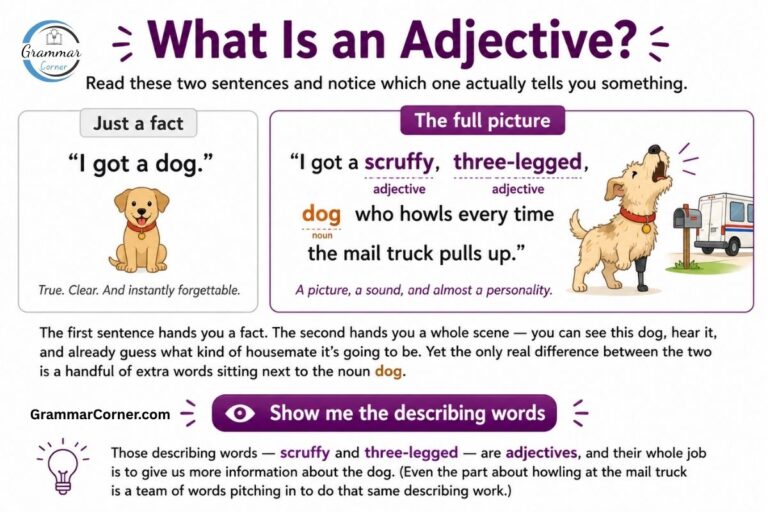
Determiners don’t describe a noun the way adjectives do. A red pen and a cheap pen tell you something about the pen’s qualities. A pen, the pen, my pen, this pen — these tell you how the noun fits into the conversation.
What kind of pen is it? What are its qualities?
Which pen? Whose pen? How does it fit into the conversation?
Compare a few more pairs:
“Pass me book.”
“Pass me the book.”
“She adopted cat.”
“She adopted a cat.”
“Where’s remote?”
“Where’s my remote?”
In each case, the sentence needed a determiner before the noun could stand up straight. English leans on these small words constantly — which is exactly why they deserve their own close look.
A determiner sits in front of a noun and answers which one, how many, or whose. An adjective answers what kind. Same position in the sentence — completely different job.
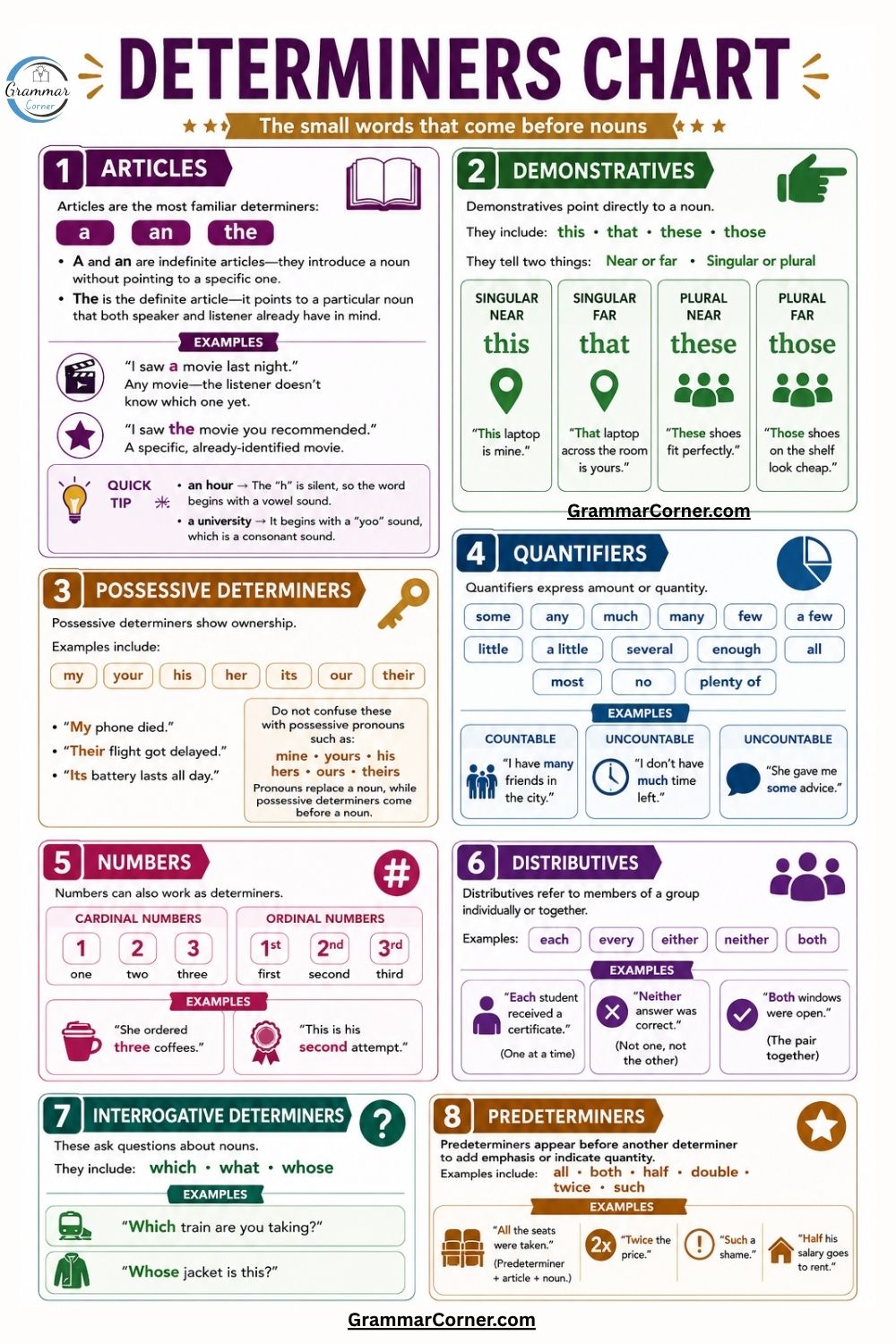
Determiners at a GlanceQuick Overview Table
| Type | Common Examples | What It Does |
|---|---|---|
| Articles | a, an, the | Introduces a noun as specific or general |
| Demonstratives | this, that, these, those | Points to a particular noun, near or far |
| Possessive determiners | my, your, his, her, its, our, their | Shows who or what a noun belongs to |
| Quantifiers | some, any, much, many, few, little, several, all, most, no | Shows an amount or quantity |
| Numbers | one, two, three, first, second, third | Shows an exact quantity or order |
| Distributives | each, every, either, neither, both | Refers to members of a group individually or as a pair |
| Interrogative determiners | which, what, whose | Asks a question about a noun |
| Predeterminers | all, both, half, double, twice, such | Appears before another determiner |
Keep this table in mind as you read on — every type in it gets its own explanation below.
Are Determiners a Part of Speech?
Here’s where grammar books start to disagree with each other, so it’s worth clearing up early.
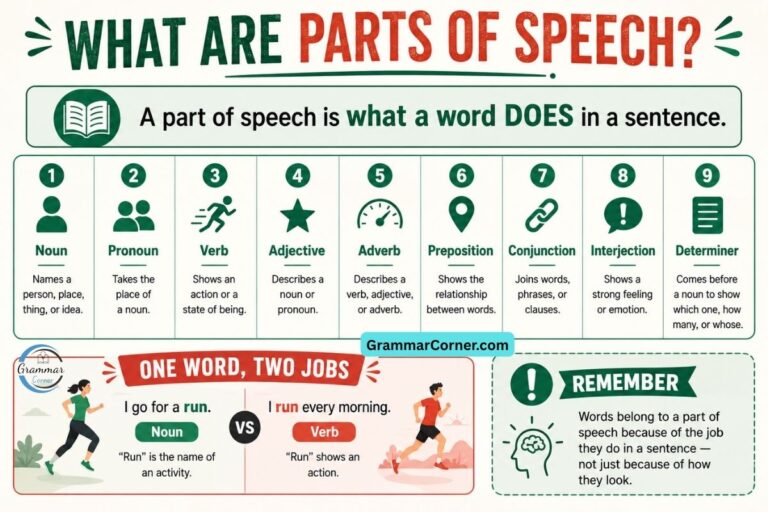
Traditional school grammar recognizes eight parts of speech: nouns, pronouns, verbs, adjectives, adverbs, prepositions, conjunctions, and interjections. Notice that determiners aren’t on that list. For a long time, words like a, the, this, and my were simply filed under “adjectives,” since they show up in the same spot — right before a noun.
Modern grammar takes a different view. Most contemporary linguists and current grammar references treat determiners as their own separate word class, distinct from adjectives. The reasoning holds up well once you test it: adjectives describe qualities and can usually be graded (tall, taller, tallest), while determiners can’t be graded at all — there’s no such thing as “more the” or “very my.” Determiners also form a small, closed set of words, while adjectives are an open, ever-growing category.
Adjectives
- Describe qualities
- Can usually be graded: tall, taller, tallest
- An open, ever-growing category
Determiners
- Point to or quantify a noun
- Can’t be graded: no “more the” or “very my”
- A small, closed set of words
Both approaches still appear in classrooms and textbooks today, and neither one is “wrong” — they’re just different ways of organizing the same language. This article follows the modern classification and treats determiners as their own word class, while pointing out the traditional adjective-based view wherever it’s useful to know.
Types of Determiners
Determiners come in several flavors, and each one does a slightly different job. Here’s the full lineup.
Articles
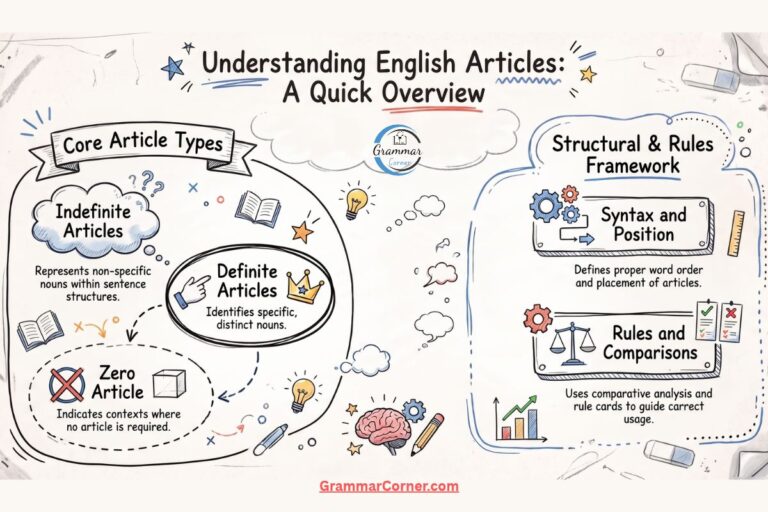
Articles are the most familiar determiners: a, an, and the. A and an are indefinite articles — they introduce a noun without pointing to a specific one. The is the definite article — it points to a particular noun that both speaker and listener already have in mind.
“I saw a movie last night.”Any movie — the listener doesn’t know which one yet. “I saw the movie you recommended.”A specific, already-identified movie.The choice between a and an comes down to sound, not spelling. Use an before a word that starts with a vowel sound, and a before a word that starts with a consonant sound.
an hour — the h is silent, so the word starts with a vowel sound.
a university — it starts with a “yoo” sound, which counts as a consonant sound despite the vowel letter.
Demonstratives
Demonstratives point directly at a noun: this, that, these, those. They tell you two things at once — how many (singular or plural) and how close (near or far).
“This laptop is mine.”
“That laptop across the room is yours.”
“These shoes fit perfectly.”
“Those shoes on the shelf look cheap.”
Possessive Determiners
Possessive determiners show who or what a noun belongs to: my, your, his, her, its, our, their. They always sit directly in front of a noun.
“My phone died.”
“Their flight got delayed.”
“Its battery lasts all day.”
Don’t confuse these with possessive pronouns like mine, yours, his, hers, ours, theirs, which stand in for a noun instead of sitting in front of one. That distinction gets its own section further down.
Quantifiers
Quantifiers show amount: some, any, much, many, few, a few, little, a little, several, enough, all, most, no, plenty of. Some pair with countable nouns, some with uncountable nouns, and a few work with both.
“I have many friends in the city.”
Countable“I don’t have much time left.”
Uncountable“She gave me some advice.”
UncountableNumbers
Cardinal numbers (one, two, three) and ordinal numbers (first, second, third) both function as determiners when they sit in front of a noun and specify quantity or order.
“She ordered three coffees.”
“This is his second attempt.”
Distributives
Distributives refer to members of a group, either one at a time or as a pair: each, every, either, neither, both.
“Each student received a certificate.”
One at a time“Neither answer was correct.”
Not one, not the other“Both windows were open.”
The pair, togetherInterrogative Determiners
Interrogative determiners ask a question about a noun: which, what, whose. Unlike interrogative pronouns, they’re always followed directly by a noun.
“Which train are you taking?”
“Whose jacket is this?”
Predeterminers
Predeterminers show up before another determiner, adding a sense of totality, proportion, or emphasis: all, both, half, double, twice, such.
“All the seats were taken.”Predeterminer + article + noun.“Twice the price.”
“Such a shame.”
“Half his salary goes to rent.”
Functions of Determiners in a Sentence
Determiners aren’t decoration. They change what a noun actually means in context. Watch the same noun, cake, shift meaning as the determiner changes:
-
The cake is on the table.
a specific cake you both know about -
A cake is on the table.
some cake, first time it’s mentioned -
This cake is delicious.
pointing to a particular cake, right here -
My cake didn’t rise properly.
ownership — it belongs to the speaker -
Some cake is left over.
an unspecified amount
Same noun, five completely different meanings, and the determiner is doing all the shifting. In general, determiners let a sentence:
- Identify a noun as one specific thing — “the report”
- Introduce a noun for the first time — “a new employee”
- Specify which one among several — “that email, not this one”
- Show ownership — “her password”
- Quantify how much or how many — “several complaints”
Once you notice this pattern, you’ll start seeing it everywhere — a determiner is often the single word doing the most work to narrow down exactly what a noun refers to.
How to Identify Determiners
A few quick tests help you spot a determiner in the wild.
-
Position test
A determiner sits before a noun, and before any adjectives that describe that noun.
“The old bridge” — the is the determiner, old is the adjective, bridge is the noun.
-
The stacking test
You generally can’t stack two determiners of the same type in front of one noun. You have to choose one.
“The my book” doesn’t work — it has to be “my book” or “the book.”
-
The grading test
Try adding very or more in front of the word. Adjectives usually accept this (“very tall,” “more careful”). Determiners reject it — there’s no “very the” or “more my.”
-
The replacement test
If you’re not sure whether a word is a determiner, try swapping in the. If the sentence still makes grammatical sense, you’re likely looking at a determiner slot.
“I lost ___ keys” works with my, these, some, or the — all determiners.
Functions of Determiners in a Sentence
Determiners aren’t decoration — they change what a noun actually means in context. Watch the same noun, cake, shift meaning as the determiner changes. Tap each one:
The cake is on the table.
A specific cake you both know about.
Same noun, five completely different meanings — and the determiner is doing all the shifting. In general, determiners let a sentence do five jobs:
Marks a noun as one specific thing.
Brings a noun into the conversation for the first time.
Picks out which one among several.
Tells us who the noun belongs to.
Shows how much or how many.
Once you notice this pattern, you’ll start seeing it everywhere — a determiner is often the single word doing the most work to narrow down exactly what a noun refers to.
How to Identify Determiners
A few quick tests help you spot a determiner in the wild.
A determiner sits before a noun — and before any adjectives that describe that noun.
Determiner first, adjective second, noun last — that order is remarkably stable in English.
You generally can’t stack two determiners of the same type in front of one noun. You have to choose one.
Try adding very or more in front of the word. Adjectives usually accept it. Determiners reject it flat.
If very sounds absurd in front of it, you’re probably looking at a determiner.
Not sure whether a word is a determiner? Try swapping in the. If the sentence still makes grammatical sense, you’re likely looking at a determiner slot. Test the slot yourself:
I lost ___ keys.
Determiners vs Related Grammar Terms
Determiners vs Articles
Articles aren’t a separate thing from determiners — they’re one type of determiner. A, an, and the are the three articles in English, and they all belong to the larger determiner category alongside demonstratives, possessives, and quantifiers.
Determiners vs Adjectives
Adjectives describe a noun’s qualities and can usually be graded: tall, taller, tallest. Determiners specify or quantify a noun and can’t be graded at all. Word order also separates them: determiners come first, then adjectives, then the noun.
Determiners vs Pronouns
A determiner sits in front of a noun and points to it. A pronoun replaces a noun entirely and stands on its own.
“This car is fast.”
Sits in front of “car.”
“This is fast.”
Stands in for the noun by itself.
Determiners vs Quantifiers
Quantifiers aren’t separate from determiners either — they’re a specific type of determiner that shows amount, like many, few, several, and all. Every quantifier is a determiner, though not every determiner is a quantifier.
Possessive Determiners vs Possessive Pronouns
This is one of the most common mix-ups in English. Possessive determiners (my, your, his, her, its, our, their) always sit directly in front of a noun. Possessive pronouns (mine, yours, his, hers, ours, theirs) stand completely on their own, replacing the noun phrase.
“This is my laptop.”
Possessive determiner + noun.
“This laptop is mine.”
Standing alone.
Notice that his is the only word that works as both a possessive determiner and a possessive pronoun without changing form:
“This is his laptop.”
“This laptop is his.”
Words That Function as Both Determiners and Pronouns
A handful of words switch roles depending on what follows them. When one of these words sits in front of a noun, it’s working as a determiner. When it stands alone in the noun’s place, it’s working as a pronoun.
“This book is mine.”
Sits before the noun “book.”
“This is mine.”
Stands in for the noun on its own.
“Some students left early.”
“Some left early.”
“Neither option works for me.”
“Neither works for me.”
The test is simple: if a noun follows the word, it’s a determiner. If nothing follows it and it’s doing the noun’s job by itself, it’s a pronoun.
Frequently Asked Questions
What is a determiner?
A determiner is a word placed before a noun to identify, specify, or quantify it — showing which one, how many, or whose it is. Common examples include a, an, the, this, my, some, and each.
Is a determiner a part of speech?
In modern grammar, yes — determiners are usually treated as their own separate word class. Traditional school grammar, which recognizes only eight parts of speech, often groups them under adjectives instead. Both views are still taught today.
What is the difference between a determiner and an adjective?
Determiners specify or quantify a noun and belong to a small, fixed set of words. Adjectives describe a noun’s qualities, form a much larger open category, and can usually be graded (big, bigger, biggest), which determiners can’t be.
Can a determiner be a pronoun?
Yes, several words can function as either, depending on the sentence. Words like this, that, some, and each act as determiners when a noun follows them, and as pronouns when they stand in for the noun on their own.
Can two determiners appear together?
Yes, but not two of the same type. You can combine a predeterminer with an article or possessive, as in “all the seats” or “half my paycheck.” You generally can’t stack two determiners from the same category, like “the my book.”
What is the difference between articles and determiners?
Articles are one specific type of determiner — just a, an, and the. Determiners is the broader category that also includes demonstratives, possessives, quantifiers, numbers, distributives, and more.
Are numbers determiners?
Yes, when a number sits directly in front of a noun and specifies quantity or order, it’s functioning as a determiner. “Three cats” and “the second attempt” both use numbers as determiners.
What is the difference between possessive adjectives and possessive determiners?
There isn’t one — they’re two names for the same words: my, your, his, her, its, our, their. Traditional grammar often calls them possessive adjectives, while modern grammar calls them possessive determiners, since they behave like determiners rather than true descriptive adjectives.
See also:
- Parts of Speech Complete Guide
- Punctuation Ultimate Guide
- Nouns Chart
- Pronouns Chart
- Verbs Chart
- Adverbs Chart
- Adjective chart
- Preposition Chart
- Conjunctions Chart
- Interjection Chart