Interjection Chart (Types, Functions & Examples)
What Is an Interjection?
Picture this: you’re carrying a stack of plates to the sink, one slips, and before you even think about it, a word jumps out of your mouth. Maybe it’s “Ouch!” or “Whoa!” or something less polite. That word wasn’t planned. It wasn’t part of a sentence you were building. It just came out, on its own, because of what you felt in that split second.
That’s an interjection.
Tap the button and let the plate slip.
An interjection is a word or short phrase that bursts out to express a sudden feeling or reaction — surprise, pain, joy, frustration, or hesitation. And here’s what makes it unusual among words: it doesn’t need to be grammatically connected to the rest of the sentence at all.
An interjection is a word or short phrase that expresses a sudden feeling or reaction. It stands apart from the grammar of the sentence — it can appear on its own, or sit at the beginning of a sentence without affecting how the sentence is put together.
Because an interjection isn’t wired into the sentence’s structure, you can lift it out and nothing breaks. Watch what happens:
Well, I suppose we can reschedule.
“Well” adds a feeling of mild reluctance — but it isn’t holding the sentence together.
The sentence stayed perfectly complete either way. That’s the clearest sign you’re looking at an interjection: it carries feeling, not grammar.
Punctuation usually tells you how strong that feeling is. A comma suggests a milder reaction, an exclamation mark signals something sharper, and some interjections are intense — or complete — enough to stand entirely alone as a one-word sentence.
Well, I suppose we can reschedule.
A soft sigh of a reaction. The comma keeps things calm.
Whoa! Watch out for that car!
Sudden and intense. The exclamation mark matches the jolt.
Ouch!
Shouted after stubbing a toe — a complete one-word sentence.
An interjection expresses a feeling, stands apart from the sentence’s grammar, and lets punctuation show how strong the reaction is: a comma for mild, an exclamation mark for sharp, or nothing but the word itself.
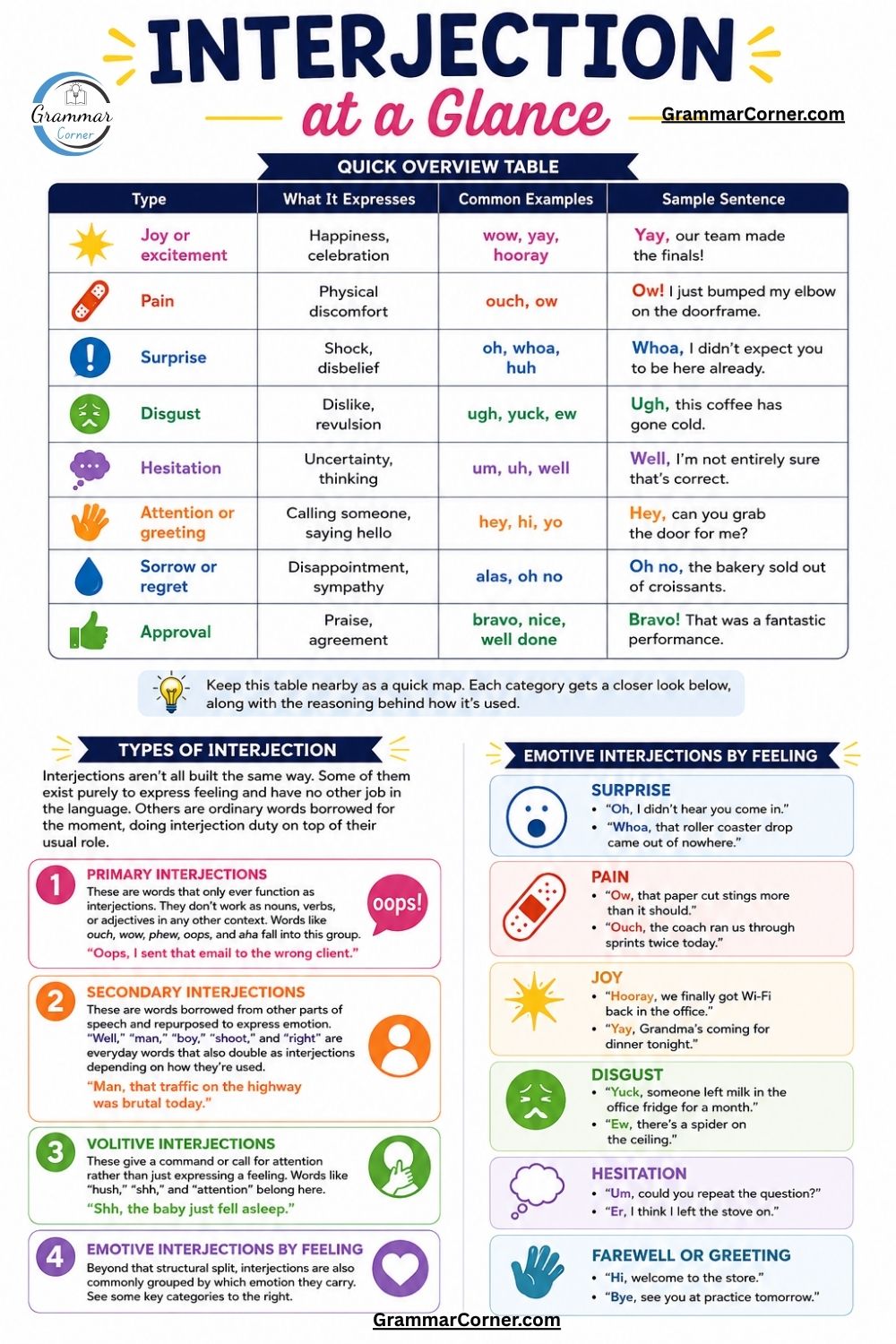
Interjection at a GlanceQuick Overview Table
| Type | What It Expresses | Common Examples | Sample Sentence |
|---|---|---|---|
| Joy or excitement | Happiness, celebration | wow, yay, hooray | Yay, our team made the finals! |
| Pain | Physical discomfort | ouch, ow | Ow! I just bumped my elbow on the doorframe. |
| Surprise | Shock, disbelief | oh, whoa, huh | Whoa, I didn’t expect you to be here already. |
| Disgust | Dislike, revulsion | ugh, yuck, ew | Ugh, this coffee has gone cold. |
| Hesitation | Uncertainty, thinking | um, uh, well | Well, I’m not entirely sure that’s correct. |
| Attention or greeting | Calling someone, saying hello | hey, hi, yo | Hey, can you grab the door for me? |
| Sorrow or regret | Disappointment, sympathy | alas, oh no | Oh no, the bakery sold out of croissants. |
| Approval | Praise, agreement | bravo, nice, well done | Bravo! That was a fantastic performance. |
Keep this table nearby as a quick map. Each category gets a closer look below, along with the reasoning behind how it’s used.
Types of Interjection
Interjections aren’t all built the same way. Some of them exist purely to express feeling and have no other job in the language. Others are ordinary words borrowed for the moment, doing interjection duty on top of their usual role.
Primary interjections
These are words that only ever function as interjections. They don’t work as nouns, verbs, or adjectives in any other context. Words like ouch, wow, phew, oops, and aha fall into this group.
“Oops, I sent that email to the wrong client.”Here, “oops” has one job: signaling a small, sudden mistake. It never shows up as a noun in a sentence like “the oops was large.”
Secondary interjections
These are words borrowed from other parts of speech and repurposed to express emotion. “Well,” “man,” “boy,” “shoot,” and “right” are everyday words that also double as interjections depending on how they’re used.
“Man, that traffic on the highway was brutal today.”Here, “man” isn’t referring to a person at all — it’s expressing frustration, borrowed from a noun for the moment.
Volitive interjections
These give a command or call for attention rather than just expressing a feeling. Words like “hush,” “shh,” and “attention” belong here.
“Shh, the baby just fell asleep.”This isn’t describing an emotion so much as directing someone’s behavior.
Emotive interjections by feeling
Beyond that structural split, interjections are also commonly grouped by which emotion they carry:
Surprise
- “Oh, I didn’t hear you come in.”
- “Whoa, that roller coaster drop came out of nowhere.”
Pain
- “Ow, that paper cut stings more than it should.”
- “Ouch, the coach ran us through sprints twice today.”
Joy
- “Hooray, we finally got Wi-Fi back in the office.”
- “Yay, Grandma’s coming for dinner tonight.”
Disgust
- “Yuck, someone left milk in the office fridge for a month.”
- “Ew, there’s a spider on the ceiling.”
Hesitation
- “Um, could you repeat the question?”
- “Er, I think I left the stove on.”
Farewell or greeting
- “Hi, welcome to the store.”
- “Bye, see you at practice tomorrow.”
British English speakers often use “oi” to get someone’s attention in a sharper, more direct way than American English typically does, and “cheers” frequently doubles as an informal thank-you or goodbye in British English — a usage that’s far less common in American English. “Hurrah” tends to feel more traditionally British, while “hooray” is heard more often in American speech, though both sides of the Atlantic use each one from time to time.
Functions of Interjection in a Sentence
An interjection’s whole purpose is to carry emotion, not to build sentence structure. That single fact explains almost everything about how interjections behave.
-
Standing completely alone
Someone slams on the brakes and you shout, “Whoa!“
a complete reaction on its own, with no subject or verb -
Attached to the front of a sentence
“Well, I suppose we should get going.”
remove “Well” and the rest still stands as a full, correct sentence -
Dropped into the middle or end of a sentence
“That test, ugh, was so much harder than I expected.”
interrupts the flow to add a burst of feeling, then continues
Let’s break one sentence apart to see this clearly:
Oh no, I think I left the oven on!
-
Interjection
“Oh no” expresses sudden alarm. It has no grammatical connection to what follows.
-
Independent clause
“I think I left the oven on” is a complete sentence entirely on its own.
Because the interjection isn’t grammatically tied to the rest of the sentence, you could swap it out entirely — “Yikes, I think I left the oven on!” — and the sentence structure wouldn’t change one bit. Only the flavor of emotion changes.
How to Identify an Interjection
Spotting an interjection gets easy once you know what to check.
-
Try removing it
If you can delete the word or phrase and the sentence around it still reads as complete and grammatically correct, you’re likely looking at an interjection.
“Well, the bus is running late” becomes “The bus is running late” — still a full sentence.
-
Ask what job it’s doing
Interjections don’t name anything, describe anything, or connect anything. They only express a feeling or reaction. If the word is doing one of those other jobs, it isn’t functioning as an interjection in that sentence.
-
Look at the punctuation around it
A comma or exclamation point right after the word, especially at the start of a sentence, is a strong clue.
“Ouch!” standing completely alone, or “Well,” followed by a comma, both point toward interjection use.
-
Watch for words with double lives
Plenty of interjections are borrowed from other parts of speech, so context matters more than the word itself.
AdverbShe sang well.
InterjectionWell, that’s unexpected.
Same spelling, completely different job, depending on what’s happening around it in that sentence.
Common Mistakes with Interjection
A mild interjection needs a comma to separate it from the rest of the sentence when you’re not using an exclamation point. Skip the comma, and the sentence runs together awkwardly.
Piling up interjections or letting the sentence run on doesn’t add impact — it just gets harder to read. One well-placed interjection, punctuated clearly, carries more weight than four repeated ones crammed together.
Interjections are conversational by nature, which makes them a poor fit for formal writing like business reports, academic essays, or official correspondence. Save them for dialogue, casual writing, or informal communication.
When an interjection begins a sentence, it needs a capital letter just like any other sentence opener, along with punctuation that matches the intensity of the feeling behind it.
Practice Exercises
Identify the interjection
Find the interjection in each sentence.
- “Yikes, I almost missed the bus this morning.”
- She said, “Oh, I forgot my badge at the front desk.”
- “Bravo! That presentation was fantastic.”
- “Ugh, the printer jammed again right before my deadline.”
Show answers
- Yikes
- Oh
- Bravo
- Ugh
Add an interjection
Fill in the blank with an interjection that fits the situation.
- , I just spilled coffee all over my keyboard!
- , I didn’t expect to see you at the gym this early.
- , this line for the fitting room hasn’t moved in ten minutes.
- , we actually got the last two tickets for the show.
Show sample answers
- Ugh (or Oh no)
- Whoa (or Oh)
- Ugh (or Argh)
- Hooray (or Yes)
Fix the punctuation
Each sentence below is missing punctuation around its interjection. Rewrite it correctly.
- Wow that was an incredible save by the goalkeeper.
- Alas we missed the last train home by two minutes.
- well I guess we will have to try again next week.
Show corrected sentences
- Wow, that was an incredible save by the goalkeeper.
- Alas, we missed the last train home by two minutes.
- Well, I guess we will have to try again next week.
Interjection vs Related Grammar Terms
Interjection vs Adverb
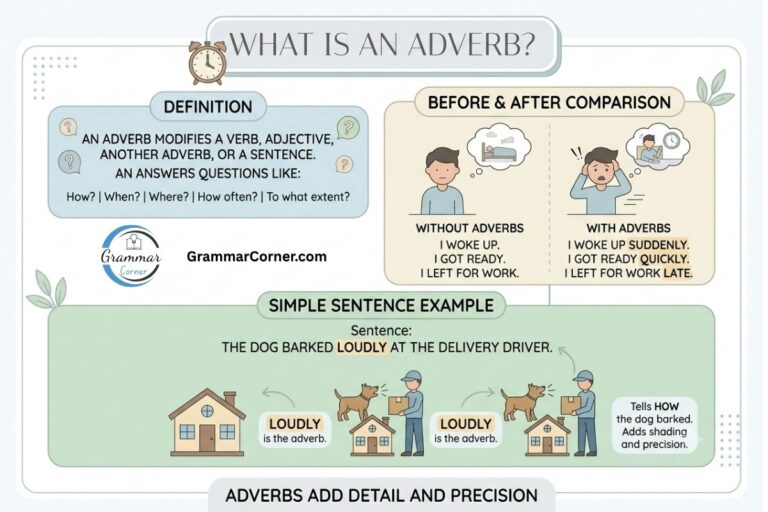
An adverb is grammatically connected to the rest of the sentence — it modifies a verb, adjective, or another adverb. An interjection stands apart and adds emotion without modifying anything.
He plays the guitar well.
well describes how he playsWell, I didn’t see that coming.
well expresses a reaction, connected to nothingInterjection vs Conjunction
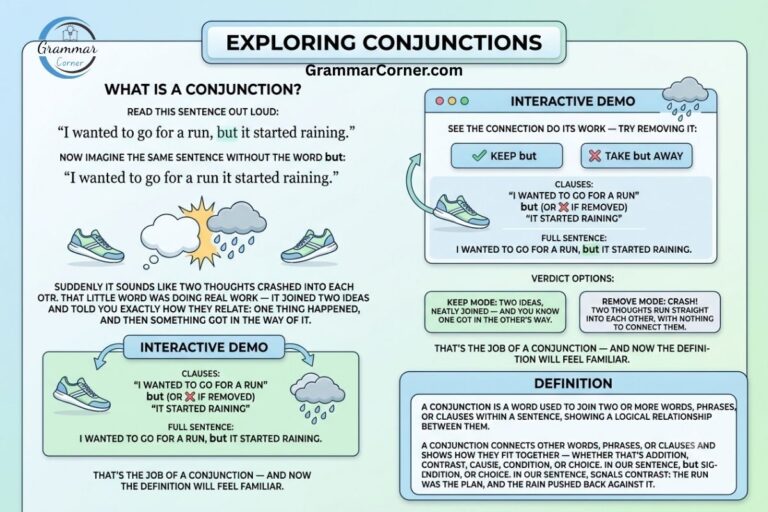
A conjunction’s entire job is connecting words, phrases, or clauses. An interjection connects nothing at all — it simply expresses feeling.
I wanted to leave, but the meeting ran long.
but links two clausesUgh, the meeting ran long.
ugh links to nothing; it just reactsInterjection vs Exclamatory Sentence
These two get confused often because both can carry strong emotion and end in an exclamation mark. An interjection is a single word or short phrase. An exclamatory sentence is a full sentence, complete with its own grammar, that expresses strong feeling on its own.
Wow!
What an incredible sunset that was!
Comparison Table
| Feature | Interjection | Adverb | Exclamatory Sentence |
|---|---|---|---|
| Grammatical role | None — stands apart | Modifies a verb, adjective, or adverb | Functions as a complete sentence |
| Can stand alone? | Yes | No | Yes, by definition |
| Example | Whoa! | She finished quickly. | What an incredible finish that was! |
Frequently Asked Questions
Do interjections always need punctuation?
Almost always, yes. A comma follows a mild interjection (“Well, that’s surprising”), and an exclamation mark follows a stronger one (“Wow!”). Occasionally, in relaxed writing like text messages, punctuation gets dropped, but in standard writing it’s expected.
Can an interjection be more than one word?
Yes. Phrases like “oh no,” “oh well,” “good grief,” and “oh my” function as single interjections even though they contain more than one word.
Is “yes” or “no” considered an interjection?
When “yes” or “no” stands alone as a reaction to a question, many grammar references classify it as an interjection, since it isn’t performing the grammatical job of a noun, verb, or adjective in that moment.
Do interjections differ much between American and British English?
The core idea works the same in both, but individual word choices shift. “Cheers” as an informal goodbye or thank-you is far more common in British English, and “oi” for getting someone’s attention leans strongly British and Australian, while American English tends to reach for “hey” in that same spot.
Can the same word work as an interjection and as another part of speech?
Very often. Words like “well,” “right,” “boy,” and “man” carry ordinary meanings elsewhere in the language but shift into interjections the moment they’re used purely to express a sudden feeling rather than to describe, name, or connect anything.
Are interjections used in formal writing?
Rarely. Because they carry such a casual, conversational tone, interjections mostly appear in dialogue, personal writing, advertising, and everyday speech rather than in reports, essays, or academic work.
See also:
- Parts of Speech Complete Guide
- Punctuation Ultimate Guide
- Nouns Chart
- Pronouns Chart
- Verbs Chart
- Adverbs Chart
- Adjective chart
- Preposition Chart
- Conjunctions Chart