Verbs Chart (Types, Examples and Rules) – Comprehensive Guide
What Is a Verb?
Think about the things happening around you every day. A child laughs, a dog barks, a phone rings, and a bird flies. Words like laughs, barks, rings, and flies all show an action or something happening. That’s the basic idea of a verb, before you even learn its formal definition.
Tap each scene below and watch the action word light up:
Tap a scene to find its verb.
A verb is a word that expresses an action, an occurrence, or a state of being.
Not every verb looks like movement, though. Verbs come in a few different flavors:
Action you can watch
Physical actions that happen right in front of you.
Something happening quietly
Things going on without much movement at all.
Connecting ideas
Words that simply link ideas together.
Here’s a verb doing its job: “The chef chopped the vegetables quickly.” The verb is chopped, and it describes exactly what the chef did.
Now watch what happens when you take chopped out of the sentence:
The chef chopped the vegetables quickly.
With chopped in place, the sentence works — something is actually happening.
Without its verb, you’re left with only “The chef the vegetables quickly,” which isn’t really a sentence at all anymore — just a pile of nouns with nothing holding them together.
Verbs are often called the engine of a sentence, and that’s not an exaggeration. A group of words needs a verb to become a complete sentence rather than just a list.
Remember: Once you get comfortable spotting verbs and understanding how they shift and change, tenses, agreement, and a lot of other grammar rules start clicking into place almost automatically.
Verb at a Glance (Quick Overview Table)
Verbs wear a few different hats. Before you meet each kind up close, here’s the whole family in one quick view:
Action verb
A physical or mental action.
Linking verb
Connects the subject to more information.
Auxiliary (helping) verb
Supports the main verb to build tense, mood, or voice.
Modal verb
Expresses possibility, permission, or necessity.
Regular verb
Forms its past tense with -ed.
Irregular verb
Forms its past tense unpredictably.
| Category | What It Shows | Example |
|---|---|---|
| Action verb | A physical or mental action | run write decide |
| Linking verb | Connects the subject to more information | is seem become |
| Auxiliary (helping) verb | Supports the main verb to build tense, mood, or voice | have will do |
| Modal verb | Expresses possibility, permission, or necessity | can must should |
| Regular verb | Forms its past tense with -ed | walk → walked |
| Irregular verb | Forms its past tense unpredictably | go → went |
Remember: if a word tells you what the subject is doing, experiencing, or being, it’s very likely the verb.
Why Verbs Matter
A sentence can make sense without an adjective or an adverb, but it cannot be complete without a verb. Every complete sentence in English needs a verb, because the verb tells us what is happening or what someone or something is.
Verbs also carry more grammatical information than any other word in a sentence:
Tense
Tells you when something happened.
Aspect
Tells you whether it’s still ongoing.
Voice
Tells you who’s responsible for the action.
Mood
Tells you how certain the statement is.
To feel the difference, compare these two sentences. The core action barely changes, but the verb form completely reshapes the meaning:
She finished the report.
Finished means the job is done — a completed action in the past.
Same subject, same report — but one small change to the verb tells a completely different story about what’s going on.
Types of Verbs
You’ve already met the main kinds of verbs briefly in the overview table. Now it’s time to look at each one in detail.
In English grammar, verbs split into several overlapping categories — the same verb can belong to more than one at once — and knowing which type you’re dealing with helps you use it correctly.
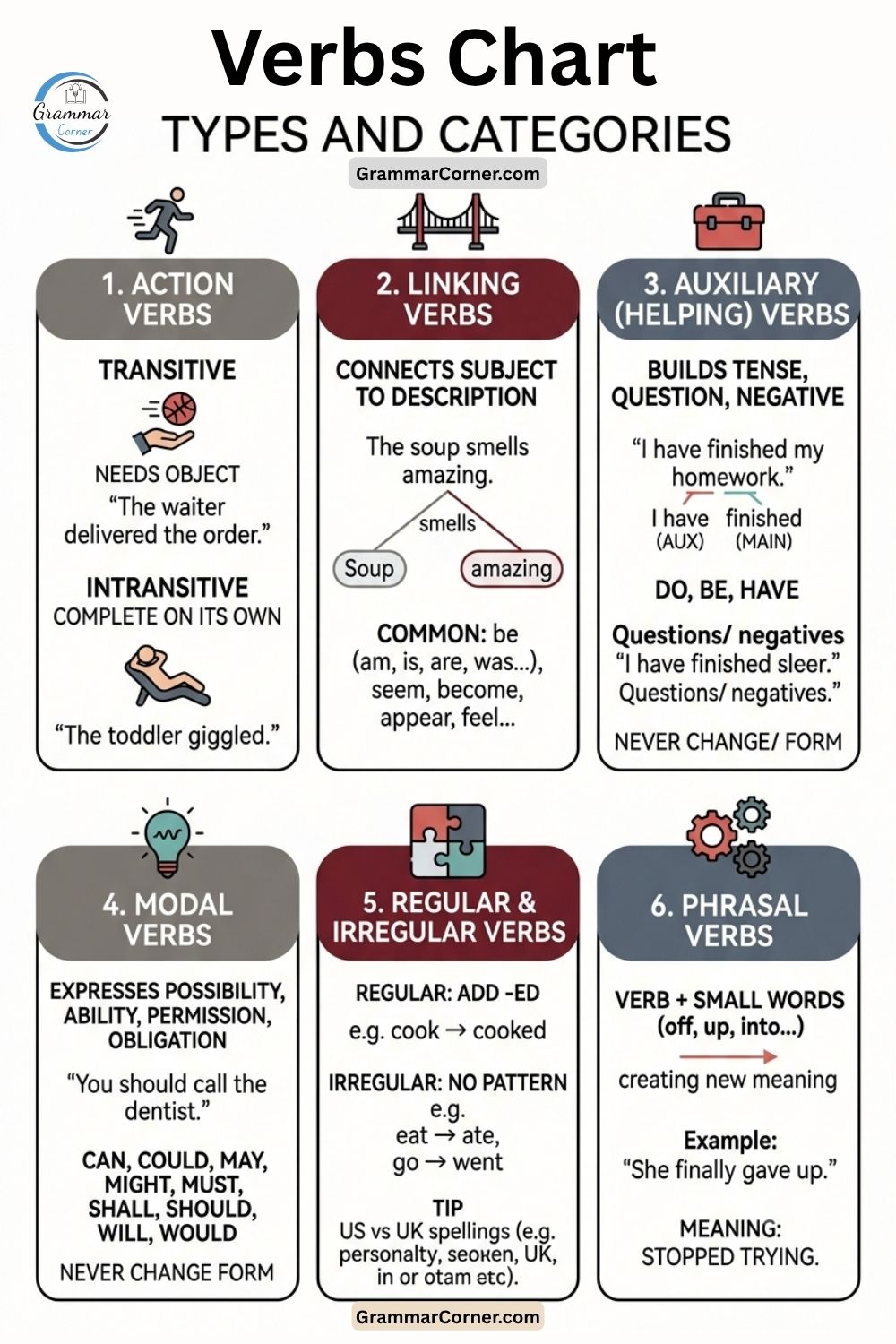
1. Action Verbs
An action verb expresses something the subject does — whether that’s a physical movement or a mental process.
“She solved the puzzle in under three minutes.”
The verb solved shows exactly what she did — even though solving a puzzle is mostly a mental action rather than a physical one. Actions don’t have to be visible to count.
Action verbs split further into transitive and intransitive, depending on whether they need a direct object to complete their meaning:
Transitive verb
The waiter delivered the order to table six.
Delivered needs an object — the order — to make sense. “The waiter delivered” would leave you asking, delivered what?
Intransitive verb
The toddler giggled uncontrollably.
Giggled doesn’t need an object — the sentence is already complete. You can’t “giggle something.”
Some verbs can work both ways, depending on the sentence. Try it yourself:
She reads every night.
No object here — reads stands on its own, so it’s working as an intransitive verb.
2. Linking Verbs
A linking verb doesn’t show action at all. Instead, it connects the subject to a word or phrase that describes or renames it.
“The soup smells amazing.”
Here, smells isn’t describing an action the soup is performing — the soup isn’t sniffing anything. It’s linking soup to the description amazing.
Tip — testing for a linking verb: try swapping the verb for a form of be (is, was, seems). If the sentence still makes sense, it’s probably a linking verb.
The soup smells amazing.
Tap the button to swap smells for is.
3. Auxiliary (Helping) Verbs
An auxiliary verb works alongside a main verb to build a particular tense, question, negative, or passive form. It doesn’t usually carry meaning on its own — its job is to support the main verb.
“I have finished my homework already.”
Have is the auxiliary verb here, helping finished form the present perfect tense. The main action is still finished — have is just doing structural work.
Do shows up constantly in questions and negatives:
In a question
“Do you like coffee?”
In a negative
“I don’t like coffee.”
Both sentences rely on do purely to build the grammar — it adds no meaning of its own. The real meaning lives in like.
4. Modal Verbs
A modal verb is a specific type of auxiliary that expresses possibility, ability, permission, obligation, or necessity.
“You should call the dentist before your appointment slips your mind.”
Should expresses a recommendation rather than a certainty. It softens the statement compared to a plain command like “Call the dentist.”
One thing sets modals apart from almost every other verb in English: they never change form based on the subject. See for yourself:
She can swim.
“She can swim” is right — modals stay the same for every subject.
5. Regular and Irregular Verbs
A regular verb forms its past tense and past participle by simply adding -ed. An irregular verb changes in a way that doesn’t follow that pattern — and often just has to be memorized.
Regular — add -ed
The past forms follow one predictable rule.
Irregular — no pattern
The past forms change unpredictably.
Common mistake
✗ Yesterday, I catched the early train to the airport.
✓ Yesterday, I caught the early train to the airport.
Why: catch is irregular. Its past tense is caught, not catched — even though the -ed pattern feels like it should apply.
Tip — American vs. British spelling of some past forms: a handful of verbs have two accepted past-tense spellings, depending on the variety of English you’re writing in.
American English usually prefers
learned, burned, dreamed
British English commonly uses
learnt, burnt, dreamt
Both spellings are grammatically correct — the choice mostly comes down to which regional style you’re writing in.
6. Phrasal Verbs
A phrasal verb combines a verb with one or more small words — like up, off, or into — to create a meaning that’s often completely different from the individual words alone.
She finally gave up on fixing the old printer herself.
Hint: nobody handed anything upward.
Taken literally, gave + up would mean handing something in an upward direction — but together, the phrase means “stopped trying.” That shift in meaning is exactly what makes phrasal verbs tricky for learners, and interesting for everyone else.
Functions of Verbs in a Sentence
A verb’s category tells you what kind of verb it is. Its function tells you what job it’s doing within a specific sentence — and most sentences actually rely on more than one verb working together.
Main Verb (Predicate)
The main verb is the core action or state the sentence is built around. Together with everything that follows it, it forms the predicate.
The committee approved the new budget.
Approved is the main verb, carrying the essential meaning of the sentence.
Supporting an Auxiliary Structure
When a main verb pairs with an auxiliary, the auxiliary carries the tense or mood, while the main verb carries the meaning.
They are traveling to Portugal next month.
Are is the auxiliary, showing the present continuous tense; traveling is the main verb, showing the action itself.
Linking to a Subject Complement
When a verb links the subject to a description or identity rather than an action, it introduces what’s called a subject complement.
My uncle became a firefighter after years of training.
Became links uncle to firefighter, which renames the subject rather than receiving an action from it.
Forming Questions and Negatives
Auxiliary verbs — especially do, does, and did — step in specifically to build questions and negative statements when there’s no other auxiliary already present.
Did you finish the assignment before the deadline?
Did carries the past tense so that finish can stay in its base form — this is standard question formation in English.
Sentence breakdown — tap each dashed verb to reveal its job:
By the time we main verb · simple past, the movie already had + started · past perfect, so we quietly main verb · simple past our seats.
One short sentence, three verbs working together. 0 of 3 labeled.
How to Identify a Verb
Not sure which word in a sentence is the verb? These quick tests will point you to it almost every time.
1. The tense-shift test
Change the sentence’s time frame and see which word changes shape — it’s one of the fastest ways to confirm a verb.
She dances beautifully.
Tap the button and watch which word changes.
2. The “to” test
Check whether the word can follow to in its base form. This pattern — called the infinitive — is a reliable sign you’re looking at a verb.
3. The position test
In English, the verb typically follows the subject fairly early in the sentence:
The engineer verb the design.
Whatever slots naturally into that position — describing what the subject does or is — is almost always the verb.
4. The disguise check
Watch out for verb forms that are secretly working as other parts of speech — the -ing spelling alone doesn’t guarantee the word is behaving like a verb in that particular sentence. See the box below.
Watch out — one word, three jobs: the word running changes its part of speech depending on the sentence it’s in.
She is running.
Part of the verb phrase — a real action in progress.
The running water woke me up.
Here it describes the water, working as an adjective.
Same spelling, three different jobs — always check what the word is doing in its own sentence.
Common Mistakes with Verbs
Even confident writers slip on these. Here are the verb mistakes you’ll run into most often — and how to fix each one.
Agreeing with the wrong noun
✗ Each of the players were given a new jersey.
✓ Each of the players was given a new jersey.
Why: each is the true subject here, and each is singular — even though the plural players sits right next to the verb. The verb has to agree with each, not with the nearby noun.
“Should of” instead of “should have”
✗ I should of called you before I left.
✓ I should have called you before I left.
Why: should of is a common mishearing of the contraction should’ve, which is short for should have. Of is a preposition and can never work as part of a verb phrase.
Simple past instead of past participle
✗ She has went to that bakery every Saturday for years.
✓ She has gone to that bakery every Saturday for years.
Why: when a verb pairs with has, have, or had, it needs the past participle form, not the simple past. Went is simple past; gone is the correct past participle of go.
“Don’t” with a singular subject
✗ The teacher don’t allow phones during exams.
✓ The teacher doesn’t allow phones during exams.
Why: with a singular third-person subject like the teacher, the auxiliary needs to match: doesn’t, not don’t.
Mixing up “lay” and “lie”
✗ I lay the book on the table yesterday and forgot about it.
✓ I laid the book on the table yesterday and forgot about it.
Why: lay and lie are famously confusing. Lie (to recline) is intransitive and becomes lay in the past tense. Lay (to place something down) is transitive and becomes laid in the past tense. Since a book is being placed down here, laid is correct.
Inconsistent tense shifting
Switching tenses mid-story without a reason is one of the most common verb mistakes in casual writing. Pick one timeframe and stay in it unless the meaning genuinely requires a shift. Try both fixes:
She walks into the room, sees the mess, and screamed.
Two verbs are present tense, one is past — the timeframe wobbles for no clear purpose.
Tips for Using Verbs Correctly
Learn irregular verbs in small batches
Don’t try to memorize the whole list at once. Grouping irregular verbs by pattern makes them far easier to remember than treating each one as a completely separate case:
Watch for words between subject and verb
Double-check subject-verb agreement whenever other words come between the subject and the verb. These phrases don’t make the subject plural — the verb still needs to match the original subject:
Stay consistent with tense
Keep one tense across a paragraph unless you’re deliberately signaling a time shift. If you start describing a memory in the past tense, keep it in the past tense unless there’s a clear reason to switch.
Use active voice by default
Active voice usually reads as more direct and easier to follow, especially in everyday writing:
Active — usually clearer
The manager approved the request.
Passive — has its place
The request was approved by the manager.
Passive voice still earns its keep when the doer of the action isn’t important or isn’t known.
Know your regional habits
American and British English sometimes differ on which auxiliary feels natural:
British English
Uses have got quite freely in conversation: “I’ve got two brothers.”
American English
Often prefers the simpler have: “I have two brothers.”
Neither is wrong — they’re just different regional habits.
Practice Exercises
Time to put all of this to work. Try each item on your own first, then check yourself — every answer is one tap away.
Exercise 1: Identify the verbs
1The children built a sandcastle before the tide rolled in.
2My father seems tired after his long shift at the hospital.
3We have already booked our flights for the summer trip.
Exercise 2: Classify each verb as action, linking, or auxiliary
4became
5organized
6will (in “will travel”)
7tastes (in “The curry tastes spicy”)
Exercise 3: Fix the mistake in each sentence
8He don’t understand the instructions.
9By noon, the guests had already ate all the appetizers.
10She should of texted me when she landed.
Full Answer Key
- Verbs: built, rolled
- Verbs: seems
- Verbs: have booked
- became — linking
- organized — action
- will — auxiliary
- tastes — linking
- He doesn’t understand the instructions.
- By noon, the guests had already eaten all the appetizers.
- She should have texted me when she landed.
Verb vs Related Grammar Terms
Verb vs Noun
A verb expresses an action or state; a noun names a person, place, thing, or idea. The confusion usually comes from -ing forms, since the exact same word can act as either one depending on the sentence.
She is jogging along the river every morning.
Jogging is a verb here — part of the present continuous tense.
Jogging is her favorite way to clear her head.
Jogging is a noun here, acting as the subject of the sentence.
Verb vs Adjective
A verb shows action or being; an adjective describes a noun. Verb forms ending in -ing or -ed often slip into an adjective role, known as a participle.
The lecture bored half the students by the end.
Bored is a verb here, showing what the lecture did.
The bored students started checking their phones.
Bored is now an adjective, describing students.
Verb vs Adverb
A verb shows the action itself; an adverb describes how, when, or where that action happens. The two work closely together but do very different jobs.
She sings beautifully at every family gathering.
Sings is the verb; beautifully is the adverb describing how she sings.
Frequently Asked Questions
Still have a question about verbs? These are the ones readers ask most often — tap any question for the answer.
What’s the difference between a main verb and an auxiliary verb? Meaning vs. support
A main verb carries the core meaning of the sentence, while an auxiliary verb supports it to build tense, questions, negatives, or passive voice.
“She has finished.”
Finished is the main verb; has is the auxiliary.
Can a sentence have more than one verb? Yes — very often
Yes, very often. A sentence can have a main verb paired with one or more auxiliaries, or multiple main verbs joined by a conjunction.
“They had been waiting.” — one main verb, two auxiliaries.
“She cooked and cleaned.” — two main verbs joined by and.
Why do some verbs not change in the past tense? A historical quirk
Some irregular verbs stay the same in their base and past forms:
(Read changes pronunciation in the past, but not spelling.) There’s no single rule for this — it’s simply a quirk of how these verbs developed historically.
Is it wrong to end a sentence with a verb? No — perfectly fine
No. Plenty of correct English sentences end with a verb, like “She smiled” or “The rain finally stopped.” There’s no grammar rule against it.
What’s the difference between tense and aspect? When vs. how
Tense shows when something happens (past, present, future), while aspect shows how that action unfolds over time (completed, ongoing, or repeated).
“She wrote.” — simple past tense.
“She has been writing.” — present perfect continuous, combining tense and aspect together.
Do all verbs have a continuous (-ing) form? Almost all
Almost all do — but a small group of stative verbs usually resist the continuous form, because they describe states rather than ongoing actions:
✗ I am knowing the answer.
Sounds off to native speakers.
✓ I know the answer.
The natural choice.
See also: