Adverbs That Start With W (Common, Positive & Descriptive Adverbs)
The letter W introduces adverbs you’ll hear and read every day — someone works well, smiles warmly, or is widely recognized.
These words make sentences clearer by adding important detail to actions and descriptions.
Adverbs that start with W add meaning to verbs, adjectives, other adverbs, or entire sentences by explaining how, when, where, how often, or to what extent something happens:
- warmly
- well
- widely
Quick Challenge
Which W-adverb best completes the sentence?
The teacher explained the lesson so __________ that everyone understood it.
Show the answer
✅ Answer: A. well
Well describes how the teacher explained the lesson — it’s an adverb of manner. The other options express frequency (weekly), scope (worldwide), or a manner that doesn’t fit the context (warmly).
Common Adverbs That Start with W
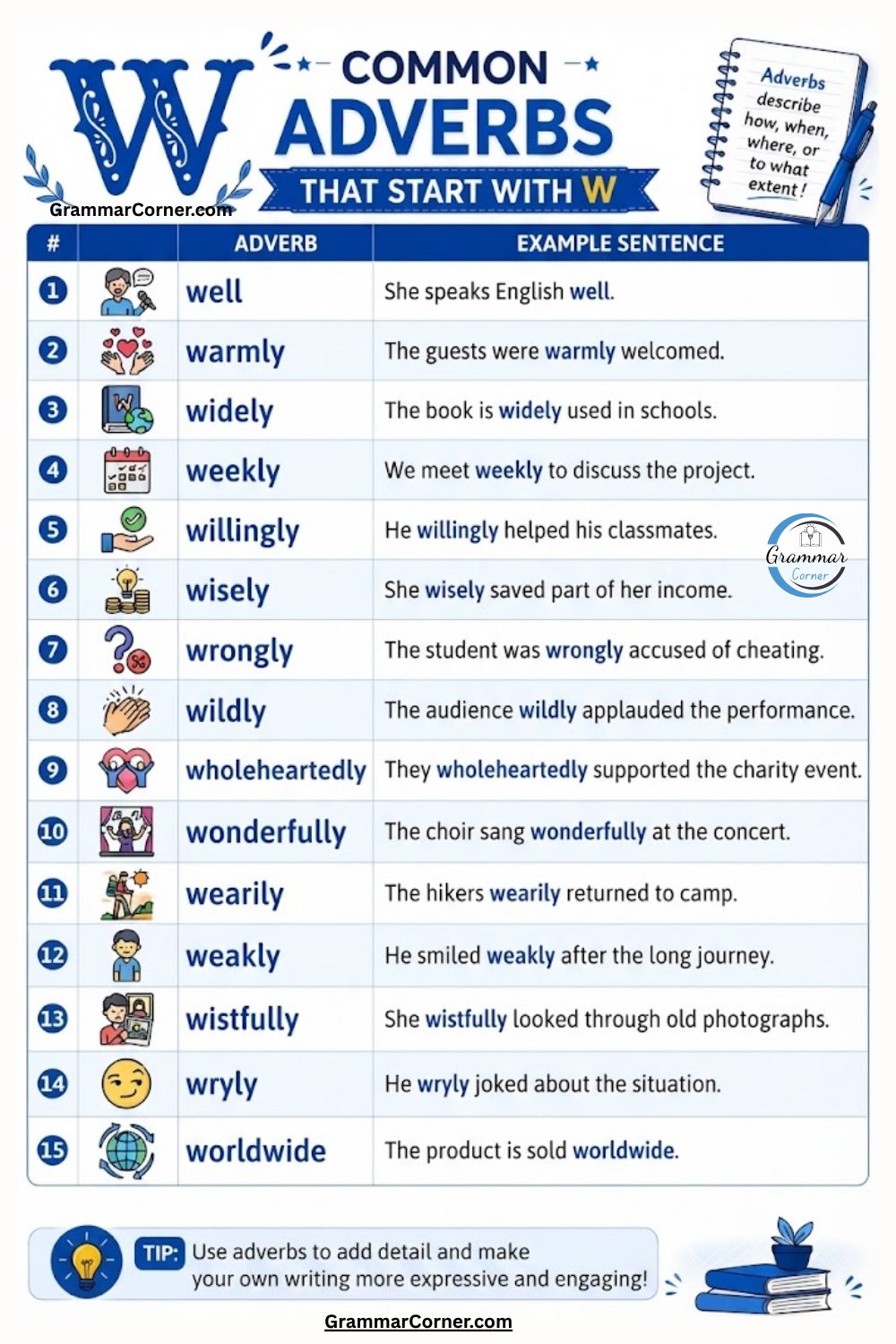
| Adverb | Example Sentence |
|---|---|
| well | She speaks English well. |
| warmly | The guests were warmly welcomed. |
| widely | The book is widely used in schools. |
| weekly | We meet weekly to discuss the project. |
| willingly | He willingly helped his classmates. |
| wisely | She wisely saved part of her income. |
| wrongly | The student was wrongly accused of cheating. |
| wildly | The audience wildly applauded the performance. |
| wholeheartedly | They wholeheartedly supported the charity event. |
| wonderfully | The choir sang wonderfully at the concert. |
| wearily | The hikers wearily returned to camp. |
| weakly | He smiled weakly after the long journey. |
| wistfully | She wistfully looked through old photographs. |
| wryly | He wryly joked about the situation. |
| worldwide | The product is sold worldwide. |
Positive Adverbs That Start with W
| Adverb | Example Sentence |
|---|---|
| wholesomely | The children wholesomely spent the afternoon outdoors. |
| wholeheartedly | The volunteers wholeheartedly embraced the community project. |
| willingly | She willingly shared her notes with the class. |
| wisely | They wisely invested their time in learning new skills. |
| wonderfully | The young pianist performed wonderfully. |
| warmheartedly | He warmheartedly welcomed every new employee. |
| winningly | The speaker winningly answered every question. |
| worshipfully | The choir worshipfully sang the closing hymn. |
| worthily | She worthily represented her school in the competition. |
| watchfully | The lifeguard watchfully observed the swimmers. |
| well | The students worked well together on the science project. |
| wholly | She was wholly committed to helping others. |
Complete List of Adverbs That Start with W
| Adverb | Meaning | Example Sentence |
|---|---|---|
| Warmheartedly | In a kind, caring way | The neighbors warmheartedly welcomed the new family. |
| Warmly | In a friendly, enthusiastic way | The audience warmly applauded the speaker. |
| Watchfully | With careful attention | The nurse watchfully monitored the patient. |
| Weakly | Without strength or force | He weakly nodded in agreement. |
| Wearily | In a tired way | She wearily climbed the final steps. |
| Weekly | Once a week | The club meets weekly after school. |
| Well | In a good or satisfactory way | She completed the assignment well before the deadline. |
| Wholly | Completely, entirely | The proposal was wholly accepted by the committee. |
| Wholeheartedly | With complete sincerity and enthusiasm | They wholeheartedly supported the fundraiser. |
| Wholesomely | In a healthy, beneficial way | The family wholesomely enjoyed a weekend picnic. |
| Widely | Over a large area; by many people | This dictionary is widely recommended by teachers. |
| Wildly | In an uncontrolled, excited way | The fans wildly cheered for their team. |
| Willingly | Without being forced; readily | He willingly volunteered for the difficult task. |
| Winningly | In a charming, appealing way | The child winningly smiled at the visitors. |
| Wisely | In a sensible, thoughtful way | We wisely planned our budget before traveling. |
| Wistfully | With a sad, longing feeling | She wistfully remembered her childhood home. |
| Wonderfully | In an excellent, delightful way | Everything turned out wonderfully in the end. |
| Worldwide | Throughout the world | The campaign was recognized worldwide. |
| Worshipfully | With deep respect or reverence | The congregation worshipfully sang together. |
| Worthily | In a way that is deserved | The athlete worthily accepted the championship trophy. |
| Wrongly | Incorrectly | He was wrongly blamed for the mistake. |
| Wryly | In a dryly humorous or ironic way | She wryly commented on the unexpected delay. |
Five-Letter Adverbs That Start with W
Note: There are only a few standard English adverbs that are exactly five letters long and begin with W.
| Adverb | Example Sentence |
|---|---|
| Well | She plays the piano well. |
| Where | Please tell me where you found the wallet. |
| While | While waiting, I finished my homework. |
| Wrong | If you guessed wrong, try again. |
Descriptive Adverbs That Start with W
These W-adverbs describe how, when, or to what extent an action happens.
| Adverb | Meaning | Example |
|---|---|---|
| Well | In a good or satisfactory way | The interview went well overall. |
| Warmly | In a friendly, enthusiastic way | He warmly greeted the new students. |
| Weakly | Without strength or force | The signal weakly reached the last floor. |
| Wearily | In a tired way | He wearily sat down after the long shift. |
| Weekly | Once a week | The newsletter is published weekly. |
| Widely | Over a large area; by many people | The theory is widely taught in schools. |
| Wildly | In an uncontrolled, excited way | The kite spun wildly in the wind. |
| Willingly | Readily, without being forced | She willingly took on the extra project. |
| Wisely | In a sensible, thoughtful way | He wisely saved part of his bonus. |
| Wistfully | With a sad, longing feeling | She looked wistfully at the old photographs. |
| Wonderfully | In an excellent, delightful way | The cake turned out wonderfully. |
| Wrongly | Incorrectly | The package was wrongly delivered to my neighbor. |
| Wryly | In a dryly humorous or ironic way | He wryly noted that the meeting had run over again. |
| Wholeheartedly | With complete sincerity and enthusiasm | She wholeheartedly agreed with the new plan. |
| Wholly | Completely, entirely | The decision was wholly her own. |
| Watchfully | With careful attention | The lifeguard watched the pool watchfully. |
| Winningly | In a charming, appealing way | She smiled winningly at the panel of judges. |
| Worthily | In a way that is deserved | He worthily earned his promotion after years of hard work. |
| Worshipfully | With deep respect or reverence | The visitors gazed worshipfully at the ancient temple. |
| Worldwide | Throughout the world | The show is broadcast worldwide. |
| Wholesomely | In a healthy, beneficial way | The children played wholesomely in the garden. |
| Warmheartedly | In a kind, caring way | She warmheartedly offered to help the new intern. |
Adverbs That Start with W to Describe a Person
These W-adverbs describe how a person speaks, works, reacts, or treats other people.
- warmheartedly
- warmly
- watchfully
- weakly
- wearily
- wholeheartedly
- wholesomely
- wholly
- widely
- wildly
- willingly
- winningly
- wisely
- wistfully
- well
- wonderfully
- worshipfully
- worthily
- wrongly
- wryly
Choosing from This List
The twenty words above don’t all behave the same way, so a couple are worth a second look before you use them about a person:
- Wholly and widely describe degree and scope rather than manner. They work about people only in set phrases — wholly committed, widely respected — not on their own after a verb.
- Wholesomely, worshipfully, and worthily are rare in modern English. They’ll read as old-fashioned in ordinary writing.
If you want more everyday options, warily, wittily, and whimsically all describe people well and turn up far more often.
Common Mistakes When Using W-Adverbs
-
Confusing Well with Good
✕Incorrect: She sings good.
✓Correct: She sings well.
Why? Good is an adjective; well is the adverb that describes how someone performs an action.
-
Adding -s to Weekly
✕Incorrect: We meet weeklys to discuss the project.
✓Correct: We meet weekly to discuss the project.
Why? Weekly is already an adverb, and adverbs never take a plural -s. The same goes for daily, monthly, and yearly.
-
Confusing Wide with Widely
✕Incorrect: The article was wide shared online.
✓Correct: The article was widely shared online.
Why? Wide is an adjective — a wide road. Widely is the adverb modifying the verb shared.
-
Using Warmly Where You Need Warm
✕Incorrect: The soup was warmly.
✓Correct: The soup was warm.
Why? Warm is an adjective describing the soup itself. Warmly describes how an action is done: She greeted us warmly.
-
Confusing Willingly with Willfully
✕Incorrect: She willfully helped the new student with homework.
✓Correct: She willingly helped the new student with homework.
Why? Willingly means by choice, or gladly. Willfully means deliberately, usually in defiance of rules or advice — so the wrong version makes helping sound like misbehaviour.
British English spells that second word wilfully, with one l.
-
Using Wrongly Where You Need Wrong
✕Incorrect: Your answer is wrongly.
✓Correct: Your answer is wrong.
Why? Wrong is the adjective describing the noun answer. Wrongly modifies verbs: He was wrongly accused.
Practice Exercises
Exercise 1: Fill in the Blanks
Complete each sentence with a word from the bank. Each one is used once.
- Word bank
- well
- warmly
- wisely
- widely
- willingly
-
The visitors were greeted at the hotel.
-
She completed the assignment before the deadline.
-
This dictionary is used by English learners.
-
He volunteered to organize the event.
-
You should spend your money .
Exercise 2: Choose the Correct Adverb
Tap the correct answer for each sentence.
-
The students worked __________ as a team.
-
The teacher was __________ respected throughout the school.
-
She __________ accepted the invitation to join the club.
-
The audience applauded __________ after the performance.
Exercise 3: Find the Mistake
Rewrite each sentence correctly, then open the answer key to compare.
- He plays basketball good.
- The volunteers willfully cleaned the park because they wanted to help.
- The article was wide shared on social media.
- The soup tasted warmly.
Exercise 4: Write Your Own Sentences
Write one sentence using each of these W-adverbs:
- well
- warmly
- widely
- wisely
- wonderfully
Sample: The audience warmly welcomed the guest speaker at the ceremony.
Show the answer key
Exercise 1: Fill in the Blanks
- warmly
- well (here well means “a long time” before the deadline — a degree use, not manner)
- widely
- willingly
- wisely
Exercise 2: Choose the Correct Adverb
- a) well
- a) widely
- a) willingly
- a) warmly
Exercise 3: Find the Mistake
- He plays basketball well.
- The volunteers willingly cleaned the park because they wanted to help.
- The article was widely shared on social media.
- The soup tasted warm.
Frequently Asked Questions
What are adverbs that start with W?
Adverbs that start with W are adverbs whose spelling begins with the letter W. They modify verbs, adjectives, other adverbs, or entire sentences, explaining how, when, where, how often, or to what extent something happens.
What are the most common W-adverbs?
Some of the most common are warmly, wearily, weekly, well, widely, wildly, willingly, wisely, wonderfully, and wrongly.
Is “well” an adverb?
Yes. Well describes how an action is performed.
Example: She writes well.
What is the difference between “well” and “good”?
Well is usually an adverb, while good is an adjective.
Well: He speaks English well.
Good: He is a good speaker.
Is “weekly” an adverb?
Yes, when it tells you how often something happens — and it works as an adjective too.
Adverb: The committee meets weekly.
Adjective: The weekly newsletter is published every Friday.
Which W-adverbs describe manner?
Many W-adverbs describe how an action is performed, including warmly, wearily, well, wildly, willingly, wisely, and wonderfully.
Are there many adverbs that start with W?
Yes. English has a good variety of W-adverbs covering manner, frequency, degree, location, and scope. Many of them are among the most-used words in the language — well alone appears in everyday speech more often than most adverbs of any letter.
See also: