Adverbs That Start With Y (Common & Positive Adverbs)
Y isn’t a common starting letter for English adverbs, but the few that exist are worth learning.
Words like yearly, year-round, and yesterday come up constantly in conversation and writing, especially when you’re talking about time and frequency.
- year-round
- yearly
- yesterday
Quick Challenge
Which Y-adverb best completes the sentence?
Our family visits our grandparents __________ during the summer holidays.
Show the answer
✅ Answer: A. yearly
Yearly is an adverb of frequency meaning once every year. The other options aren’t adverbs at all — yellow and young are adjectives, and yard is a noun — so none of them fits the sentence.
Common Adverbs That Start with Y
| Adverb | Example Sentence |
|---|---|
| yearly | The conference is held yearly in different cities. |
| year-round | The museum remains open year-round. |
| yesterday | She arrived yesterday after a long journey. |
| yet | We haven’t finished the project yet. |
| yonder (literary) | The cabin stands yonder, beyond the hill. |
Positive Adverbs That Start with Y
| Adverb | Example Sentence |
|---|---|
| youthfully | She youthfully approached every new challenge with enthusiasm. |
| yieldingly | He yieldingly accepted the helpful advice and improved his work. |
| yarely (rare) | The experienced sailor responded yarely to the captain’s command. |
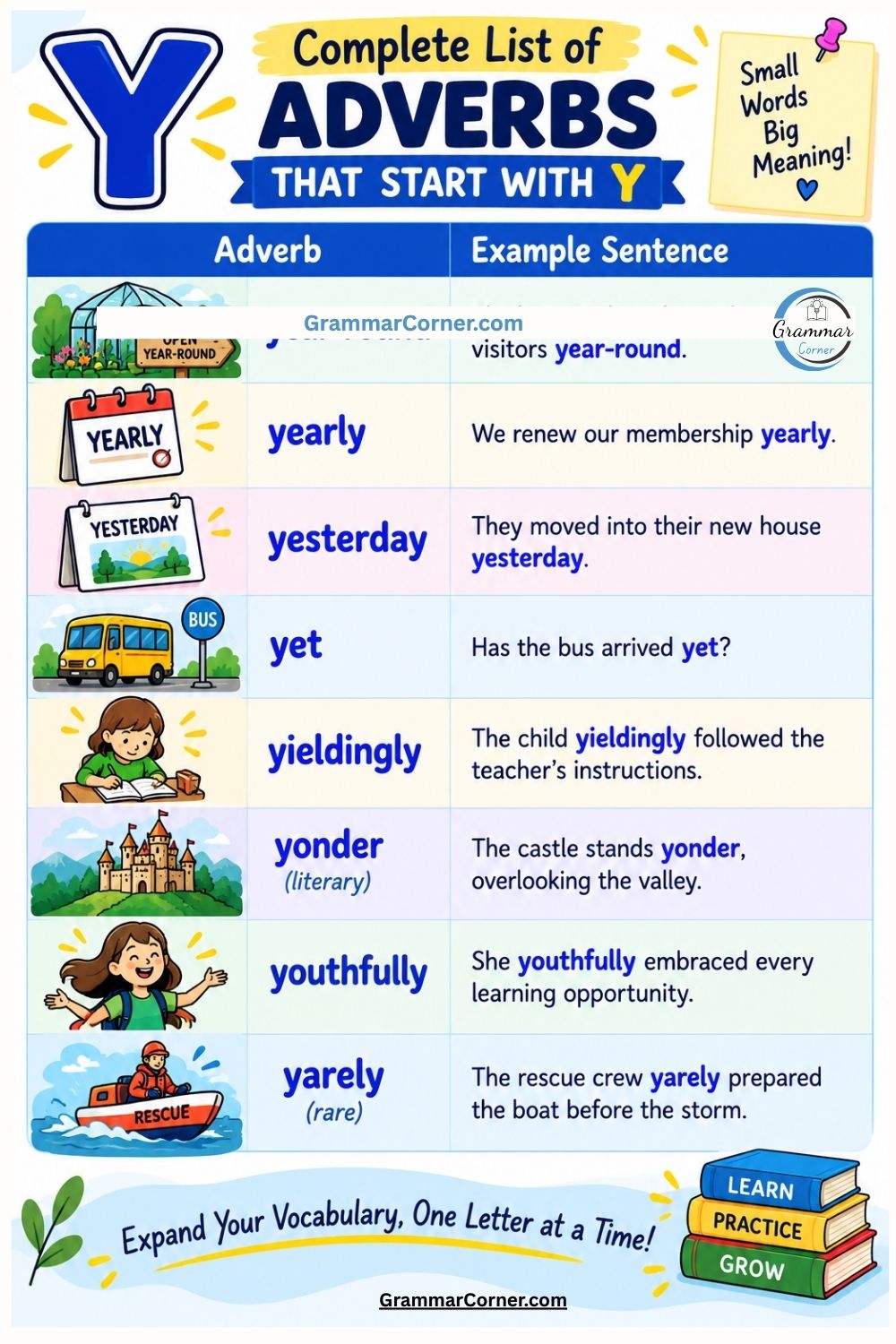
Complete List of Adverbs That Start with Y
| Adverb | Example Sentence |
|---|---|
| year-round | The botanical garden welcomes visitors year-round. |
| yearly | We renew our membership yearly. |
| yesterday | They moved into their new house yesterday. |
| yet | Has the bus arrived yet? |
| yieldingly | The child yieldingly followed the teacher’s instructions. |
| yonder (literary) | The castle stands yonder, overlooking the valley. |
| youthfully | She youthfully embraced every learning opportunity. |
| yarely (rare) | The rescue crew yarely prepared the boat before the storm. |
6-Letter Adverbs That Start with Y
Note: English has very few adverbs beginning with Y, and yearly is the only widely accepted adverb that is exactly six letters long.
| Adverb | Example Sentence |
|---|---|
| Yearly | The school organizes a science fair yearly. |
Descriptive Adverbs That Start with Y
These Y-adverbs describe how, when, or to what extent an action happens.
| Adverb | Meaning | Example |
|---|---|---|
| Yearly | Once a year; happening every year | The company reviews salaries yearly. |
| Year-round | Happening throughout the entire year | The pool is open year-round. |
| Yesterday | On the day before today | I mailed the package yesterday. |
| Yet | Up until now; still (mainly in negatives and questions) | She hasn’t called yet. |
| Yieldingly | In a way that gives in or submits easily | He responded yieldingly to her request. |
| Youthfully | In a way that seems young or energetic | She dressed youthfully for her age. |
| Yonder(literary) | At a distance, over there | The old mill stood yonder, beyond the fields. |
| Yarely(rare) | Quickly, promptly (archaic/nautical) | The sailors moved yarely to trim the sails. |
Adverbs That Start with Y to Describe a Person
These adverbs describe how a person behaves or responds in a given situation.
| Adverb | How It Describes a Person | Example |
|---|---|---|
| Youthfully | Shows youthful energy or spirit | She danced youthfully despite her age. |
| Yieldingly | Shows a gentle, accommodating nature | He responded yieldingly when his colleague pushed back. |
| Yarely(rare) | Shows brisk, prompt readiness (archaic/nautical) | The crew moved yarely at the captain’s command. |
Common Mistakes When Using Y-Adverbs
-
1. Confusing Yearly with Annual
We hold a yearly meeting every month.
We hold a yearly meeting every year.
Why? Yearly means once a year. Do not use it for events that happen monthly or weekly.
-
2. Using Yesterday as an Adjective Instead of an Adverb
We had a yesterday meeting.
We had a meeting yesterday.
Why? Yesterday is commonly used as an adverb to tell when something happened. It should not be placed before a noun in this way.
-
3. Confusing Yet with Still
She is yet working on her homework.
She is still working on her homework.
or
She hasn’t finished her homework yet.
Why? Yet is usually used in negative sentences and questions, while still describes an action that continues.
-
4. Using Yearly with the Wrong Frequency
The magazine is published yearly every week.
The magazine is published weekly.
or
The report is published yearly.
Why? Choose the adverb that matches the correct time period. Yearly means once every year.
-
5. Confusing Yonder with Here
Please come yonder and sit beside me.
Please come here and sit beside me.
Why? Yonder means at some distance and is mostly used in literary or old-fashioned English. It does not mean here.
-
6. Using Yet in an Affirmative Sentence Incorrectly
I yet finished my homework.
I have already finished my homework.
or
I haven’t finished my homework yet.
Why? Yet is generally used in negative statements and questions, not in simple affirmative sentences.
Practice Exercises
Exercise 1: Fill in the Blanks
Type the right word in each gap. Each one is used once.
- Word bank
- yearly
- yesterday
- yet
- year-round
- youthfully
-
The museum is open for visitors.
-
We celebrate our school anniversary .
-
She completed the project .
-
Have you finished your homework ?
-
Even at seventy, he walked .
Exercise 2: Choose the Correct Adverb
Tap the adverb that fits each sentence.
-
The company reviews employee performance __________.
-
We haven’t received the package __________.
-
The hotel welcomes tourists __________.
-
She completed the assignment __________.
Exercise 3: Correct the Mistake
Rewrite each sentence correctly, then open the answer key to compare.
- We celebrate the festival yearly every month.
- I yet finished my homework.
- The park is open yearly for visitors.
- She arrived yearly from London.
Exercise 4: Write Your Own Sentences
Write one sentence using each adverb:
- yearly
- yesterday
- yet
- year-round
- youthfully
Sample: Our family travels to the mountains yearly during the summer holidays.
Show the answer key
Exercise 1: Fill in the Blanks
- year-round
- yearly
- yesterday
- yet
- youthfully
Exercise 2: Choose the Correct Adverb
- a) yearly
- b) yet
- a) year-round
- a) yesterday
Exercise 3: Correct the Mistake
- We celebrate the festival yearly.
- I haven’t finished my homework yet.
- The park is open year-round for visitors.
- She arrived yesterday from London.
Frequently Asked Questions
What are adverbs that start with Y?
Adverbs that start with Y are adverbs whose spelling begins with the letter Y. They modify verbs, adjectives, other adverbs, or entire sentences, expressing how, when, where, how often, or to what extent something happens.
Are there many adverbs that start with Y?
No. English has very few adverbs beginning with Y. Most of them relate to time, and a handful are literary or uncommon.
What are the most common Y-adverbs?
The everyday ones are year-round, yearly, yesterday, and yet. Less common examples include youthfully, yieldingly, yonder (literary), and yarely (rare).
Is “yesterday” an adverb?
Yes. Yesterday is an adverb of time because it tells you when an action happened.
Example: She returned home yesterday.
Is “yet” an adverb?
Yes. Yet is an adverb used mainly in questions and negative sentences, meaning up to the present time.
Example: Have you eaten yet?
What is the difference between “yearly” and “year-round”?
Yearly means once every year. Year-round means throughout the entire year without stopping.
Yearly: The festival is held yearly. (once a year)
Year-round: The library remains open year-round. (all year, without a break)
Which Y-adverbs describe manner?
Only a few: youthfully, yieldingly, and the rare yarely. Most Y-adverbs describe time rather than how an action is performed.
Are there any five-letter adverbs that start with Y?
No. Standard English has no commonly recognized adverb that is exactly five letters long and begins with Y.
How can I remember Y-adverbs more easily?
Group them by meaning — it’s a short list, so two categories cover almost all of it.
Time: year-round, yearly, yesterday, yet
Manner: youthfully, yieldingly
See also: