Adjectives Chart (Types, Rules, Examples)
What Is an Adjective?
Read these two sentences and notice which one actually tells you something.
Just a fact
“I got a dog.”
True. Clear. And instantly forgettable.
The full picture
“I got a scruffyadjective, three-leggedadjective dognoun who howls every time the mail truck pulls up.”
A picture, a sound, and almost a personality.
The first sentence hands you a fact. The second hands you a whole scene — you can see this dog, hear it, and already guess what kind of housemate it’s going to be. Yet the only real difference between the two is a handful of extra words sitting next to the noun dog.
Those describing words — scruffy and three-legged — are adjectives, and their whole job is to give us more information about the dog. (Even the part about howling at the mail truck is a team of words pitching in to do that same describing work.)
Definition of Adjective
An adjective is a word that describes, limits, or adds detail to a noun or pronoun. It answers questions like What kind? Which one? How many? or Whose? Without adjectives, every sentence would sound like a police report — factual, flat, and missing the details that actually matter to a reader or listener.
Here’s the same idea across a few everyday situations:
-
School
She turned in a late assignment.
Tells your teacher exactly why points were deducted.
-
Shopping
I need waterproof hiking boots.
Saves you a return trip to the store.
-
Travel
We booked a window seat on the early flight.
Sets real expectations before you even board.
-
Technology
My laptop has a cracked screen.
Explains the problem in four words instead of twenty.
-
Sports
The exhausted goalkeeper made one last save.
Tells you as much about the moment as the score does.
In every case, the adjective isn’t decoration. It’s information.
Two Positions, Same Job
Sometimes an adjective appears before the noun it describes. Other times, it comes after a linking verb. Either way, it’s still doing the same job.
A late assignment.
The assignment was late.
In both cases, the word late is still an adjective. You’ll learn more about these uses later in this article.
One quick note before moving on: adjectives describe nouns and pronouns only. If a word is describing a verb, another adjective, or an entire sentence instead, it’s an adverb, not an adjective.
Adjectives at a Glance
Quick overview table| Type | What it does | Example | Sample sentence |
|---|---|---|---|
| Descriptive | Tells what kind | quiet, spicy, ancient | The library stays quiet after 6 p.m. |
| Quantitative | Tells how many or how much | several, enough, few | We only had a few tickets left. |
| Demonstrative | Points to a specific noun | this, that, these, those | Hand me that wrench, not this one. |
| Possessive | Shows ownership | my, her, their | Their flight got delayed twice. |
| Interrogative | Asks about a noun | which, what, whose | Whose backpack is this? |
| Proper | Comes from a proper noun | Italian, Victorian, Shakespearean | We ordered Italian bread with dinner. |
| Comparative | Compares two things | faster, more careful | Her second attempt was faster. |
| Superlative | Compares three or more things | fastest, most careful | She had the fastest lap of the day. |
Treat this table as a map, not the destination. Each type listed here gets its own full walkthrough further down, along with the reasoning behind every example.
Why Adjectives Matter
Picture a coworker who says, “Send me the report.” Now picture one who says, “Send me the updated report, not the draft from Tuesday.” The second version heads off a mix-up before it can happen. That’s the real job of an adjective: it removes guesswork.
Adjectives also carry emotional weight that a plain noun can’t. “My brother’s car” is neutral. “My brother’s beat-up, unreliable car” tells a story — you can practically hear the engine straining. Writers, marketers, teachers, and everyday texters all lean on adjectives for the same reason: adjectives turn a flat statement into something a reader can picture or feel.
Types of Adjectives
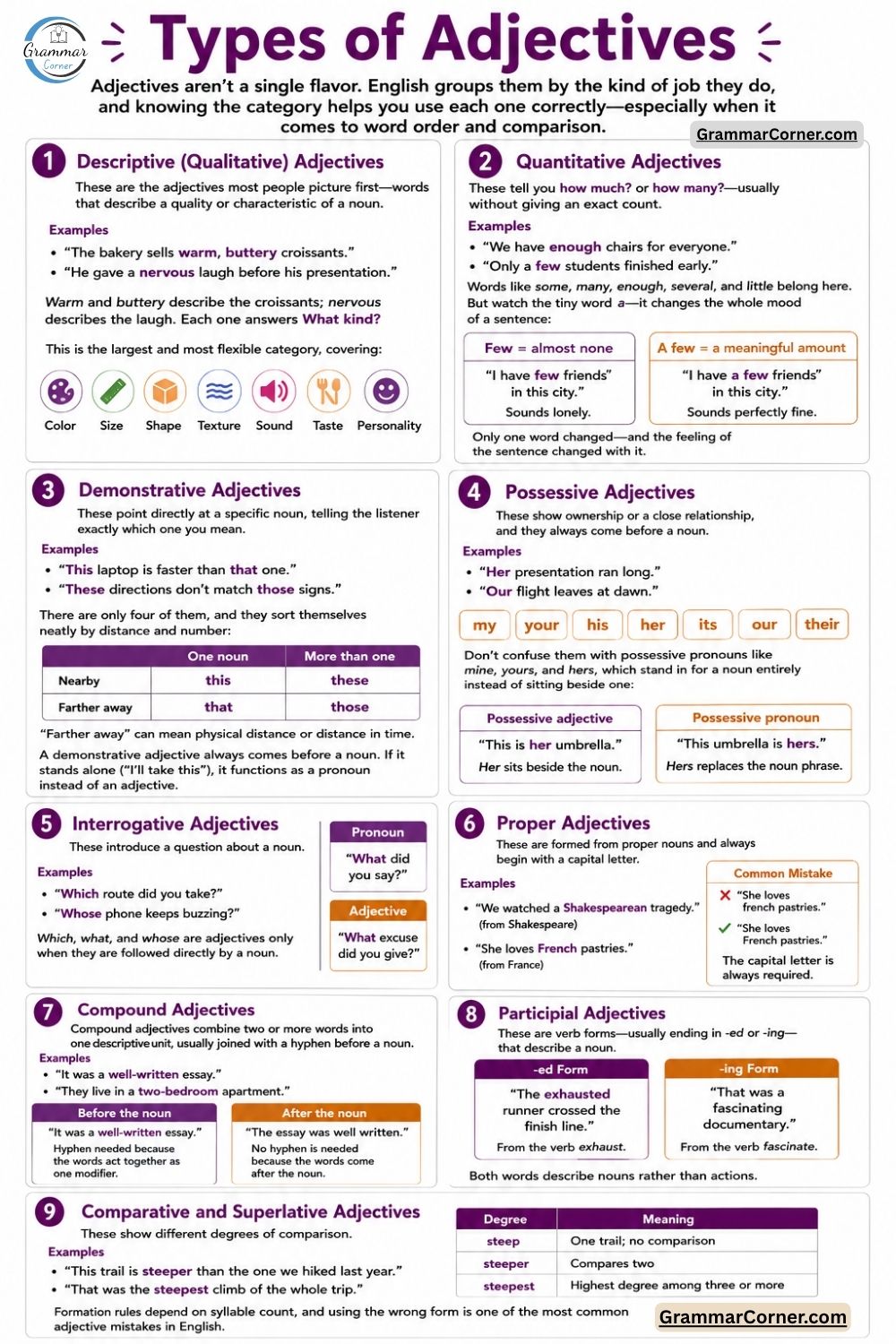
Adjectives aren’t a single flavor. English groups them by the kind of job they do, and knowing the category helps you use each one correctly — especially when it comes to word order and comparison.
Descriptive (Qualitative) Adjectives
These are the adjectives most people picture first — words that describe a quality or characteristic of a noun.
“The bakery sells warm, buttery croissants.”
“He gave a nervous laugh before his presentation.”
Warm and buttery describe the croissants; nervous describes the laugh. Each one answers what kind? This is the largest and most flexible category, and it covers a lot of ground:
Quantitative Adjectives
These tell you how much? or how many? — usually without giving an exact count.
“We have enough chairs for everyone.”
“Only a few students finished early.”
Words like some, many, enough, several, and little fall here. But watch the tiny word a — it changes the whole mood of a sentence:
few = almost none
“I have few friends in this city.”
Sounds lonely.
a few = a meaningful amount
“I have a few friends in this city.”
Sounds perfectly fine.
Only one word changed — and the feeling of the sentence changed with it.
Demonstrative Adjectives
These point directly at a specific noun, telling the listener exactly which one you mean.
“This laptop is faster than that one.”
“These directions don’t match those signs.”
There are only four of them, and they sort themselves neatly by distance and number:
“Farther away” can mean physical distance or distance in time. And a demonstrative adjective always sits right in front of a noun — if it stands alone without a noun after it (“I’ll take this”), it’s working as a pronoun instead, not an adjective.
Possessive Adjectives
These show ownership or a close relationship, and they always come before a noun.
“Her presentation ran long.”
“Our flight leaves at dawn.”
Don’t confuse them with possessive pronouns like mine, yours, and hers, which stand in for a noun entirely instead of sitting beside one:
Possessive adjective
“This is her umbrella.”
Her sits beside the noun.
Possessive pronoun
“This umbrella is hers.”
Hers replaces the noun phrase.
Interrogative Adjectives
These introduce a question about a noun.
“Which route did you take?”
“Whose phone keeps buzzing?”
Which, what, and whose only count as adjectives when a noun follows them directly. The same word can play two different roles:
Pronoun — no noun after it
“What did you say?”
Adjective — describes a noun
“What excuse did you give?”
Proper Adjectives
These are built from proper nouns, and they always keep a capital letter.
“We watched a Shakespearean tragedy.” from Shakespeare
“She loves French pastries.” from France
Common mistake
Incorrect: “She loves french pastries.”
Correct: “She loves French pastries.”
The capital letter is non-negotiable — lowercase “french” is a small but real capitalization error.
Compound Adjectives
These combine two or more words into a single descriptive unit, usually joined by a hyphen when they sit before the noun.
“It was a well-written essay.”
“They live in a two-bedroom apartment.”
The hyphen isn’t decoration — it depends on where the compound sits. Try moving it and watch the hyphen come and go:
“It was a well-written essay.”
Hyphen needed — well-written works as one unit before essay.
Participial Adjectives
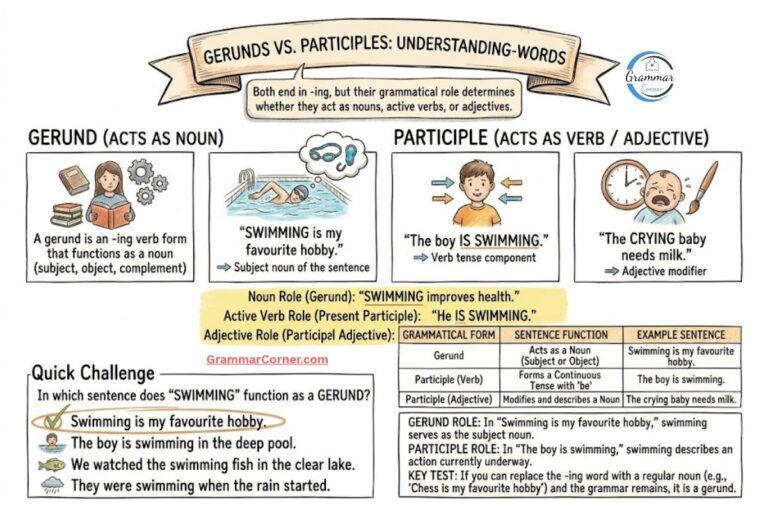
These are verb forms — usually ending in -ed or -ing — that have taken on the job of describing a noun.
-ed form
“The exhausted runner crossed the finish line.”
From the verb exhaust.
-ing form
“That was a fascinating documentary.”
From the verb fascinate.
Both words describe nouns here, not actions. The -ed/-ing distinction trips up a lot of learners, so it’s worth reading those two sentences twice.
Comparative and Superlative Adjectives
These show the degree of a quality by comparing two or more nouns.
“This trail is steeper than the one we hiked last year.”
“That was the steepest climb of the whole trip.”
steep
one trail, no comparison
steeper
compares two
steepest
singles one out among three or more
Formation rules depend on syllable count, and getting them wrong is one of the most common adjective mistakes in English.
Functions of Adjectives in a Sentence
Knowing the types of adjectives is only half the picture. The other half is where an adjective sits in a sentence, because position changes how it behaves — and it’s the key to catching most adjective errors.
Attributive position
This is when an adjective sits directly before the noun it describes.
She adopted a shy cat.
Shy sits right in front of cat. This is the most common position, and it’s the one most people picture when they think of adjectives.
Predicative position
This is when an adjective follows a linking verb (is, seems, became, looks, feels, and similar verbs) instead of sitting next to the noun.
The cat seemed shy at first.
Shy is doing the exact same job here — describing the cat — but it comes after the verb seemed rather than before the noun. Both attributive and predicative adjectives are still adjectives; they’ve just taken different seats in the sentence.
Postpositive position (adjective after the noun)
A small set of adjectives can follow the noun directly, with no linking verb involved. This is rare in everyday English but shows up in fixed expressions and formal titles.
The president elect gave a short speech.
There’s something strange about this room.
Elect follows president in an established title, and strange follows something because indefinite pronouns like something, anyone, and nothing almost always place their adjective after them rather than before.
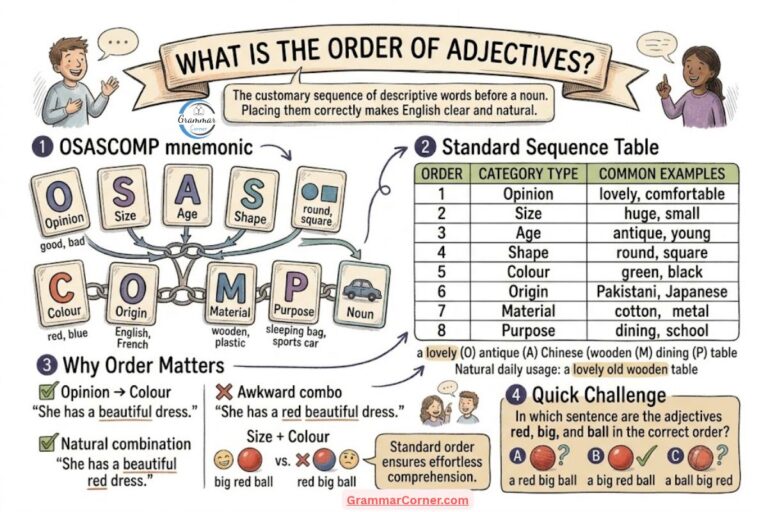
Adjective order (stacking multiple adjectives)
When more than one attributive adjective describes the same noun, native English speakers follow an unwritten order almost automatically. Get the order wrong and a sentence sounds distinctly “off,” even if every word is correct on its own.
The general sequence is Opinion, Size, Age, Shape, Color, Origin, Material, Purpose.
Put together: “She bought a beautiful small antique round Italian silver serving spoon.” Every word is doing its job in an order that sounds natural to a native ear.
A beautiful small antique round Italian silver serving spoon.
A silver small beautiful spoon.
Reverse a few of the adjectives and the sentence starts to feel scrambled, even without any single word being wrong.
How to Identify an Adjective
If you’re staring at a sentence and trying to figure out whether a word is an adjective, run it through these checks.
Test 1Ask “what kind, which one, how many, or whose?”
If the word answers one of those questions about a nearby noun, it’s very likely an adjective.
In “the crowded train,” crowded answers what kind of train?
Test 2Try inserting “very” or “extremely” in front of it.
Most descriptive adjectives accept a degree word comfortably: “very crowded,” “extremely nervous.” If the sentence still makes sense, that’s a strong sign you’re looking at an adjective. Try it yourself:
“The train was crowded.”
Press the button and see whether the sentence survives.
This test doesn’t work for every type — possessive adjectives like her and demonstrative adjectives like this will fail it (“very her desk” is nonsense), which is fine, since the test is aimed specifically at descriptive adjectives.
Test 3Check whether it has comparative and superlative forms.
Words that behave this way do so almost exclusively as adjectives. If a word can be compared in this fashion, it’s doing an adjective’s job.
Test 4See if it can follow a linking verb.
Try placing the word after is, seems, or became:
Works naturally
“The room is spacious.”
Spacious is confirmed as an adjective.
Clearly fails
“The room is furniture.”
A noun can’t sit here the same way — which is exactly the point of the test.
Test 5Watch out for words wearing a disguise.
Some -ed and -ing words look like verbs but are actually functioning as adjectives. And some words that look identical to nouns are working as adjectives too:
“a morning routine” — here morning describes the routine rather than naming a thing on its own
Remember
When in doubt, ask what job the word is doing in that specific sentence — not what job it usually does.
Common Mistakes with Adjectives
1Using an adverb form where an adjective belongs (or the reverse)
Incorrect: “She sings good.”
Correct: “She sings well.”
Why: Good describes a noun; well describes how she sings, which is an action, so it needs an adverb. This mix-up runs in both directions — watch for adjectives sneaking into adverb spots too, and vice versa.
2Double comparatives or double superlatives
Incorrect: “This is the most easiest recipe I’ve tried.”
Correct: “This is the easiest recipe I’ve tried.”
Why: Easiest already carries the superlative meaning on its own. Adding most on top of it is redundant — the same way “more better” and “most best” double up unnecessarily.
3Ignoring adjective order
Incorrect: “He wore a leather black jacket.”
Correct: “He wore a black leather jacket.”
Why: Color comes before material in the standard order, so black leather sounds natural while leather black sounds reversed — even though nothing is technically “wrong” with either individual word.
4Confusing few/little and fewer/less with countable and uncountable nouns
Incorrect: “We have less apples than last week.”
Correct: “We have fewer apples than last week.”
Why: Apples can be counted one by one, so they need fewer, not less. Less belongs with uncountable nouns instead: “We have less time than last week” is correct, because time can’t be counted individually.
5Mixing up -ed and -ing participial adjectives
Incorrect: “I’m so boring in this meeting.”
Correct: “I’m so bored in this meeting.”
Why: The -ing form describes the thing that causes a feeling (“This meeting is boring”), while the -ed form describes the person experiencing it (“I am bored”). Saying “I’m boring” accidentally claims that you, personally, are dull to be around — probably not the intended message.
6Dropping the hyphen in a compound adjective before a noun
Incorrect: “It’s a well known restaurant.”
Correct: “It’s a well-known restaurant.”
Why: Because well-known sits directly before restaurant and works as a single descriptive unit, it needs the hyphen. Remember: the hyphen usually disappears once the same words move after the noun (“The restaurant is well known”).
7Forgetting the comma between coordinate adjectives
Incorrect: “It was a long boring lecture.”
Correct: “It was a long, boring lecture.”
Why: A comma belongs between two adjectives when each one independently describes the noun and their order could be swapped without changing the meaning (“a boring, long lecture” still works). If you can insert and between them naturally (“long and boring”), they need a comma.
Comma needed
“a long, boring lecture”
“long and boring” sounds natural — both words describe the lecture.
No comma needed
“a bright red sweater”
Bright modifies red, not sweater — you wouldn’t say “a bright and red sweater.”
Practice Exercises
Exercise 1: Identify every adjective in each sentence
-
The exhausted hikers finally reached the quiet, snow-covered summit.
Show answer
exhausted, quiet, snow-covered
-
My little sister borrowed her favorite blue jacket without asking.
Show answer
little, her, favorite, blue
-
Which restaurant serves the spiciest curry in this neighborhood?
Show answer
Which, spiciest, this
Exercise 2: Fix the mistake in each sentence
-
This is the most cheapest flight I could find.
Show answer
This is the cheapest flight I could find.
-
We had less options than we expected.
Show answer
We had fewer options than we expected.
-
She wore a bright orange new scarf.
Show answer
She wore a bright new orange scarf.Opinion/quality comes before color.
Exercise 3: Choose the correct comparative or superlative form
-
Today’s traffic is (bad / worse / worst) than yesterday’s.
Show answer
worse
-
Out of all three routes, this one is (short / shorter / shortest).
Show answer
shortest
-
He’s the (careful / more careful / most careful) driver in our family.
Show answer
most careful
Frequently Asked Questions
Can an adjective come after the noun it describes?
Yes, though it’s less common. This happens with linking verbs (“The soup tastes delicious”), fixed titles (“attorney general”), and indefinite pronouns (“nothing important happened”).
What’s the real difference between comparative and superlative?
Comparative compares exactly two things (“Mia is taller than Jen”). Superlative compares three or more, singling one out from the group (“Mia is the tallest player on the team”).
Can numbers function as adjectives?
Yes. In “three dogs” or “the fifth attempt,” the numbers three and fifth are describing how many or which one — exactly what an adjective does.
Is “the” an adjective?
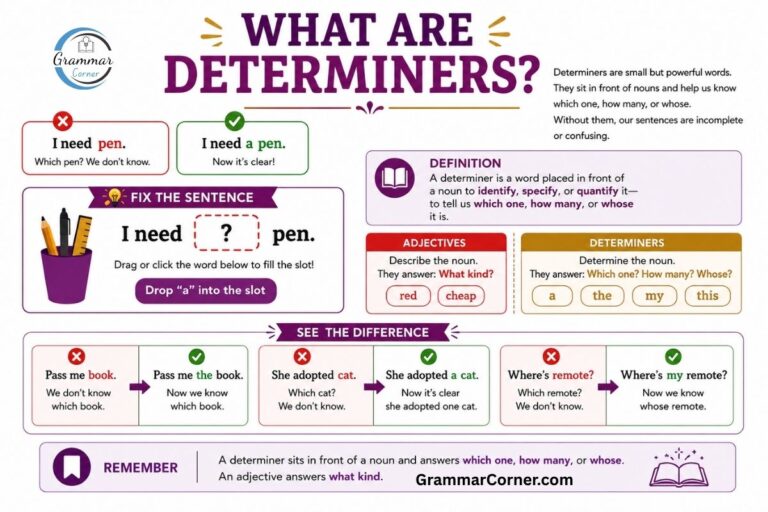
Under traditional grammar, articles like the, a, and an are sometimes grouped with adjectives because they modify nouns. Under modern grammar, they’re classified as a specific type of determiner. Either way, you don’t need to memorize the label to use them correctly.
Can the same word be an adjective in one sentence and something else in another?
Constantly. English reuses words across categories all the time. “Light” is an adjective in “a light suitcase,” a noun in “turn on the light,” and a verb in “light the candle.” Always judge the word by the job it’s doing in that particular sentence.
Do all adjectives have comparative and superlative forms?
No. Absolute adjectives like unique, perfect, and dead describe an all-or-nothing state, so grammatically they resist degrees of comparison, even though you’ll hear phrases like “very unique” in casual speech.
See also:
- Parts of Speech Complete Guide
- Punctuation Ultimate Guide
- Nouns Chart
- Pronouns Chart
- Verbs Chart
- Adverbs Chart