Irregular Adjectives (Types and Examples)
What Are Irregular Adjectives?
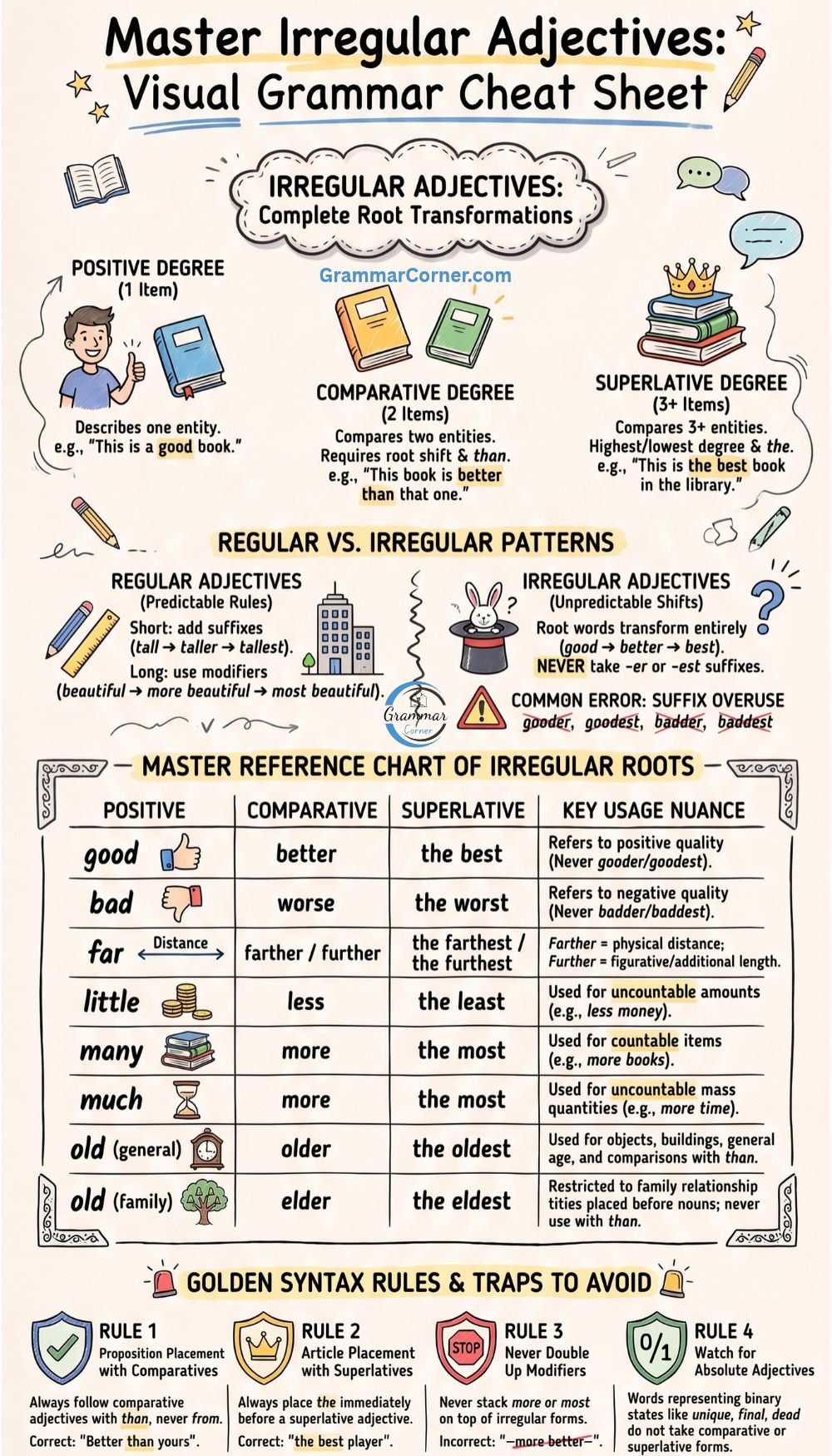
Adjectives describe people, animals, places, and things, and they also allow us to compare items using regular suffixes like -er or -est. However, irregular adjectives do not follow these standard patterns—instead of taking suffixes, they transform into completely unique words when comparing quantities or qualities.
The Three Degrees of Adjectives
Adjectives generally function across three distinct comparative degrees:
Describes a single person, place, animal, or thing without comparing it to others (e.g., good, bad, tall).
Compares two people, places, or things (e.g., better, worse, taller).
Shows the highest or lowest degree among three or more items (e.g., best, worst, tallest).
• ❌ Incorrect:
• ❌ Incorrect:
Never attach regular comparative suffixes (-er or -est) to irregular root adjectives. Memorizing root transformations ensures your comparisons remain natural and grammatically correct.
Quick Challenge
What is the correct superlative form of the irregular adjective bad? Tap an option.
See the full explanation
Answer: C. worst
Grammar breakdown:
- Three Degrees of Bad: Positive (bad) ➔ Comparative (worse) ➔ Superlative (worst).
- Irregular Root Shift: Because bad is an irregular adjective, it transforms into entirely new root words rather than accepting regular -er or -est endings.
Regular and Irregular Adjectives
To fully grasp irregular adjectives, it is helpful to first contrast them with standard regular adjectives. While regular comparisons follow predictable morphological rules, irregular adjectives undergo root transformations that must be memorized.
Short adjectives take suffixes, while longer adjectives use modifiers:
- tall ➔ taller ➔ tallest
- fast ➔ faster ➔ fastest
- small ➔ smaller ➔ smallest
- beautiful ➔ more beautiful ➔ most beautiful
- expensive ➔ more expensive ➔ most expensive
These adjectives transform completely into new root words:
- good ➔ better ➔ best
- bad ➔ worse ➔ worst
- little ➔ less ➔ least
Common Irregular Adjectives Reference Table
Below is a master reference chart of the most important irregular adjectives in English, displaying their Positive, Comparative, and Superlative degrees:
| Positive Degree | Comparative Degree | Superlative Degree |
|---|---|---|
| good | better | the best |
| bad | worse | the worst |
| far | farther / further | the farthest / the furthest |
| little | less | the least |
| many / much | more | the most |
| old | older / elder | the oldest / the eldest |
• Far: Both farther/farthest and further/furthest denote distance, though further also frequently means “additional” or “extra” (e.g., “further details”).
Because irregular forms cannot be calculated with suffix rules, practice them in three-word sets: good-better-best, bad-worse-worst, little-less-least.
Quick Challenge
Complete the sentence correctly: “My sister is ______ than me at tennis.” Tap an option.
See the full explanation
Answer: B. better
Grammar breakdown:
- Comparative Trigger: The presence of than indicates a comparison between two subjects (myself and my sister), requiring the comparative form better.
- Irregular Pattern: good (positive) ➔ better (comparative) ➔ best (superlative).
Core Irregular Adjectives: Good, Bad, and Far
Examining high-frequency irregular roots like good, bad, and far reveals how English transitions across positive, comparative, and superlative degrees without relying on standard suffixes.
Progression:
- Positive: This is a good book.
- Comparative: This book is better than that one.
- Superlative: This is the best book in the library.
Progression:
- Positive: I had a bad day.
- Comparative: Today is worse than yesterday.
- Superlative: Monday was the worst day.
Progression:
- Positive: far
- Comparative: farther / further
- Superlative: the farthest / the furthest
Differentiating “Farther” and “Further”
While both comparative forms derive from far, standard English applies subtle distinctions between physical distance and abstract concepts:
• Further (Figurative / Additional): Used for abstract ideas, extra details, or metaphorical extension (e.g., “We need further information”, “Let us discuss this further”).
Never use gooder, goodest, badder, or baddest. Always switch to root alternatives: better/best and worse/worst.
Quick Challenge
Which comparative form is traditionally preferred for literal, physical distance? “My house is ______ from the school than yours.” Tap an option.
See the full explanation
Answer: A. farther
Grammar breakdown:
- Physical Distance: Farther measures physical length or distance (e.
Quantity Adjectives: Little, Many, and Much
Quantity adjectives like little, many, and much undergo specific irregular transformations when comparing amounts. Distinguishing between countable and uncountable nouns is crucial for selecting the correct comparative and superlative forms.
Little ➔ Less ➔ The LeastUncountable AmountsProgression for quantity:
- Positive: I have little money.
- Comparative: Ali has less money than me.
- Superlative: Ahmed has the least money.
*(Note: When meaning physical size, regular forms apply: little ➔ littler ➔ littlest).*Many ➔ More ➔ The MostCountable Nouns (Numbers)Progression for countable items:
- Positive: I have many books.
- Comparative: Sara has more books than me.
- Superlative: Ahmed has the most books.
Much ➔ More ➔ The MostUncountable Nouns (Mass)Progression for uncountable mass items:
- Positive: I do not have much time.
- Comparative: You have more time than I do.
- Superlative: She has the most time.
Countable vs. Uncountable Distinction:• Many (Countable): Used with items you can count individually (e.g., more students, more apples, more pencils, more books).
• Much / Little (Uncountable): Used with mass quantities you cannot count individually (e.g., less water, less time, much money, much food). Note how both many and much share the same comparative form: more.Grammar Check:Never say many money—money is an uncountable noun, so it requires much money or more money.
Quick Challenge
Which sentence correctly compares an uncountable noun? “I have ______ money than my brother.” Tap an option.
See the full explanation
Answer: A. I have more money than my brother.
Grammar breakdown:
- Uncountable Nouns: Money is uncountable, so it pairs with much in the positive degree and more in the comparative degree.
- Countable Nouns: Pencils are countable (e.g., “Ali has more pencils than Hamza”).
Old: General Comparisons vs. Family Relationships (Elder/Eldest)
The adjective old offers a unique dual structure in English. While it primarily follows regular comparative patterns for everyday objects and general comparisons, it shifts to specialized forms (elder / eldest) when describing family relationships.
General ComparisonObjects, Buildings & General UseStandard regular progression for everyday items:
- old ➔ older ➔ the oldest
- “My house is older than yours.”
- “This is the oldest building in town.”
Family RelationshipsElder & EldestUsed restrictively before nouns for family members:
- my elder brother
- her elder sister
- his eldest brother
Grammar Usage Constraints for Elder:• Attributive Position Only: Elder is normally placed directly before a noun (e.g., “He is my elder brother”).
• No “Than” Constructions: You cannot follow elder with than. To compare ages across individuals with than, always use older (e.g., “He is older than me”, not “He is elder than me”).Summary Checklist:Use older / oldest for general comparisons and with than. Reserve elder / eldest exclusively for attributive family titles (e.g., eldest son, elder sister).
Quick Challenge
Which sentence uses the adjective form correctly? Tap an option.
See the full explanation
Answer: A. He is my elder brother.
Grammar breakdown:
- Family Attributive Rule: Elder and eldest sit directly before family nouns (e.g., elder brother).
- Than Rule: When comparing ages directly with than, always use older (e.g., “He is older than me”).
When Do We Use Comparative and Superlative Forms?
Comparative adjectives evaluate two entities (typically followed by than), while superlative adjectives compare three or more entities (usually preceded by the article the).
Comparative Form (2 Items)Comparing Two EntitiesIrregular comparative roots include:
better worse farther / further less more elder“This book is better than that book.”
Superlative Form (3+ Items)Comparing Three or MoreCommon irregular superlative roots include:
the best the worst the farthest the least the most“Ali is the best player on the team.”
Irregular Adjectives in Sentences
Studying grammar tables is helpful, but seeing irregular adjectives in complete sentence progressions is the best way to master their real-world usage:
Good ➔ Better ➔ The Best- Positive: This is a good idea.
- Comparative: This idea is better than the first one.
- Superlative: This is the best idea of all.
Bad ➔ Worse ➔ The Worst- Positive: The weather is bad today.
- Comparative: The weather is worse than yesterday.
- Superlative: Monday was the worst day this week.
Little ➔ Less ➔ The Least- Positive: I have little free time.
- Comparative: I have less free time than my sister.
- Superlative: Ahmed has the least free time in our group.
Many ➔ More ➔ The Most- Positive: There are many students here.
- Comparative: There are more students here than yesterday.
- Superlative: This school has the most students in the area.
Usage Summary:Notice how each root word shifts entirely across degrees without adding regular suffixes (e.g., good ➔ better ➔ best, never gooder ➔ goodest).
Quick Challenge
Complete the sentence correctly: “This is a ______ book, but that one is ______.” Tap an option.
See the full explanation
Answer: A. good / better
Grammar breakdown:
- First Blank (Positive Degree): “This is a good book” describes a single item without comparison.
- Second Blank (Comparative Degree): “…that one is better“ compares two books, invoking the irregular comparative form of good.
Adjectives That Can Have Two Comparative Forms
Not every adjective that departs from strict regular patterns is fully irregular. Certain two-syllable adjectives possess unique flexibility, allowing speakers to choose between two acceptable comparison patterns depending on style, context, and rhythm.
Clevercleverer ➔ cleverest
or more / most cleverFriendlyfriendlier ➔ friendliest
or more / most friendlyQuietquieter ➔ quietest
or more / most quietSimplesimpler ➔ simplest
or more / most simpleGentlegentler ➔ gentlest
or more / most gentleThe Crucial Rule: Never Double Up!While both single-word suffixes (-er/-est) and modifier patterns (more/most) are valid individually, never combine both patterns in the same form.
• ❌ Incorrect:more friendlier
• ✅ Correct: friendlier or more friendlyAdjectives That Do Not Normally Have Comparative Forms (Absolute Adjectives)
Some adjectives describe absolute qualities or binary states that cannot logically exist on a sliding scale. Because they represent all-or-nothing conditions, they do not naturally take ordinary comparative or superlative degrees.
Absolute Qualities (No Scale)All-or-Nothing StatesCommon absolute adjectives include:
unique final dead fatal universal• Standard Usage: “This is a unique design.”
• Avoid in Formal Writing:more uniqueormost unique.Stylistic Note for Learners:While casual speech sometimes uses expressions like “very unique” or “most unique” to mean “unusual,” careful writers and young learners should treat these terms as absolute (an item is either unique or it is not).
Quick Challenge
Which sentence is the safer choice for a beginner writer? Tap an option.
See the full explanation
Answer: B. This is a unique idea.
Grammar breakdown:
- Absolute Adjectives: Words like unique, dead, and final represent absolute binary states that cannot logically be modified by more or most in careful writing.
- Dual Comparative Adjectives: Adjectives like friendly or clever accept two valid patterns (friendlier or more friendly), but you must never combine them into more friendlier.
Irregular Adjectives: A Simple Way to Learn Them
Because irregular adjectives do not follow one simple rule, memorizing their forms is important. However, rather than learning them as isolated vocabulary words, mastering them in structured root groups and practicing them within complete sentences makes retention much easier.
Group 1: Quality Roots- good ➔ better ➔ best
- bad ➔ worse ➔ worst
Group 2: Quantity Roots- little ➔ less ➔ least
- much ➔ more ➔ most
- many ➔ more ➔ most
Group 3: Distance Roots- far ➔ farther / further ➔ farthest / furthest
Group 4: Age Roots- old ➔ older ➔ oldest
- old ➔ elder ➔ eldest
Contextual Sentence Practice
Instead of reciting words in isolation, integrate all three degrees into meaningful sentence progressions:
Meaningful Sentence Progression (Good / Better / Best)- Positive: This is a good book.
- Comparative: This book is better than that one.
- Superlative: This is the best book here.
Syntax Rules: Pairing with “Than” and “The”
Mastering irregular adjectives requires proper preposition and article placement:
Comparative + ThanNaming Two ThingsAlways pair comparatives with than, never from:
- ✅ Correct: My bag is better than yours.
- ❌ Incorrect: My result is
better fromyours. - ✅ Correct: This road is worse than the other.
The + SuperlativeIdentifying Group ExtremesAlways include the definite article the before superlatives:
- ✅ Correct: Sara is the best student in class.
- ✅ Correct: This is the worst restaurant in town.
- ✅ Correct: Ahmed has the most books.
Golden Rule:Group irregular roots together in sets of three (Positive ➔ Comparative ➔ Superlative), always follow comparatives with than, and always precede superlatives with the.
Quick Challenge
Which comparative sentence follows standard English grammar rules? Tap an option.
See the full explanation
Answer: B. My result is better than yours.
Grammar breakdown:
- Comparative Preposition: When comparing two items using a comparative adjective (like better or worse), the correct preposition is always than.
- Superlative Article: When identifying the highest member of a group, use the definite article with the superlative form (e.g., “the best student”).
Practice Exercises on Irregular Adjectives
Test your mastery of irregular adjectives with these 7 comprehensive practice modules. Strengthen your understanding across comparative tables, multiple-choice selections, error corrections, degree identification, sentence completions, and creative writing exercises.
Exercise 1: Complete the FormsFill in the missing comparative and superlative forms for each irregular root:
Positive Comparative Superlative good _________ _________ bad _________ _________ far _________ _________ little _________ _________ many _________ _________ much _________ _________ old _________ _________ Check Exercise 1 Answers
Positive Comparative Superlative good better the best bad worse the worst far farther / further the farthest / the furthest little less the least many more the most much more the most old older / elder the oldest / the eldest Exercise 2: Choose the Correct Word1. This book is ______ than that one.2. Today is ______ than yesterday.3. Sara has ______ books than Ali.4. This is ______ movie I have ever seen.5. I have ______ money than my brother.Check Exercise 2 Answers
- B. better (Comparative of good)
- A. worse (Comparative of bad)
- A. more (Comparative for countable nouns)
- B. the worst (Superlative with definite article the)
- A. less (Comparative for uncountable quantity)
Exercise 3: Correct the MistakesIdentify and correct the error in each sentence:
1. This is gooder than that.2. He is the most best player.3. Today is badder than yesterday.4. She has more books than me.5. This is the most worst idea.6. I have less money than Ali.7. He is my elder brother.Check Exercise 3 Answers
- This is better than that. (Replace gooder with better)
- He is the best player. (Remove redundant most)
- Today is worse than yesterday. (Replace badder with worse)
- Correct. (Grammatically sound)
- This is the worst idea. (Remove redundant most before worst)
- Correct. (Grammatically sound for uncountable money)
- Correct. (Attributive family use of elder)
Exercise 4: Comparative or Superlative?Fill in the correct comparative or superlative form using the adjective in parentheses:
1. Ali is ______ than Ahmed. (good)2. Sara is ______ student in the class. (good)3. Today is ______ than yesterday. (bad)4. That was ______ day of my holiday. (bad)5. I have ______ money than you. (much)6. Ahmed has ______ money in the group. (little)Check Exercise 4 Answers
- better (Comparing two people with than)
- the best (Superlative across a class)
- worse (Comparative with than)
- the worst (Superlative across a holiday)
- more (Comparative for uncountable quantity with than)
- the least (Superlative across a group)
Exercise 5: Complete the SentencesUse the correct positive, comparative, or superlative form of the adjective in brackets:
1. This is a ______ idea. (good)2. Your idea is ______ than mine. (good)3. Her idea is ______ of all. (good)4. The weather is ______ today. (bad)5. Yesterday was ______ than today. (bad)6. Monday was ______ day of the week. (bad)Check Exercise 5 Answers
- good (Positive degree – single idea)
- better (Comparative degree with than)
- the best (Superlative degree – “of all”)
- bad (Positive degree)
- worse (Comparative degree with than)
- the worst (Superlative degree of the week)
Exercise 6: Find the MistakeEach sentence contains a mistake. Rewrite it correctly:
1. This test is more easier.2. He is the most best student.3. My result is gooder than yours.4. This is the baddest day.5. I have littler money than you.6. She has the most books in the class.Check Exercise 6 Answers
- This test is easier. (Remove redundant more)
- He is the best student. (Remove redundant most)
- My result is better than yours. (Replace gooder with better)
- This is the worst day. (Replace baddest with worst)
- I have less money than you. (Replace littler with less for money)
- Correct. (Grammatically sound superlative)
Exercise 7: Make Your Own SentencesWrite an original sentence using each target form:
- better
- the best
- worse
- the worst
- more
- less
- the most
- the least
View Sample Answers
- My new bicycle is better than my old one.
- Ali is the best player on the team.
- The weather is worse today.
- That was the worst mistake I made.
- Sara has more books than me.
- I have less time today.
- Ahmed has the most pencils.
- Bilal has the least money.
* Your sentences can be different as long as the irregular forms are used correctly in context.
Practice Tip:Review any incorrect answers above by checking your root groups. Remember that comparatives pair with than and superlatives require the.
Quick Challenge
Which sentence correctly uses an irregular superlative form? Tap an option.
See the full explanation
Answer: B. This is the best book.
Grammar breakdown:
- Superlative Structure: Superlatives require the definite article the combined with the superlative root (the best).
- No Redundancy: Avoid stacking modifiers like most in front of irregular superlatives (most best is incorrect).
Frequently Asked Questions About Irregular Adjectives
Get clear, direct answers to common questions regarding irregular adjectives, covering root transformations, common error corrections, distance versus degree distinctions, and family vs. general forms.
What is an irregular adjective and what are the most common examples?An irregular adjective is an adjective whose comparative or superlative forms do not follow the standard suffix pattern (e.g., good ➔ better ➔ best instead of gooder ➔ goodest). Key examples include:good ➔ better ➔ best bad ➔ worse ➔ worst far ➔ farther/further ➔ farthest/furthest little ➔ less ➔ least many/much ➔ more ➔ most old ➔ older/elder ➔ oldest/eldestAre words like “gooder”, “badder”, “more better”, or “most best” correct?No. In standard English, these forms are ungrammatical:• ❌ gooder ➔ ✅ better• ❌ badder ➔ ✅ worse• ❌ more better ➔ ✅ better (redundant to add more)• ❌ most best ➔ ✅ the best (redundant to add most)What are the comparative and superlative forms of “good” and “bad”?- Good: Comparative is better (“This book is better than that book”); superlative is the best (“This is the best book in the library”).
- Bad: Comparative is worse (“Today’s weather is worse than yesterday’s”); superlative is the worst (“That was the worst day of my holiday”).
What is the difference between “farther” and “further”, “less” and “least”, and “more” and “most”?Farther vs. Further: Farther is used for physical distance (“The school is farther away”); further is used for figurative or additional meanings (“We need further information”), though British English also uses further for distance.Less vs. Least: Less is the comparative form for uncountable amounts (“I have less money than you”); least is the superlative form (“I have the least money”).More vs. Most: More compares two quantities (“Sara has more books than Ali”); most identifies the greatest quantity in a group (“Sara has the most books in the class”).Is “elder” the same as “older”? Can some adjectives have two comparative forms?Older vs. Elder: Older is general (“My father is older than my uncle”), whereas elder / eldest are restricted to family relationships (“My elder brother”, “She is the eldest daughter”).Dual Forms: Yes, certain two-syllable adjectives accept two patterns (e.g., clever ➔ cleverer ➔ cleverest or more/most clever; similarly for friendly, quiet, simple, gentle). Never combine both into more quieter.Do all adjectives have comparative forms, like absolute adjectives?No. Adjectives describing absolute conditions or binary states do not naturally form comparatives or superlatives (e.g., more unique or most unique should be avoided in careful writing because uniqueness is an absolute state).Irregular Adjectives Quick Reference Chart
A master reference guide summarizing the Positive, Comparative, and Superlative forms of essential irregular adjectives:
Adjective Comparative Superlative Example Sentence good better the best This is better. bad worse the worst Today is worse. far farther / further the farthest / furthest It is farther away. little (amount) less the least I have less money. many more the most She has more books. much more the most We need more water. old (general) older the oldest This is the oldest house. old (family) elder the eldest He is my elder brother. Core Takeaway:Memorize irregular adjectives in root groups, always pair comparatives with than, and always use the with superlatives.
Quick Challenge
Which sentence correctly uses the irregular comparative of bad? Tap an option.
See the full explanation
Answer: B. Today is worse than yesterday.
Grammar breakdown:
- Irregular Root Shift: bad transforms into worse (comparative) and the worst (superlative).
- Preposition: Comparative adjectives are followed by than when naming the second entity.


Similar Posts
Prepositions Chart (Types, Examples & Usage)
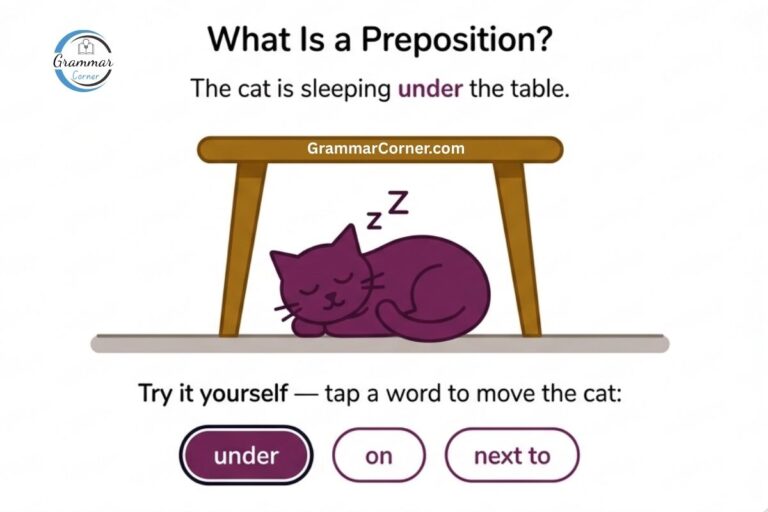
What Is a Preposition? “The cat is sleeping under the table.” Now take away the word under, and something breaks. You still have a cat and a table — but no idea how they relate to each other. Is the cat on the table? Next to it? Nowhere near it? That one small word is…
9 Parts of Speech (Chart, Rules, Examples & Definitions) – Ultimate Guide
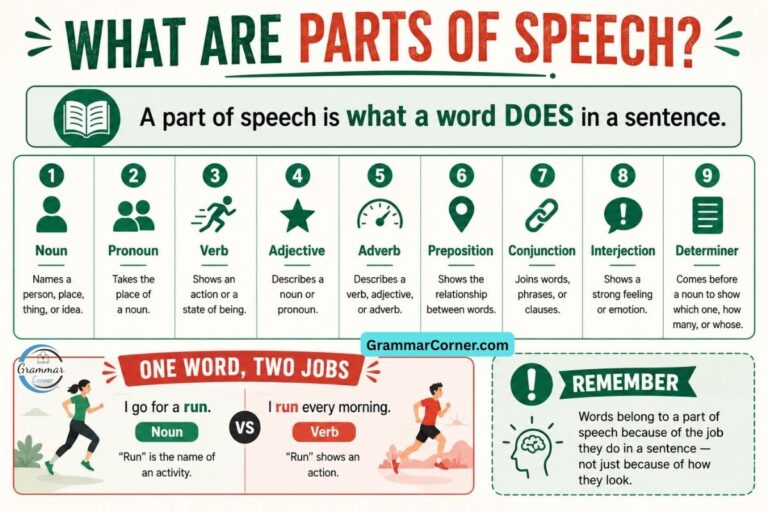
Every sentence you have ever spoken or written is made up of nine basic building blocks. These are known as parts of speech. Some of them, like nouns and verbs, play an important role in the sentence. Others, like interjections, show up only when you’re excited, surprised, or annoyed. Once you learn to recognize all…
Non Action Verbs | Stative Verbs (Rules & Examples)
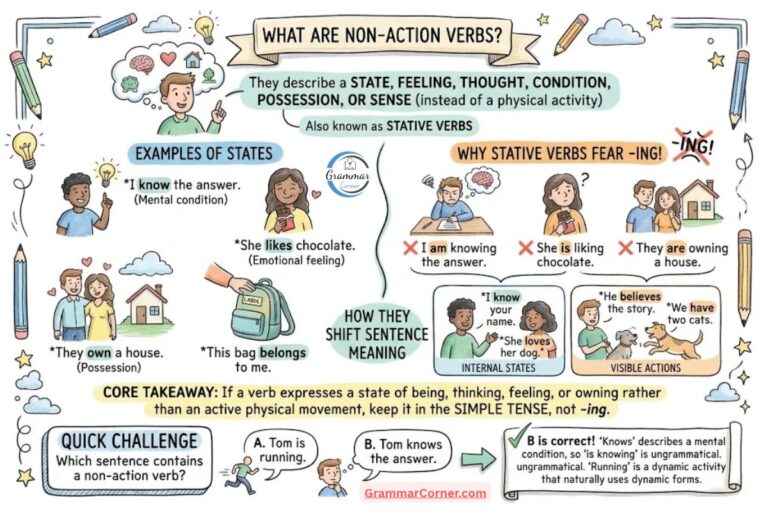
What Are Non-Action Verbs? A non-action verb describes a state, feeling, thought, condition, possession, or sense rather than a physical activity. Because they do not portray activities that can be watched happening in real time, they are also widely known as stative verbs. Stative Examples Describing Conditions & Thoughts I know the answer. She likes…
Pronouns Chart (Types, Examples and Rules) – Ultimate Guide
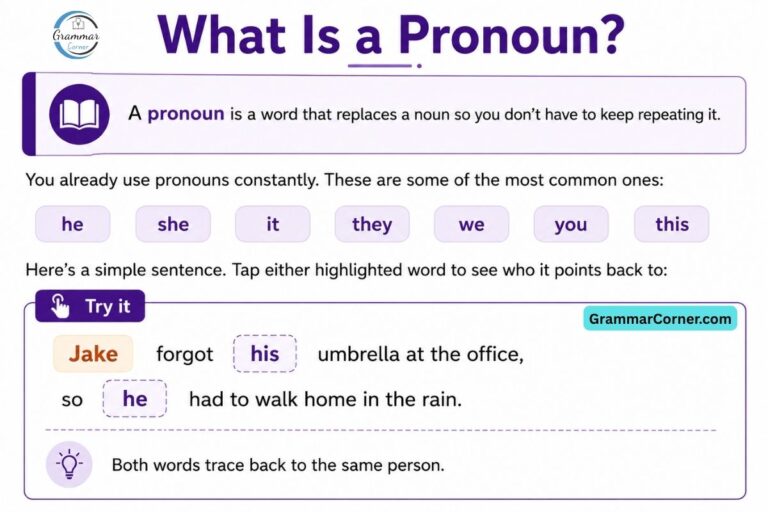
Picture this text message: “Oliver texted Sara to tell Sara that Oliver would pick Sara up at seven, but Oliver got stuck in traffic, so Oliver texted Sara again.” Painful to read, right? Now compare it with how anyone would actually write it: “Oliver texted Sara to tell her that he would pick her up…
Gerunds and Participles: Meaning, Rules, Examples, and Exercises
Gerunds vs. Participles: Understanding -ing Words Both gerunds and present participles are verb forms that end in -ing, but they perform fundamentally different jobs in a sentence. While they look identical on the surface, their grammatical role determines whether they act as nouns, active verbs, or adjectives. What Is a Gerund? A gerund is an…
Determiners Chart (Types, Usage & Examples)
What Are Determiners? Say these two sentences out loud: ✗ Sounds broken “I need pen.” ✓ Sounds right “I need a pen.” The first one sounds broken, even though every word in it is spelled correctly and the grammar mostly holds together. Something is missing — and that something is a tiny word sitting right…