Order of Adjectives in English
What Is the Order of Adjectives?
The order of adjectives refers to the customary sequence followed in English when two or more descriptive words modify the same noun. While adjectives enrich our descriptions of size, age, colour, shape, origin, and material, placing them in the expected order makes speech and writing sound natural and clear.
When using multiple modifiers before a single noun, native speakers intuitively arrange them according to specific categories:
- “She has a beautiful red dress.” (Opinion → Colour)
- “He bought a small wooden table.” (Size → Material)
- “We saw a large old Chinese house.” (Size → Age → Origin)
❌ Awkward: a red big ball
While both are understandable, standard ordering ensures effortless comprehension.
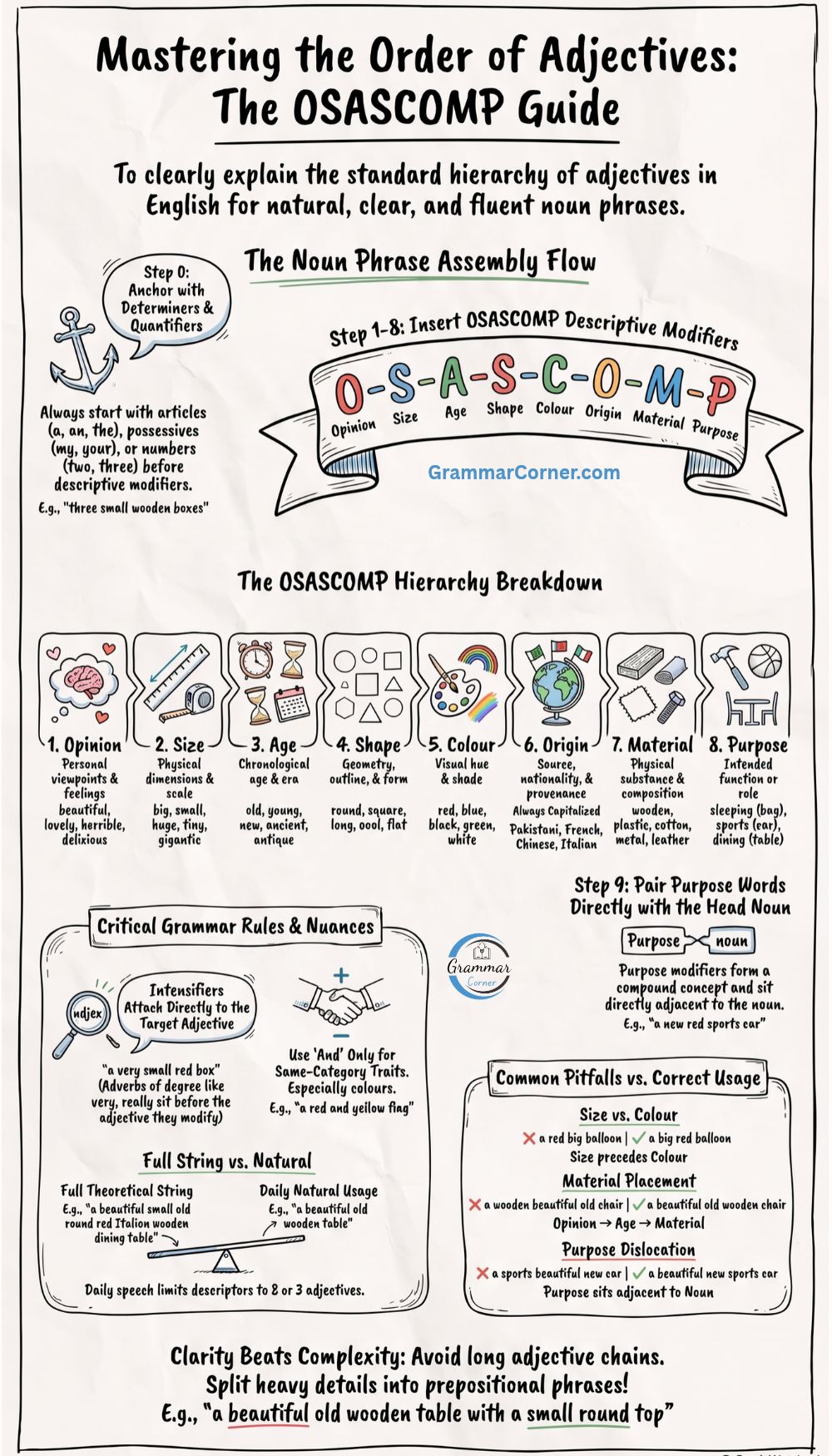
The Standard Sequence: OSASCOMP
The standard hierarchy of adjective categories can be remembered using the acronym OSASCOMP:
Basic Order of Adjectives at a Glance
Reference table outlining the 8 primary categories in their standard sequential order:
| Order | Category Type | Common Examples |
|---|---|---|
| 1 | Opinion | beautiful, ugly, lovely, horrible, delicious, comfortable |
| 2 | Size | big, small, huge, tiny, large, gigantic |
| 3 | Age | old, young, new, ancient, antique, modern |
| 4 | Shape | round, square, long, narrow, oval, triangular |
| 5 | Colour | red, blue, black, green, yellow, white |
| 6 | Origin | Pakistani, English, French, Chinese, Italian, Japanese |
| 7 | Material | wooden, plastic, cotton, metal, silk, leather |
| 8 | Purpose | sleeping (bag), sports (car), school (bus), cooking (oil), dining (table) |
• Natural Daily String: “a beautiful old wooden table” (Opinion → Age → Material)
In standard communication, using two or three adjectives before a noun is the most effective approach. Mastering frequent pairings (such as Size + Colour or Opinion + Material) creates smooth, natural descriptions without overloading your sentence.
Quick Challenge
Which sentence arranges the adjectives red, big, and ball in the correct natural order? Tap an option.
See the full explanation
Answer: B. a big red ball
Grammar breakdown:
- Category Check: big = Size (Category 2) | red = Colour (Category 5) | ball = Noun.
- Rule: In the OSASCOMP framework, Size precedes Colour, giving:
a + [Size: big] + [Colour: red] + [Noun: ball]. - Summary: While native speakers occasionally shift order for poetic emphasis, standard English overwhelmingly prefers general, physical attributes (like size) before specific surface qualities (like colour).
Opinion Adjectives vs. Size Adjectives
In English adjective ordering (OSASCOMP), subjective evaluation always precedes objective physical measurement. That is why Opinion adjectives (what we feel or think) occupy position 1, followed directly by Size adjectives (physical dimensions) in position 2.
Describes personal viewpoints that can vary from person to person:
• an interesting book
• a wonderful teacher
• a strange story
Describes measurable height, width, length, or bulk:
• a small dog
• a huge building
• a tiny box
Combining Opinion and Size in Noun Phrases
When you place an opinion adjective alongside a size adjective or other descriptive category, the opinion adjective almost always leads:
• ✅ “a beautiful big house” (Opinion → Size)
• ✅ “an ugly small room” (Opinion → Size)
• ✅ “a lovely little puppy” (Opinion → Size)
• ✅ “a beautiful red dress” (Opinion → Colour)
• ✅ “an interesting old book” (Opinion → Age)
• ✅ “a wonderful little house” (Opinion → Size)
Saying a little lovely puppy or a red beautiful dress feels unnatural to native speakers because your brain wants to register how you feel about the item before registering its physical form. Keep opinion first!
Quick Challenge
Which option arranges the opinion and size adjectives in the most natural order? Tap an option.
See the full explanation
Answer: B. a lovely little puppy
Grammar breakdown:
- Category Analysis: lovely = Opinion (Position 1) | little = Size (Position 2) | puppy = Noun.
- OSASCOMP Ordering: Opinion comes before Size, making
a + [Opinion: lovely] + [Size: little] + [Noun: puppy]the natural sequence. - Similar Pairings: “a beautiful red dress” (Opinion → Colour), “an interesting old book” (Opinion → Age), “a wonderful big garden” (Opinion → Size).
Age Adjectives vs. Shape Adjectives
In the standard English sequence (OSASCOMP), Age adjectives (Position 3) and Shape adjectives (Position 4) naturally follow Opinion and Size, allowing you to define a noun’s chronological state and physical form before introducing its colour and material.
Tells us how old, young, or historic something or someone is:
• a new phone
• a young boy
• an ancient building
Describes the contour, geometry, or outline of an object:
• a square box
• an oval mirror
• a long rectangular table
Combining Age and Shape with Other Categories
When integrating age or shape with opinion and size adjectives, maintain the step-by-step sequence:
• ✅ “a beautiful old house” (Opinion → Age)
• ✅ “a small new car” (Size → Age)
• ✅ “an interesting old book” (Opinion → Age)
• ✅ “a large ancient temple” (Size → Age)
• ✅ “a beautiful round mirror” (Opinion → Shape)
• ✅ “a small square box” (Size → Shape)
• ✅ “an old rectangular building” (Age → Shape)
• ✅ “a big round table” (Size → Shape)
Saying a new beautiful house sounds inverted because subjective evaluation (beautiful) must lead before objective age (new). Always position Opinion first, followed by Size, Age, and Shape.
Quick Challenge
Complete the noun phrase in natural order: “a big ______ table”. Tap an option.
See the full explanation
Answer: A. round
Grammar breakdown:
- Category Analysis: big = Size (Position 2) | round = Shape (Position 4) | table = Noun.
- Formula:
Determiner (a) + Size (big) + Shape (round) + Noun (table)➔ “a big round table”. - Opinion & Age Comparison: In “a beautiful new house,” Opinion (beautiful) precedes Age (new), making Option B the natural choice over “a new beautiful house.”
Colour Adjectives vs. Origin Adjectives
In the OSASCOMP order of adjectives, visual surface details like Colour (Position 5) are placed before geographic provenance or nationality, known as Origin (Position 6).
Describes the colour or tint of an object:
• a blue shirt
• a green apple
• a black bag
Specifies where a person, food, or item originates:
• an Italian painting
• a Chinese vase
• a Pakistani truck
Multi-Adjective Combinations in Practice
When building longer descriptive phrases, keep physical traits before colour, and colour before origin:
• ✅ “a big red car” (Size → Colour)
• ✅ “a small blue box” (Size → Colour)
• ✅ “an old red car” (Age → Colour)
• ✅ “a new black bicycle” (Age → Colour)
• ✅ “a beautiful old Italian painting” (Opinion → Age → Origin)
• ✅ “a large red American car” (Size → Colour → Origin)
• ✅ “a small new Chinese phone” (Size → Age → Origin)
Remember that Origin and Nationality adjectives (like Pakistani, French, Italian, Chinese) are proper adjectives and must always begin with a capital letter, whereas colour, size, and age adjectives use lowercase letters.
Quick Challenge
Which option arranges the adjectives in the most natural order: “French”, “beautiful”, “old”, and “painting”? Tap an option.
See the full explanation
Answer: B. a beautiful old French painting
Grammar breakdown:
- Category Hierarchy:
- beautiful = Opinion (Position 1)
- old = Age (Position 3)
- French = Origin (Position 6)
- painting = Noun
- Ordering Check: Size precedes Colour (“a small blue bag”, not a blue small bag), and Opinion/Age precede Origin (“a beautiful old French painting”).
Material Adjectives vs. Purpose Adjectives
At the final end of the OSASCOMP hierarchy, Material adjectives (Position 7) and Purpose / Use modifiers (Position 8) sit closest to the head noun because they define what an item is made of and what it is fundamentally designed to do.
Identifies the material or matter from which the item is constructed:
• a plastic bottle
• a leather bag
• a silk dress
Specifies what the object is used for (often functioning as a noun adjunct or gerund):
• a sports car
• a sleeping bag
• a cooking pot
Combining Material and Purpose with Other Modifiers
Because Material and Purpose define core physical attributes, they appear after general descriptions like size, age, and colour:
• ✅ “a beautiful old wooden chair” (Opinion → Age → Material)
• ✅ “a small black leather bag” (Size → Colour → Material)
• ✅ “a new red plastic bottle” (Age → Colour → Material)
• ✅ “a beautiful old wooden dining table” (Opinion → Age → Material → Purpose)
• ✅ “a new red sports car” (Age → Colour → Purpose)
• ✅ “a large blue sleeping bag” (Size → Colour → Purpose)
Purpose words (such as dining, sports, or sleeping) form a single compound concept with the head noun (dining table, sports car, sleeping bag). Therefore, purpose words always sit immediately adjacent to the noun, with material placed just before them.
Quick Challenge
Which option arranges the adjectives new, red, and sports in the most natural sequence before car? Tap an option.
See the full explanation
Answer: B. a new red sports car
Grammar breakdown:
- Category Hierarchy:
- new = Age (Position 3)
- red = Colour (Position 5)
- sports = Purpose (Position 8)
- car = Noun
- Material Check: In “a small black leather bag,” Size (small) comes first, Colour (black) comes second, and Material (leather) sits directly before the noun.
How to Use Two Adjectives
In everyday spoken and written English, using two adjectives before a noun is the most common and practical structure. Rather than memorizing the entire 8-part OSASCOMP sequence for every sentence, mastering high-frequency two-adjective combinations helps you write naturally and quickly.
How to Use Three Adjectives
While using four or five adjectives before a noun feels heavy in natural conversation, three adjectives provide rich, vivid description without sounding forced. The more adjectives you combine, the more essential it is to follow the standard hierarchical flow:
Opinion: beautiful ➔ Size: small ➔ Colour: red ➔ [Noun: bag]
Age: old ➔ Shape: round ➔ Material: wooden ➔ [Noun: table]
Size: large ➔ Age: old ➔ Origin: Italian ➔ [Noun: house]
If you have more than three details to share about an object, avoid stacking them all before the noun. Instead, place two before the noun and attach the rest in a prepositional phrase (e.g., “a beautiful old wooden chair with red velvet cushions“).
Quick Challenge
Arrange these words into the most natural noun phrase: wooden / beautiful / old / chair. Tap an option.
See the full explanation
Answer: B. a beautiful old wooden chair
Grammar breakdown:
- Category Hierarchy:
- beautiful = Opinion (Position 1)
- old = Age (Position 3)
- wooden = Material (Position 7)
- chair = Noun
- Two-Adjective Check: Size precedes Colour (“a large red box”, not a red large box), and Opinion precedes Material (“a beautiful wooden chair”).
What Happens When We Use Four or More Adjectives?
While English grammar permits chaining four or more adjectives before a noun (e.g., Opinion + Size + Age + Shape + Material), stacking too many modifiers in front of a noun makes sentences cumbersome. Natural English avoids overloaded adjective chains by redistributing extra details into prepositional phrases or relative clauses.
• Natural Alternative: “a beautiful old wooden table with a small round top“
Using Adjectives with “And”
When two adjectives describe equal qualities within the same category (such as two colours or two personal attributes), they are joined with the coordinating conjunction and:
Used when a single noun possesses two distinct qualities of equal weight:
- a black and white dress (Two colours on one dress)
- a red and yellow flag (Two distinct flag colours)
- a kind and helpful teacher (Two coordinated personality traits)
When adjectives come from different OSASCOMP tiers, they follow standard order without conjunctions:
- a big red ball (Size → Colour, no and needed)
- an old wooden table (Age → Material, no and needed)
Never stack two colour adjectives directly next to each other (e.g., a yellow red flag). Because both words belong to the same Category (Colour), you must join them with and (e.g., a red and yellow flag).
Quick Challenge
Which sentence describes a multicolored flag in the most natural English phrasing? Tap an option.
See the full explanation
Answer: A. a red and yellow flag
Grammar breakdown:
- Same-Category Coordination: Adjectives from identical categories (e.g., black and white, red and yellow, kind and helpful) require and to show they are separate, equal attributes.
- Cross-Category Sequences: Adjectives from different tiers follow OSASCOMP directly without and (“a big red ball”, not “a big and red ball”).
- Long Chain Readability: When managing 4 or more descriptors, splitting the attributes (“a beautiful old wooden dining table with a small round top”) is clearer than stacking them all in front of the noun.
Adjectives with Numbers and Determiners
Before the descriptive adjective group begins, a noun phrase is introduced by determiners (articles, demonstratives, possessives) and numbers (quantifiers). These words anchor and specify the noun and must always sit at the very front of the adjective sequence.
Specifies quantity, definiteness, or possession:
• the large old house
• my new black shoes
• three small wooden boxes
• those lovely little flowers
❌ Incorrect: beautiful red three flowers
Always count the items before describing their attributes.
Adjectives and Adverbs Together
When an adjective is modified by an adverb of degree (such as very, really, extremely, quite, rather), the adverb sits directly in front of the specific adjective it intensifies:
Intensifies or qualifies the following adjective:
• a really small room
• an extremely old building
• a quite interesting story
- a: Determiner (article)
- very: Adverb modifying small
- small: Size adjective
- red: Colour adjective
- box: Head noun
• ❌ Incorrect: “a very red beautiful dress” ➔ Misplaces the opinion adjective after colour and incorrectly separates the modifier.
Determiner / Number ➔ [Adverb + Adjective] ➔ Remaining Adjectives ➔ Noun. Always place determiners and numbers first, attach intensifiers directly to the adjective they modify, and let OSASCOMP guide the rest.
Quick Challenge
Which phrase arranges the determiner, number, and adjectives in the most natural English order? Tap an option.
See the full explanation
Answer: B. three small red apples
Grammar breakdown:
- Hierarchy:
Number (three) + Size (small) + Colour (red) + Noun (apples). - Adverb Placement Check: In “a very beautiful red dress,” the adverb very modifies beautiful (Opinion), which naturally precedes red (Colour).
Adjective Order Is a Pattern, Not a Rigid Formula
It is helpful to view the order of adjectives as a natural linguistic tendency rather than an absolute mathematical equation. While English speakers intuitively default to the OSASCOMP sequence, phrasing can occasionally be adjusted for stylistic cadence, creative storytelling, or specific focal emphasis.
The most consistent part of the pattern is placing broad, subjective impressions before objective physical traits:
- “a big round table” (Size → Shape)
- “a beautiful old house” (Opinion → Age)
- “a lovely small garden” (Opinion → Size)
Speakers occasionally shift modifier positions to highlight contrast or create a specific rhetorical effect:
Why Does Adjective Order Matter?
Even when an unconventional sequence remains understandable, adhering to standard adjective order is key to making your English feel natural and polished:
• ⚠️ Awkward: “a red big ball”
Rather than stressing over multi-adjective strings, focus on internalizing everyday two-adjective combinations (such as Size + Colour: “a large green tree” or Opinion + Age: “a lovely old town”). Practising these frequent pairs builds natural intuition effortlessly.
Quick Challenge
Which option arranges the adjectives green and large before tree in the most natural sequence? Tap an option.
See the full explanation
Answer: B. a large green tree
Grammar breakdown:
- Category Hierarchy: large = Size (Category 2) | green = Colour (Category 5) | tree = Noun.
- Standard Flow:
Determiner (a) + Size (large) + Colour (green) + Noun (tree). - Pattern Flexibility: Adjectives follow general conventions rather than strict mathematical laws (making the statement “Adjectives must always follow OSASCOMP without any exceptions” False). Nonetheless, standard order remains essential for natural fluency.
Common Mistakes with the Order of Adjectives
Because English adjectives follow an intuitive hierarchy from subjective evaluation to specific physical composition, errors typically occur when objective categories (like material, purpose, or colour) are pushed ahead of general traits (like opinion, size, or age).
✅ Better: a big red balloon (Size → Colour)
✅ Better: a beautiful old wooden chair (Opinion → Age → Material)
✅ Better: a beautiful French painting (Opinion → Origin)
✅ Better: a beautiful new sports car (Opinion → Age → Purpose)
✅ Usually Better: a big round red ball
*(Note: “And” is correct only when linking equal traits from the same category, e.g., a red and yellow flag).*
✅ Natural Split: a beautiful old Italian dining table with a small round wooden top
Build Intuition with High-Frequency Groups
Rather than reciting the acronym for every sentence, native fluency comes from internalizing frequent two- and three-word combinations:
Effective writing is about making your meaning effortless to grasp. Stick to 2 or 3 well-chosen adjectives in standard order, and redistribute extra details into prepositional phrases.
Quick Challenge
What category does the letter M in the acronym OSASCOMP represent? Tap an option.
See the full explanation
Answer: B. Material
Grammar breakdown:
- OSASCOMP Breakdown:
Opinion (beautiful) → Size (small) → Age (old) → Shape (round) → Colour (red) → Origin (French) → Material (wooden) → Purpose (dining). - Unscrambling Example: Arranging wooden / small / beautiful / old / chair yields “a beautiful small old wooden chair” (Opinion → Size → Age → Material).
Order of Adjectives Examples
Explore this curated reference collection of practical order of adjectives combinations in English. From high-frequency two-word pairings to descriptive three- and four-adjective phrases, these models demonstrate how OSASCOMP organizes natural speech and writing.
Four-Adjective Strings & Complex Descriptions
When constructing rich, detailed descriptions, ensure each category follows the overarching progression from subjective judgment down to physical composition:
• Order Breakdown: Opinion: beautiful ➔ Size: large ➔ Age: old ➔ Material: wooden ➔ [Noun: house]
Notice how Origin (e.g., Italian, Chinese, American) and Material (e.g., wooden, leather, plastic) always sit closest to the noun, while Opinion and Size lead the phrase.
Quick Challenge
Arrange these words into the most natural noun phrase: Chinese / beautiful / old / vase. Tap an option.
See the full explanation
Answer: B. a beautiful old Chinese vase
Grammar breakdown:
- Category Analysis:
- beautiful = Opinion (Position 1)
- old = Age (Position 3)
- Chinese = Origin (Position 6)
- vase = Noun
- Formula:
Determiner (a) + Opinion (beautiful) + Age (old) + Origin (Chinese) + Noun (vase).
Practice Exercises on the Order of Adjectives
Master the OSASCOMP hierarchy (Opinion → Size → Age → Shape → Colour → Origin → Material → Purpose) with these targeted practice exercises covering pair selection, word unscrambling, category identification, sentence correction, and phrase building.
B. a big red car
B. an old wooden table
B. a French beautiful painting
B. a black small bag
B. an Italian new restaurant
Show Answers for Exercise 1
2. B. an old wooden table (Age → Material)
3. A. a beautiful French painting (Opinion → Origin)
4. A. a small black bag (Size → Colour)
5. A. a new Italian restaurant (Age → Origin)
Show Answers for Exercise 2
2. an old wooden chair (Age → Material)
3. a large Italian restaurant (Size → Origin)
4. a small black leather bag (Size → Colour → Material)
5. a beautiful old Chinese painting (Opinion → Age → Origin)
6. a big round wooden table (Size → Shape → Material)
Show Category Identifications
2. small ➔ Size | blue ➔ Colour
3. beautiful ➔ Opinion | Italian ➔ Origin
4. old ➔ Age | wooden ➔ Material
5. black ➔ Colour | leather ➔ Material
Show Corrected Sentences
2. wooden old ➔ We live in an old wooden house.
3. leather black ➔ He has a black leather bag.
4. Italian large ➔ They saw a large Italian car.
5. Chinese beautiful ➔ I found a beautiful Chinese vase.
6. plastic small ➔ She bought a small plastic box.
A. beautiful old B. old beautiful
A. red large Italian B. large red Italian
A. wooden round old B. old round wooden
A. leather small black B. small black leather
A. beautiful old French B. French old beautiful
Show Answers for Exercise 5
2. B. large red Italian (Size → Colour → Origin)
3. B. old round wooden (Age → Shape → Material)
4. B. small black leather (Size → Colour → Material)
5. A. beautiful old French (Opinion → Age → Origin)
Show Sample Phrases
2. a small old house
3. black leather shoes
4. a large Italian restaurant
5. a beautiful round wooden table
Quick Challenge: 5-Word Unscramble
Put all the adjectives in the most natural order: wooden / red / beautiful / small / box. Tap an option.
See the full explanation
Answer: B. a beautiful small red wooden box
Grammar breakdown:
- Category Hierarchy:
- beautiful ➔ Opinion (Position 1)
- small ➔ Size (Position 2)
- red ➔ Colour (Position 5)
- wooden ➔ Material (Position 7)
- box ➔ Noun
- Formula:
Determiner (a) + Opinion (beautiful) + Size (small) + Colour (red) + Material (wooden) + Noun (box).
Frequently Asked Questions About the Order of Adjectives
Explore clear, practical answers to frequently asked questions about the order of adjectives in English, covering the OSASCOMP memory acronym, two-tier priority comparisons (Size vs. Colour, Origin vs. Material), comma rules, and natural learning strategies.
- O = Opinion
- S = Size
- A = Age
- S = Shape
- C = Colour
- O = Origin
- M = Material
- P = Purpose
Then move to 3-item phrases (“beautiful old house”, “small black leather bag”) through consistent reading exposure.
Focus on internalizing natural two-adjective combinations. As you read and speak English regularly, the standard OSASCOMP rhythm will quickly become second nature.
Quick Challenge
Which option arranges the size and colour adjectives before the noun in the most natural order? Tap an option.
See the full explanation
Answer: B. a big red ball
Grammar breakdown:
- Hierarchy Principle: big = Size (Position 2) | red = Colour (Position 5) | ball = Noun.
- Standard Flow:
Determiner (a) + Size (big) + Colour (red) + Noun (ball). - Summary: Size adjectives naturally lead before surface visual properties like colour across all standard English noun phrases.