Question Mark Anchor Chart (Rules & Examples)
What is a Question Mark?
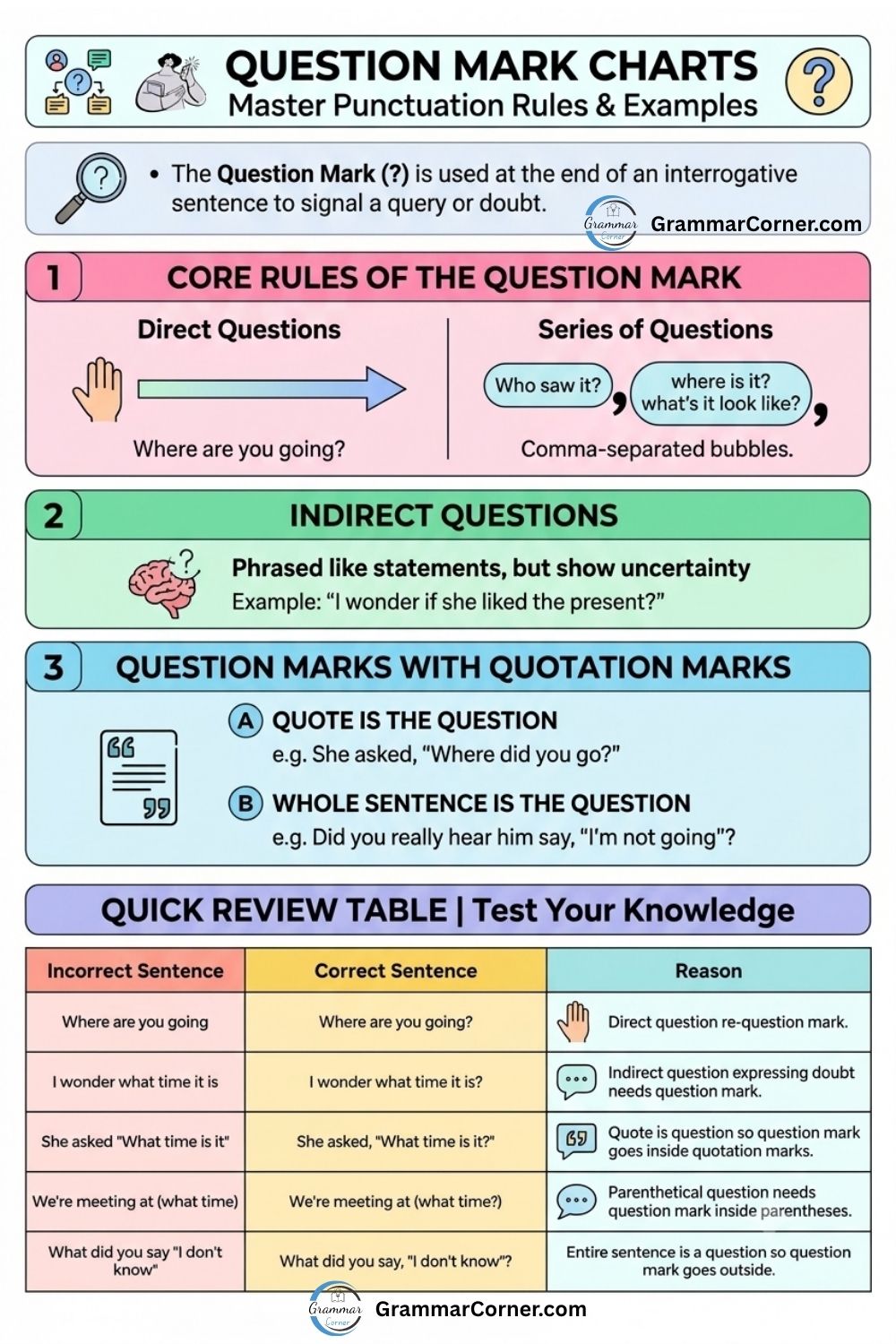
A question mark (?) is a punctuation mark that is used at the end of an interrogative sentence. The question mark shows that the sentence is asking a question. It is different from a statement or exclamation.
For Example
- What time is it?
- Where are you going?
- Can you help me?
How to Use a Question Mark?
A question mark should be used at the end of any direct question:
- Who is your favorite author?
- How many ounces are in a pound?
- Why is the sky blue?
- What time does the movie start?
- Where should I meet you for dinner?
- Can you please pass me the salt?
Direct questions often start with interrogative words like:
However, they don’t have to include an interrogative word as long as the sentence is specifically posed as a question:
- Are you ready to go?
- You’re coming with us, right?
Indirect questions can also take question marks if the statement is structured in interrogative form:
- I wonder why she said that?
- Could you tell me where the restroom is?
Only the Last Question Gets the Mark
If a sentence has multiple questions separated by commas, only the last question in the series gets a question mark:
Indirect Questions
Indirect questions are phrased like statements, but end with question marks if the context shows uncertainty. For example:
- I wonder where she went?
- Do you know what time it is?
The question mark suggests the speaker is questioning the information, even though the wording is more of a statement than a direct question.
- I wonder where she went.
- Can you tell me what time it is.
- I’m not sure if this is the right way to solve this math problem.
An indirect question can be punctuated as a statement without a question mark if it is simply a comment rather than showing uncertainty.
So question mark usage depends on whether the indirect question is intended to show doubt or skepticism.
Test Yourself: Mark or No Mark?
1 / 10Read each sentence and decide how it should end.
See also: