Apostrophe Chart (Rules & Examples)
Punctuation Guides · Grammar Corner
What is an Apostrophe?
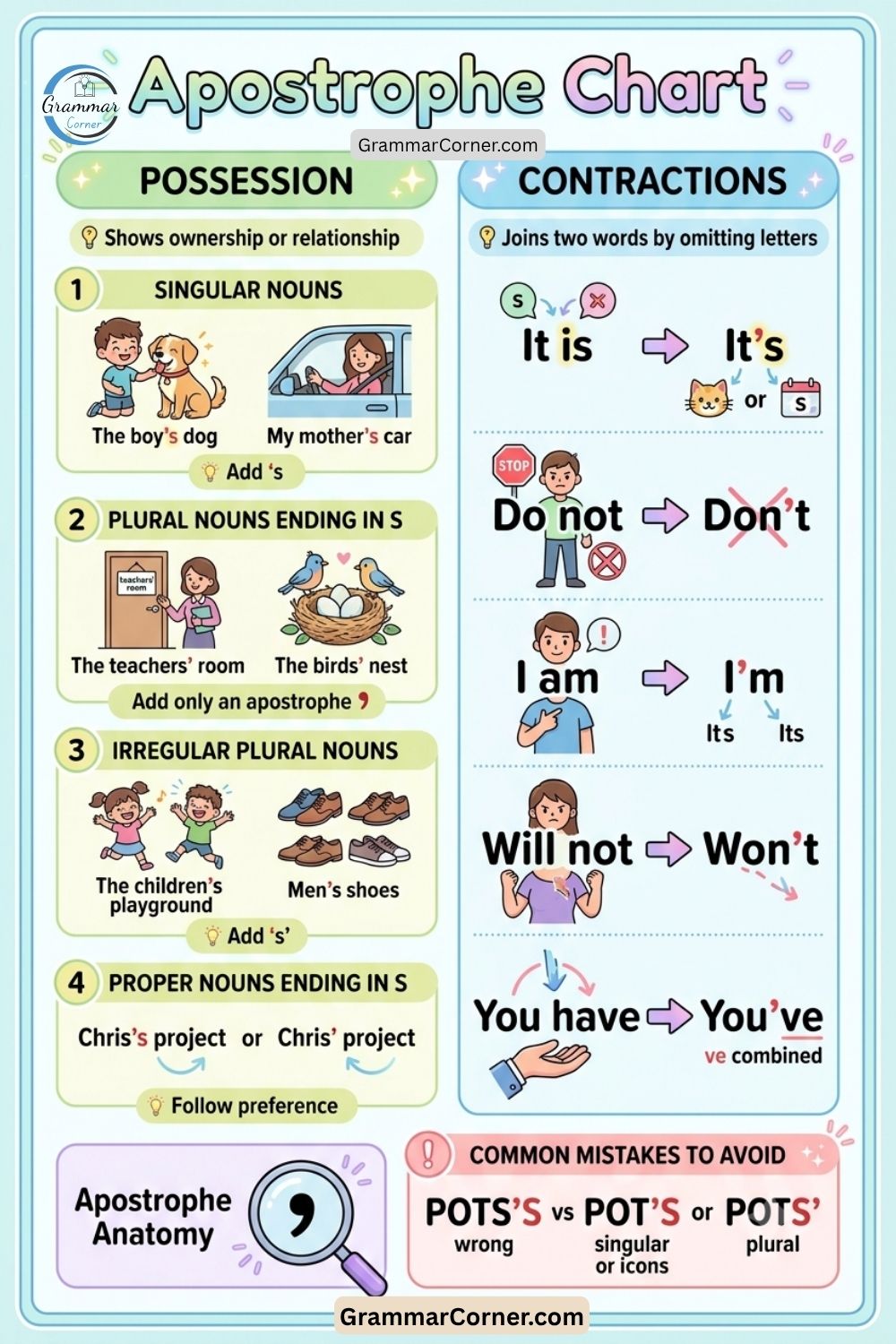
The apostrophe ( ‘ ) is a punctuation mark that performs two main functions in writing.
Apostrophes create contractions, combining two words into a shortened form with the apostrophe taking the place of the omitted letters — “do not” contracts to “don’t.” An apostrophe also shows that something belongs to someone: adding apostrophe + s (‘s) to a noun makes it possessive, like “the dog’s leash” or “the writer’s desk.”
Job 1Contractions
Two words combine into a shortened form; the apostrophe stands exactly where the omitted letters used to be.
Job 2Possession
Apostrophe + s (‘s) attaches to a noun to show that something belongs to it.
do not
“do not” — two full words, no apostrophe needed yet.
the dog + leash
Two nouns side by side — the leash doesn’t belong to anyone yet.
Proper use of apostrophes for both contractions and possessives improves clarity and understanding in writing. Apostrophes have specific roles, and they must be used according to standard grammar rules. The appropriate use of the apostrophe is an important part of developing writing skills: this punctuation mark performs unique actions not replicated by any other punctuation, which makes it essential for clear communication.
Contractions with Apostrophes
A contraction is a shortened form of two words. An apostrophe replaces the missing letter or letters that are left out when the words are combined — do not becomes don’t, and I am becomes I’m.
Contractions make writing and speech sound more natural and conversational. They are widely used in everyday English — conversations, emails, text messages, and informal writing.
Tone check: when to contract
Everyday English (chats, emails, texts, informal writing): contractions are welcome — they keep the tone natural.
Formal documents, academic papers, and legal writing: full word forms are generally preferred, because they create a more formal tone.
Learning common contractions and using them correctly improves both writing and speaking skills while making sentences easier to read.
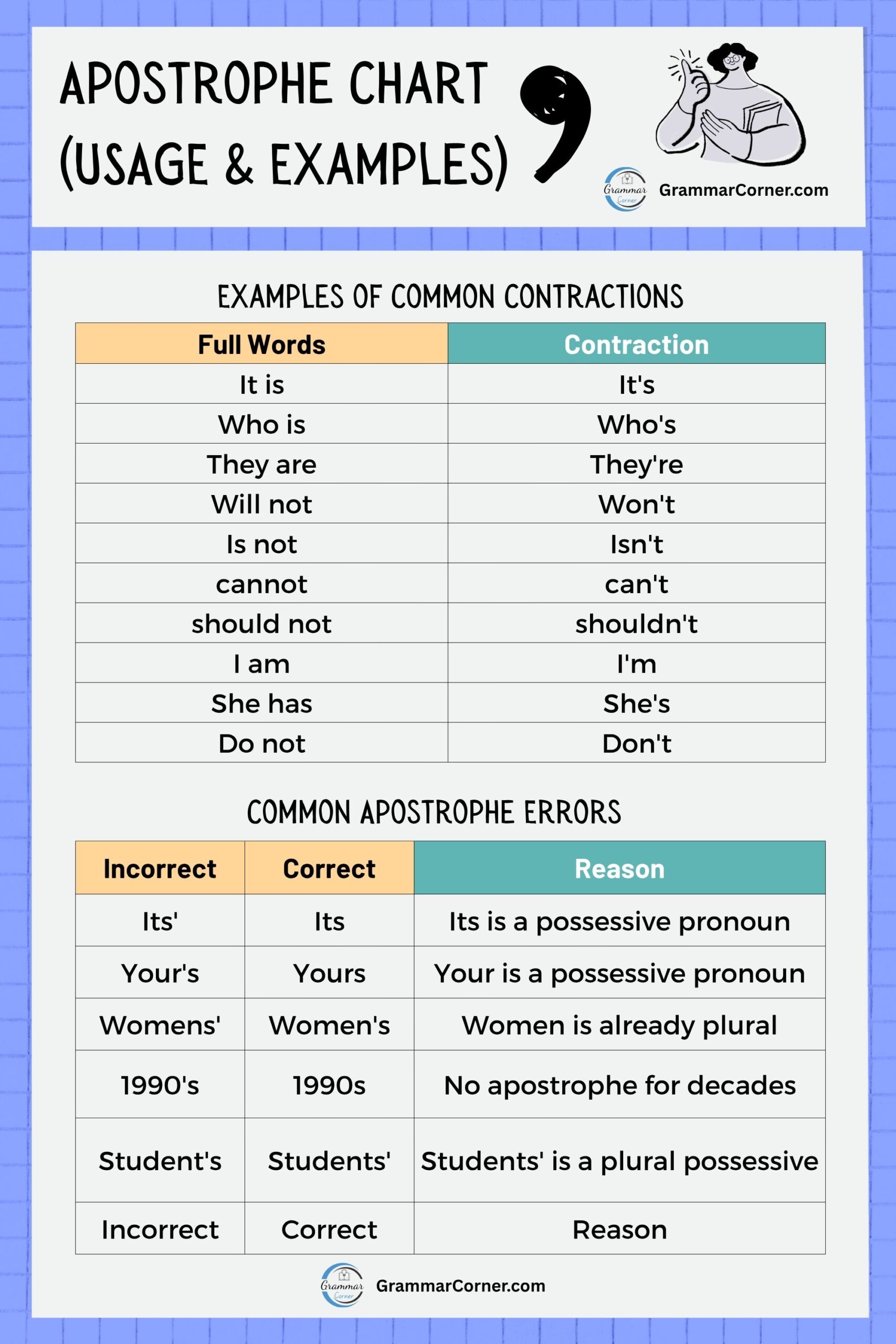
Examples of Common Contractions
| Full Words | Contraction |
|---|---|
| it is | it’s |
| who is | who’s |
| they are | they’re |
| will not | won’t |
| is not | isn’t |
| cannot | can’t |
| should not | shouldn’t |
| I am | I’m |
| she has | she’s |
| do not | don’t |
Tap any card to squeeze the full words into their contraction — tap again to expand them back:
Every apostrophe stands exactly where letters were dropped — won’t and can’t are the shape-shifting exceptions worth memorizing.
Tips for Using Contractions
An apostrophe shows where letters are missing in a contraction. The apostrophe sits exactly where the dropped letters used to be:
- can’t = cannot (the apostrophe replaces “no”)
- it’s = it is (the apostrophe replaces “i”)
- you’re = you are (the apostrophe replaces “a”)
Contractions are common in informal writing because they mirror how we speak. In formal texts — reports, academic papers, cover letters — write the words out in full.
Watch out! Take care not to confuse it’s (contraction of “it is”) with its (possessive form).
- It’s going to rain. (“It is going to rain” — makes sense)
- The dog wagged it’s tail. (“The dog wagged it is tail” — nonsense, so no apostrophe: “its tail”)
Quick test: Expand the contraction to its full form and reread the sentence. If the sentence still makes sense, the apostrophe belongs there. If it turns into nonsense, you need the plain word instead — its, your, their, or whose.
Possessives with Apostrophes
A possessive noun shows ownership or belonging. To form the possessive, add an apostrophe and “s” to singular nouns, and just an apostrophe to plural nouns that already end in “s.” Irregular plurals that don’t end in “s” (like children) take an apostrophe and “s.” Possessive pronouns such as hers and its never use apostrophes. Getting possessives right makes it instantly clear who or what owns something in a sentence.
Add ‘s to Most Singular Nouns
| Possessive Form | Meaning |
|---|---|
| The dog’s leash | The leash belongs to the dog |
| The writer’s desk | The desk belongs to the writer |
| The company’s policy | The policy belongs to the company |
Add ‘ to Most Plural Nouns
| Possessive Form | Meaning |
|---|---|
| The dogs’ leashes | The leashes belong to the dogs |
| The writers’ desks | The desks belong to the writers |
| The companies’ policies | The policies belong to the companies |
Two exceptions to remember:
- Irregular plurals not ending in “s” add ‘s: children’s toys, people’s choice
- Possessive pronouns never take apostrophes: hers, theirs, whose, its
Special Cases for Apostrophes
Joint Possession
When two people own one thing together, only the final name takes the apostrophe. When each person owns their own thing, both names take one:
- Jim and Jane’s project (one project, owned together)
- Jim’s and Jane’s bikes (two bikes, one each)
Names Ending in s
For names that already end in “s,” most style guides accept the apostrophe alone, while some prefer adding ‘s. Both are correct — pick one style and stay consistent:
- Charles Dickens’ novels (AP style; common in journalism)
- Charles Dickens’s novels (Chicago style; matches the spoken “Dickens-iz”)
Acronyms and Numbers
Plurals of acronyms, decades, and numbers do not take apostrophes. The one exception is plural lowercase letters, where an apostrophe prevents misreading:
- CEOs, DVDs, the 1990s
- CEO’s, DVD’s, the 1990’s (no possession here — plain “s” only)
- Dot your i’s and cross your t’s. (without the apostrophe, “is” and “ts” would confuse readers)
Quick Quiz: Can You Place the Apostrophe?
Tap the correct option in each question.
1. The cat licked ___ paws.
2. One writer, one desk. Which is correct?
3. Several companies share new policies. Which is correct?
4. Jim and Jane built one treehouse together. It is…
5. Which plural is written correctly?
Apostrophes and Possessive Nouns
To make most singular nouns possessive, add an apostrophe + s. For plural nouns that already end in s, add just an apostrophe.
| Example | Explanation |
|---|---|
| The dog’s leash | The leash belongs to one dog (singular noun + ’s) |
| The dogs’ leashes | The leashes belong to several dogs (plural noun adds only ’) |
| The writer’s desk | The desk belongs to one writer (singular noun + ’s) |
| The writers’ desks | The desks belong to several writers (plural noun adds only ’) |
Apostrophes and Possessive Pronouns
Possessive pronouns like hers, his, its, theirs, and yours already show ownership, so they never take an apostrophe.
- ✓The book is hers. (no apostrophe needed for the pronoun hers)
- ✓The pen is his. (no apostrophe needed for the pronoun his)
- ✓Its fur was shiny. (no apostrophe needed for the pronoun its)
- ✓Their uniforms were ready. (no apostrophe needed for the pronoun their)
Apostrophes and Joint Possession
When two people own something together, add ’s to the last name only. When they own things separately, add ’s to each name.
| Example | Explanation |
|---|---|
| Jim and Jane’s project | One project co-owned by Jim and Jane |
| Jim’s and Jane’s bikes | Separate bikes owned individually |
| The students’ and teacher’s roles | Different roles for the students vs. the teacher |
Don’t Create a Double or Triple “s”
To avoid an awkward pile-up of s sounds, use the apostrophe alone after plural nouns ending in s.
- ✓The class’ grades (not “classs’s”)
- ✓The companies’ policies (not “companie’ss”)
- ✓The boys’ locker room needs renovating. (not “boyss’s”)
- ✓The birds’ migration patterns were studied. (not “birdss’s”)
Don’t Use an Apostrophe for Plural Nouns
Never use an apostrophe just to make a noun plural.
- ✓The dogs played in the park. (no apostrophe needed for the plural dogs)
- ✓Many CDs were on sale. (no apostrophe needed for the plural CDs)
- ✓There were five cats in the yard. (no apostrophe for the plural cats)
- ✓The children were laughing and playing. (no apostrophe for the plural children)
| Incorrect | Correct |
|---|---|
| Cats’ (as a plural) | Cats |
| CD’s | CDs |
| Jone’s (as a family name) | Joneses (“the Joneses” = the family, plural) |
Common Apostrophe Errors
Here are the apostrophe mistakes readers spot most often — and the fix for each one.
| Incorrect | Correct | Reason |
|---|---|---|
| Its’ | Its | Its is a possessive pronoun — it never takes an apostrophe |
| Your’s | Yours | Yours is a possessive pronoun — it never takes an apostrophe |
| Womens’ | Women’s | Women is already plural, so the apostrophe goes before the s |
| 1990’s | 1990s | No apostrophe is needed for decades |
| Student’s (for many students) | Students’ | Students’ is the plural possessive |
Test Yourself: Apostrophe Quiz
Related Posts
- Comma Rules and Examples
- Semicolon Rules and Usage
- Parentheses Examples and Chart
- Question Mark Anchor Chart