Quotation Marks Chart (” “) – Rules and Examples
What Are Quotation Marks?
Quotation marks (“ ”) are punctuation marks that always work in pairs. One mark opens, one mark closes, and everything between them is set apart from the rest of the sentence.
Writers use them for three main jobs: to show direct speech (someone’s exact words), to mark certain titles, and to make a word or phrase stand out when it needs special attention.
Other Names You Might Hear
Depending on where you live and who is teaching you, the same punctuation goes by a few different names. They all mean exactly the same thing:
- Speech markscommon in schools
- Quotesthe everyday shorthand
- Inverted commasmostly British English
The Three Main Jobs
Repeating a person’s exact words.
The teacher said, “Open your books.”
Naming certain works, such as poems, songs, and short stories.
We read “The Road Not Taken” in class today.
Drawing attention to a particular word or phrase.
The word “queue” has four silent letters.
Why They Matter to Your Reader
Imagine reading a story where you couldn’t tell which words a character actually spoke and which words belonged to the narrator. Quotation marks solve that problem instantly. The moment a reader sees an opening mark, they know: these are someone’s exact words. The closing mark tells them the speech has ended.
Rain hammered the windows as Sam packed his bag. “I’m not missing that train,” he muttered, grabbing his coat on the way out.
Tap the button to see exactly which words Sam said out loud.
American English vs British English
Both varieties of English use quotation marks for the same jobs — the difference is which style of mark comes first.
American English
“ ”Double quotation marks are the standard first choice.
Dad said, “Dinner is ready.”
British English
‘ ’Single quotation marks are widely preferred, and the marks are often called inverted commas.
Dad said, ‘Dinner is ready.’
Neither style is more “correct” than the other. What matters is picking the convention your school, publisher, or style guide follows — and sticking with it throughout a piece of writing.
Remember: quotation marks always travel in pairs. If you open a quotation, you must close it — a lone mark leaves your reader stranded inside a quote that never ends.
Rules of Using Quotation Marks
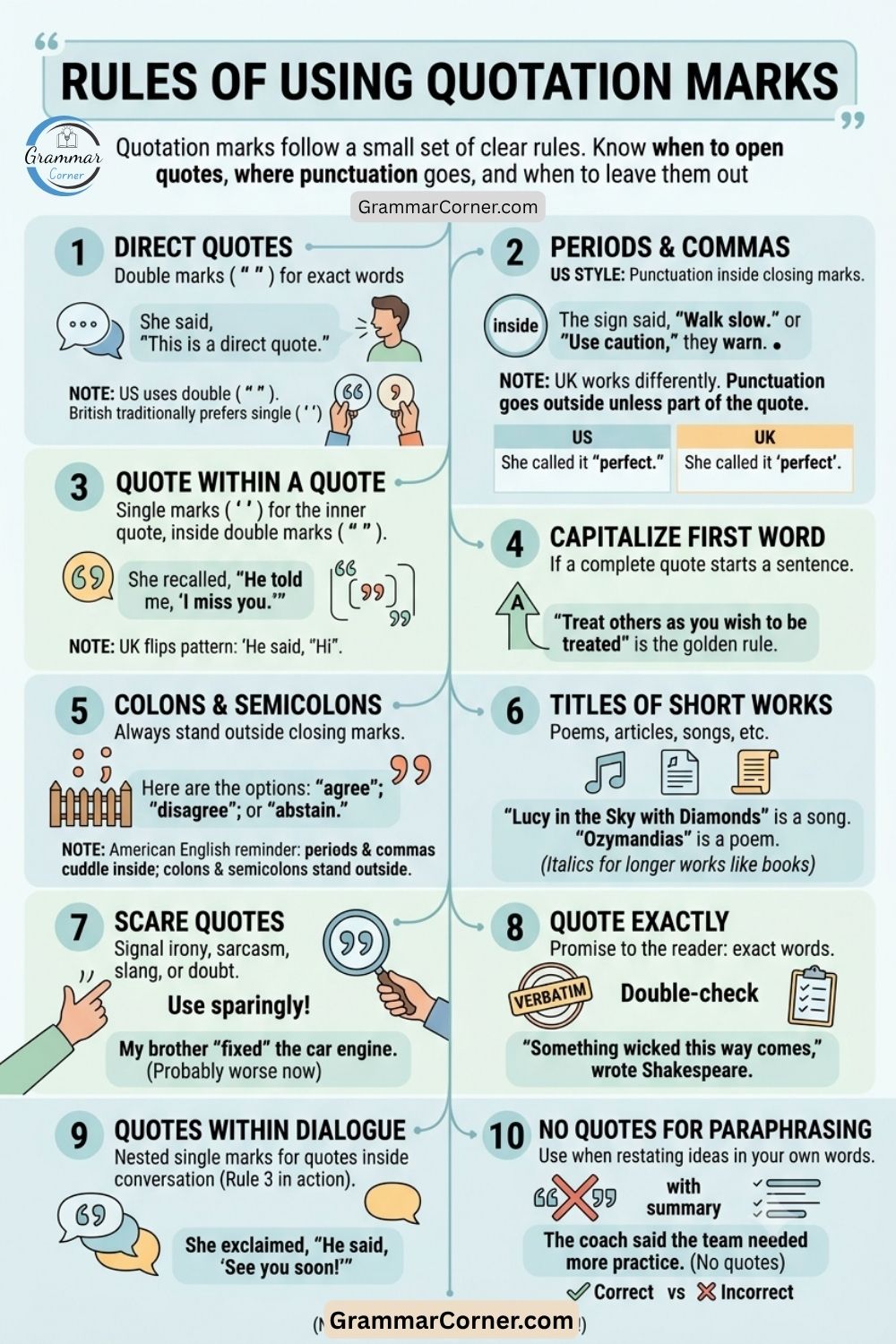
Quotation marks follow a small set of clear rules. Once you know them, you will always know when to open the quotes, where the punctuation goes, and when to leave the marks out entirely. Let’s walk through each rule with examples.
Use double quotation marks for direct quotes
Whenever you repeat someone’s exact words — a line of dialogue from a book, a lyric from a song, or a phrase from a speech — enclose those words in double quotation marks. The words inside the marks must match the source word for word.
- She said, “This is a direct quote from the book.”
- The coach told them, “Keep playing hard.”
- He asked, “Will you go to prom with me?”
American English uses double quotation marks (” “) as the standard. British English traditionally prefers single quotation marks (‘ ‘), although many modern British publishers now use doubles too. Whichever style you choose, stay consistent throughout your writing.
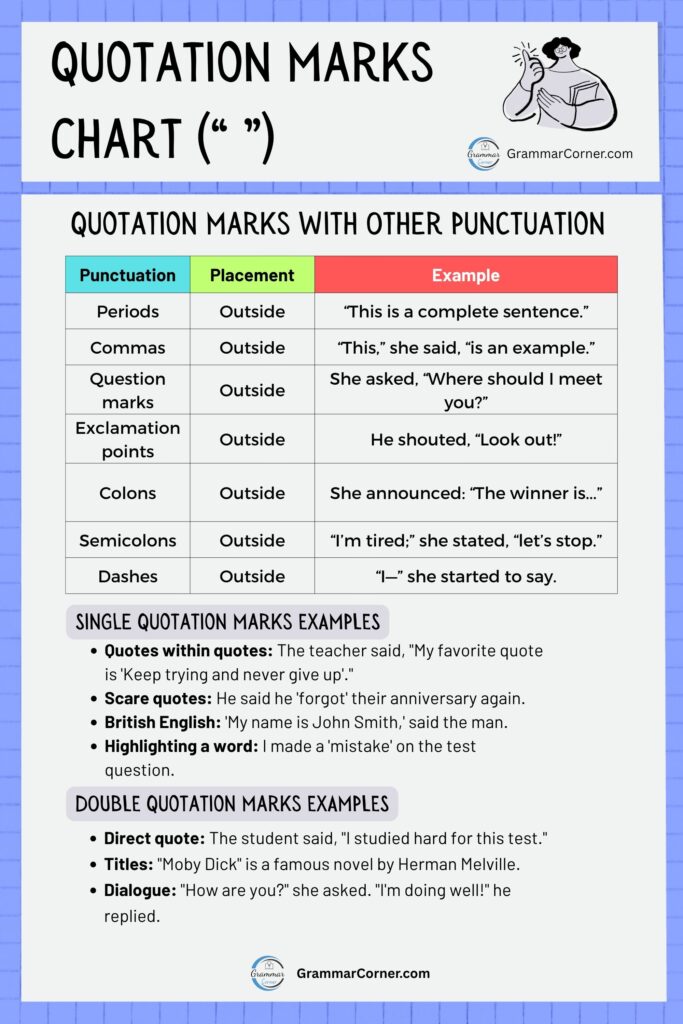
Place periods and commas inside the closing quotation marks (American English)
In American English, periods and commas always sit inside the closing quotation mark — no exceptions, even when the quote is just one or two words.
- The sign said, “Walk slow.“
- The instructions warn, “Use caution,“ when lifting heavy objects.
- She whispered, “Don’t make any sudden noises.“
He labeled the box “fragile.“
The period tucks inside the closing mark.
He labeled the box “fragile”.
In American English, the period never sits outside.
British English works differently: the period or comma goes outside the closing quotation mark unless it is actually part of the original quote. So a British writer would type: The sign said, ‘Walk slow’.
Try it: switch between the two styles
The teacher described the essay as “outstanding.“
American English: double quotation marks, and the period sits inside the closing mark.
Use single quotation marks for a quote within a quote
When one quote appears inside another, switch to single quotation marks for the inner quote. Alternating double and single marks keeps the two quotes visually distinct, so the reader always knows who said what.
- She recalled, “He told me, ‘I miss you.’“
- The actor said, “My catchphrase is ‘Well, well, well.’“
- The student shouted, “I heard her yell, ‘Help me!’“
British English flips the pattern: single marks on the outside, double marks for the quote inside. She recalled, ‘He told me, “I miss you”.’
Capitalize the first word of a full quote at the start of a sentence
If a complete quote opens your sentence, capitalize its first word — even if that word was lowercase in the original source.
- “Simplicity is key” expressed the designer’s aesthetic.
- “Treat others as you wish to be treated” is the golden rule.
- “Be the change you wish to see in the world” is a famous quote.
Colons and semicolons go outside the closing quotation marks
Unlike periods and commas, colons and semicolons always sit outside the closing quotation mark. That’s because they belong to the structure of the whole sentence, not to the quoted words themselves — and this rule applies in both American and British English.
- Here are the options: “agree”; “disagree”; or “abstain.”
- There are two choices: “stay” or “leave.”
- She declared: “I’ll be there”; then she left.
A quick way to keep it straight in American English: periods and commas cuddle inside the quotes; colons and semicolons stand outside.
Use quotation marks for titles of short works
Titles of short works — poems, articles, songs, lectures, chapters, and other minor compositions — take quotation marks. (Longer works, such as books and albums, are usually italicized instead.)
- “Lucy in the Sky with Diamonds” is a Beatles song.
- “The Causes of Climate Change” was the lecture title.
- “Ozymandias” is a famous poem by Percy Bysshe Shelley.
Use scare quotes sparingly
Scare quotes wrap a word to signal irony, sarcasm, slang, or doubt — the writer is holding the word at arm’s length. They can be effective, but use them judiciously: too many disrupt the flow and make readers question your sincerity everywhere.
- My brother “fixed” the car engine. (It’s probably worse now.)
- She has a “small appetite” but ate two plates.
- He “forgot” their anniversary again.
Quote the source exactly, word for word
Anything inside quotation marks is a promise to the reader: these are the exact words. Changing, adding, or dropping words breaks that promise, and any error reflects poorly on the writer. Double-check every quote against the original.
- “Something wicked this way comes,” wrote Shakespeare.
- “We shall overcome,” stated Dr. King during his speech.
- “I came, I saw, I conquered,” remarked Julius Caesar.
Use single quotation marks for quotes within dialogue
This is Rule 3 in action inside conversation. When a character repeats someone else’s words within their own dialogue, the nested quote takes single marks so it stands out clearly from the surrounding speech.
- She exclaimed, “He said, ‘See you soon!’“
- I replied, “She yelled, ‘I need some space!’“
- He asked, “Did you say, ‘I love you’?”
Never use quotation marks for paraphrased content
Quotation marks are reserved for exact, verbatim quotes. If you summarize or restate an idea in your own words, leave the marks out — using them would falsely signal that these were the original words.
- The book summarized the key events of the battle.
- The review provided a brief overview of the plot.
- The teacher restated the homework instructions clearly.
The coach said the team needed more practice.
A paraphrase — no quotation marks.
The coach said “the team needed more practice.”
These weren’t his exact words, so the marks mislead the reader.
Quick practice: inside or outside? (American English)
Decide where the punctuation mark in brackets should go. Tap your answer for instant feedback.
1. The note read, “Back in five minutes[.] — where does the period go?
2. She listed her favorite song as “Yesterday”[;] then she pressed play — where does the semicolon go?
3. “Use caution[,]” the label warns — where does the comma go?
Note: in British English, answers 1 and 3 would usually go outside the quotes unless the punctuation is part of the original quote.
Using Quotation Marks as Scare Quotes
Have you ever seen someone raise both hands and wiggle two fingers while speaking? Those are air quotes, and people use them to show they don’t quite mean a word the way it sounds. Scare quotes are the written version of that gesture.
When you wrap a word or phrase in scare quotes, you signal irony, slang, doubt, or skepticism. The quotation marks tell your reader, “I’m using this term in an unusual or questionable way — don’t take it at face value.”
Two tiny marks, one big change in meaning.
Notice how the marks flip the meaning. Scare quotes often make a word mean the opposite of what it normally says, or at least cast doubt on it. Try it yourself below.
Tone Decoder
Each sentence looks like a compliment or a plain fact. Tap a button to reveal what the scare quotes are really saying.
He has a “big heart.”
Hidden meaning: he is actually uncaring. The quotes turn the praise into sarcasm.
My brother is a web “designer.”
Hidden meaning: he calls himself a designer, but his skills are doubtful.
She felt “sick” at work.
Hidden meaning: she probably wasn’t really ill — the writer is skeptical.
American English
Uses double quotation marks for scare quotes, and a period or comma that follows sits inside the closing mark.
He has a “big heart.”
British English
Often uses single quotation marks, and a period or comma that isn’t part of the quoted term sits outside the closing mark.
He has a ‘big heart’.
Use scare quotes sparingly. One well-placed pair adds a sharp touch of irony; a paragraph full of them makes your writing look uncertain — as if you doubt your own words.
Other Uses of Quotation Marks
Beyond quoting speech and signaling irony, quotation marks quietly do several other jobs in everyday writing. Here are four you’ll meet all the time.
Nicknames
When a nickname appears between a person’s first and last name, it goes in quotation marks.
Thomas “TJ” Jefferson
Dialogue
In stories, quotation marks enclose the exact words a character speaks. The short phrase that identifies the speaker — like Marcia said — is called a dialogue tag, and it stays outside the marks.
Marcia said, “Let’s go to the mall this weekend.”
Definitions
When you define a term, a common convention puts the word being discussed in single quotation marks (or italics) and its definition in double quotation marks.
‘Whom’ means “the objective case of who.”
Emphasis
Writers sometimes use quotation marks to stress a single word.
The “only” option is to ask for an extension.
This use is common in informal writing, but handle it with care — see the warning below.
Major style guides advise against using quotation marks for emphasis, because readers usually interpret them as scare quotes. A shop sign that says ✗ We sell “fresh” fish accidentally suggests the fish is anything but fresh! In formal writing, emphasize a word with italics or bold instead: ✓ The only option is to ask for an extension.
Quotation marks around a single word change its tone, not just its look. Before you add them, ask yourself: do I want my reader to hear doubt or sarcasm here? If not, leave the marks out.
Quotation Marks FAQs
Q: When should single and double quotation marks be used?
A: Use double quotation marks for primary quoted text in American English. Single quotation marks are more common for primary quotes in British English. Moreover, use single quotation marks for quotes within quotes. This allows you to differentiate between nested quotes.
Q: Where does punctuation go in relation to quotation marks?
A: Commas and periods always go inside the closing quotation marks. Question marks, exclamation points, colons, and semicolons go outside.
Q: Should the first word of a quote be capitalized?
A: Yes, capitalize the first word of a quote if it begins a sentence, even if it wasn’t capitalized in the original.
Q: How is dialogue between multiple speakers quoted?
A: Start a new paragraph each time the speaker changes. Add a dialogue tag like “she said” before or after the quote to identify speakers.
Q: How much quoted material can be used?
A: Quotes should be used sparingly. As a guideline, aim for less than 10-20% quoted material. Too many direct quotes makes writing sound disjointed.
Q: How to avoid plagiarism by using quotes?
A: Always cite direct quotes appropriately with in-text or parenthetical citations pointing to your works cited page. Not crediting quotes is considered plagiarism.
See also:
- Punctuation Comprehensive Guide
- Apostrophe Rules and Examples
- Exclamation Mark Chart
- Question Mark Rules and Examples