Comma Chart (Rules and Usage With Examples)
Punctuation Basics · Part 3
Commas in the Wild
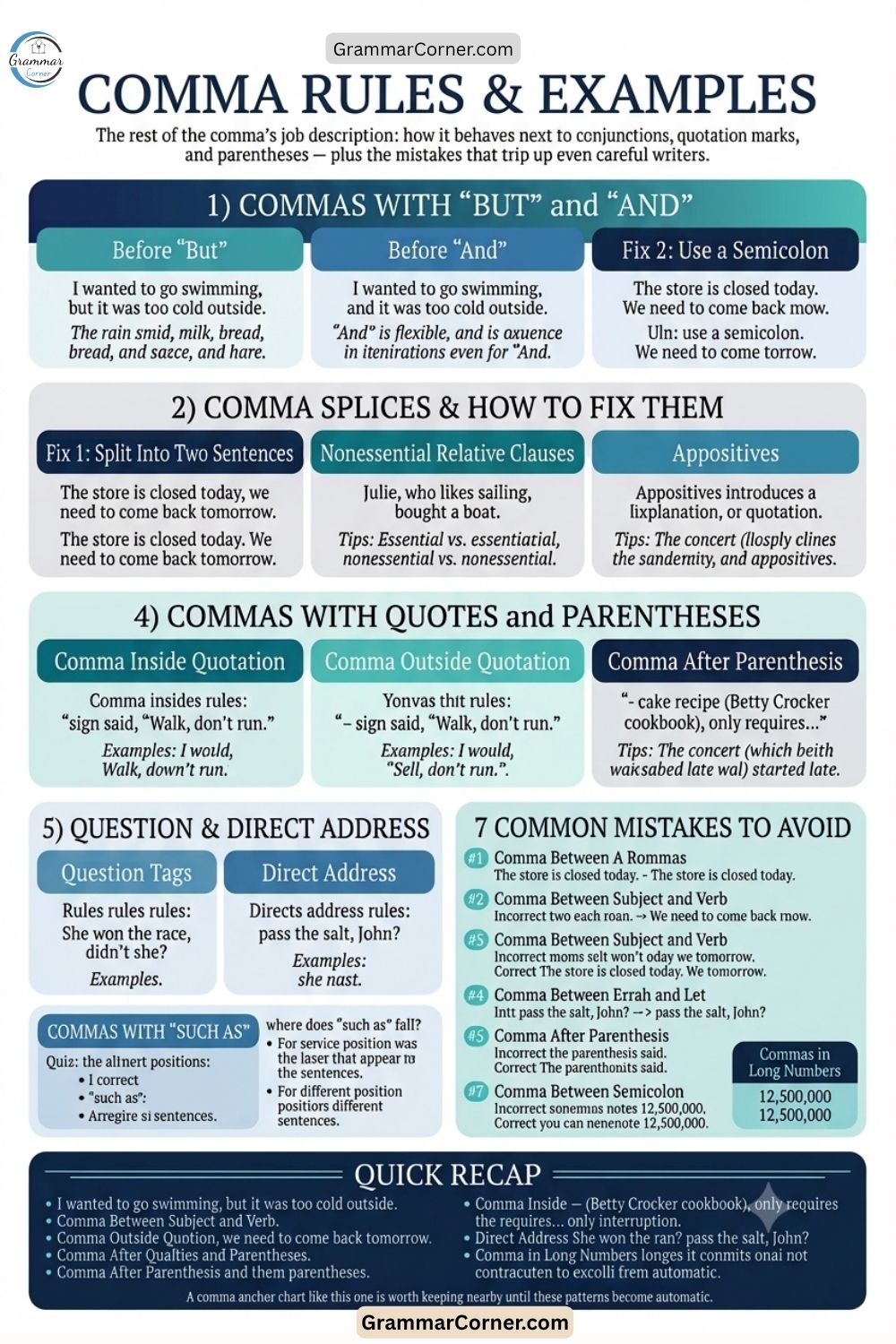
The rest of the comma’s job description: how it behaves next to conjunctions, quotation marks, and parentheses — plus the mistakes that trip up even careful writers.
Commas With “But” and “And”
The two most common joining words don’t follow the same comma rule.
Before “But”
When “but” connects two full sentences, a comma comes right before it.
Before “And”
“And” is more flexible. Two short, closely linked clauses often read fine without a comma — but adding one before “and” can make a longer or less obvious sentence clearer.
Comma Splices — and How to Fix Them
A comma by itself can’t join two complete sentences. Here are the two standard fixes.
Fix 1: Split Into Two Sentences
Replace the comma with a period and capitalize the next word.
Which is correctly punctuated?
Fix 2: Use a Semicolon
If the two ideas are closely related, a semicolon can join them without a conjunction.
Which is correctly punctuated?
Relative Clauses & Appositives
Both add detail about a noun — the comma depends on whether that detail is optional.
Nonessential Relative Clauses
If the clause could be removed without changing who or what is being talked about, set it off with two commas.
No commas when the clause is essential to identify the subject: The boy that lives next door is very nice. Removing “that lives next door” would leave it unclear which boy.
Appositives
An appositive renames or adds detail about a noun right next to it. Set it off with a comma on each side.
Commas With Quotes and Parentheses
Where the comma sits depends on whether it belongs to the quoted or bracketed text, or to the sentence around it.
Comma Inside the Quotation
When the comma is part of the quoted material itself, it stays inside the quotation marks.
Comma Outside the Quotation
When the comma belongs to the larger sentence rather than the quote, it goes after the closing quotation mark.
Comma After a Parenthesis
If the comma belongs to the overall sentence, it goes outside the closing parenthesis, not inside.
When the comma is part of the parenthetical text itself, it stays inside: The baking ingredients (flour, sugar, eggs, milk, and butter) were laid out on the counter.
Commas With “Such As”
The comma depends entirely on where “such as” sits in the sentence.
Guess the Position
Read the sentence below, then choose where “such as” sits.
“Such as novels, biographies, and comics, the library has many books.” — where does “such as” fall?
- Middle of a sentence, no comma needed: Books such as novels and biographies are available in the library.
- Right after a complete main clause, use a comma: The library has many books, such as novels, biographies, and comics.
- At the very start, use a comma after the examples: Such as novels, biographies, and comics, the library has many books.
Common Mistakes to Avoid
For each pair below, pick the version that’s correctly punctuated.
Commas in Long Numbers
Numbers over 1,000 get commas for readability: 12,500,000 · $125,600 · 36,524,000 miles. Written as 12500000, the same figure is much harder to read at a glance.
Quick Recap
- Use a comma before “but” joining two sentences; before “and,” it’s often optional unless it aids clarity.
- Fix a comma splice with a period or a semicolon — never a comma alone.
- Set off nonessential relative clauses and appositives with commas on both sides; skip them when the detail is essential to meaning.
- A comma sits inside quotation marks or parentheses only when it belongs to the quoted or bracketed text itself.
- Question tags and direct address both get a comma marking the shift.
- With “such as,” the comma placement follows where the phrase falls in the sentence.
- Most common mistakes come from adding a comma out of habit rather than for a reason — between subject and verb, between cumulative adjectives, or before “and”/”but” that isn’t joining two full sentences.
A comma anchor chart like this one is worth keeping nearby until these patterns become automatic.
See also: