Parentheses Chart (Round Brackets) | Rules & Examples
Parentheses — also known as round brackets — are curved punctuation marks that always appear in pairs and look like this: ( ). They set off explanatory or qualifying remarks inside a sentence.
Parentheses let writers smoothly slip supplementary material into a sentence without disturbing its grammatical structure. Used judiciously, they clarify meaning, provide context, and add helpful asides.
Proper Use of Parentheses in Writing
Parentheses isolate information that elaborates on other parts of the sentence. Here are the six most common jobs they perform:
1Clarify overall meaning
The professor demanded that students submit assignments on time (without exceptions or excuses).
2Insert an afterthought or aside
The meeting ended abruptly (after the power unexpectedly went out).
3Explain an acronym
The environmental organization (Sierra Club) is accepting new members.
4Provide context or background
Recent analysis confirms this hypothesis (first proposed by Johnson in a 2019 paper).
5Add related, non-essential data
The centenarian (born in rural Mississippi in 1912) vividly remembers World War I.
6Offset interjections or opinions
She gave an excellent presentation (if I do say so myself).
Setting Off Non-Essential Material
The defining function of parentheses is holding information that is helpful but not essential. Here’s the test: if you can remove the parenthetical content and the sentence still makes complete sense, the parentheses are doing their job correctly.
Don’t take our word for it — try removing them:
The medical study (which included 250 participants over 6 months) found no correlation between the drug regimen and blood pressure.
She set a new school record (jumping an incredible 45 feet) in the district long jump competition.
Both sentences survive intact. That’s how parentheses let writers efficiently set apart content that adds value but isn’t critical to the primary point.
Parentheses vs. Dashes vs. Commas
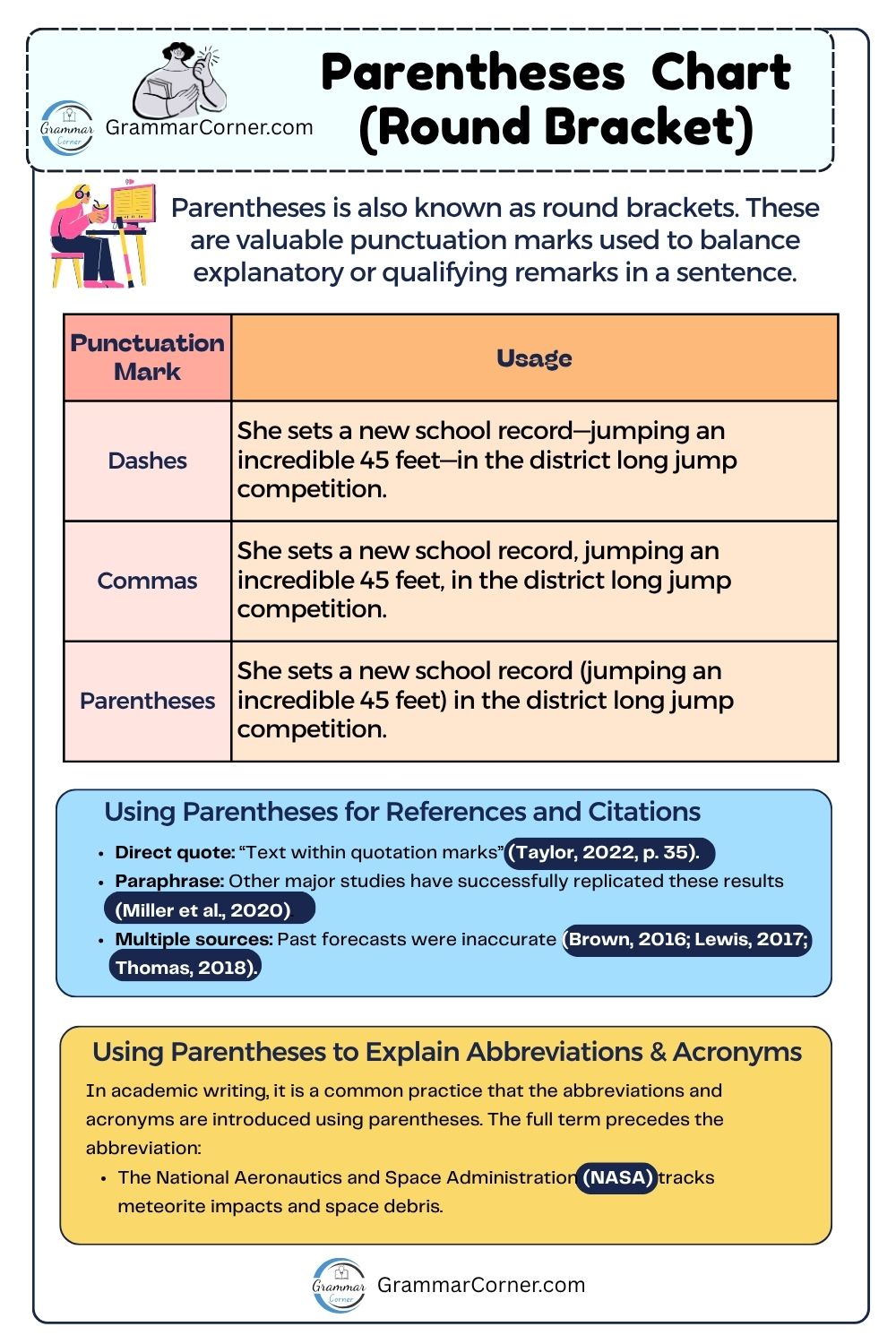
Dashes and commas can also set off an aside — so which should you choose? Think of it as a volume knob for the interruption: dashes shout, commas whisper, and parentheses murmur off to the side. Click each option to re-punctuate the same sentence:
She set a new school record (jumping an incredible 45 feet) in the district competition.
Parentheses: the aside feels most independent and tucked away — a quiet murmur that the reader may skip.
- Parentheses give the strongest separation — the aside feels optional and self-contained.
- Dashes emphasize the interruption — they draw attention to it.
- Commas integrate the aside smoothly — best for short, closely related phrases.
- Parentheses also eliminate the confusion that can arise when an interrupting clause itself contains commas.
When to Avoid Parentheses
Despite their advantages, parentheses reduce readability when overused. Too many asides visually clutter sentences and create ambiguity — especially in formal academic and professional writing. It is often better to rephrase an unwieldy sentence than to cram material into parentheses:
The communications director (who was hired just last month to rehabilitate the company’s image and improve public perception after the recent ethics scandals) resigned unexpectedly today.
The newly hired communications director resigned unexpectedly today, leaving the company’s reputation in flux.
Reserve parentheses for short clarifying content. Lengthy explanatory notes usually fit better in footnotes.
Using Parentheses for References and Citations
Academic papers and scientific articles use parentheses to cite sources in APA format and other established citation styles. The author’s last name and publication year appear within parentheses, letting the source be referenced discreetly without interrupting the flow:
Recent analysis of the clinical data confirms this hypothesis (Johnson, 2020).
“Text within quotation marks” (Taylor, 2022, p. 35).
Other major studies have successfully replicated these results (Miller et al., 2020).
Past forecasts were inaccurate (Brown, 2016; Lewis, 2017; Thomas, 2018).
Properly incorporating citations within parentheses lets papers integrate references and enhance credibility without hampering readability — this has become the scholarly standard. (Notice the semicolons separating multiple sources — a nice callback to our semicolon rules.)
Explaining Abbreviations and Acronyms
In academic and professional writing, abbreviations and acronyms are introduced using parentheses. The full term comes first, followed by the abbreviation in parentheses:
This clarifies the acronym even for unfamiliar readers. Every later mention can then drop the parentheses:
Parentheses for Numbers, Symbols, and Figures
Numbers, symbols, figures, and other non-alphabetic characters sometimes need parentheses to avoid confusion:
The Pythagorean Theorem (a² + b² = c²) is essential to Euclidean geometry.
The directions indicate there are 10 (ten) possible ways this reaction could occur.
To pass this course, students need a grade of C (≥70%) or better.
Periods (Full Stops): Inside or Outside the Round Brackets?
When a sentence contains a parenthetical aside, a common question arises: should the period go inside or outside the closing parenthesis? Happily, the rule is the same in both American and British English, and it depends on one simple question — is the whole sentence inside the parentheses?
Case 1: The parenthetical is part of a larger sentence → period goes OUTSIDE
The period concludes the overall sentence, so it belongs to the main sentence — outside the parenthesis.
Case 2: The entire sentence is inside the parentheses → period goes INSIDE
Here the parenthetical is a complete, standalone sentence, so it carries its own period inside the closing mark.
A Note on American vs. British English
Many writers assume US and UK styles conflict here — they don’t. For parentheses, both conventions follow the two cases above. The famous American/British punctuation split concerns quotation marks: American style places periods and commas inside closing quotation marks, while British style places them according to sense. With round brackets, everyone agrees.
Which is punctuated correctly?
Punctuation and Parentheses Rules
1. Placing other punctuation with parentheses
- Commas and periods go outside the closing parenthesis — except when the parenthetical is a full standalone sentence.
- Question marks and exclamation points go outside if they apply to the overall sentence; inside if they apply only to the parenthetical.
- Semicolons and colons always go outside parentheses.
2. Using commas with parentheses
Never place a comma immediately before an opening parenthesis. If the sentence needs a comma at that point, it moves after the closing parenthesis:
The golden rule: punctuate the main sentence as if the parenthetical text were not there.
3. Question marks and exclamation points
The team won the championship (?)
4. Parentheses within quotation marks
Parentheses go inside quotation marks if they are part of the quoted material:
But if the parentheses contain your own supplemental note, they go outside:
This distinguishes what was actually said from your added commentary.
5. Other parentheses guidelines
- Avoid overusing parentheses — reword sentences instead of cramming in asides.
- Always use parentheses in pairs: every opening mark needs a closing mark.
- Avoid nesting parentheses inside parentheses — use square brackets for the inner level, or rephrase.
Parentheses vs. Square Brackets
Parentheses ( ) and square brackets [ ] look similar and both enclose material, but they have different jobs:
| Parentheses ( ) | Square Brackets [ ] |
|---|---|
| Set apart the writer’s own asides, clarifications, and supplemental details | Mark editorial changes or insertions inside quoted material |
| The results (see Table 2) were conclusive. | She said, “[The manager] approved it yesterday.” |
| Introduce acronyms, citations, and translations | Flag errors in a quote with [sic]: “Their [sic] going to win.” |
| Enclose numbers or symbols for clarity: a grade of C (≥70%) | Serve as the inner level when nesting: (see Johnson’s data [2019] for details) |
| Common in everyday and academic writing alike | Mostly appear in academic, journalistic, and technical writing |
The memory hook: parentheses hold your words about your sentence; brackets hold your words inside someone else’s.
Parentheses Chart
This infographic summarizes everything — the six uses on the left, the punctuation placement rules on the right:
Interactive Quiz: Test Your Parentheses Skills
Answer all 8 questions for instant feedback and a final score.
1. What is the “removal test” for parentheses?
Parenthetical content must be non-essential — the sentence must stand on its own without it.
2. Which sentence places the period correctly?
The parenthetical is part of a larger sentence, so the period concludes the whole sentence — outside the parenthesis.
3. When does the period go INSIDE the closing parenthesis?
A standalone parenthetical sentence carries its own period inside: “(She never found out why.)” This rule is the same in US and UK English.
4. Which is correct?
Never place a comma immediately before an opening parenthesis — the sentence’s comma moves after the closing one.
5. “He finally replied (can you believe it?) after three weeks.” Why is the ? inside?
Question marks and exclamation points follow scope: inside if they belong to the aside, outside if they belong to the whole sentence.
6. When should you use square brackets [ ] instead of parentheses?
Brackets mark your insertions inside someone else’s words — plus [sic] and the inner level of nesting.
7. How is an acronym properly introduced?
Standard practice: the full term first, then the acronym in parentheses. (The reverse order is seen, but full-term-first is the academic convention.)
8. What’s the best fix for a sentence overloaded with a long parenthetical?
Rewording beats cramming. Long explanatory notes may also fit better in footnotes.
Parentheses vs. Brackets FAQs
When should parentheses be used instead of brackets?
Do parentheses and brackets follow the same punctuation rules?
Is it acceptable to use brackets in formal writing?
Can multiple parentheses or brackets be nested?
What are brackets useful for in technical writing?
Do parentheses impact the meaning of a sentence?
Is there a limit on how much text parentheses should contain?
Key Points to Remember
- Parentheses always travel in pairs and hold material the sentence can live without — apply the removal test.
- Period placement: outside when the aside is part of a sentence; inside only when the whole sentence is parenthetical. Same rule in US and UK English.
- Never put a comma before an opening parenthesis; punctuate the sentence as if the aside weren’t there.
- Square brackets are for editorial insertions in quotes, [sic], and nesting — not just “longer asides.”
- If parentheses are piling up, rephrase — clarity beats cramming.